Medicare Advantage vs Medigap in 2027: Costs, Coverage, and How to Choose
This voice experience is generated by AI.
Medicare Advantage and Medigap are two different answers to the same question: how much of your Medicare cost-sharing do you want to pay yourself? You cannot have both. A Medigap policy only works with Original Medicare, and it will not pay a Medicare Advantage plan’s copays. So the choice is a fork in the road, not a combination — and for 2027, the decision has a deadline. Annual Enrollment ends December 7, 2026, and any change you make by then takes effect January 1, 2027.
The 2027 numbers make the trade-off sharper than last year. The average Medicare Advantage premium is projected to fall to $12.00 a month, while the most a plan may set as its in-network out-of-pocket limit rises to $9,850. Medigap Plan G, the most comprehensive plan open to people new to Medicare, costs more every month but leaves you with only the $292 Part B deductible for Medicare-approved services. This guide puts the 2027 figures side by side, works through what each path costs in a normal year and a bad year, and ends with a decision framework and a pre-December 7 checklist.
The short answer
Medicare Advantage (Part C) replaces Original Medicare with a private plan: often a $0 premium beyond Part B, drug coverage usually included, a yearly cap on what you pay for covered care — but a network, referrals, and prior authorization. Medigap (Medicare Supplement Insurance) sits on top of Original Medicare: you pay a separate monthly premium, keep any doctor who accepts Medicare with no network and no referrals, and with Plan G your only cost-sharing for Medicare-approved services is the $292 Part B deductible in 2027. You still need a separate Part D drug plan, and drug spending has its own $2,400 yearly cap.
Choose Medicare Advantage if a low monthly premium matters most, you are comfortable staying in a network, and your doctors are in the plan. Choose Original Medicare with Medigap if predictable costs, free choice of doctors, and no prior-authorization friction matter most — and you can afford the monthly premium. The catch, and the reason timing matters: Medigap is easy to buy when you first turn 65, and much harder later.
Medicare Advantage vs Medigap at a glance
| Medicare Advantage (Part C) | Original Medicare + Medigap Plan G + Part D | |
|---|---|---|
| Monthly plan premium (2027) | Often $0 beyond Part B; CMS projects the average at $12.00/mo | Medigap premium on top of Part B; independent guides commonly quote about $150–$300+ a month at 65, varying by age, state and insurer |
| Part B premium | $209.40/mo standard in 2027 — you pay it under either path | Same $209.40/mo standard |
| Yearly cap on medical cost-sharing | Yes — every plan has one; the most a plan may set in-network is $9,850 in 2027 ($14,800 combined in- and out-of-network for PPOs) | No cap in Original Medicare itself — but Plan G pays nearly all cost-sharing, leaving only the $292 Part B deductible |
| Drug coverage | Usually included (MAPD) | Not included — buy a separate Part D plan |
| Drug out-of-pocket cap (2027) | $2,400 a year | $2,400 a year (same Part D cap) |
| Doctors and hospitals | Network only; HMOs usually need referrals | Any provider that accepts Medicare, nationwide; no referrals |
| Prior authorization | Common — plans may require approval before some services | None from Medigap; Medicare’s own coverage rules apply |
| Dental, vision, hearing | Often included, with limits that vary by plan | Not covered by Medigap (except limited exceptions); buy separately if you want them |
| Travel | Emergency care covered nationwide; routine care usually limited to the plan’s area | Covered anywhere in the US where Medicare is accepted; Plan G also covers 80% of foreign travel emergency care up to a $50,000 lifetime limit |
| Can you switch later? | Yes, each Annual Enrollment (Oct 15–Dec 7) and during the Jan 1–Mar 31 Medicare Advantage Open Enrollment Period | Switching back to Medigap later usually means medical underwriting in most states — you can be turned down or charged more |
Every figure above is for 2027 unless it says otherwise. Your own costs depend on your plan, your age, your state, and your health — these are the national baselines, not a quote for any individual plan.
How the costs really compare
The mistake is comparing premiums only. A $0-premium Medicare Advantage plan is not a $0 plan, and a $200-a-month Medigap premium is not wasted money in a bad year. Compare total yearly cost: premiums plus the cost-sharing you actually pay.
A normal year. Take someone with a few doctor visits and one short hospital stay. On a $0-premium Medicare Advantage plan, the fixed cost is the Part B premium: $209.40 × 12 = $2,512.80 a year. Copays for the visits and the stay might add a few hundred dollars — the exact amount is in the plan’s Summary of Benefits. On Original Medicare with Plan G, the fixed cost is higher: Part B $2,512.80, plus the Medigap premium, plus a standalone Part D premium. Using labelled example figures — Plan G at $200 a month ($2,400 a year) and a Part D plan at $50 a month ($600 a year) — the fixed cost is $5,512.80, and the only further medical cost-sharing is the $292 Part B deductible, for a predictable total of about $5,804.80 before drug copays. In a light year, Medicare Advantage usually wins on cash out the door.
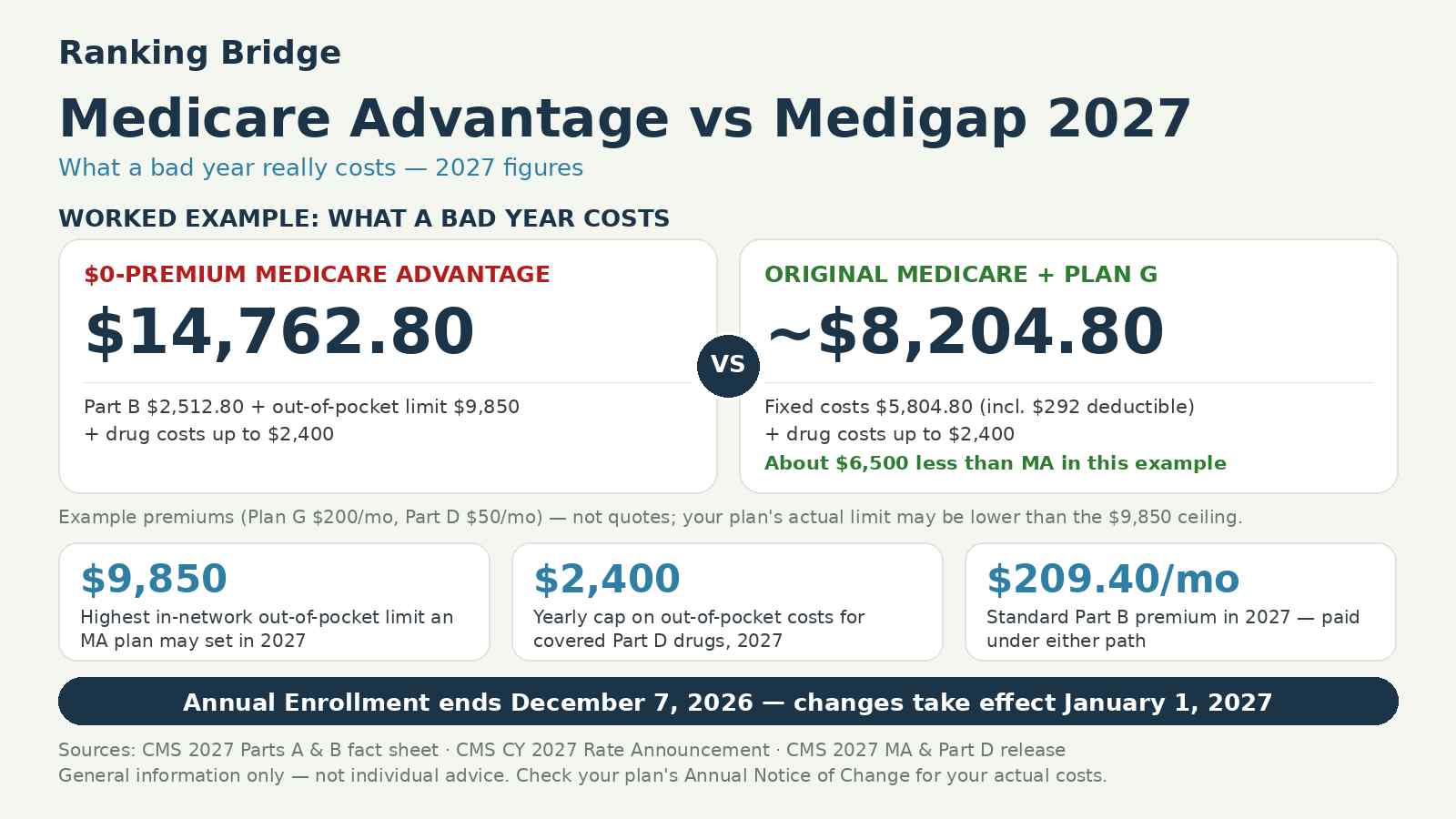
A bad year. Now take a year with a major surgery and months of follow-up care. On Medicare Advantage, medical cost-sharing stops at the plan’s out-of-pocket limit. The federal ceiling for 2027 is $9,850 in-network — most plans set their limit lower (KFF found the average in-network limit was $5,421 in 2026), so check your plan’s actual number. On top of that, drug spending can add up to the $2,400 Part D cap. Worst case on a $0-premium plan: $2,512.80 in Part B premiums + $9,850 + $2,400 = $14,762.80. On Original Medicare with Plan G, the worst case is the same predictable $5,804.80 plus up to $2,400 in drug cost-sharing — about $8,204.80. That gap, roughly $6,500 in this example, is what the Medigap premium buys: a ceiling on the year that can go wrong. The break-even point moves with the actual premiums — if your Plan G quote is $150 a month instead of $200, the Medigap path gets cheaper still; at $300 a month, the gap narrows.
Two warnings about the averages. First, the $12.00 Medicare Advantage average premium is a CMS projection, not a price — many plans charge $0, others charge far more. Second, the $9,850 figure is the highest limit a plan may set, not what most people pay; your plan’s limit is in its Annual Notice of Change. Neither number is your number.
The Medigap plans, in plain terms
Medigap plans are standardized by letter. A Plan G from one insurer covers the same benefits as a Plan G from another — only the premium and the company’s service differ. That makes shopping a price comparison, not a benefits comparison, once you have picked a letter.
Plan G is the most comprehensive plan available to people new to Medicare. It covers the Part A hospital deductible ($1,776 in 2027), Part B coinsurance (the 20% of Medicare-approved amounts that Original Medicare leaves you), Part B excess charges, skilled nursing facility coinsurance, and foreign travel emergency care at 80% up to a $50,000 lifetime limit. The one thing it does not cover is the Part B deductible itself: $292 in 2027. After you have paid that, Plan G pays 100% of Medicare-approved cost-sharing for the rest of the year.
Plan N costs less per month and covers nearly as much, with two differences: you pay copays of up to $20 for some office visits and up to $50 for emergency room visits that do not lead to admission, and it does not cover Part B excess charges — the amount above the Medicare-approved amount that some doctors may charge. If your doctors all accept Medicare assignment, excess charges rarely arise; if they do not, Plan N leaves you exposed to them.
High-deductible Plan G is the middle ground: a much lower monthly premium, but you pay Medicare-covered costs up to a deductible of $3,050 in 2027 (up from $2,950 in 2026) before the policy pays anything. It suits someone who wants catastrophic protection at a low premium and can absorb a few thousand dollars in a bad year.
Plans C and F are closed to anyone who became eligible for Medicare on or after January 1, 2020. They were the only plans that covered the Part B deductible, and Congress phased out that first-dollar coverage for new enrollees. If you were eligible before 2020 you can still buy or keep them, but for everyone else Plan G is the top of the range.
How insurers price Medigap. There is no national average premium, which is why this guide does not quote one as fact. Insurers use one of three methods: community-rated (everyone in an area pays the same regardless of age), issue-age-rated (priced on your age when you buy, and it does not rise with age after that), or attained-age-rated (rises as you get older). The same Plan G letter can cost very different amounts from different insurers in the same ZIP code, and attained-age policies that look cheap at 65 can become expensive at 75. Compare the pricing method, not just the first year’s premium, and get quotes from several insurers.
Networks, referrals, and prior authorization
This is where the two paths feel most different day to day. Medicare Advantage is managed care. An HMO usually requires you to use network doctors and get a referral before seeing a specialist; a PPO lets you go out of network at a higher cost. Plans may also require prior authorization — approval before a service, test, or procedure is covered. That is the trade for the low premium and the out-of-pocket cap.
Original Medicare with Medigap has no network and no referrals. Any doctor or hospital that accepts Medicare will take you, anywhere in the country, and there is no prior authorization from the supplement — Medicare’s own coverage rules are the only gate. For someone who travels, splits time between two states, has a rare condition that needs a specialist in another state, or simply does not want to argue with an insurer before a scan, that freedom is the product. For someone whose doctors are all in one local network and who rarely needs care outside it, the network may never be felt.
Drugs: the part people forget
Medigap does not include drug coverage. If you choose Original Medicare with Medigap, you also need a standalone Part D plan — and you need to pick it during Annual Enrollment, because the Part D late-enrollment penalty is permanent. Most Medicare Advantage plans bundle Part D (MAPD), so drugs are inside the same plan.
The drug math is the same on both paths in 2027: the annual out-of-pocket cap on covered Part D drugs is $2,400, and the most a plan may charge as a deductible is $700. The Part D base beneficiary premium is $41.33 a month, but your plan’s actual premium is set by the plan. What changes your drug bill is the formulary — which drugs your plan covers and on which tier. Check your actual prescriptions against the 2027 formulary on Medicare.gov Plan Finder before December 7, on either path. A drug moving tiers matters more than the premium does.
Switching: the one-way door
You can move from Original Medicare to Medicare Advantage every year during Annual Enrollment, and you can switch Medicare Advantage plans or return to Original Medicare during the Medicare Advantage Open Enrollment Period, January 1 to March 31. What you cannot reliably do is move the other way — from Medicare Advantage back to Medigap — on your own schedule.
Medigap’s easy window is the six-month Medigap Open Enrollment Period, which starts the month you are both 65 or older and enrolled in Part B. During it, insurers must sell you any Medigap plan sold in your state, cannot deny you, and cannot charge more because of your health. Outside that window, insurers in most states can use medical underwriting: they can ask health questions, turn you down, or charge you more. A few states (Connecticut, Massachusetts, Maine, and New York among them) have broader year-round protections, but in most states the door narrows sharply after the first six months.
Federal guaranteed-issue rights are the exception. If your Medicare Advantage plan leaves Medicare or your area, if you move out of its service area, if employer coverage that paid after Medicare ends, or if you leave a Medicare Advantage plan within your first year under the trial right, insurers must sell you certain Medigap plans — for people newly eligible since 2020, Plans A, B, D, G, K, or L — and you generally have 63 days after the old coverage ends to apply. The trial right matters most for people who join Medicare Advantage when first eligible at 65: within the first year, you can switch back to Original Medicare and buy a Medigap policy with guaranteed-issue protection.
The practical consequence is blunt: if you think you may want Medigap later, buying it at 65 is the safe move, because later you may not be able to buy it at any price. If you start in Medicare Advantage while healthy and develop a serious condition, the plan you want may be closed to you. That is the strongest argument for Medigap, and it has nothing to do with this year’s premium.
How to choose: a decision framework
Work through these four questions in order. The first one that gives a clear answer usually decides it.
- Can you afford the Medigap premium every month, even in a year with no care? If the premium would strain your budget, Medicare Advantage’s low or $0 premium is the honest answer — a Medigap policy you drop for non-payment helps nobody. If you can afford it comfortably, keep going.
- How much care do you expect, and how bad could the year get? Frequent care, a chronic condition, or a planned surgery pushes toward Medigap’s predictable ceiling. Light, predictable care with doctors all in one network pushes toward Medicare Advantage.
- Do your doctors, hospitals, and travel patterns fit a network? If your specialists are out of network, you travel often, or you split time between states, Medigap’s nationwide access is worth real money. If everything you need is local and in-network, the network costs you nothing.
- How much friction will you tolerate? Referrals and prior authorization are real work and real delay. If you would rather pay more per month than argue for approval, that is a legitimate reason to choose Medigap.
If you are still torn, compare total yearly cost, not the premium: add Part B ($2,512.80 a year at the standard rate) + plan premiums + expected copays for your drugs and visits, then look at the worst case — the plan’s out-of-pocket limit on the Medicare Advantage side, the Part B deductible plus drug cap on the Medigap side. The path with the lower worst case is the one that lets you sleep.
What to check before December 7
Annual Enrollment ends December 7, 2026, and changes take effect January 1, 2027. Work through this list before then.
- Read your Annual Notice of Change (ANOC). Your plan had to send it by the end of September. On the Medicare Advantage side, the number that matters is the out-of-pocket limit; on the Medigap side, it is next year’s premium.
- Check your drugs against the 2027 formulary on Medicare.gov Plan Finder, with your actual prescriptions, doses, and pharmacy entered.
- Check your doctors are still in network if you are on or considering Medicare Advantage. Networks change every year.
- Get Medigap quotes from several insurers if you are considering the switch — same letter, different premiums, and check whether the pricing is community-rated, issue-age-rated, or attained-age-rated.
- If you are 65 and newly eligible, do not let the six-month Medigap Open Enrollment Period pass without deciding. It closes once.
- If you joined Medicare Advantage at 65 and are still in your first year, remember the trial right — you can still switch back to Original Medicare with guaranteed-issue Medigap protection.
- Do not miss December 7. After that date, most people cannot change plans until the next Annual Enrollment, with only narrow exceptions. Set a reminder for December 5 at the latest.
For the 2027 figures behind this comparison — Part B $209.40, Part A $1,776, the Part D cap $2,400 — see our Medicare Changes for 2027 guide. For the plan types behind these choices, see HMO vs PPO vs POS vs EPO vs HDHP, and for the open-enrollment picture beyond Medicare, ACA Open Enrollment 2027.
Frequently asked questions
Is Medicare Advantage or Medigap better in 2027?
Neither is better in general. Medicare Advantage usually costs less per month — the average premium is projected at $12.00 in 2027, and many plans charge $0 beyond Part B — but it has a network, referrals, prior authorization, and an out-of-pocket limit of up to $9,850 in-network. Medigap Plan G costs more per month but leaves only the $292 Part B deductible for Medicare-approved services, with no network and no referrals. The right choice depends on your budget, your doctors, and how much risk you want to carry.
Can I have both Medicare Advantage and Medigap?
No. Medigap only works with Original Medicare and will not pay a Medicare Advantage plan’s copays or cost-sharing. You must choose one path. If you already have Medigap and join a Medicare Advantage plan, you cannot use the Medigap policy to pay the plan’s costs.
How much does Medigap Plan G cost in 2027?
There is no single national price. Premiums are set by each insurer and vary by your age, your state, and the pricing method — community-rated, issue-age-rated, or attained-age-rated. Independent guides commonly quote about $150–$300+ a month at 65, but your quote is the only number that matters. Get quotes from several insurers for the same letter and compare the pricing method, not just the first year’s premium.
What is the Medicare Advantage out-of-pocket maximum for 2027?
The most a plan may set as its in-network out-of-pocket limit for covered Part A and Part B services is $9,850 in 2027, up from $9,250 in 2026. For PPO plans, the combined in-network and out-of-network limit is $14,800. Most plans set their limit lower — the average in-network limit was $5,421 in 2026, according to KFF — so check your plan’s actual limit in its Annual Notice of Change.
Can I switch from Medicare Advantage to Medigap?
Yes, but outside your six-month Medigap Open Enrollment Period (which starts when you turn 65 and enroll in Part B) or a guaranteed-issue situation, insurers in most states can use medical underwriting and may turn you down or charge more. If you joined Medicare Advantage when first eligible at 65, the 12-month trial right lets you switch back to Original Medicare and buy a Medigap policy with guaranteed-issue protection. The safest time to buy Medigap is at 65.
Does Medigap cover prescription drugs?
No. Medigap policies sold today do not include drug coverage. If you choose Original Medicare with Medigap, buy a separate Part D drug plan. In 2027 the Part D out-of-pocket cap is $2,400 a year and the maximum deductible is $700.
Sources
- Centers for Medicare & Medicaid Services, “2027 Medicare Parts A & B Premiums and Deductibles” (fact sheet, 17 Nov 2026) — https://www.cms.gov/newsroom/fact-sheets/2027-medicare-parts-b-premiums-deductibles
- Centers for Medicare & Medicaid Services, Announcement of Calendar Year (CY) 2027 Medicare Advantage Capitation Rates and Part C and Part D Payment Policies (Rate Announcement, 6 Apr 2026) — Part D out-of-pocket cap $2,400, maximum deductible $700, base beneficiary premium $41.33
- Centers for Medicare & Medicaid Services, 2027 Medicare Advantage and Part D premiums release (28 Sep 2026) — average Medicare Advantage premium projected $12.00
- Centers for Medicare & Medicaid Services, Final Contract Year 2027 Standards for Part C Benefits (22 Apr 2026) — 2027 in-network out-of-pocket maximum $9,850; combined in- and out-of-network maximum $14,800
- Medicare.gov, Choosing a Medigap Policy — plan standardization, Plan C/F closure to newly eligible since 1 Jan 2020, guaranteed-issue rights, 63-day application window, 12-month trial right
- Medicare.gov, Compare Medigap Plan Benefits — Plan G, Plan N and high-deductible Plan G benefit details
- KFF — average Medicare Advantage in-network out-of-pocket limit $5,421 (2026)
- Medicare.gov Plan Finder — plan comparison (medicare.gov)
General information about Medicare costs and coverage, not individual advice. Figures are the national 2027 baselines announced by CMS; your plan’s actual premium, deductible, cost-sharing, network, and formulary are in its Annual Notice of Change and Summary of Benefits.
