Flu vs COVID vs RSV: Symptoms, Vaccines, and What to Do This Winter (2026–27)
This voice experience is generated by AI.
You wake up with a fever, a cough and aching muscles. Is it flu, COVID-19 or RSV? The honest answer is that symptoms alone cannot settle flu vs COVID vs RSV. The three viruses cause nearly identical illness, and only a test can tell them apart.
Still, the differences matter. Flu usually hits suddenly, with a high fever and body aches that arrive within hours. COVID-19 more often builds over days, and it can take away taste or smell. RSV is most distinctive for wheezing, and it hits infants and older adults hardest. This guide puts flu vs COVID vs RSV side by side. It covers who needs which vaccine for winter 2026–27, and what to do if you get sick.
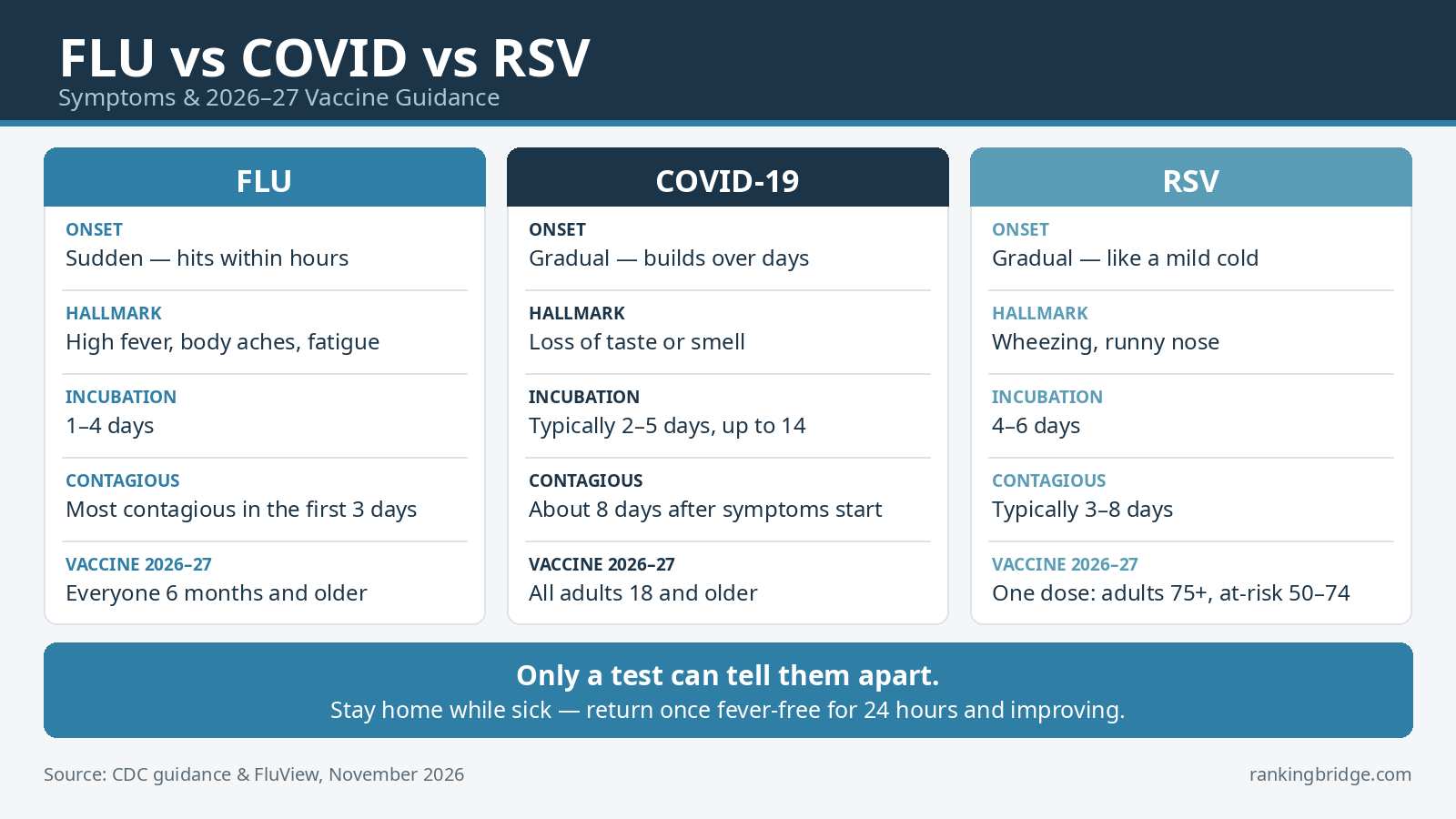
Flu vs COVID vs RSV at a Glance
| Flu (influenza) | COVID-19 | RSV | |
|---|---|---|---|
| Virus | Influenza A and B | SARS-CoV-2 | Respiratory syncytial virus |
| Incubation | 1–4 days | Typically 2–5 days, up to 14 days | 4–6 days |
| Contagious for | From 1 day before symptoms; most contagious in the first 3 days | From 2–3 days before symptoms; about 8 days after symptoms start | Typically 3–8 days |
| Hallmark symptoms | Sudden high fever, body aches, fatigue | Gradual onset; loss of taste or smell | Wheezing, runny nose, mild fever |
| Most at risk | Young children, adults 65+, pregnant women | Older adults, people with chronic conditions | Infants, adults 65+, people with heart or lung disease |
| Vaccine for 2026–27 | Everyone 6 months and older | All adults 18 and older | One-time dose for adults 75+ and at-risk 50–74 |
| Treatment | Prescription antivirals, best started early | Antivirals within 5–7 days for high-risk people | No routine antiviral; supportive care |
Every figure in this guide comes from CDC sources, current as of 20 November 2026. Flu activity is rising early this season. COVID-19 and RSV remain low nationally, but that picture can change fast in winter.
How the Symptoms Compare
Flu and COVID-19 share almost every symptom. Both can cause fever or chills, cough, shortness of breath and fatigue. Sore throat, a runny or stuffy nose, muscle pain and headache are common too. Vomiting or diarrhea happen sometimes. Loss of taste or smell happens with both, but it is far more common with COVID-19. RSV adds its own twist. In healthy adults it usually feels like a mild cold, with a congested nose, dry cough, low-grade fever and sneezing.
So how do you tell them apart? First, look at how fast it arrives. Flu typically strikes abruptly — people often describe it as feeling fine in the morning and terrible by the afternoon. COVID-19 more often builds gradually over several days. Second, listen for wheezing, which points more toward RSV, especially in infants and young children. Third, note any loss of taste or smell, which still favors COVID-19.
But none of these clues is a diagnosis. CDC is clear: symptoms alone cannot tell flu from COVID-19. Only testing can confirm which virus you have. The same applies to RSV, because its symptoms overlap heavily with the other two. Co-infection is possible too. You can catch flu and COVID-19 at the same time, though it is uncommon. And it can make illness more severe than either virus alone. Both viruses can also lead to complications. These include pneumonia, respiratory failure and acute bronchitis. Secondary bacterial infections are more common with flu.
How Long Each Virus Takes to Show Up — and How Long You’re Contagious
| Flu | COVID-19 | RSV | |
|---|---|---|---|
| Time from infection to symptoms | 1–4 days | Typically 2–5 days, up to 14 days | 4–6 days |
| When you can spread it | From about 1 day before symptoms | From 2–3 days before symptoms | From before symptoms appear |
| How long you stay contagious | Most contagious in the first 3 days | About 8 days after symptoms start, on average | Typically 3–8 days |
COVID-19 spreads more easily than flu, CDC says, and it causes more superspreading events. It can also spread from people with no symptoms at all. Flu is most contagious early. So the first days of illness are when you pass it on most easily. Young children and people with weakened immune systems can stay contagious with flu for longer than usual. With RSV, most people stop being contagious within about a week. But people with weakened immune systems can spread it for much longer.
All three viruses travel mainly in the tiny particles released when an infected person coughs, sneezes or talks. They can also spread through contaminated hands and surfaces, which is why handwashing still matters in winter.
Who Is Most at Risk This Winter
Age sits at the top of the risk list for all three viruses. Adults 65 and older face the highest risk of hospitalization from flu, COVID-19 and RSV alike. At the other end of life, infants face serious risk too — especially from RSV, and from flu as well. CDC notes that flu seems to cause more severe illness in young children than COVID-19 does.
Chronic conditions raise the stakes further. People with asthma, diabetes, heart disease or lung disease face higher risk. So do people with weakened immune systems. Any of the three viruses can hit them harder. Pregnancy also increases the risk of severe flu and COVID-19. And nursing-home residents face higher RSV risk, because the virus spreads easily in close living quarters.
The numbers from last season show why this matters. CDC’s November 2026 review of the 2025–26 season tells the story. RSV hospitalization rates were highest in infants under 12 months: 790 per 100,000. Adults 75 and older came next, at 352 per 100,000. COVID-19 hospitalizations were highest in adults 75 and older. A new national surveillance system provisionally counted 34 RSV-associated and 31 COVID-19-associated deaths in children during the 2025–26 season. Most of those children had at least one underlying condition. The counts are provisional and likely incomplete, because national reporting only began in March 2026.
The 2026–27 Season So Far: Flu Is Early, COVID and RSV Still Low
Flu season arrived early this year. CDC’s Week 44 report covers the week ending 7 November. It says flu activity “continues to increase in many parts of the country.” Activity is “higher than typically observed at this time of year.” Test positivity reached 11.3% of clinical-lab specimens, up from 9.1% the week before. And 99.2% of positive tests were influenza A, almost all A(H1N1)pdm09. Outpatient visits for flu-like illness hit 3.2%, above the 2.9% baseline for the first time this season. Seven states were already at high or very high activity: California, Louisiana, Oregon, South Carolina, Tennessee, Texas and Washington.
Hospitalizations are climbing too. CDC recorded 9,584 lab-confirmed flu admissions in Week 44. That is a rate of 2.8 per 100,000. The highest rate was in adults 65 and older: 8.6 per 100,000. For the season so far, CDC estimates at least 2.6 million illnesses, 36,000 hospitalizations and 2,100 deaths. Five children have died from flu this season, two of them in Week 44. Still, CDC’s preliminary severity rating remains low across all ages. And the agency cautions that an early rise “does not necessarily lead to a higher seasonal peak or greater overall severity.”
COVID-19 and RSV are quieter for now. In its 13 November update, CDC put COVID-19 activity at low nationally. Wastewater levels were moderate in most of the country. RSV activity was low in most areas, with wastewater very low. Acute respiratory illness causing people to seek care is low but increasing. Johns Hopkins’ outbreak-risk team reached the same verdict in its 16 November assessment: national respiratory illness activity is low. But it noted flu test positivity in the West and South above 10%, against under 2% in the same week last year. And RSV hospital admissions have risen for nine straight weeks.
What the Season Outlook Expects
Looking ahead, CDC’s September season outlook expects a winter much like last year. It puts the combined peak hospitalization rate for all three viruses within 20% of last season’s peak. COVID-19 is most likely to peak in early to mid-January. Flu typically peaks between December and February. RSV usually peaks in late December or early January, though last season’s peak came unusually late, in February. CDC says that may signal a later peak again. These are outlooks based on trends and expert judgment, not dated forecasts.
Flu Vaccine 2026–27: Who Needs It
CDC recommends a flu vaccine every year for everyone 6 months and older. The 2026–27 vaccines are trivalent. They cover A(H1N1)pdm09, A(H3N2) and B/Victoria — the influenza viruses behind seasonal flu. All three vaccine components changed from last season. Influenza also has its own ICD-10 coding — see our explainer on ICD-10 code J09. Adults 65 and older should get a higher-dose or adjuvanted vaccine where available: Fluzone High-Dose, Fluad or Flublok. Children aged 6 months to 8 years need two doses the first time they get a flu vaccine. The doses come at least four weeks apart.
Ideally, get vaccinated by the end of October. But CDC says people should keep getting vaccinated “as long as flu viruses pose a threat to their community.” In plain terms, November is not too late — and with flu already spreading, now is a good time. CDC’s Week 44 report carries the same message. People who have not had their vaccine yet this season should get vaccinated now.
One note on this season’s guidance. CDC’s recommendations rest on the July 2025 immunization schedule. The agency says it remains in effect for 2026–27 “because of legal uncertainties and inquiries.” The guidance is explicitly interim while a federal court case about the vaccine advisory committee continues. That does not change the recommendation itself. But it is worth knowing why the guidance looks the way it does.
COVID-19 Vaccine 2026–27: Who Needs It
For 2026–27, CDC recommends a COVID-19 vaccine for all adults 18 and older. Children aged 6 months to 17 years with moderate to severe immunocompromise should also get vaccinated. For other children in that age range, CDC recommends vaccination through shared clinical decision-making between parents and their healthcare professional. This season’s vaccines use the Omicron JN.1 lineage.
That is a change from last season, when CDC recommended shared clinical decision-making for everyone 6 months and older. One detail worth knowing: some CDC recommendations go beyond FDA approval. For example, FDA approval for ages 12 to 64 covers people with at least one high-risk underlying condition. CDC flags these as off-label recommendations, so talk to your healthcare provider if you are unsure where you stand.
Medical societies go slightly further than CDC in places. A joint guidance endorsed in November 2026 recommends updated COVID-19 vaccination for adults 19 and older. It also suggests adults 65 and older get a second dose six months after the first. That second dose is society guidance, not CDC guidance. But it is worth raising with your doctor if you are 65 or older.
RSV Vaccine: Who Needs It — and Why It’s a One-Time Shot
RSV vaccination works differently from flu and COVID-19 vaccination, because it is not annual. CDC recommends a single dose for all adults 75 and older. It also covers adults aged 50 to 74 at increased risk of severe RSV illness. If you have already had one dose, you have completed vaccination. CDC recommends no booster at this time. One dose protects for at least two years, though CDC is still learning exactly how long protection lasts.
The at-risk list for ages 50 to 74 is broad. It includes chronic heart or lung disease, diabetes with organ damage, and end-stage kidney disease. Chronic liver disease, severe obesity, moderate to severe immune compromise, and nursing-home residence also qualify. The US has licensed three products — Arexvy, mResvia and Abrysvo — and CDC expresses no preference between them.
Infants get protection a different way. For babies under 8 months, CDC recommends one of two options. Either the mother gets vaccinated during pregnancy, or the infant gets a long-acting monoclonal antibody. Note that the recommended windows differ slightly by source. CDC advises maternal vaccination from 1 September to 31 January. The obstetricians’ college recommends 1 September to 1 March. Either way, the protection matters. RSV sends an estimated 110,000 to 180,000 US adults aged 50 and older to hospital each year. And infants under a year old face the highest hospitalization rates of any age group.
Can You Get All Three Vaccines at Once?
You can get flu, RSV and COVID-19 vaccines at the same visit. There is no minimum interval between them, and you can add other vaccines you are due. That is the position of the joint medical-society guidance endorsed in November 2026. It exists for a practical reason: every extra trip is another chance to miss a vaccine entirely. If you prefer to space them out, that is fine too. But do not let a perfect schedule become the enemy of getting vaccinated at all.
What to Do If You Get Sick
First, stay home. CDC’s guidance for respiratory viruses is simple. Stay home and away from others while you have symptoms that are not explained by something else. That includes household members who are not sick. You can return to normal activities once two things have both been true for at least 24 hours. Your symptoms are getting better overall. And you have had no fever without using fever-reducing medicine.
Then take extra care for five more days. When you go back around other people indoors, improve ventilation and wash your hands often. Consider a well-fitted mask, and keep some distance. If your fever comes back or you feel worse, stay home again. Wait until you meet the 24-hour rule, then restart the five days of precautions.
Second, test early if you are at higher risk. Flu and COVID-19 treatments work best when they start promptly. Flu antivirals should begin as soon as possible. They matter most for hospitalized patients and people at higher risk of complications. COVID-19 antivirals must start within five to seven days of symptoms beginning. RSV has no routine antiviral treatment, so care is supportive — rest and fluids while the illness runs its course. A telehealth visit can be a good first step if you are unsure whether you need in-person care.
Finally, know the warning signs. Seek emergency care right away for trouble breathing, chest pain, confusion, or lips turning blue. For infants, watch for fast or shallow breathing and chest muscles pulling inward with each breath. Poor feeding or unusual sleepiness also matter. Get help quickly if you see any of these.
How to Lower Your Risk This Winter
Vaccination is the single most effective step, and it is not too late. Beyond that, the basics still work. Open windows or use air purifiers to keep indoor air cleaner. Wash your hands often, especially after being in crowded places. Consider a mask in crowded indoor spaces if you are at higher risk. The same applies if you will be around someone who is. And stay home when you are sick — it protects everyone around you.
Winter habits help too. Shorter days mean less sunlight. And vitamin D deficiency is common in the colder months, so it is worth checking whether your levels are low. Sleep, regular movement and a balanced diet all support your immune system too. There are simple, practical ways to support your immune system naturally through the winter.
Frequently Asked Questions
How do flu vs COVID vs RSV symptoms differ?
Flu usually arrives suddenly, with a high fever, body aches and deep fatigue. COVID-19 more often builds gradually and can cause loss of taste or smell. RSV usually feels like a mild cold in healthy adults, but it often causes wheezing. And it is most dangerous in infants and older adults. Still, the three overlap so much that only a test can tell them apart for certain.
Is it too late to get a flu shot in November?
No. Ideally, get vaccinated by the end of October. But CDC says people should keep getting vaccinated as long as flu is circulating in their community. Flu activity is already rising this season. So November is a good time to get the shot if you have not had it yet.
Do I need an RSV vaccine every year?
No. The RSV vaccine is a single dose, not an annual shot. Adults 75 and older need one dose. So do at-risk adults aged 50 to 74. And if you have already had it, you do not need another one at this time. One dose protects for at least two years.
Can I get the flu, COVID-19 and RSV vaccines at the same time?
Yes. You can get all three at the same visit, with no minimum interval between them. Medical societies endorse same-visit vaccination so that no dose gets missed. You can space them out if you prefer, but getting them done matters more than the schedule.
How long should I stay home if I have flu, COVID or RSV?
Stay home until two things have both been true for at least 24 hours. Your symptoms are improving overall. And you have had no fever without fever-reducing medicine. After that, take added precautions for five more days around other people indoors. That means cleaner air, hygiene, a mask and distance.
When should I get tested — and when should I seek urgent care?
Get tested early if you are at higher risk of severe illness. Flu and COVID-19 treatments work best when started promptly. Seek emergency care right away for trouble breathing, chest pain, confusion, or blue lips. For infants, fast or shallow breathing, poor feeding or unusual sleepiness are reasons to get help quickly.
Sources
- CDC, 2026–2027 Respiratory Disease Season Outlook
- CDC FluView, Week 44 (week ending 7 November 2026)
- CDC Respiratory Illnesses Data Channel (updated 13 November 2026)
- CDC, Respiratory Virus Activity — United States, July 2025–June 2026 (MMWR, 19 November 2026)
- CDC, Similarities and Differences between Flu and COVID-19
- CDC, Preventing Spread of Respiratory Viruses When You’re Sick
- CDC, Interim Clinical Considerations for Seasonal Influenza Vaccines (1 September 2026)
- CDC, Interim Clinical Considerations for Use of COVID-19 Vaccines (23 September 2026)
- CDC, RSV Vaccine Guidance for Adults (24 February 2026)
- Mayo Clinic, Respiratory Syncytial Virus (RSV)
- Johns Hopkins CORI, Respiratory Illnesses Risk Assessment (16 November 2026)
- AAAAI/ATS/CHEST/SCCM Interim Joint Guidance on Flu, RSV and COVID-19 Vaccines (5 November 2026)
General information about flu, COVID-19 and RSV, not individual medical advice. Figures are CDC data current as of 20 November 2026; check CDC’s latest updates for the current week’s numbers. Talk to your healthcare provider about vaccination and treatment decisions.
