Best AI Medical Scribe Companies in 2027
This voice experience is generated by AI.
The best AI medical scribe companies in 2027 split into two clear groups. Enterprise platforms serve health systems with deep EHR integration. Self-serve tools serve solo doctors and small practices with fast signup. This guide covers both groups, so you can compare them on the factors that matter most: EHR write-back, HIPAA and BAA posture, and specialty fit.
In short, Abridge leads for large health systems, while Freed and Nabla lead for small practices that want to start today. However, the right choice depends on your EHR, your specialty, and how your team works. So read the buyer split first, then shortlist two or three vendors to trial.
The 2026 Shift: Your EHR Now Has a Scribe Built In
2026 changed the AI scribe market in a fundamental way. Epic and athenahealth now ship native scribes inside their EHRs. As a result, standalone vendors must prove they are worth paying for on top of what your EHR already includes.
Epic released AI Charting in February 2026 as part of Art, its clinician AI suite. Now called Chart with Art, it drafts notes and queues orders inside the Epic chart. Epic runs 43.7% of US acute care hospitals, so this move affects a huge share of US clinicians. Meanwhile, athenahealth shipped athenaAmbient network-wide in August 2026. It is included with athenaOne at no additional cost, and it reached more than 170,000 clinicians.
Standalone vendors responded with scale and specialization. Abridge won Best in KLAS for Ambient AI in 2025 and again in 2026, based on direct customer feedback. In September 2026, the US Department of Veterans Affairs selected Abridge under an enterprise contract, with a pilot already live at more than 75 VA medical centers. In the same month, Heidi Health raised $340 million in financing at a $900 million valuation. The Office of the National Coordinator for Health Information Technology (ONC/ASTP) sets the standards these EHR integrations run on.
The evidence base is growing too. A 2026 JAMA Network Open study of 1,547 clinicians at Providence St Joseph Health linked DAX Copilot use with lower documentation burden. Another 2026 study at UCSF Health, covering 1.9 million encounters, found adopters gained about 0.8 encounters per week, with no change in the share of denied claims. Still, accuracy is not automatic. Ontario’s Auditor General reported in May 2026 that every approved product it tested produced inaccuracies. Therefore, human review of every AI-drafted note remains essential.
How This Shortlist Was Put Together
This shortlist is editorial, based on public information about each company’s product, integrations, and buying path. Companies are listed in no particular order within each buyer group. Six criteria guided the selection:
- Buying path. Enterprise platforms sell through sales teams and implementation projects. Self-serve tools let a clinician sign up and start the same day. We flag the difference clearly, because most roundups mix the two without saying so.
- EHR write-back. A scribe that writes into your chart saves far more time than one that needs copy-paste. We note whether each vendor offers true write-back, a one-way sync, or copy-paste only.
- HIPAA and BAA posture. A business associate agreement is essential for US practices. We note where a BAA is included and where it is gated behind a paid or enterprise tier.
- Specialty fit. Some scribes cover 100 or more specialties. Others focus on primary care and a few common specialties. We note the breadth of each product.
- Independent recognition. We favored vendors with Best in KLAS recognition, peer-reviewed evidence, or large verified deployments — not vendor marketing claims alone.
- Real product, verified live. Every company link in this post was checked at draft time. We list only companies whose product pages load and describe a real service.
Before signing, trial two or three vendors with your own clinicians, test them on your hardest note types, and confirm the BAA in writing.
The 7 Best AI Medical Scribe Companies at a Glance
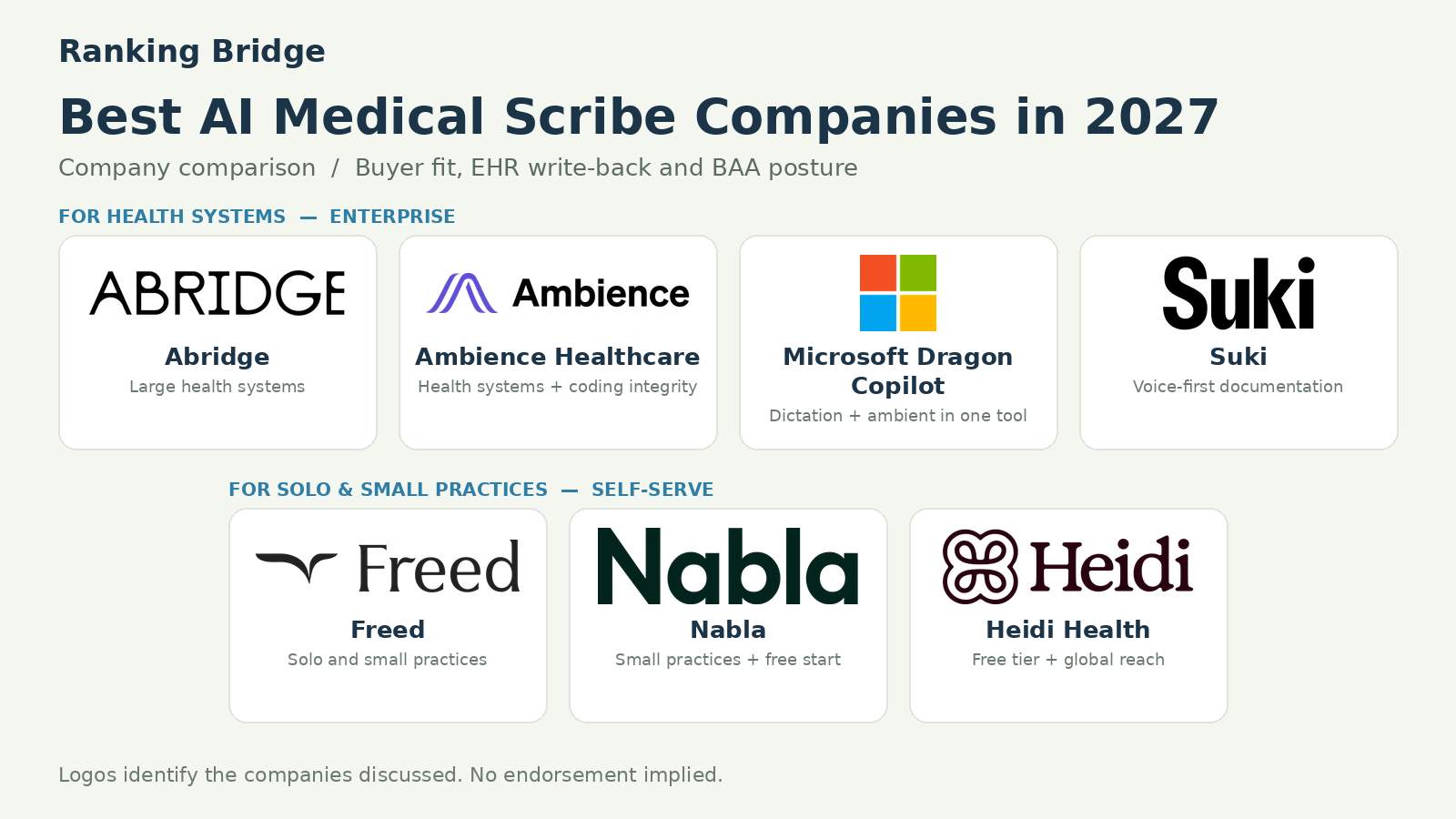
| Company | Best for | Buyer | EHR write-back |
|---|---|---|---|
| Abridge | Large health systems | Enterprise | Yes — Epic, Oracle Cerner |
| Ambience Healthcare | Health systems + coding integrity | Enterprise | Yes — Epic, Oracle Cerner, athenahealth |
| Microsoft Dragon Copilot | Dictation + ambient in one tool | Enterprise | Yes — Epic embed |
| Suki | Voice-first documentation | Enterprise | Yes — Epic, Oracle Cerner, athenahealth, MEDITECH |
| Freed | Solo and small practices | Self-serve | One-way sync (Premier plan) |
| Nabla | Small practices + free start | Self-serve | Yes — Epic + 20 EHRs |
| Heidi Health | Free tier + global reach | Self-serve | Practice tier only |
For Health Systems: Enterprise AI Scribes
Enterprise scribes sell through sales teams, not signup pages. They integrate deeply with your EHR, support dozens of specialties, and come with implementation projects measured in weeks. In return, they offer governance, customization, and coding features that self-serve tools cannot match.
Abridge — Best for Large Health Systems
Abridge is the enterprise benchmark for ambient AI. It won Best in KLAS for Ambient AI in 2025 and again in 2026, based on direct customer feedback. Founded in 2018 by cardiologist Dr. Shiv Rao, it now serves more than 250 health systems. Its customers include Kaiser Permanente, Mayo Clinic, UPMC, Johns Hopkins, Duke Health, and Yale New Haven Health.
Its platform covers more than 55 specialties and 28 languages. Notes link back to the source audio through Linked Evidence, so a clinician can check any section against the recording. It was also Epic’s first generative-AI partner, with bidirectional write-back in Haiku and Hyperdrive. In September 2026, the US Department of Veterans Affairs selected Abridge under an enterprise contract, with a pilot already live at more than 75 VA medical centers. Abridge also launched a pre-bill review product for clinical documentation and coding in the same month.
Abridge is enterprise-only, with no self-serve signup, free trial, or published price. It fits a health system that wants the most widely deployed ambient platform with deep Epic integration. Ask how implementation works for your specialties and which EHR workflows it covers.
Ambience Healthcare — Best for Health Systems That Want Coding Integrity Built In
Ambience Healthcare builds an ambient platform that goes beyond the note. Its AutoScribe covers more than 100 specialties. AutoCDI checks coding integrity, AutoAVS drafts after-visit summaries, and AutoRefer handles referrals. As a result, documentation and coding work flow from the same encounter.
Cleveland Clinic chose Ambience after a six-month head-to-head pilot across more than 80 specialties. The health system then signed a five-year exclusive contract. Other customers include UCSF Health, Houston Methodist, Memorial Hermann, and Ardent Health. Ambience holds SOC 2 Type II and HITRUST r2 certifications, signs BAAs, and integrates natively with Epic, Oracle Cerner, and athenahealth. It also earned a KLAS Spotlight score of 97.7 in 2025 for emerging solutions.
Ambience is enterprise-only, with no self-serve tier. It fits a health system that wants documentation, coding integrity, and referrals in one ambient platform. Ask how AutoCDI handles your highest-volume specialties and which EHR your teams use.
Microsoft Dragon Copilot — Best for Dictation and Ambient in One Tool
Microsoft Dragon Copilot combines ambient documentation with the dictation tool clinicians already know. In March 2025, Microsoft merged DAX Copilot, its ambient product, with Dragon Medical One dictation. The result is one workspace for ambient capture, dictation at the cursor, clinical questions, coding suggestions, referral letters, and after-visit summaries.
It offers role-based experiences for physicians, nurses, and radiologists. It embeds in supported EHRs, including Epic, and runs as a web, desktop, and mobile app. Because it comes from Microsoft, it also fits organizations that already standardize on Microsoft 365 and Azure. Licensing is quote-only, through Per User subscription or Flex plus consumption.
Dragon Copilot fits a health system that wants ambient AI and dictation in one contract, with the backing of a major platform vendor. Ask whether your EHR embed is supported and which roles your license covers.
Suki — Best for Voice-First Documentation
Suki has run in clinical use since 2017, longer than any other ambient scribe on this list. Its Suki Assistant pairs an ambient scribe with a voice assistant, so clinicians can stage orders, ask chart questions, and dictate by voice. Suki Compose offers a documentation-only tier for teams that need notes without the full assistant.
It syncs bidirectionally with Epic, Oracle Cerner, athenahealth, and MEDITECH Expanse. It covers more than 100 specialties and offers coding suggestions for ICD-10, HCC, E&M, and CPT. Patient instructions are available in about 80 languages. Suki holds SOC 2 Type II certification, signs BAAs, and serves more than 300 health systems, including MedStar Health. A platform SDK also lets developers embed Suki inside other products.
Suki is sales-led, with no self-serve free tier or open trial. It fits a health system that wants voice-first documentation with deep EHR sync. Ask how its voice commands work inside your EHR and which specialties your teams need.
For Solo and Small Practices: Self-Serve AI Scribes
Self-serve scribes let a clinician sign up and document a real visit the same day. They cost less and deploy faster than enterprise platforms. However, they often limit EHR write-back and BAA coverage on free tiers, so check the fine print before you rely on one.
Freed — Best for Solo Practices That Want Speed
Freed is built for solo doctors and small practices. Founded in 2023 by former Meta engineer Erez Druk, it turns a visit into a SOAP note in one to two minutes. It covers more than 30 specialties and 90 languages, and clinicians can configure templates to match their own note style.
Freed holds HIPAA and SOC 2 Type II compliance and publishes monthly plans for individuals and groups. Its default workflow is copy-paste into the EHR. EHR Push, a one-way browser-extension sync, is available on the Premier plan — but it is not bidirectional write-back. Freed raised a $30 million Series A led by Sequoia Capital.
Freed fits a solo or small practice that wants fast notes with minimal setup. Ask which plan covers your EHR workflow and whether copy-paste is acceptable for your team.
Nabla — Best Free Start for Small Practices
Nabla offers the most generous free start on this list. Its free tier covers 30 consultations a month. However, the free tier does not include a BAA, so US practices need a paid plan for compliant use with patient data. That detail matters, and it is easy to miss.
Founded in Paris in 2018, Nabla now serves more than 150 health systems. It supports 35 languages and integrates with more than 20 EHRs, including an Epic Toolbox and Haiku embed. It also offers ICD-10 coding suggestions and a clinical documentation agent. Audio is not stored by default, and patient data is never used for training. Nabla holds HIPAA, SOC 2 Type II, ISO 27001, and GDPR compliance, and it has raised more than $120 million, including a $70 million Series C in 2025.
Nabla fits a small practice that wants to trial an ambient scribe free, then upgrade to a paid plan with a BAA. Ask which paid tier covers your EHR and how its coding suggestions work for your specialty.
Heidi Health — Best Free Tier With Global Reach
Heidi Health offers a free tier with unlimited ambient consultation transcription. Founded in Melbourne by surgeon Dr. Thomas Kelly, it now operates in Australia, New Zealand, the US, Canada, and South Africa, with offices in New York and San Francisco. In September 2026, it raised $340 million in financing at a $900 million valuation.
Heidi launched Heidi II in September 2026, adding agentic work around the visit. It holds ISO 27001 and SOC 2 Type II certifications, and in January 2026 it became the first AI scribe certified to ISO/IEC 42001, the AI management standard. Its enterprise rollout includes Beth Israel Lahey Health.
US practices should read the fine print. EHR write-back and a signed BAA sit behind the custom-quoted Practice tier, not the self-serve Clinician plan. Heidi fits a practice that wants a generous free tier and is willing to upgrade for full EHR integration. Ask which tier covers your EHR and confirm the BAA before you go live.
Three More Worth a Look
DeepScribe suits specialty practices that want deep note customization. Its Customization Studio offers more than 50 options for note structure and phrasing, and its AI Coding covers E/M, HCC, and ICD-10. It integrates with Epic, Cerner, athenahealth, and several ambulatory EHRs, with implementation typically taking two to four weeks.
Commure Scribe suits athenahealth users. Its official athenahealth API writes into five named free-text fields, and appointments sync automatically. It also offers ICD-10 and CPT suggestions and a free ScribeCore tier. Commure acquired Augmedix in October 2024 and merged with Athelas in 2023.
Doximity Scribe is free for NPI-verified US physicians, nurse practitioners, physician assistants, and medical students. It includes a BAA in its platform terms. However, notes are kept for only 29 days, and there is no EHR write-back — copy-paste only. It suits a clinician who wants a free starting point inside the Doximity network.
How to Choose an AI Medical Scribe
- 1. Start with your buying path. A solo doctor needs a tool that works today. A health system needs governance and EHR depth. So match the buying path to your organization first.
- 2. Confirm EHR write-back — and what kind. True write-back drops the note into your chart for review. A one-way sync pushes text through a browser extension. Copy-paste means manual work after every visit. Ask which model each vendor offers for your EHR. If you are still comparing EHRs, see our list of the top 10 EHR software companies in the USA.
- 3. Get the BAA in writing. A BAA is not optional for US practices handling patient data. Some include it on every plan; others gate it behind paid tiers. Confirm the BAA covers your plan before you record a visit.
- 4. Test your hardest note types. A scribe that handles a simple follow-up may struggle with a complex multi-problem visit. Trial each vendor on your toughest notes, then compare the drafts side by side.
- 5. Check specialty and language coverage. A scribe built for primary care may miss the vocabulary of cardiology, orthopedics, or behavioral health. Multilingual support matters too. Ask for a specialty list and test a visit in your most common non-English language.
- 6. Ask about accuracy review and data use. Every AI scribe makes mistakes, so your workflow must include clinician review of each note. Ask how the vendor flags uncertainty, whether audio is stored, and whether your data trains its models. KLAS Research rates ambient AI vendors on real customer feedback.
AI scribes also connect with the wider revenue cycle: cleaner notes support cleaner coding, which is why they pair well with the best AI-driven medical billing companies and the best AI-powered RCM companies. See also predictive analytics in healthcare.
Frequently Asked Questions
What is the best AI medical scribe for a small practice?
For a small practice, Freed and Nabla are the strongest starting points. Freed turns visits into SOAP notes in one to two minutes with minimal setup. Nabla offers a free tier of 30 consultations a month, though US practices need a paid plan for a BAA. Heidi Health offers a free tier with unlimited transcription, but EHR write-back and a BAA sit behind its paid Practice tier.
Do AI scribes write directly into the EHR?
Some do, and some do not. Enterprise vendors such as Abridge, Ambience, Suki, and Microsoft Dragon Copilot offer true EHR write-back, often with Epic integration. Self-serve tools vary: Nabla integrates with more than 20 EHRs, Freed offers a one-way sync on its Premier plan, and Doximity Scribe is copy-paste only. Always confirm write-back for your specific EHR before you buy.
Are AI medical scribes HIPAA compliant?
Most established vendors hold HIPAA and SOC 2 Type II compliance and will sign a BAA. However, free tiers are the exception: Nabla’s free tier has no BAA, and Heidi’s free Clinician plan does not include one either. Therefore, confirm the BAA in writing for the exact plan you will use.
How much does an AI medical scribe cost?
Enterprise platforms are quote-only, so pricing depends on your size, specialties, and EHR. Self-serve tools publish monthly plans for individuals and groups. Meanwhile, EHR-native options such as athenaAmbient are included with athenaOne at no additional cost. Request proposals from two or three vendors and compare total cost, not just the headline price.
Can an AI scribe replace a human scribe?
An AI scribe can replace the typing and drafting work of a human scribe, but it cannot replace clinical judgment. Every AI-drafted note needs clinician review, because all tested products produce occasional errors. In practice, most organizations use AI scribes to cut documentation time, then keep clinicians in the review loop.
Which AI scribe works best with Epic?
Abridge is Epic’s first generative-AI partner and offers bidirectional write-back in Haiku and Hyperdrive. Microsoft Dragon Copilot also embeds in Epic, and Suki, Ambience, and Nabla all integrate with Epic too. If you use Epic, also consider Epic’s own Chart with Art, which drafts notes inside the chart. Compare the native option against standalone vendors before you decide.
Conclusion
The best AI medical scribe companies are not interchangeable. A large health system will look at Abridge or Ambience, and a Microsoft-centered organization will look at Dragon Copilot. A voice-first team will look at Suki, and a solo or small practice will look at Freed, Nabla, or Heidi Health. Shortlist two or three, trial them on your hardest notes, confirm the BAA and EHR write-back in writing, and choose the vendor whose notes your clinicians actually trust.
Sources
- KLAS Research — Best in KLAS Ambient AI ratings, based on direct customer feedback.
- Husa et al., JAMA Network Open, 2026 — ambient documentation at Providence St Joseph Health, 1,547 clinicians. doi:10.1001/jamanetworkopen.2026.15762
- Holmgren et al., JAMA Network Open, 2026 — ambient AI adoption at UCSF Health, 1,908,160 ambulatory encounters. doi:10.1001/jamanetworkopen.2025.53233
- Office of the National Coordinator for Health Information Technology (ONC/ASTP) — health IT standards and EHR integration guidance.
- HIMSS — healthcare technology research and industry guidance.
- Company websites linked throughout (Abridge, Ambience Healthcare, Microsoft, Suki, Freed, Nabla, Heidi Health, DeepScribe, Commure, Doximity) — product pages verified live at draft time, November 21, 2026.
