Epic vs Oracle Health (Cerner): Which EHR Is Better in 2027?
This voice experience is generated by AI.
If you are weighing Epic vs Cerner in 2027, you are really comparing Epic with Oracle Health. Oracle bought Cerner in June 2022 and renamed the business, so every Cerner search today leads to Oracle Health. This guide compares the two EHR giants on market share, KLAS scores, interoperability, AI, and cost.
The short answer: Epic leads on nearly every measure that matters in 2027. It runs 43.7% of US acute care hospitals. It also won Best in KLAS for the 16th straight year and added 77 hospitals in 2025. Oracle Health, meanwhile, lost 56 hospitals in 2025 and is rebuilding its EHR from scratch. Yet the right choice still depends on your size, your setting, and your timing — as this guide shows.
Epic vs Oracle Health at a Glance
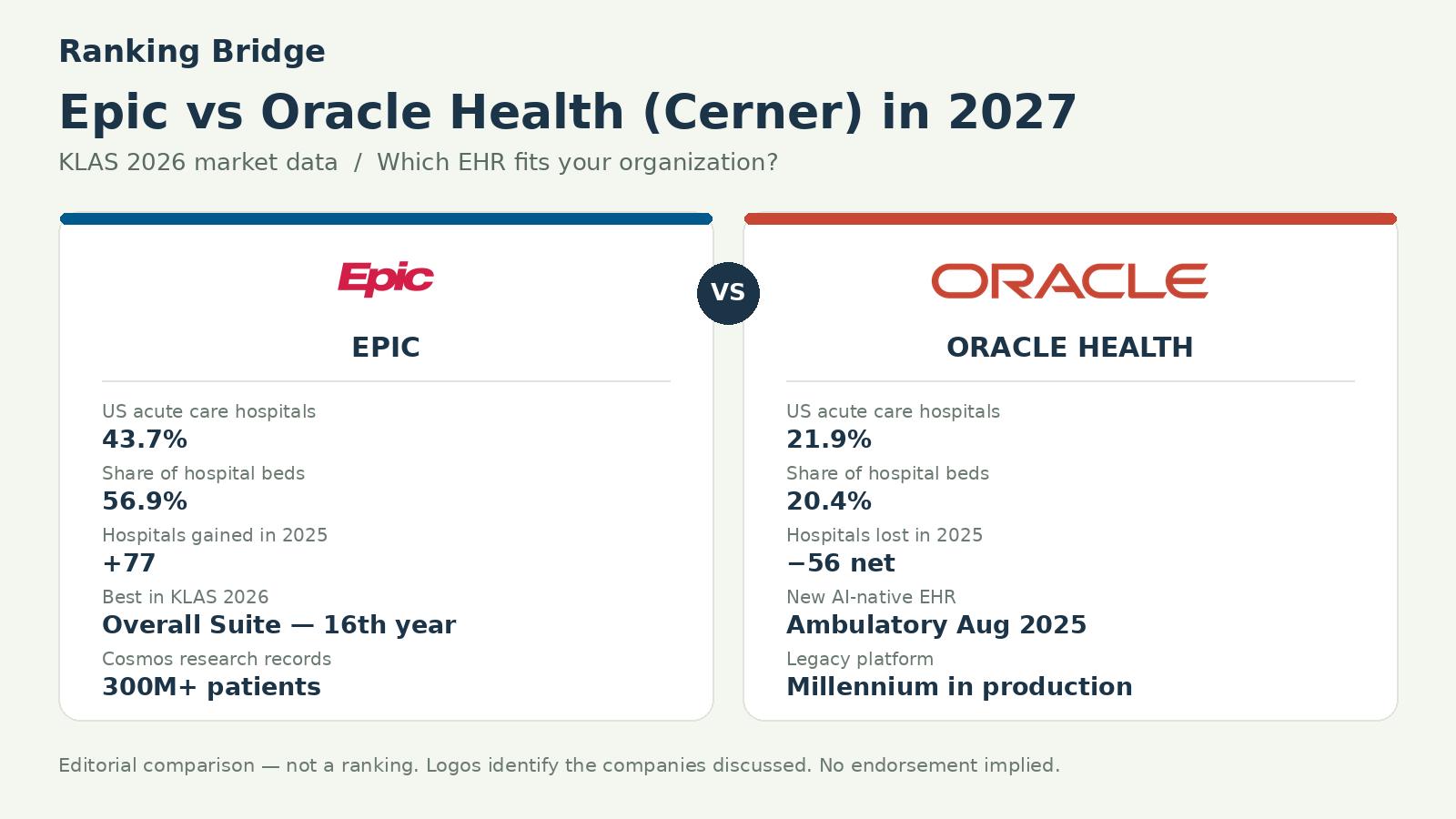
This table sums up the comparison. The sections below explain what each number means for a buyer.
| Epic | Oracle Health | |
|---|---|---|
| US acute care hospitals | 43.7% | 21.9% |
| Share of hospital beds | 56.9% | 20.4% |
| Hospitals gained or lost in 2025 | +77 | −56 (net) |
| Best in KLAS 2026 | Overall Suite, 16th year | No acute care EHR win |
| Flagship EHR | EpicCare | Millennium + new Oracle Health EHR |
| Patient portal | MyChart | HealtheLife |
| Interoperability | Care Everywhere, Epic Nexus (QHIN), Carequality | CommonWell, Carequality, Oracle Health Information Network (QHIN) |
| AI approach | AI layered across the platform; Cosmos data | Ground-up AI-native rebuild; Clinical AI Agent |
| Best for | Large health systems; organizations switching now | Current Millennium users; ambulatory-first buyers |
For the wider market, see our top 10 EHR software companies in the USA.
First, the Name Change: Is Cerner Now Oracle Health?
Yes. Oracle completed its $28.3 billion purchase of Cerner on June 8, 2022. It then rebranded the business as Oracle Health. So “Cerner” is now a legacy brand, not a separate company.
This matters because most comparison content still says “Epic vs Cerner.” That framing is out of date. In 2027, the real comparison is Epic against two Oracle Health platforms at once.
The first is Millennium, the Cerner EHR that still runs in production at thousands of hospitals. The second is the new Oracle Health EHR, a ground-up rebuild that launched for ambulatory care in August 2025. Oracle is running both systems in parallel, and any buyer must know which one a sales conversation is actually about.
If the basic terms are new to you, start with what an EMR is.
Market Share in 2027: What the KLAS Data Shows
KLAS Research tracks every US acute care EHR contract. Its US Acute Care EHR Market Share 2026 data, as reported by Fierce Healthcare, covers contracts signed from January to December 2025. The gap between the two vendors is now wide — and still growing.
Epic gained 77 hospitals and 18,679 beds in 2025. It lost just one customer. As a result, Epic now runs 43.7% of US acute care hospitals, up from 42.3% a year earlier. It also holds 56.9% of hospital beds.
Oracle Health moved the other way. It lost a net 56 hospitals and 14,676 beds in 2025. That was its third straight year as the largest net loser in the market. It now holds 21.9% of hospitals, down from 22.9%, and 20.4% of beds.
The five-year picture is starker still. From 2021 to 2025, Epic gained a net 568 hospitals. Over the same period, Oracle Health lost a net 173.
Two details explain where Epic’s wins came from. First, smaller health systems drove the action: Epic added 49 hospitals from smaller health systems and midsize standalone hospitals. Second, only two large health systems made enterprise-wide EHR decisions in 2025, and both chose Epic. In fact, no other vendor won a decision involving more than three multispecialty hospitals. Most of these wins came from organizations leaving Oracle Health.
One caution: the whole market slowed down. Hospitals affected by EHR purchase decisions fell about 40% from 2024 and nearly 50% from 2023. Policy uncertainty, AI spending, and Oracle Health customers waiting for clarity on the new platform all played a part.
Epic: What It Does Best
Epic is the market leader by every major measure. Epic, based in Verona, Wisconsin, runs its EpicCare platform across inpatient, ambulatory, and revenue cycle work in one system. Its billing product, Resolute, sits inside the same platform.
The KLAS scores back up the market share. In the 2026 Best in KLAS report, Epic won Overall Health System Suite for the 16th consecutive year. It also won 11 individual segment awards. That includes Acute Care EHR for large and midsize hospitals, with an overall performance score of 89.7 out of 100. Its Ambulatory EHR for health-system-owned practices scored 90.0.
Interoperability is Epic’s quiet advantage. Its Care Everywhere network launched in 2008 and now exchanges billions of patient records a year. Epic also runs Epic Nexus, its own designated Qualified Health Information Network (QHIN) under TEFCA, the federal exchange framework. Because so many nearby hospitals run Epic, joining Epic often means instant data sharing with regional partners. KLAS named that network effect as a key driver of Epic’s 2025 wins.
Epic’s data scale is a second advantage. Its Cosmos research platform holds more than 300 million de-identified patient records from over 310 health systems. Researchers use that data for real-world studies. Epic also trains AI models on it. In short, Epic’s size feeds its research, and its research feeds its product.
Finally, Epic has opened a route for smaller hospitals. Its Community Connect program lets a small hospital join a larger Epic organization’s system. Seven smaller standalone hospitals chose that route in 2025. For a small hospital that wants Epic without a full independent rollout, this is now a real option.
Oracle Health: Where It Stands in 2027
Oracle Health is the second-largest EHR vendor in the US. Yet its position has weakened every year since the acquisition. The KLAS data tells the story. Oracle Health has been the market’s largest net loser for three straight years, and its customer base is openly shopping around.
Satisfaction scores explain why. In the Best in KLAS 2026 report, Millennium ranked as the lowest-scoring acute care EHR in every size band. KLAS customer satisfaction data shows the same trend. Roughly 65% of Oracle Health customers are either leaving or vulnerable. About 30% have removed it from their long-term plans, and another 35% are at risk.
That does not mean Millennium is a failed product. It still runs major hospitals, and Oracle continues to update it. For existing customers, Millennium remains the production EHR today. The problem is momentum: new buyers are not choosing it, and current customers are weighing their options.
Oracle Health’s real strength is its parent company. Oracle runs one of the world’s largest cloud platforms, Oracle Cloud Infrastructure (OCI). That gives the health division deep pockets and serious AI infrastructure. The question for buyers is whether that backing turns into a product they want to buy.
The New Oracle Health EHR: A Rebuild, Not an Upgrade
The most important fact about Oracle Health in 2027 is that it is building a second EHR. This is not a Millennium upgrade. It is a new platform, built from the ground up on OCI.
Oracle announced the new EHR on August 13, 2025. It became generally available for US ambulatory providers on that date. Oracle says the platform is AI-native and voice-first, with built-in AI agents for charting and administrative work. It received ONC certification for ambulatory use in late 2025.
Acute care is the open question. Oracle plans to roll out acute care functionality through 2026, but that rollout is phased and early. For a hospital choosing an EHR in 2027, the new platform has no long track record in inpatient settings. Live-site data is still limited.
Meanwhile, Millennium is not going away. Oracle says it will keep supporting Millennium and its existing customers. However, Oracle has not announced migration tooling from Millennium to the new EHR. Buyers should also note that Oracle describes its roadmap as planning guidance, not a commitment. Dates can move.
The bottom line for buyers: the new EHR is real, and its ambulatory launch is genuine. But it is early. A hospital betting on it in 2027 is betting on a roadmap, not a record.
Interoperability: FHIR, TEFCA and Sharing Records
Interoperability matters because no hospital is an island. Patients move between systems, and records must follow them. Here, both vendors meet the same federal baseline — but their networks differ.
Both support FHIR R4, the modern standard for health data exchange. That is not optional: ONC certification has required FHIR R4 and US Core data elements since 2023. Both also operate designated QHINs under TEFCA, the federal framework that went live in December 2023. Epic runs Epic Nexus, and Oracle Health runs the Oracle Health Information Network.
The networks around them differ. Epic is a member of Carequality, the largest exchange framework. It connects over 600,000 care providers, 50,000 clinics, and 4,200 hospitals. Oracle Health is a member of both Carequality and CommonWell, a network Cerner helped found. Epic has never joined CommonWell.
In practice, the honest answer is that both vendors can exchange data with the other. The real differences are deployment, not technology. How well your EHR shares records depends on three things. They are your configuration, your partners’ networks, and whether staff actually use the exchange tools. A buyer should test real record exchange with local partners before signing, not just check a standards list.
AI in the EHR: Two Different Strategies
AI is where the two vendors differ most. Epic adds AI to a proven platform. Oracle Health rebuilt its platform around AI.
Epic’s approach is incremental. It has layered AI across inpatient and outpatient workflows — ambient charting, message drafting, and workflow assistants. Its Cosmos data gives it a training advantage. In 2025, Epic researchers published work on foundation models trained on 118 million patient records and 115 billion clinical events. That scale is hard for any rival to match.
Oracle Health’s approach is more radical. Oracle designed the new EHR from the start as voice-first, with AI agents handling charting and admin tasks. Its Clinical AI Agent drafts notes from patient conversations. About 10,000 clinicians across dozens of specialties already use it, according to Oracle. Oracle also says the platform stays open at the AI layer, so third-party models can plug in.
Which strategy wins is still open. Epic’s AI works today on a system that most large hospitals already run. Oracle Health’s AI is more ambitious, but it runs on a platform that is still new. For a buyer in 2027, the practical test is simple. Watch real clinicians use each system’s AI on real workflows, and measure the time it saves.
What Does Epic vs Oracle Health Cost?
Neither vendor publishes list prices. Both price by negotiation, based on organization size, scope, and contract length. Any article quoting a fixed monthly price for either system is guessing.
What buyers should know is where the money really goes. License fees are only part of the total. Implementation, data migration, training, and ongoing support usually cost far more than the software itself. An EHR switch is a multi-year project, and staffing the change is often the biggest line item.
For that reason, buyers should ask for a five-to-seven-year total cost of ownership, not a first-year quote. Ask what implementation includes, what migration from your current system costs, and what happens to pricing at renewal. Small hospitals should also compare Community Connect pricing with a standalone Epic rollout. Joining a larger system can cut implementation costs sharply.
Which EHR Should You Choose?
There is no single right answer. Use this framework instead.
Choose Epic if:
- You run a large health system and want the vendor with the deepest market momentum.
- Your regional partners already run Epic, so Care Everywhere gives you instant data sharing.
- You need a proven inpatient platform with strong KLAS scores today, not a roadmap.
- You want access to Cosmos-scale research data and the AI models built on it.
Choose Oracle Health if:
- You already run Millennium and a switch would cost more than the benefits it brings.
- You are an ambulatory-first organization and want to adopt the new AI-native EHR early.
- Your organization runs heavily on Oracle cloud and wants one vendor for cloud and health IT.
- You value CommonWell membership and the Oracle Health Information Network for your exchange needs.
Switch only if:
- Your current platform blocks your strategy — for example, your partners cannot exchange records with you.
- Your contract renewal lines up with a realistic migration window, and your board has funded it.
- You have tested the new system with your own clinicians, and the time savings are real.
- You have a clear plan for data migration, training, and the productivity dip that every switch causes.
Frequently Asked Questions
Is Cerner now Oracle Health?
Yes. Oracle acquired Cerner in June 2022 for $28.3 billion and renamed the business Oracle Health. Cerner is no longer a separate company. Its Millennium EHR still runs under the Oracle Health name.
Which is better, Epic or Cerner?
Epic leads on market share and KLAS scores in 2027. It runs 43.7% of US acute care hospitals, against 21.9% for Oracle Health. It also won Best in KLAS for the 16th straight year. However, Oracle Health’s new AI-native EHR is a genuine rebuild, and current Millennium users may have good reasons to stay. The better choice depends on your size, setting, and timing.
Is Cerner Millennium being discontinued?
No. Oracle says Millennium remains in production and will keep receiving updates. The new Oracle Health EHR is a separate platform, not a replacement that forces migration. That said, Oracle has not announced migration tooling from Millennium to the new system.
Can small practices use Epic?
Yes. Epic offers ambulatory products for smaller organizations. Its Community Connect program also lets small hospitals join a larger Epic organization’s system. Seven smaller standalone hospitals chose Community Connect in 2025.
What is Epic’s market share in 2027?
Epic runs 43.7% of US acute care hospitals and 56.9% of hospital beds. That is KLAS data for contracts signed in 2025. Oracle Health holds 21.9% of hospitals and 20.4% of beds.
Do Epic and Oracle Health work with TEFCA?
Yes. Both vendors operate designated Qualified Health Information Networks under TEFCA. Epic runs Epic Nexus, and Oracle Health runs the Oracle Health Information Network. Both also support FHIR R4 for data exchange.
The Bottom Line
The Epic vs Cerner decision in 2027 is really a question about timing. Epic is the safe choice today: the largest market share, the strongest KLAS scores, and the deepest data network. Oracle Health is the bet on tomorrow. It is a rebuilt, AI-native platform with a powerful parent company behind it — but a thin inpatient track record so far.
For most large health systems choosing now, Epic is the lower-risk answer. For current Millennium users, staying put and watching the new EHR mature is often the wiser move. And for any buyer, the deciding test is the same. Put real clinicians in front of both systems, on real workflows, and measure what actually saves time.
Sources
- KLAS 2026 Best in KLAS Awards: Global Software
- Fierce Healthcare: Epic continues to grow EHR market share (KLAS market share 2026)
- Health System CIO: Acute Care EHR Market Share 2026
- Becker’s Hospital Review: Best in KLAS 2026
- Healthcare IT News: Best in KLAS 2026
- Oracle press release: new AI-driven EHR, August 13, 2025
- MedCloudInsider: Oracle Health’s cloud-native EHR rebuild
- PMC: Cosmos — 300M+ patient records
- arXiv: Cosmos foundation models (“Curiosity”)
- National Academy of Medicine: TEFCA and the national digital architecture
- Fierce Healthcare: Epic joins TEFCA
- NXTMT: EHR interoperability — what makes systems actually talk
