Medicare Telehealth in 2027: What’s Extended, What Expires December 31, and New Billing Rules
This voice experience is generated by AI.
Medicare telehealth 2027 runs on two clocks, and most roundups blur them into one. First, Congress extended the Medicare telehealth flexibilities through December 31, 2027. Second, the DEA’s permission to prescribe controlled substances by telehealth without an in-person visit expires much sooner, on December 31, 2026. In other words, one clock gives you 13 more months, while the other gives you just over five weeks.
This guide covers Medicare telehealth 2027 in full. It separates what Medicare extended, what the DEA lets lapse, and the billing changes already in force. For example, FQHCs and RHCs have billed without code G2025 since October 1, 2026. In addition, the new BB and BC modifiers become required on January 1, 2027. Finally, it ends with a checklist your team can run before December 31. For the clinical side of virtual care, see our guide to telehealth physician oversight.
Medicare Telehealth in 2027: Two Clocks, Two Deadlines
Here is the short answer. Medicare’s telehealth flexibilities run through December 31, 2027. However, the DEA’s tele-prescribing flexibilities expire on December 31, 2026. No permanent DEA rule has replaced them yet. As a result, a practice can hold a Medicare telehealth visit in 2027 and still lose the right to prescribe a controlled substance during it.
The confusion is understandable. Both clocks started in the pandemic, and both were extended several times. Nevertheless, they now run on different laws, different agencies, and different dates. The table below keeps them apart.
| Date | What happens | Who acts |
|---|---|---|
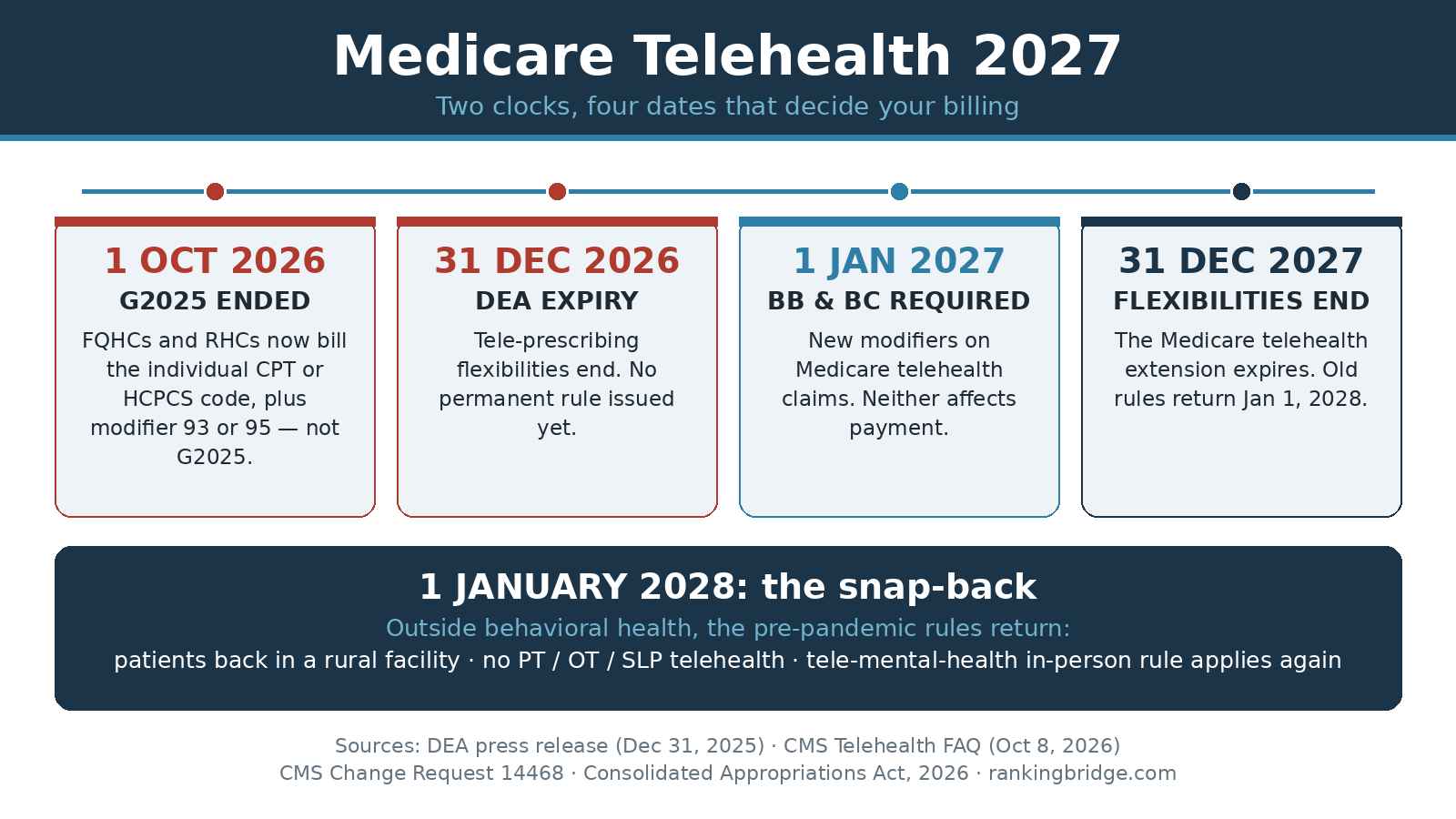
| Oct 1, 2026 | G2025 ends for FQHCs and RHCs | FQHC/RHC billers — already in effect |
| Dec 31, 2026 | DEA tele-prescribing flexibilities expire | Prescribers of controlled substances |
| Jan 1, 2027 | Modifiers BB and BC become required | Medicare telehealth billers |
| Dec 31, 2027 | Medicare telehealth flexibilities expire | Every Medicare telehealth provider |
| Jan 1, 2028 | Pre-pandemic rules return (outside behavioral health) | Every Medicare telehealth provider |
The rest of this Medicare telehealth 2027 guide takes each date in turn. First, the Medicare extension. Next, the DEA expiry. Then the billing changes. Finally, the 2028 snap-back.
Clock One: What Medicare Extended Through December 31, 2027
Congress extended the Medicare telehealth flexibilities through December 31, 2027. The extension came in the Consolidated Appropriations Act, 2026 (H.R. 7148, §6209), signed on February 3, 2026. The timing matters. The flexibilities briefly lapsed in late January 2026, then Congress restored them retroactively on February 3. In other words, the extension arrived after a gap, not before one. Practices should not assume a last-minute rescue next time.
Six flexibilities stay in place through December 31, 2027:
| Flexibility | What it means in practice |
|---|---|
| No geographic or originating-site limits | The patient can be at home, anywhere in the US |
| Expanded eligible practitioners | More provider types can furnish telehealth |
| FQHCs and RHCs as distant sites | Safety-net clinics can deliver telehealth visits |
| Audio-only for certain services | Phone visits count where clinically appropriate |
| Tele-mental-health in-person delay | The in-person visit rule stays paused until Jan 1, 2028 |
| Hospice recertification by telehealth | Face-to-face encounters can happen virtually |
These six rules define Medicare telehealth 2027 for most practices. They are coverage rules, not billing codes. They decide whether Medicare pays for a telehealth visit at all. The billing mechanics sit underneath them, and those changed separately in 2026. For the payment side of the same story, see the CMS 2027 Physician Fee Schedule final rule, which sets the conversion factors and telehealth payment policy for 2027.
One caution applies to the whole extension. Congress set an end date, not a permanent policy. From January 1, 2028, the old rules return for everyone outside behavioral health, unless Congress acts again. The CCHP fact sheet on the CY 2027 final rule puts it plainly. Permanent policies go back into effect on January 1, 2028, pending further action from Congress. The section below on what returns covers exactly what comes back.
Clock Two: DEA Tele-Prescribing Expires December 31, 2026
This is the urgent clock. The DEA and HHS issued a Fourth Temporary Extension of the COVID-19 Telemedicine Flexibilities for the Prescription of Controlled Medications. It runs from January 1, 2026 through December 31, 2026. After that date, the flexibilities expire unless a permanent rule replaces them. As of this writing, no permanent rule has been issued.
Under the extension, DEA-registered practitioners may prescribe Schedule II–V controlled medications by audio-video telemedicine without a prior in-person medical evaluation. The prescription must still serve a legitimate medical purpose and comply with federal and state law. In addition, audio-only telemedicine remains available for Schedule III–V narcotic medications that the FDA approved for maintenance and withdrawal treatment of opioid use disorder. That audio-only path also needs no prior in-person visit.
Two final rules sit alongside the extension, and they survive it. The DEA and HHS published them on January 17, 2025, and they took effect on December 31, 2025. First, the Expansion of Buprenorphine Treatment via Telemedicine Encounter. Second, Continuity of Care via Telemedicine for Veterans Affairs Patients. These two rules are permanent authorities in their own right. However, they cover specific situations only. They do not replace the broad temporary extension for everyone else.
The DEA has said a permanent rule is coming. HHS stated on January 2, 2026 that the extension gives both agencies more time to finalize permanent regulations, including the proposed Special Registration for Telemedicine. Nevertheless, no permanent rule had appeared by late November 2026, and no date has been announced for one. Do not plan around a date that does not exist.
What Happens on January 1, 2027?
What happens on January 1, 2027, if nothing replaces the extension? The sources do not state a single fallback. The DEA’s own press release warns only that expiry without further regulation could disrupt patient care. It names no grace period and no blanket continuation. That uncertainty is the hardest part of Medicare telehealth 2027 for prescribers. Therefore, prescribers should audit their telehealth patients now. Check DEA and state guidance before the deadline. Identify which patients need an in-person visit or a pathway under the two final rules. The checklist below lays out the steps.
G2025 Already Ended: What FQHCs and RHCs Must Bill Now
This Medicare telehealth 2027 change is already in force, and some practices are still getting it wrong. Through September 30, 2026, rural health clinics and federally qualified health centers billed non-behavioral distant-site telehealth services with HCPCS code G2025. Beginning October 1, 2026, that code no longer applies. Instead, RHCs and FQHCs bill the individual CPT or HCPCS code that describes the distant-site telehealth service, along with the appropriate telehealth modifier and revenue code.
The modifier depends on the visit type. Use modifier 95 for a real-time audio-video visit. Use modifier 93 for an audio-only visit. The authority is CMS Change Request 14468, Transmittal 13776, issued May 27, 2026. Its effective date was October 1, 2026, with implementation on October 5, 2026. The CMS Telehealth FAQ, updated October 8, 2026, states the same rule in its Q4 answer.
| Period | What RHCs and FQHCs bill |
|---|---|
| Through Sep 30, 2026 | HCPCS code G2025 for non-behavioral distant-site telehealth |
| From Oct 1, 2026 | Individual CPT/HCPCS code + modifier 93 or 95 + revenue code |
Three points keep this change in proportion. First, it is a billing change, not a coverage change. RHC and FQHC distant-site authority itself runs through December 31, 2027 under the CAA 2026. Second, behavioral-health services are unaffected. RHCs and FQHCs still bill those under the all-inclusive rate and the prospective payment system, as before. Third, the payment rate is still a CMS-calculated rate, similar to national average rates for comparable services under the Physician Fee Schedule.
If your clearinghouse still accepts G2025 on dates of service after September 30, 2026, do not take that as approval. CMS instructed Medicare Administrative Contractors to apply the new rule from October 1. Claims filed the old way risk denial or recoupment. Scrub October and November claims now, before the volume grows.
New Billing Rules for January 1, 2027: BB and BC
One more billing change arrives on January 1, 2027. Medicare telehealth claims must carry two new modifiers. Modifier BB flags a telehealth service furnished through a contracted virtual platform. Modifier BC flags a telehealth service furnished incident to a professional service. Both become required on Medicare telehealth claims from that date. CMS states explicitly that neither modifier has payment implications. In other words, they identify how the service was delivered. They do not change what Medicare pays for it.
The full detail belongs in the coding post, not here. For the claim-line examples, the platform-relationship edge case, and the incident-to rules under 42 CFR 410.26, see our companion guide, Telehealth Coding 2027. It covers BB and BC alongside POS 02 vs 10 and modifiers 95, 93 and GT. The one action for this post is simple. Confirm your billing system can append BB and BC before January 1. Then confirm which of your telehealth visits each modifier applies to.
What Returns on January 1, 2028
The Medicare extension ends on December 31, 2027. From January 1, 2028, the pre-pandemic rules return for everyone outside behavioral health, unless Congress acts again. Three changes matter most.
First, the patient must again be in a qualifying rural medical facility. The home will no longer count as an originating site for non-behavioral telehealth. Second, physical therapists, occupational therapists, speech-language pathologists and audiologists will no longer be able to furnish Medicare telehealth. Third, the expanded practitioner list narrows back to the pre-pandemic roster.
Behavioral health follows a different path. The in-person visit requirement for tele-mental-health services is delayed to January 1, 2028. That delay is verified in the CY 2027 PFS final rule. Beyond that date, the requirement applies again unless Congress or CMS acts. Note the distinction: the delay is confirmed, while the long-term status of tele-mental-health to the home is not settled in the sources for this post.
One related benefit is easy to confuse with telehealth, so keep it separate. Remote therapeutic monitoring, such as the respiratory monitoring billed under CPT 98977, is a different Medicare benefit with its own rules. It does not run on the telehealth clocks above. Our guide to remote therapeutic monitoring for respiratory care covers it separately. For the wider 2027 picture, see Medicare Changes for 2027. In short, plan for Medicare telehealth 2027 with the 2028 date already in view.
Telehealth Deadline Checklist: Before December 31, 2026
The DEA deadline is the nearest one in Medicare telehealth 2027, so it leads the list. Run these steps before December 31, 2026.
- Audit telehealth prescriptions. List every patient who receives a controlled substance by telehealth without an in-person evaluation. For each one, decide whether an in-person visit, a buprenorphine pathway, or a VA pathway applies.
- Check DEA and state guidance. DEA rules set the floor. State law can add requirements of its own. Confirm both before the deadline, not after it.
- Scrub G2025 claims. If you bill for an RHC or FQHC, pull every claim with a date of service on or after October 1, 2026. Any claim still carrying G2025 for a non-behavioral distant-site service needs correction.
- Load BB and BC into your billing system. Test the new modifiers on a claim before January 1, 2027. Confirm which visits take BB and which take BC.
- Check the January 1 cluster. The same date brings 453 CPT code changes and the prior authorization API requirements. Coordinate the updates so nothing ships half-finished.
- Confirm payer rules in writing. Medicare sets the baseline. Commercial payers set their own telehealth rules. Get each payer’s 2027 telehealth policy in writing before January 1.
FAQs
Is Medicare telehealth extended through 2027?
Yes. Congress extended the Medicare telehealth flexibilities through December 31, 2027 in the Consolidated Appropriations Act, 2026. The extension covers the geographic waiver, the expanded practitioner list, FQHC and RHC distant sites, and audio-only visits for certain services. It does not cover DEA tele-prescribing, which expires a year earlier.
When does DEA telehealth prescribing expire?
December 31, 2026. The Fourth Temporary Extension of the COVID-19 Telemedicine Flexibilities runs through that date. After it, DEA-registered practitioners lose the temporary authority to prescribe Schedule II–V controlled medications by telemedicine without a prior in-person evaluation, unless a permanent rule replaces it. No permanent rule has been issued yet.
Can controlled substances still be prescribed by telehealth in 2027?
It depends on the authority. Two final rules survive the expiry: the buprenorphine telemedicine rule and the VA continuity-of-care rule, both effective December 31, 2025. In addition, any permanent rule the DEA issues would create a new pathway. Beyond those, the sources do not state a blanket continuation. Check DEA and state guidance for the specific situation.
What replaced code G2025 for FQHCs and RHCs?
From October 1, 2026, RHCs and FQHCs bill the individual CPT or HCPCS code for the distant-site service. They add modifier 93 for audio-only or 95 for audio-video, plus the appropriate revenue code. Code G2025 no longer applies to non-behavioral distant-site telehealth. Behavioral-health services were never affected by this change.
Do the new BB and BC modifiers change Medicare payment?
No. CMS states that neither modifier has payment implications. Modifier BB identifies a telehealth service furnished through a contracted virtual platform. Modifier BC identifies a telehealth service furnished incident to a professional service. Both become required on Medicare telehealth claims from January 1, 2027. Full claim-line detail is in our telehealth coding guide.
What happens to Medicare telehealth on January 1, 2028?
Outside behavioral health, the pre-pandemic rules return unless Congress acts. Patients must again be in a qualifying rural medical facility, and physical therapists, occupational therapists, speech-language pathologists and audiologists can no longer furnish Medicare telehealth. The in-person visit requirement for tele-mental-health services also applies again from that date.
Sources
- DEA, “DEA Extends Telemedicine Flexibilities to Ensure Continued Access to Care” (Dec 31, 2025)
- HHS, “HHS & DEA Extend Telemedicine Flexibilities for Prescribing Controlled Medications Through 2026” (Jan 2, 2026)
- Federal Register Vol. 90 No. 247 (Dec 31, 2025), Fourth Temporary Extension
- CMS, Telehealth FAQ (updated Oct 8, 2026)
- CMS, Change Request 14468 / Transmittal 13776 (May 27, 2026)
- KFF, “What to Know About Medicare Coverage of Telehealth” (updated Mar 19, 2026)
- Foley, “Medicare Telehealth Flexibilities: Countdown to January 30, 2026 (and What Comes Next)”
- CCHP, “Medicare Physician Fee Schedule — Final CY 2027” fact sheet
