ICD-10 Code Z23: Encounter for Immunization — When to Use It and What Pairs With It
This voice experience is generated by AI.
ICD-10 code Z23 is the diagnosis code for an encounter where a patient receives a vaccine. Coders report it when the shot itself is the reason for the visit. For example, a flu clinic, a childhood immunization appointment, and a standalone COVID-19 vaccine visit all fit. In short, Z23 answers one question: why did the patient come in? The patient came in for a vaccine.
This guide covers ICD-10 code Z23 for coders and billers. First, it explains the descriptor and the tabular notes. Next, it shows when Z23 leads the claim and when another code leads instead. Then it maps Z23 against the Z28 family, where the vaccine did not happen. Finally, it pairs Z23 with the right CPT administration code and lists the errors that trigger denials. For the clinical side of this season’s vaccines, see our guide to flu vs COVID vs RSV.
What ICD-10 Code Z23 Means
Z23 means “encounter for immunization.” It sits in the Z20–Z29 block, which covers persons with potential health hazards related to communicable diseases. The code is billable and specific, so coders can report it as a standalone diagnosis code. CMS also lists it as POA exempt, so the present-on-admission indicator does not apply to it.
Still, FY 2027 brought no change to Z23. The code set effective October 1, 2026, through September 30, 2027, keeps the same descriptor and the same tabular notes. Coders who used Z23 last year can keep using it the same way.
One note matters most. Specifically, the tabular list says coders must add procedure codes to identify the types of immunizations given. So Z23 alone never completes a claim. It names the encounter only. In contrast, a CPT code names the administration, and a product code names the vaccine itself. The administration section below shows the full three-part claim.
In addition, two more notes shape how coders use Z23. First, the Code First note: code any routine childhood examination first. Second, the Code Also note: add Z71.85 for immunization safety counseling when it applies. Z71.85 is a 2022 code for an encounter where the clinician counsels the patient about vaccine product safety. Z23 belongs to the same family of encounter codes as Z12.11 for colon cancer screening. Both codes describe why the patient came in, not a disease.
When Z23 Is the Primary Code — and When It Is Not
Overall, the first-listed code is the main reason for the encounter. Z23 leads when the vaccine is that reason. Another code leads when the visit has a different main purpose. The table below covers the common scenarios.
| Scenario | First-listed code | How Z23 fits |
|---|---|---|
| Vaccine-only visit (flu clinic, vaccine appointment) | Z23 | Z23 leads; add the administration and product CPT codes |
| Well-child exam with vaccines | Z00.129 or Z00.121 | Code First the routine childhood examination; Z23 follows |
| Sick visit, vaccine also given | The illness or symptom | The visit’s reason leads; Z23 follows as an additional code |
| Vaccine safety counseling, vaccine given | Z23 | Add Z71.85 (Code Also) for the counseling |
| Vaccine safety counseling, vaccine declined | Z28.21 | Z28.21 for the refusal; add Z71.85 for the counseling |
Notably, the well-child rule trips up new coders most. For example, a child comes in for a checkup and gets two shots. The checkup is the reason for the visit, so the examination code leads. Specifically, Z00.129 covers a routine child health examination without abnormal findings. Z00.121 covers the same examination with abnormal findings. Then Z23 goes second. For the adult side of the same rule, see our guide to the routine examination codes.
Similarly, the sick-visit rule works the same way. For instance, a patient comes in with a sore throat and gets a flu shot during the same visit. The sore throat is the reason for the visit, so its code leads. Z23 follows. The vaccine does not move to the front just because the practice gave one.
ICD-10 Code Z23 vs Z28: The One Fork That Decides the Code
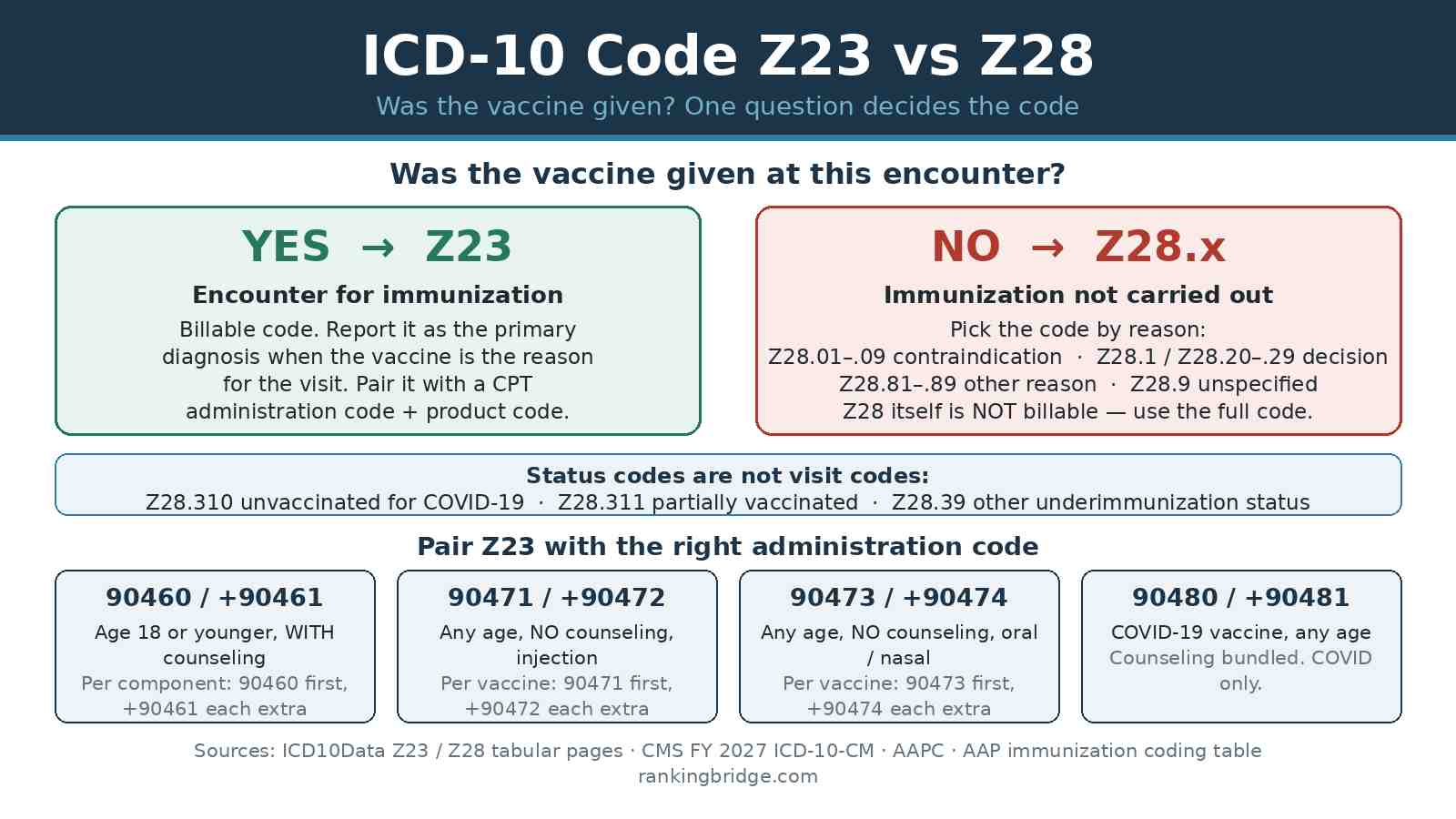
The fork is simple. Did the patient receive a vaccine at this encounter? If yes, the code is Z23. If no, the code comes from the Z28 family — and the reason it did not happen picks the code. Overall, coders should ask the fork question first, before they open the code book.
| Why the vaccine was not given | Code |
|---|---|
| Acute illness of the patient | Z28.01 |
| Chronic illness or condition of the patient | Z28.02 |
| Immune compromised state of the patient | Z28.03 |
| Allergy to the vaccine or a component | Z28.04 |
| Other contraindication | Z28.09 |
| Patient decision for reasons of belief or group pressure | Z28.1 |
| Patient refusal | Z28.21 |
| Patient decision for other reason | Z28.29 |
| Patient decision for unspecified reason | Z28.20 |
| Patient already had the disease | Z28.81 |
| Caregiver refusal | Z28.82 |
| Vaccine unavailable | Z28.83 |
| Other reason | Z28.89 |
| Unspecified reason | Z28.9 |
However, three codes in the family describe status, not an event. Z28.310 means unvaccinated for COVID-19. A partially vaccinated patient takes Z28.311. Z28.39 covers other underimmunization status. Coders use these codes to record a patient’s vaccination status. In other words, they do not replace Z23 on a vaccine-visit claim.
Finally, one more warning applies to the whole family. Z28 itself never goes on a claim. It is a category header, not a billable code. Likewise, Z28.0, Z28.2, Z28.3, and Z28.8 are not billable either. So coders must carry the code to its full length. Otherwise, the claim will reject.
In addition, one more code sits near Z23 but serves a different service. Specifically, Z29.11 covers prophylactic immunotherapy for RSV — the monoclonal antibody given to infants, not a vaccine. Coders pair it with 96380 or 96381, not the 90460–90474 family. So an RSV antibody visit is not a Z23 visit.
Which CPT Administration Code Goes With Z23
The diagnosis code is only the first part of the claim. In fact, every vaccine visit needs three parts: the diagnosis (Z23), the administration CPT code, and the vaccine product code (CPT 90476–90749). The administration code depends on three facts: the patient’s age, whether a physician or qualified health care professional counseled the patient, and the route.
| Situation | Administration code | How to count |
|---|---|---|
| Age 18 or younger, with counseling | 90460 + 90461 | Per component: 90460 for the first component, 90461 for each additional component |
| Any age, no counseling, injection | 90471 + 90472 | Per vaccine: 90471 for the first vaccine, 90472 for each additional vaccine |
| Any age, no counseling, oral or nasal | 90473 + 90474 | Per vaccine: 90473 for the first, 90474 for each additional |
| COVID-19 vaccine, any age | 90480 (+90481) | Counseling bundled; COVID-19 vaccines only |
Above all, the 90460 rule is the one coders get wrong most. In other words, it counts components, not vaccines. For example, a four-component combination vaccine means one unit of 90460 plus three units of 90461. Similarly, two single-component vaccines with counseling mean two units of 90460. In contrast, 90471 counts vaccines. For example, two flu shots at one visit mean one unit of 90471 plus one unit of 90472. The age limit also matters. Coders can report 90460 only for patients through 18 years of age, and only when a physician or qualified health care professional provides counseling. Without documented counseling, the claim drops to the 90471 family instead.
COVID-19 Vaccines: Code 90480
In contrast, COVID-19 vaccines have their own administration code. Coders report 90480 for any COVID-19 vaccine, for any age. Counseling comes bundled with 90480, so coders should not report counseling separately. CPT 2026, in effect since January 1, 2026, revised the 90480 descriptor and added +90481 for each additional component. Still, do not report 90480 with a non-COVID vaccine. Likewise, do not report 90460–90474 for a COVID-19 vaccine.
Finally, one last detail can affect payment. Some payers want modifier 33 on the administration code to mark the service as preventive and exempt from patient cost-sharing. So check payer guidance before you submit the claim.
Documentation Requirements
In short, the note must support every code on the claim. For a Z23 visit, the record should show:
- The vaccine given, with the lot number and expiration date.
- The route and the injection site.
- The date of the Vaccine Information Statement given to the patient.
- Counseling content and who provided it, when the claim reports 90460.
- Consent for the vaccine, or the reason for refusal when the claim reports a Z28 code.
Notably, the counseling line matters most for audits. Code 90460 includes counseling in its descriptor. So the note must show that a physician or qualified health care professional counseled the patient or family. In contrast, a nurse-only administration note will not support 90460. Then the claim drops to 90471.
Common Z23 Coding Errors
- Reporting Z23 with no administration or product code. Z23 names the encounter only. A claim with Z23 and no CPT codes is incomplete.
- Reporting Z23 when the patient refused the vaccine. A refusal is not an immunization encounter. Report Z28.21 instead.
- Reporting 90460 without documented counseling. Counseling is part of the code. Without it, report 90471.
- Reporting 90460 for an adult. The code covers patients through 18 years of age only. Adults go to the 90471 family.
- Reporting 90480 with a non-COVID vaccine. Code 90480 covers COVID-19 vaccines only.
- Reporting the Z28 header on a claim. Z28, Z28.0, Z28.2, Z28.3, and Z28.8 are not billable. Carry the code to its full length.
- Putting Z23 first at a well-child exam. The examination code leads. Z23 follows as an additional code.
FAQs
When is ICD-10 code Z23 the primary diagnosis code?
Z23 is primary when the vaccine is the main reason for the encounter. For example, a flu clinic visit, a vaccine-only appointment, and a standalone COVID-19 vaccine visit all qualify. When the visit has another main purpose — a checkup or a sick visit — that reason leads instead, and Z23 follows.
Can I report Z23 if the vaccine was not given?
No. Z23 means the patient received a vaccine at the encounter. When the vaccine was not given, report a code from the Z28 family instead. The reason picks the code: Z28.01 for acute illness, Z28.21 for patient refusal, Z28.83 when the vaccine was unavailable, and so on.
What is the difference between Z23 and Z28.21?
Z23 means the patient received the vaccine. In contrast, Z28.21 means the patient refused it. The two codes describe opposite outcomes, so they never appear on the same claim for the same vaccine. Finally, document the refusal and the reason, and add Z71.85 if the clinician counseled the patient about vaccine safety.
Which CPT code goes with Z23 for a child’s flu shot with counseling?
Report 90460 for a patient through 18 years of age when a physician or qualified health care professional provides counseling. Report one unit of 90460 per vaccine component. For a combination vaccine, add 90461 for each additional component. Overall, the note must document the counseling.
Do I use 90471 or 90460 for an adult flu shot?
Use 90471. Code 90460 covers patients through 18 years of age only, and it requires counseling. For an adult, report 90471 for the first injected vaccine. Then add 90472 for each additional vaccine at the same visit.
What administration code do I use for a COVID-19 vaccine?
Use 90480 for any COVID-19 vaccine, for any age. Counseling comes bundled with it, so do not report counseling separately. In addition, CPT 2026 added +90481 for each additional component. Finally, do not use 90460–90474 for COVID-19 vaccines, and do not use 90480 for any other vaccine.
Sources
- ICD10Data, ICD-10-CM Diagnosis Code Z23: Encounter for immunization — https://www.icd10data.com/ICD10CM/Codes/Z00-Z99/Z20-Z29/Z23-
- ICD10Data, ICD-10-CM Diagnosis Code Z28: Immunization not carried out and underimmunization status — https://www.icd10data.com/ICD10CM/Codes/Z00-Z99/Z20-Z29/Z28-
- ICD10Data, ICD-10-CM Diagnosis Code Z00: Encounter for general examination without complaint, suspected or reported diagnosis — https://www.icd10data.com/ICD10CM/Codes/Z00-Z99/Z00-Z13/Z00-
- CMS, FY 2027 ICD-10-CM files and POA exempt list, effective October 1, 2026 – September 30, 2027 (cms.gov)
- AAPC, “Report Vaccine Administration Scenarios With Success” — https://www.aapc.com/codes/coding-newsletters/my-internal-medicine-coding-alert/cpt-coding-strategies-report-vaccine-administration-scenarios-with-success-139550-article
- AAPC, “Boost Your Flu, COVID-19, and RSV Vaccine Coding Knowledge This Season” — https://www.aapc.com/codes/coding-newsletters/my-pediatric-coding-alert/pulmonology-coding-boost-your-flu-covid-19-and-rsv-vaccine-coding-knowledge-this-season-179944-article
- American Academy of Pediatrics, Immunization Coding Table, updated October 2025 — https://downloads.aap.org/aap/pdf/coding_vaccine_coding_table.pdf
- AMA, CPT Assistant Special Edition: Coronavirus (SARS-CoV-2), August 2023 — 90480 administration code
- CDC FluView, Week 44, 2026 (week ending November 7, 2026) — flu season figures, via the Ranking Bridge flu vs COVID vs RSV guide
