
HMO, PPO, POS, EPO, & HDHP: What’s the Difference?
Health plan letters are confusing by design — or at least, they feel that way. HMO, PPO, POS and EPO describe the network: which doctors you can see and how. HDHP describes something different: cost-sharing, a higher deductible in exchange for a lower premium. An HDHP can also be a PPO or an HMO. Once that distinction clicks, the rest falls into place.
This guide explains each type, how they compare, and what to check before choosing — for patients, and for the RCM teams who have to verify eligibility and bill under each one.
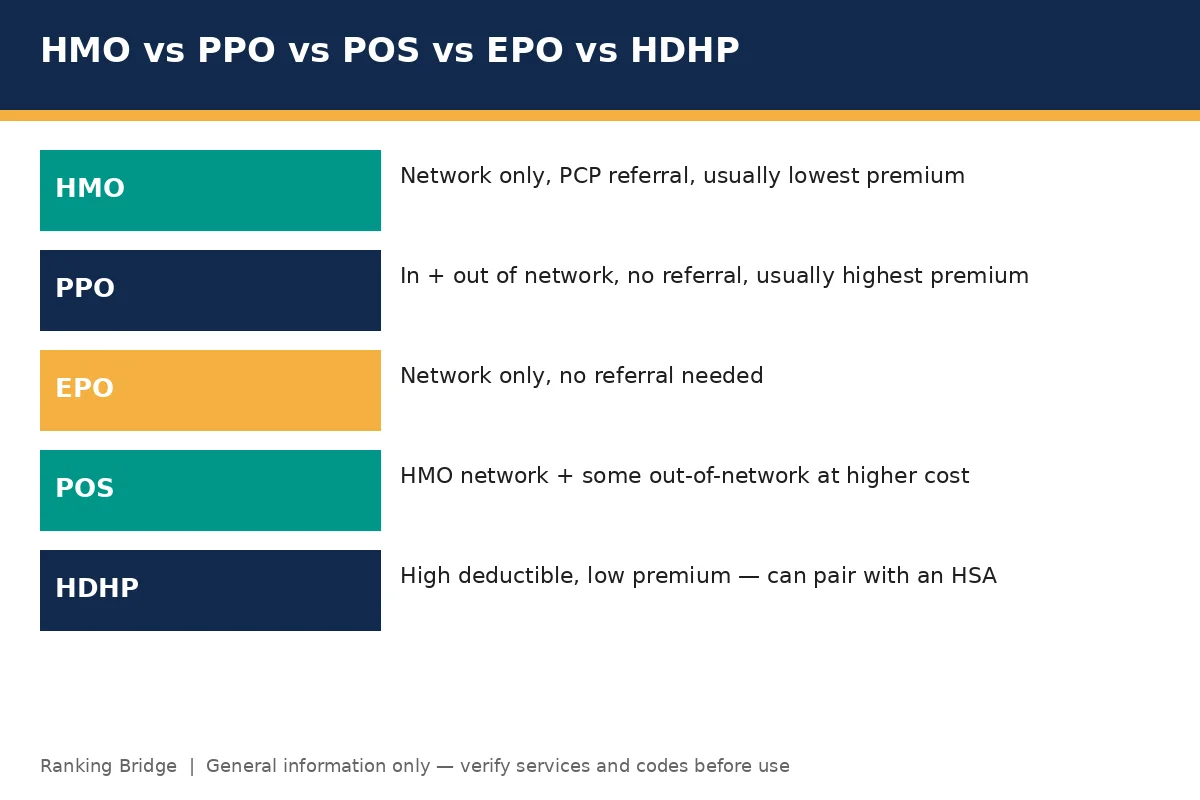
The five plan types at a glance
| Plan | Network rule | Referral for specialists? | Out-of-network cover | Premium tendency |
|---|---|---|---|---|
| HMO | Must use network providers | Usually yes, via primary care provider | Generally no, except emergencies | Usually lowest |
| PPO | Large network plus outside providers | No | Yes, at higher cost | Usually highest |
| EPO | Must use network providers | No | Generally no, except emergencies | Middle |
| POS | HMO-style network with some outside cover | Usually yes | Yes, at higher cost | Middle |
| HDHP | Depends on the underlying network type | Depends on network type | Depends on network type | Low, with high deductible |
HMO in detail
A Health Maintenance Organization usually limits coverage to doctors who work for or contract with the HMO. You choose a primary care provider (PCP) who coordinates your care and refers you to specialists, and you may need to live or work in the plan’s service area. HMOs often focus on prevention and integrated care, and they generally do not cover out-of-network care except in emergencies.
Good for: People who want low, predictable costs, are happy with one doctor group, and do not travel frequently for care.
Watch out for: Referral delays, a narrow network, and no cover if you see an out-of-network specialist without approval.
PPO in detail
A Preferred Provider Organization offers a large network plus the choice to see providers outside the network for more money. You do not need a PCP to manage your care, and you do not need referrals to see specialists. You pay more in premiums for that freedom, and out-of-network care costs more than in-network care.
Good for: People who want to choose any specialist, see doctors in several states, or keep a doctor who is out of network.
Watch out for: Higher premiums, and out-of-network bills that can still be large even when “covered.”
EPO in detail
An Exclusive Provider Organization is the middle ground between HMO and PPO: you must use network providers to keep costs low, and out-of-network care is generally not covered except in emergencies — but you do not need a PCP or referrals to see in-network specialists.
Good for: People who want no referrals and lower costs, and who can stay in network.
Watch out for: The network is exclusive. One out-of-network visit can mean the full bill.
POS in detail
A Point of Service plan combines HMO and PPO features. You choose a PCP, as in an HMO, but you also have the option to see out-of-network providers at a higher cost, as in a PPO. Referrals are usually required, and out-of-network care costs more.
Good for: People who want HMO-style prices with an escape hatch for out-of-network care.
Watch out for: Referral paperwork still applies, and out-of-network costs can be steep.
HDHP in detail
A High Deductible Health Plan offers lower monthly premiums and a higher yearly deductible — the amount you pay before insurance starts to pay. An HDHP is not a network type on its own: it can be built on an HMO, PPO, EPO or POS network. What makes it an HDHP is the deductible level, and qualifying HDHPs can be paired with a Health Savings Account (HSA), letting you save pre-tax dollars for medical expenses.
Good for: Healthy people with low expected care use, and savers who can fund an HSA and absorb a large bill if one arrives.
Watch out for: A single hospital visit can mean paying the full deductible first. An HDHP without savings behind it is a financial risk, not a bargain.
How to choose: five questions
- Are my doctors in network? Check every regular doctor and hospital, not just the plan’s headline network size.
- Do I need referrals? If you see specialists directly, an HMO or POS referral step will slow you down.
- Do I travel or live in two places? A PPO’s out-of-network cover matters far more then.
- What is my worst-case year? Compare the out-of-pocket maximum, not just the premium — an HDHP’s low premium can hide a high maximum.
- Can I use an HSA? Only a qualifying HDHP allows one, and the tax benefit only helps if you can actually contribute.
What this means for RCM teams
Plan type drives eligibility verification, prior authorisation and denial patterns. HMO claims fail on missing referrals; PPO claims fail on out-of-network pricing; HDHP claims fail when patients do not understand that the deductible applies before coverage begins. Front-end verification should capture network type, referral requirements, deductible status and out-of-pocket accumulation — before the visit, not after the denial. That front-end discipline is exactly what our claim denials analysis shows is missing in many practices.
For patients navigating open enrollment, our ACA open enrollment 2027 guide covers dates, premium changes and what to check before enrolling.
FAQ
Is an HDHP a separate plan type from PPO and HMO? No. HDHP describes cost-sharing (a high deductible, low premium), while HMO, PPO, EPO and POS describe networks. An HDHP can be built on any of those network types.
Which plan is cheapest? Usually an HMO has the lowest premium, and an HDHP has a low premium with a high deductible. “Cheapest” depends on how much care you actually use — a low premium with a high out-of-pocket maximum can cost more in a bad year.
Do I always need a referral in an HMO? Usually yes, from your primary care provider, to see a specialist. Exceptions exist for emergencies and some services — check your plan’s rules.
Can I see an out-of-network doctor in an EPO? Generally no, except in emergencies. Out-of-network care in an EPO is usually not covered at all.
What is an HSA, and who can open one? A Health Savings Account is a tax-advantaged account for medical expenses, available only with a qualifying high deductible health plan. Contributions, growth and qualified withdrawals can all be tax-free, subject to IRS rules.
Sources and further reading
- UF Health, Understanding Health Insurance Plans: https://ufhealth.org/care-sheets/understanding-health-insurance-plans
- HealthCare.gov plan and network type guidance (via HealthCare.gov glossary and plan-type pages)
- Ranking Bridge, ACA Open Enrollment for 2027: https://rankingbridge.com/aca-open-enrollment-2027/
- Ranking Bridge, Claim Denials Are Still Rising in 2026: https://rankingbridge.com/claim-denials-rising-2026-experian-state-of-claims/
Note: Plan rules vary by insurer, state and specific plan. Always confirm network, referral, deductible and out-of-pocket details in your plan documents before relying on general descriptions.