CMS Prior Authorization Reform 2027: What CMS-0057-F Means for Your Revenue Cycle
This voice experience is generated by AI.
The CMS prior authorization rule 2027 deadline is six weeks away. On 1 January 2027, Medicare Advantage, Medicaid, CHIP and federal Marketplace plans must switch on four electronic prior authorization APIs. As a result, requests and decisions will flow between your EHR and the payer, not by fax and phone. The decision clocks are already live. Since 1 January 2026, covered plans must decide urgent requests within 72 hours and standard requests within seven calendar days. They must also give a specific reason for every denial. This post explains what changes, who it covers, and what your billing team must do before 1 January.
Prior authorization is one of the most expensive manual workflows in US healthcare. CMS puts the cost at roughly $34,000 and 700 hours per physician each year. In the AMA’s 2026 physician survey, reported by Physicians Practice, doctors complete an average of 40 prior authorizations a week.
What CMS-0057-F Is — and Who It Actually Covers
CMS-0057-F is the CMS Interoperability and Prior Authorization Final Rule. CMS released it on 17 January 2024. It appeared in the Federal Register on 8 February 2024 (89 FR 8758) and took effect on 8 April 2024. The rule binds payers, not practices. Yet your billing team feels every part of it.
The rule covers these “impacted payers”:
- Medicare Advantage organizations
- State Medicaid and CHIP fee-for-service programs
- Medicaid managed care plans
- CHIP managed care entities
- Qualified Health Plan issuers on the Federally Facilitated Exchanges
For the 2027 figures behind these plans, see our Medicare Changes for 2027 guide.
Four groups sit outside the rule. Employer-sponsored commercial plans are out, and so are self-insured ERISA plans. Traditional Medicare is out too — although WISeR now brings prior authorization to Original Medicare in six states (see below). Finally, plans on state-run exchanges sit outside the federal rule — about 18 states, including California and New York.
And the rule does not cover prescription drugs at all. That includes drugs your office administers and bills to the medical benefit. Every deadline in this post applies to medical items and services only. That is who the CMS prior authorization rule 2027 covers — and who it leaves out.
The Deadlines: What Is Already Live and What Hits on 1 January 2027
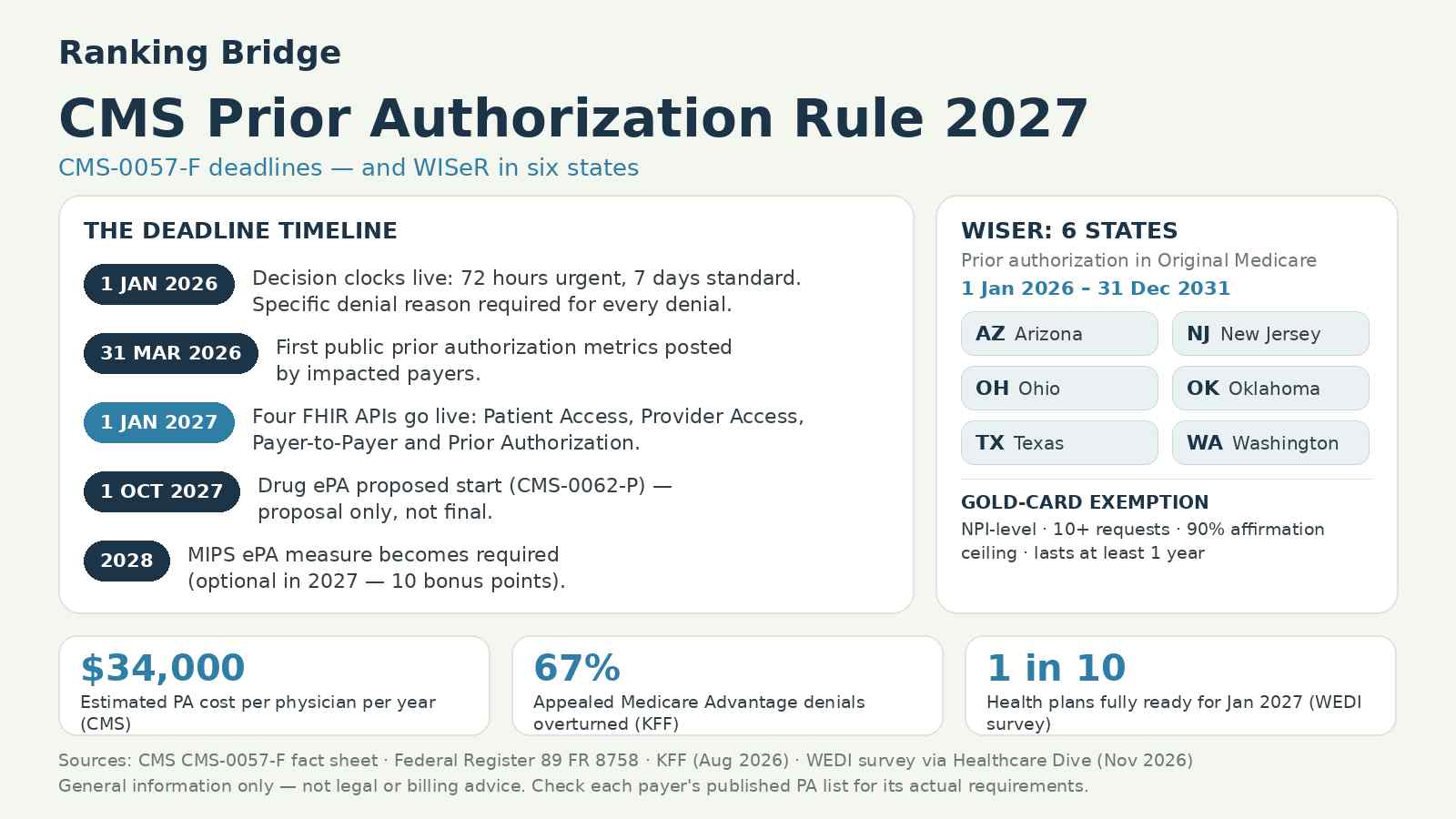
Half of this rule is already live. The decision clocks and the denial-reason rule started on 1 January 2026. But the APIs are the part that lands on 1 January 2027.
| Date | What happens | Who it affects |
|---|---|---|
| 1 Jan 2026 | 72-hour urgent and 7-day standard decision clocks; specific reason for every denial | Impacted payers except FFE QHP issuers |
| 31 Mar 2026 | First public PA metrics posted (covering 2025) | Impacted payers |
| 1 Jan 2027 | Four FHIR APIs go live | MA plans, Medicaid/CHIP FFS (see note below) |
| 1 Jan 2027 | MIPS ePA measure becomes optional (10 bonus points) | MIPS-eligible clinicians |
| 1 Oct 2027 | Drug ePA proposed start (CMS-0062-P) | Proposed only — not final |
| 2028 | MIPS ePA measure becomes required | MIPS-eligible clinicians |
One clarification: the date applies directly to Medicare Advantage organizations and state Medicaid and CHIP fee-for-service programs. For Medicaid and CHIP managed care plans, it falls in the rating period beginning on or after that date. For QHP issuers, it falls in the plan year beginning on or after it (89 FR 8758).
And the deadline itself? As of 20 November 2026, CMS has announced no delay and no enforcement relief. The rule pages still say the APIs apply “primarily January 1, 2027.” So plan for 1 January. Those are the dates that define the CMS prior authorization rule 2027.
The Four FHIR APIs, in Plain English
An API is a standard connection that lets two systems exchange data without a human in the middle. CMS-0057-F requires four of them — three new, and one expanded.
| API | What it does | Who feels it |
|---|---|---|
| Patient Access API (expanded) | Adds PA information to the data patients see in their health apps, while the authorization is active and for at least 1 year after the last status change | Patients |
| Provider Access API (new) | Shares claims, encounter and PA data with in-network providers who have a treatment relationship; patients may opt out | Your practice |
| Payer-to-Payer API (new) | Moves claims, encounter and PA data to the new payer when a patient changes plans; 5-year lookback; patient opt-in | Payers — and your intake team |
| Prior Authorization API (new) | Publishes the payer’s PA list, shows the documentation it needs, carries the request and the response | Your billing team |
The Prior Authorization API is the one your billing team will use every day. First, it publishes the payer’s list of items and services that need prior authorization. Next, it shows the documentation the payer needs for each one. Then it carries your request to the payer and brings back the response. That response must approve the request, deny it with a specific reason, or ask for more information.
The technical standards are USCDI and HL7 FHIR Release 4.0.1. They also include the US Core guide (STU 3.1.1), SMART App Launch, FHIR Bulk Data Access and OpenID Connect Core 1.0. CMS recommends the Da Vinci guides, but does not require them. You can run an all-FHIR Prior Authorization API and skip the older X12 278 transaction. HHS will not enforce HIPAA against you for that choice.
What Your Billing Team Must Do Differently on 1 January 2027
Nothing in the rule forces your practice to stop faxing on 1 January. The obligation sits on the payer, not on you. But every fax you send after the API goes live is work your competitors automate.
- Map your payers. List your top 10 payers by PA volume. Then confirm which ones will offer a live Prior Authorization API on 1 January.
- Ask your EHR vendor two questions. Does our system connect to payer PA APIs? Which Da Vinci guides does it support?
- Rework your queues. The PA API can return a “more information” response. So build a queue for those requests, and answer them the same day.
- Set your baselines now. Record your auth volume, turnaround times, manual touchpoints, staff hours, denials and appeal rates before go-live.
- Send at least one electronic PA in 2027. The MIPS ePA measure is optional next year and worth 10 bonus points. It becomes required in 2028. CMS-1848-F, which also made the 2027 ePA measure optional, sets the timeline.
- Pair this with the fee schedule work. Your 2027 changes do not stop at prior authorization. Our CY 2027 PFS checklist covers the payment side in the same format.
Hospitals follow a separate track. The ePA measure becomes optional for them from the CY 2028 EHR reporting period.
The Specific-Denial-Reason Rule: Your New Appeals Weapon
Since 1 January 2026, impacted payers must give a specific reason for every denied prior authorization. The rule applies however the request arrived — portal, fax, email, mail or phone. A generic “not medically necessary” no longer counts.
That single change turns your appeals workflow upside down. Before 2026, your team often appealed blind. Now the payer must tell you exactly why it said no.
KFF analysed the first year of public PA metrics from 14 major insurers, covering about 71 million enrollees. The overturn rates are striking.
| Market | Standard-request denial rate | Expedited denial rate | Overturned on appeal |
|---|---|---|---|
| Medicare Advantage | 12% | 10% | 67% |
| Medicaid managed care | 14% | 12% | 47% |
| ACA federal Marketplace | 18% | 16% | 43% |
Two out of three appealed Medicare Advantage denials get overturned. That is the strongest argument for appealing every denial that has a case. Median response times look fast, at about a day for standard requests. But KFF cautions that medians hide the slow outliers. And the metrics have gaps: no service-level breakdowns, and percentages only — no request volumes.
Use the payer’s own public metrics in your appeals and in your payer negotiations. When a payer denies far more often than its peers, say so — with its own numbers. Denials are already rising across the industry. If appeals volume outgrows your team, denial management partners can take the overflow.
The Drug Carve-Out: What CMS-0057-F Does Not Cover
Here is the exclusion most summaries bury. CMS-0057-F does not cover prescription drugs. That means no drug decision clocks, no drug denial reasons and no drug metrics under this rule. That exclusion also reaches drugs your office administers and bills to the medical benefit.
A separate proposal would close the gap. CMS-0062-P, released on 10 April 2026, would extend the Prior Authorization API to medical-benefit drugs, with drug decision deadlines and specific denial reasons. Its proposed compliance dates fall mostly on 1 October 2027. But it is a proposal, not a final rule. The comment period closed on 15 June 2026, and CMS has not finalised it.
Do not let a vendor blur this line. Drug ePA under CMS-0057-F does not exist today. And do not confuse the drug proposal with the hospital payment rule. The FY 2027 IPPS final rule (CMS-1849-F) only adopted updated FHIR implementation guides — a standards update, not a drug PA mandate.
WISeR: Prior Authorization Comes to Original Medicare in Six States
CMS-0057-F leaves Traditional Medicare alone. But a separate model brings prior authorization to Original Medicare in six states. WISeR — the Wasteful and Inappropriate Service Reduction model — is a six-year test from the CMS Innovation Center. It uses AI-enhanced technology to review selected services before payment.
How WISeR works
CMS announced WISeR on 27 June 2025, and the Federal Register notice followed on 1 July 2025 (90 FR 28749). The model runs from 1 January 2026 to 31 December 2031. Prior authorization started in January 2026, with pre-payment review applying from 15 January.
In the six states, a provider must request prior authorization before furnishing a selected service. The request goes to a WISeR participant — a technology company. Otherwise the provider faces mandatory pre-payment review after furnishing it. For hospital outpatient and surgery-center services, the review applies to the facility claim. The model excludes inpatient-only, emergency and time-sensitive services.
| State | WISeR participant |
|---|---|
| Texas | Cohere Health |
| New Jersey | Genzeon |
| Oklahoma | Humata Health |
| Ohio | Innovaccer |
| Washington | Virtix Health |
| Arizona | Zyter |
WISeR contractors must decide within 3 calendar days of an initial or resubmitted request. Expedited requests get 2 calendar days. The selected services include nerve stimulator implants and sacral nerve stimulation. They also include epidural steroid injections, knee arthroscopy for knee osteoarthritis, and skin and tissue substitutes. Note that epidural steroid injections fall inside the list, but facet joint injections do not. CMS can change the list. So check Appendix A of the current WISeR Operational Guide before you rely on it.
The gold-card exemption
WISeR offers an exemption program, often called gold-carding. It works at the individual NPI level — not at the hospital or group level. So a facility claim benefits only when that physician’s NPI holds the exemption.
To qualify, a provider needs at least 10 prior authorization requests across WISeR services in the assessment period. The provider must also hit an affirmation threshold. CMS set 90% as the ceiling, and participants may set it lower, never higher. A provider on a Medicare exclusion list cannot qualify.
The program began in July 2026. Washington went first on 6 July 2026 under Virtix Health, and other states followed quarterly. Exemptions last at least one year, and CMS re-evaluates them quarterly. CMS can remove an exemption if the affirmation rate drops below the threshold.
One point needs care. Sources disagree on how broad the exemption runs. One law-firm analysis says it covers only the specific WISeR services where the provider showed compliance. A billing-industry playbook says an exempt NPI is exempt for all WISeR services across all sites of care. Until CMS clarifies, treat the scope as open. Check the CMS WISeR Exemption Status Program fact sheet before you assume a service falls inside it.
Early results show why the exemption matters. Polsinelli reported that WISeR participants in Texas affirmed only about 62% of requests at initial review. The national average is 92%.
WISeR’s legal status
WISeR has faced legal and political challenges from the start. On 12 May 2026, the Government Accountability Office ruled that the WISeR notice is a “rule” under the Congressional Review Act (B-337994). That means CMS should have sent it to Congress before it took effect.
A Senate resolution to overturn the model failed, 46–50. A House funding bill would bar HHS from spending on WISeR. But Congress has not passed the full-year 2027 health funding bill. The government runs on temporary funding through 11 December 2026. So the spending ban takes effect only if the language survives in a final bill that becomes law.
A JAMA study published online on 26 October 2026 reported falling service use under WISeR. Senator Gillibrand renewed her call to end the model on 30 October 2026. Yet WISeR is still active and set to keep running through 2027. The CMS FAQ, last updated on 22 September 2026, confirms the six-year model through 31 December 2031.
If you practise in a WISeR state, the model reaches your hospital outpatient and surgery-center claims. Our OPPS/ASC final rule checklist covers the payment rules for those same settings.
Is Anyone Actually Ready?
Short answer: mostly not. A WEDI survey, reported by Healthcare Dive on 19 November 2026, found low readiness. Only about 1 in 10 health plans were fully ready for January 2027. About 17% had not started at all. And 62% said the project costs more than they expected.
Providers lag too. About a fifth had not started, and fewer than a tenth had finished. Worse, 7% said they did not plan to implement at all.
The AMA is holding the line on the date. On 18 September 2026, AMA CEO John Whyte wrote to CMS Administrator Mehmet Oz. He urged CMS to keep the 1 January 2027 timeline and to “reject broad enforcement discretion during 2027.” CMS had not publicly responded as of late September 2026.
So the picture stays mixed. Readiness is poor, yet the deadline holds. As of 20 November 2026, CMS has announced no delay and no enforcement relief. Treat 1 January as fixed.
The American Hospital Association released a readiness guide in mid-November 2026. Its core advice: treat 1 January 2027 as a milestone, not a finish line. Set payer-by-payer baselines before go-live. Then track auth-related denials, rework, appeals and write-offs.
Your Pre-1 January Checklist
Work through this list before 1 January. Each item takes an hour or less. Together they cover the whole CMS prior authorization rule 2027.
- List your top 10 payers by PA volume. Confirm which ones will offer a live Prior Authorization API on 1 January.
- Ask your EHR vendor for its connection plan. Get a go-live date in writing.
- Set your baseline metrics now. Record auth volume, turnaround, manual touchpoints, staff hours, denials and appeal rates.
- Train the team on specific denial reasons. Every denial now arrives with a reason — use it in appeals.
- Check for WISeR. If you practise in Arizona, New Jersey, Ohio, Oklahoma, Texas or Washington, list your WISeR-covered services and their vendors.
- Plan at least one electronic PA in 2027. It earns 10 MIPS bonus points next year, and it becomes required in 2028.
- Book the six-month check-in. Put a leadership review on the calendar for July 2027.
Frequently asked questions
What is CMS-0057-F and when does it take effect?
CMS-0057-F is the CMS Interoperability and Prior Authorization Final Rule. CMS released it in January 2024, and it took effect on 8 April 2024. The decision clocks and denial-reason rules started on 1 January 2026. The four FHIR APIs follow on 1 January 2027.
Which health plans must follow the CMS prior authorization rule in 2027?
The rule covers Medicare Advantage organizations and state Medicaid and CHIP fee-for-service programs. It also covers Medicaid and CHIP managed care plans, plus Qualified Health Plan issuers on the Federally Facilitated Exchanges. Employer commercial plans, self-insured ERISA plans, Traditional Medicare and state-run exchange plans sit outside the rule.
What are the four FHIR APIs required by 1 January 2027?
Patient Access adds PA data to patient health apps. Provider Access shares claims and PA data with in-network providers. Payer-to-Payer moves data between payers when a patient changes plans. And the Prior Authorization API publishes each payer’s PA list and carries the request and response.
Does CMS-0057-F cover prescription drug prior authorization?
No. The rule excludes all prescription drugs, including drugs your office administers and bills to the medical benefit. A separate proposal, CMS-0062-P, would add drug ePA from October 2027. But it is still a proposal — CMS has not finalised it.
What is the WISeR model, and which states does it affect?
WISeR is a six-year CMS test of prior authorization in Traditional Medicare. It covers selected services in six states, using AI-enhanced review: Arizona, New Jersey, Ohio, Oklahoma, Texas and Washington. It started in January 2026 and runs through 31 December 2031.
How does the WISeR gold-card exemption work?
Exemption works at the individual NPI level, not at the hospital or group level. A provider needs at least 10 WISeR prior authorization requests in the assessment period. The provider must also hit an affirmation rate, with 90% as the ceiling CMS set. Exemptions last at least one year. One caution: sources disagree on how broad the exemption runs. Some say it covers only the services where the provider showed compliance. Others say it covers all WISeR services.
Sources
- CMS Interoperability and Prior Authorization Final Rule (CMS-0057-F) fact sheet
- CMS Electronic Prior Authorization overview
- CMS Electronic Prior Authorization: Key Milestones & Progress Summary (PDF)
- Federal Register — CMS-0057-F final rule, 89 FR 8758 (8 Feb 2024)
- Federal Register — WISeR Model notice, 90 FR 28749 (1 Jul 2025)
- GAO decision B-337994 — WISeR and the Congressional Review Act (12 May 2026)
- KFF — Prior Authorization Metrics Provide New Insights into Insurer Practices, but Gaps Remain (13 Aug 2026)
- AMA — National Advocacy Update, 25 Sep 2026 (18 Sep letter to CMS)
- AHA — 2027 Guide to Electronic Prior Authorization Go-live Readiness (Nov 2026, PDF)
- Physicians Practice — Electronic prior authorizations arrive Jan. 1. Is your practice ready? (14 Oct 2026)
- ASA — WISeR Prior Authorization Process and Exemption Status Program
- Georgetown CHIR — CMS’s WISeR Model Faces Potential Repeal Following GAO Determination
General information about Medicare and Medicaid policy, not legal or billing advice. Figures are the national baselines announced by CMS; your payers’ actual requirements are in their published PA lists and provider manuals.
