
Medicare Changes for 2027: Part B Premium, Part D Cap, and What to Check Before December 7
This voice experience is generated by AI.
Medicare changes for 2027 are now final, and the most important date is not January 1 — it is December 7, 2026. That is when Annual Enrollment ends. Any plan change you make by then takes effect on January 1, 2027. After December 7, most people are locked into their 2027 coverage.
The headline numbers moved in both directions. The standard Part B premium rises to $209.40 a month, and the Part D out-of-pocket cap on prescription drugs rises to $2,400 a year. At the same time, the average Medicare Advantage premium is projected to fall to $12.00 a month. This guide puts every final 2027 figure next to its 2026 figure, explains what each one means in practice, and ends with a short checklist to work through before December 7.
The short answer
In 2027, the standard Medicare Part B premium is $209.40 a month (up $6.50 from $202.90 in 2026) and the Part B deductible is $292 a year (up $9 from $283). The Part A hospital deductible is $1,776 (up $40 from $1,736). For prescription drugs, the Part D out-of-pocket cap rises to $2,400 a year (up from $2,100) and the most a Part D plan may charge as a deductible rises to $700 (up from $615). Medicare Advantage premiums are projected to average $12.00 a month (down from $14.37), but the most a plan may set as its in-network out-of-pocket limit rises to $9,850 (up from $9,250). Annual Enrollment runs October 15 to December 7, 2026.
2026 vs 2027 at a glance
| Figure | 2026 | 2027 | Status |
|---|---|---|---|
| Part B standard monthly premium | $202.90 | $209.40 | Final (CMS, 17 Nov 2026) |
| Part B annual deductible | $283 | $292 | Final (CMS, 17 Nov 2026) |
| Part A hospital deductible | $1,736 | $1,776 | Final (CMS, 17 Nov 2026) |
| Part A daily coinsurance, days 61–90 | $434 | $444 | Final (CMS, 17 Nov 2026) |
| Part A lifetime reserve days, per day | $868 | $888 | Final (CMS, 17 Nov 2026) |
| Skilled nursing facility coinsurance, days 21–100 | $217/day | $222/day | Final (CMS, 17 Nov 2026) |
| Part D out-of-pocket cap (yearly) | $2,100 | $2,400 | Final (CMS Rate Announcement, Apr 2026) |
| Part D maximum deductible (yearly) | $615 | $700 | Final (CMS Rate Announcement, Apr 2026) |
| Part D base beneficiary premium (monthly) | $38.99 | $41.33 | Final (CMS, Jul 2026) |
| Medicare Advantage average premium (monthly) | $14.37 | $12.00 | Projected by CMS (Sep 2026) |
| Medicare Advantage in-network out-of-pocket limit (most a plan may set) | $9,250 | $9,850 | Final ceiling (CMS) |
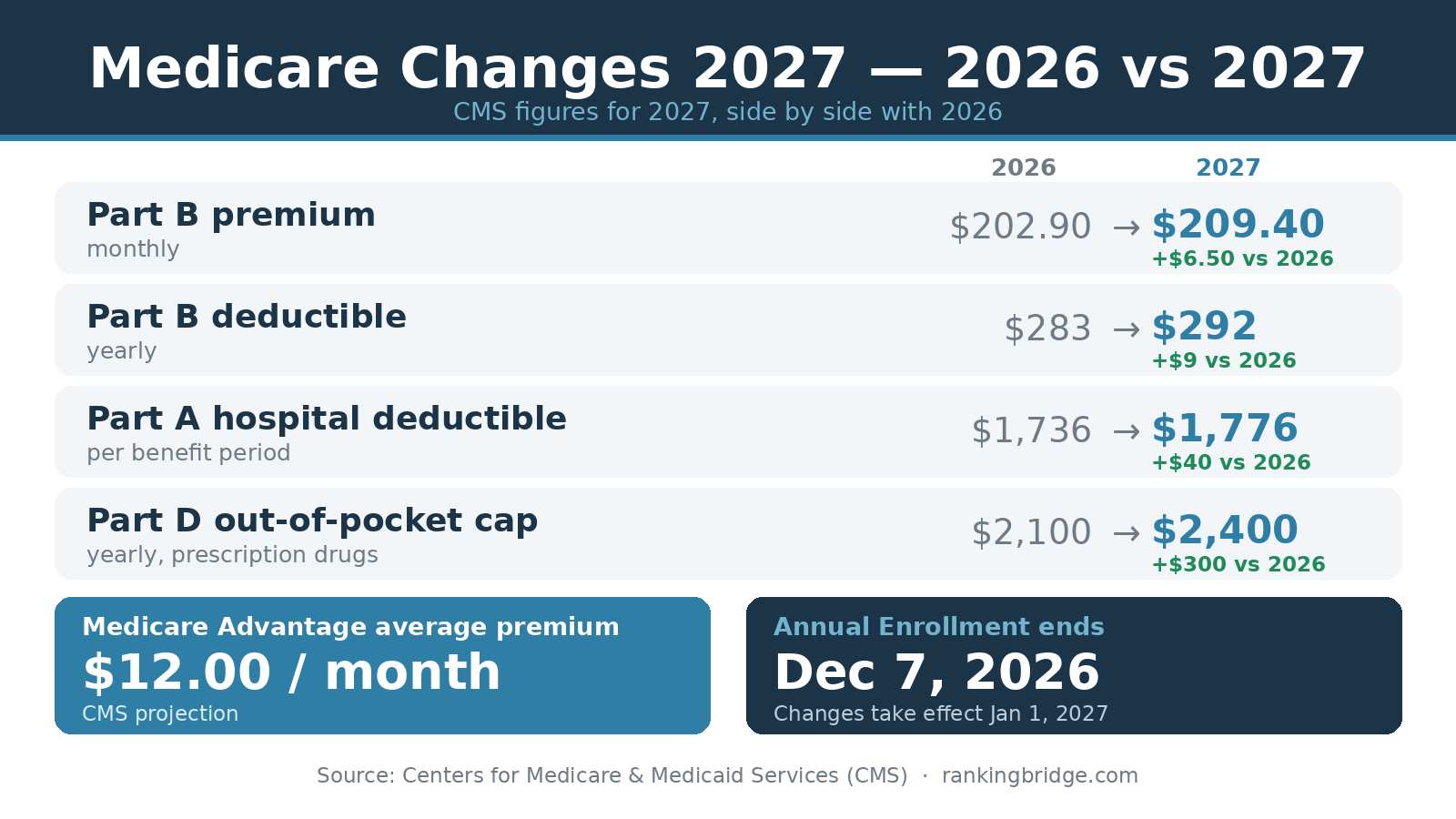
Every figure above is for 2027 unless it says 2026. Your own costs depend on your plan, your income, and where you live — these are the national baselines, not a quote for any individual plan.
Part B: premium $209.40, deductible $292
Part B covers doctors’ services, outpatient hospital care, some home health services, durable medical equipment, and other medical services not covered by Part A. The Centers for Medicare & Medicaid Services (CMS) announced the final 2027 figures on November 17, 2026.
The standard monthly premium for 2027 is $209.40, an increase of $6.50 from $202.90 in 2026. The annual deductible is $292, up $9 from $283. CMS says the increase is mainly due to projected increases in health care spending.
That $209.40 is the standard premium. About 9% of people with Part B pay more because of income-related monthly adjustment amounts (IRMAA). For 2027, the standard premium applies to individuals with modified adjusted gross income of $112,000 or less ($224,000 or less for joint filers). At the top end — individuals at $500,000 or more, joint filers at $750,000 or more — the total monthly premium is $711.80. If your income is near a threshold, check which bracket you fall in before budgeting, because a small income difference can move you into a higher bracket.
One point worth stating plainly: earlier in the autumn, several pages quoted a Trustee projection of about $209.50. That was a projection. The final figure CMS announced on November 17 is $209.40. If you see $209.50 anywhere, it is out of date.
Part A: hospital deductible $1,776
Part A covers inpatient hospital care, skilled nursing facilities, hospice, inpatient rehabilitation, and some home health care. About 99% of beneficiaries pay no Part A premium, because they have at least 40 quarters of Medicare-covered employment.
The Part A inpatient hospital deductible — what you pay if admitted to hospital — is $1,776 in 2027, up $40 from $1,736 in 2026. It covers your share of costs for the first 60 days of Medicare-covered inpatient care in a benefit period. After that, the daily coinsurance is $444 for days 61 through 90 (up from $434), and $888 a day for lifetime reserve days (up from $868). In a skilled nursing facility, the daily coinsurance for days 21 through 100 is $222 in 2027 (up from $217).
People with fewer than 40 quarters who buy into Part A pay a premium. With at least 30 quarters, the reduced monthly premium is $328 in 2027 (up from $311). With fewer than 30 quarters, the full premium is $597 a month (up from $565).
Part D: the drug cap rises to $2,400 — and the deductible to $700
The prescription-drug numbers are the ones most likely to change what people actually pay, and they were final months ago. CMS set them in its Calendar Year 2027 Rate Announcement on April 6, 2026, so they are not estimates.
The annual out-of-pocket cap on covered Part D drugs rises from $2,100 in 2026 to $2,400 in 2027. Once your spending on covered drugs reaches $2,400 in the year, you pay $0 for covered Part D drugs for the rest of the calendar year. Premiums do not count toward the cap, and neither do drugs your plan does not cover.
The most a Part D plan may charge as a deductible rises from $615 to $700. That $700 is a ceiling, not a requirement: no plan may charge more, but many plans charge less, and some charge no deductible at all for certain drug tiers. The Part D base beneficiary premium is $41.33 a month in 2027, up from $38.99 — but again, that is a national base figure. Your plan’s actual premium is set by the plan.
Why did both limits rise so much? CMS updates them each year by the growth in average per-capita Part D drug spending, which it put at 13.65% for 2027. It is the largest jump since the cap was created — which is exactly why checking your own drug list against your plan’s formulary matters more this year than last.
Medicare Advantage: premiums fall, the ceiling rises
Medicare Advantage moves the other way in 2027. CMS projects the average plan premium will fall about 16.5%, from $14.37 to $12.00 a month, and many plans still charge $0 beyond the Part B premium. Remember that this is a national average and a projection — your plan’s premium is your plan’s premium.
The ceiling on what a plan may charge moves up. The most a plan may set as its yearly out-of-pocket limit for in-network care rises to $9,850 in 2027, up from $9,250 in 2026. For PPO plans, the combined in-network and out-of-network limit rises to $14,800. These limits apply to medical cost-sharing for covered Part A and Part B services — not to premiums, Part D drugs, or services your plan does not cover.
That combination is the real story of Medicare Advantage in 2027: cheaper on average at the premium line, more expensive at the worst-case line. A $0-premium plan is not a $0 plan. If you use a lot of care, the out-of-pocket limit is the number that decides your worst year — and most plans set their limit below the $9,850 ceiling, so check your plan’s actual number in its Annual Notice of Change, not the federal maximum.
CMS also raised Medicare Advantage payment rates by 2.48% for 2027. That is a payment to plans, not a benefit to you directly, but it is part of why premiums are projected to fall while the out-of-pocket ceiling rises.
What about Medigap?
This post covers the Original Medicare and Medicare Advantage numbers. The detailed comparison — Medicare Advantage vs Medigap in 2027, with the cost, coverage, and network trade-offs side by side — is the next post in this series. The short version: Medigap (a Medicare Supplement plan) pairs with Original Medicare and pays much of the cost-sharing above, so its value shows up precisely where the numbers above bite — the $1,776 hospital deductible, the $292 Part B deductible, and the 20% Part B coinsurance, which has no cap under Original Medicare. If you are weighing a switch, do not decide on premium alone; compare the premium against the out-of-pocket limit you would face without the supplement.
What to check before December 7
Annual Enrollment ends December 7, 2026, and changes take effect January 1, 2027. Work through this list in order — it takes most people under an hour, and it is the highest-value hour in the Medicare year.
- Read your Annual Notice of Change (ANOC). Your plan had to send it by the end of September. It lists exactly what changes in your plan for 2027: premium, deductible, copays, formulary, and network. Do not rely on last year’s numbers.
- Check your drugs against the 2027 formulary. With the deductible ceiling at $700 and the cap at $2,400, a drug moving tiers or leaving the formulary changes your year more than the premium does. Use Medicare.gov Plan Finder and enter your actual prescriptions and doses.
- Check your doctors and hospital are still in network. Networks change every year, and an out-of-network visit under a Medicare Advantage plan can cost far more than the premium you saved.
- Compare total yearly cost, not just the monthly premium. Add premium + deductible + expected copays for your drugs and visits. A $0-premium plan with a $9,850 out-of-pocket limit can cost more in a bad year than a higher-premium plan with a lower limit.
- Check the Part D cap math for your drugs. If your drug spending is likely to pass $2,400, the cap protects you — but only for covered drugs on your plan’s formulary. Drugs outside the formulary do not count toward it.
- If your income changed, check your IRMAA bracket. The 2027 thresholds start at $112,000 for individuals and $224,000 for joint filers. A retirement, a sale, or a one-off income year can push you into a higher bracket — and you can ask Social Security to reconsider if your income has since fallen.
- Do not miss December 7. After that date, most people cannot change plans until the next Annual Enrollment, with only narrow exceptions (such as a move, a plan leaving your area, or qualifying for Extra Help). Set a reminder for December 5 at the latest, so a Plan Finder problem still leaves you two days.
For the provider side of the same CMS cycle — what the 2027 physician fee schedule means for billing teams — see our CMS 2027 Physician Fee Schedule final rule and the CY 2027 Medicare Physician Fee Schedule RCM checklist. For the open-enrollment picture beyond Medicare, see ACA Open Enrollment 2027, and for the plan types behind these choices, HMO vs PPO vs POS vs EPO vs HDHP.
Frequently asked questions
When does Annual Enrollment for 2027 Medicare coverage end?
December 7, 2026. Open enrollment runs October 15 to December 7, 2026, and any change you make by then takes effect January 1, 2027.
What is the Medicare Part B premium for 2027?
The standard Part B premium is $209.40 a month in 2027, up $6.50 from $202.90 in 2026. The annual Part B deductible is $292, up $9 from $283. Both figures are final, announced by CMS on November 17, 2026. Higher-income beneficiaries pay more under IRMAA.
What is the Part D out-of-pocket cap for 2027?
$2,400 a year, up from $2,100 in 2026. Once your spending on covered Part D drugs reaches $2,400, you pay $0 for covered drugs for the rest of the year. The most a Part D plan may charge as a deductible is $700, up from $615.
Is the average Medicare Advantage premium really falling in 2027?
CMS projects the average Medicare Advantage premium will fall to $12.00 a month in 2027, down from $14.37 in 2026. That is a projected national average — many plans charge $0, others charge more, and you still pay the $209.40 Part B premium on top. The in-network out-of-pocket ceiling rises to $9,850.
Do Medicare changes for 2027 affect people already enrolled?
Yes. The new premiums, deductibles, and caps apply from January 1, 2027, whether you change plans or stay put. Staying in the same plan does not freeze your 2026 costs — your plan’s 2027 figures are in its Annual Notice of Change.
Where can I compare 2027 Medicare plans?
Use Medicare.gov Plan Finder (medicare.gov) with your actual prescriptions, doses, pharmacies, and doctors entered. It compares total yearly cost across plans in your area, which is the number that matters — not the monthly premium alone.
Sources
- Centers for Medicare & Medicaid Services, “2027 Medicare Parts A & B Premiums and Deductibles” (fact sheet, 17 Nov 2026) — https://www.cms.gov/newsroom/fact-sheets/2027-medicare-parts-b-premiums-deductibles
- Centers for Medicare & Medicaid Services, Announcement of Calendar Year (CY) 2027 Medicare Advantage Capitation Rates and Part C and Part D Payment Policies (Rate Announcement, 6 Apr 2026) — Part D out-of-pocket cap $2,400, maximum deductible $700
- Centers for Medicare & Medicaid Services, 2027 Medicare Advantage and Part D premiums release (28 Sep 2026) — average Medicare Advantage premium projected $12.00; Part D base beneficiary premium $41.33
- Centers for Medicare & Medicaid Services, Final Contract Year 2027 Standards for Part C Benefits (22 Apr 2026) — 2027 in-network out-of-pocket maximum $9,850; combined in- and out-of-network maximum $14,800
- Medicare.gov Plan Finder — plan comparison (medicare.gov)
General information about Medicare costs, not individual advice. Figures are the national 2027 baselines announced by CMS; your plan’s actual premium, deductible, and cost-sharing are in its Annual Notice of Change.
