ICD-10 Code I48.91: Atrial Fibrillation, Unspecified
This voice experience is generated by AI.
ICD-10 code I48.91 is the billable code for unspecified atrial fibrillation. Coders use it when the physician documents atrial fibrillation but does not state which type it is. In other words, the chart confirms the condition but gives no detail about its pattern or duration. As a result, I48.91 is the correct choice only when no more specific code fits the documentation.
What I48.91 Means
Atrial fibrillation is an irregular heartbeat. In this rhythm, the heart’s two upper chambers beat chaotically instead of in a steady pattern. The I48 category covers atrial fibrillation and atrial flutter in ICD-10-CM. Within that family, I48.91 sits at the bottom of the specificity ladder. It says “atrial fibrillation” and nothing more.
However, that simplicity is both the point and the risk for coders. I48.91 is fully billable in FY 2027, which runs from 1 October 2026 through 30 September 2027. CMS flags it with a clear instruction, though: codes with a greater degree of specificity should be considered first. Therefore, I48.91 is a fallback, not a first choice. Use it when the record genuinely lacks the detail for a more specific code.
The I48 Family at a Glance
The I48 range holds 13 codes in FY 2027, and 9 of them are billable. However, the four headers — I48, I48.1, I48.2, and I48.9 — cannot be billed on their own. Instead, coders must pick the valid code beneath each header.
| Code | Descriptor | Billable? |
|---|---|---|
| I48.0 | Paroxysmal atrial fibrillation | Yes |
| I48.11 | Longstanding persistent atrial fibrillation | Yes |
| I48.19 | Other persistent atrial fibrillation | Yes |
| I48.20 | Chronic atrial fibrillation, unspecified | Yes |
| I48.21 | Permanent atrial fibrillation | Yes |
| I48.3 | Typical atrial flutter | Yes |
| I48.4 | Atypical atrial flutter | Yes |
| I48.91 | Unspecified atrial fibrillation | Yes |
| I48.92 | Unspecified atrial flutter | Yes |
Note the gap in the numbering. I48.1, I48.2, and I48.9 are category headers, so they never appear on a claim. Similarly, the plain I48 header groups the whole family but bills nothing. In short, every claim needs one of the nine codes in the table above.
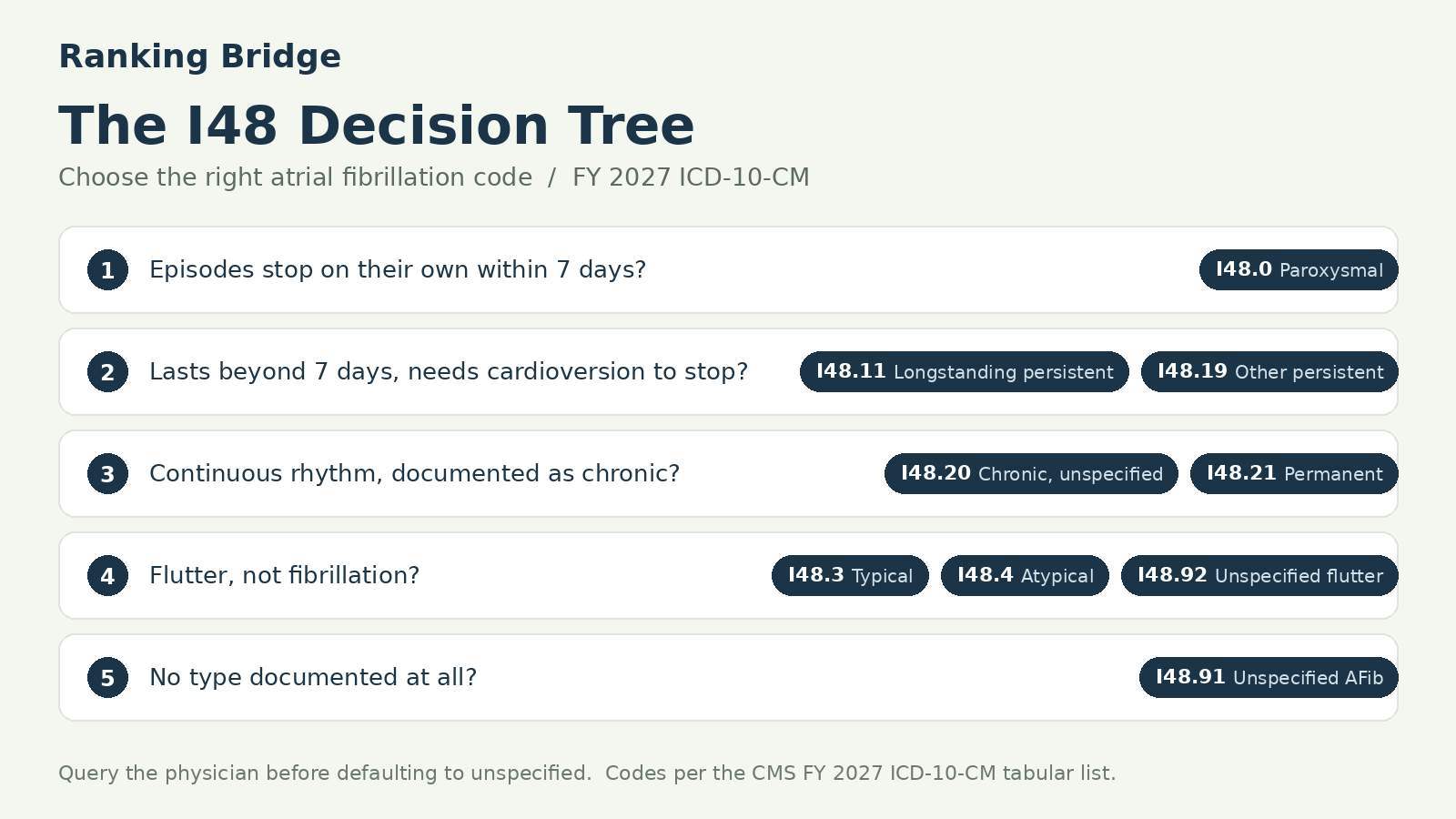
The I48 Decision Tree: Choosing the Right Code
Above all, start with the physician’s words, not with a guess. The type of atrial fibrillation decides the code, and each type has a distinct pattern.
First, check for paroxysmal atrial fibrillation (I48.0). Paroxysmal episodes come and go. As a rule, they terminate on their own within seven days, and they often last less than 24 hours. If the note describes intermittent episodes that stop spontaneously, I48.0 fits.
Next, check for persistent atrial fibrillation (I48.11 or I48.19). Persistent episodes last beyond seven days. They need cardioversion — medication or an electrical shock — to stop. Longstanding persistent (I48.11) means the rhythm has continued for over a year. Other persistent cases take I48.19.
Then, check for chronic atrial fibrillation (I48.20 or I48.21). Chronic means the irregular rhythm is continuous. If the physician documents chronic atrial fibrillation without further detail, use I48.20. On the other hand, if the physician has accepted the rhythm as permanent, use I48.21. That applies when conversion attempts failed or the patient is not a candidate.
Finally, use I48.91 only when none of the above fits. For instance, if the chart says “atrial fibrillation” with no type, no duration, and no pattern, then unspecified is the honest code. As a rule, work down the tree in this order and stop at the first code the documentation supports.
I48.91 vs I48.20: The Pair Coders Mix Up
These two codes cause more confusion than any other pair in the I48 family. The reason is simple. Both contain the word “unspecified.” Yet they describe different situations, and swapping them is a coding error.
I48.20 means the physician documented chronic atrial fibrillation but did not say whether it is permanent. In other words, the “unspecified” part refers only to the permanent question. In contrast, I48.91 means the physician documented atrial fibrillation with no type at all. No chronicity, no pattern, no duration — just the diagnosis itself.
Here is a quick test. Ask one question: does the note say “chronic”? If the answer is yes, I48.20 is correct. Otherwise, if the note says only “atrial fibrillation,” I48.91 is correct. For example, a cardiology note reading “chronic AF, rate controlled” supports I48.20. Meanwhile, an emergency note reading “AF noted on ECG” with no further detail supports I48.91.
In short, getting this pair right matters for audits. A payer reviewer can spot an I48.91 claim where the chart says “chronic.” As a result, that mismatch invites a denial or a downcode. Therefore, read the note twice when either code is in play.
When “Unspecified” Is the Right Choice
Unspecified codes exist for a reason. Sometimes the documentation truly does not name a type. In that case, I48.91 is the correct and honest code. For instance, a first visit may confirm atrial fibrillation on an ECG before any history is available. Similarly, a transfer record may carry the diagnosis forward with no detail attached.
However, “unspecified” should never be the default. Before assigning I48.91, check the full record. For example, the type may appear in an earlier visit note, a cardiology consult, or an ECG report. If the detail exists anywhere in the chart, use the specific code it supports.
Otherwise, when the detail is genuinely missing, query the physician. A short clarification request often resolves the question in one reply. For example: “Please confirm the type of atrial fibrillation: paroxysmal, persistent, chronic, or permanent?” Above all, never guess a type from the patient’s history or from a pattern you assume. Coding from an assumption creates a false record. Auditors treat that far more seriously than an honest unspecified code.
Documentation: What Coders Need from the Physician
Good documentation makes the I48 decision easy. Ideally, the physician’s note should state four things:
- The type of atrial fibrillation
- How long episodes last
- What the ECG shows
- Whether any procedure changed the picture
Above all, the type matters most. A single word — paroxysmal, persistent, chronic, or permanent — points straight to the right code. Similarly, duration helps, especially at the seven-day line between paroxysmal and persistent. Meanwhile, the ECG report may confirm the rhythm and rule out flutter. Finally, note any ablation history. Ablation is a treatment, not a diagnosis, so it does not change the code by itself. Instead, what matters is whether atrial fibrillation is still active after the procedure.
Coders can help by flagging vague notes early. A query template for atrial fibrillation saves time on every cardiology chart. It should ask for type, duration, and flutter status. In addition, a coding tip sheet with the I48 decision tree keeps the whole team consistent.
Atrial Fibrillation vs Atrial Flutter
Atrial fibrillation and atrial flutter are related but distinct rhythms. In fibrillation, the atria beat chaotically. In flutter, the atria pulse rapidly but in an organized, regular pattern. As a result, that difference decides whether the code comes from the fibrillation side (I48.0–I48.2, I48.91) or the flutter side (I48.3, I48.4, I48.92).
Flutter splits into two types. For example, typical flutter (I48.3) involves the cavotricuspid isthmus of the right atrium and includes Type I flutter. Atypical flutter (I48.4) does not involve that pathway and includes Type II flutter. Otherwise, when the record names neither type, I48.92 covers unspecified flutter.
Both conditions can appear in the same patient. When the documentation supports both, code both. For example, report I48.91 for unspecified fibrillation plus I48.92 for unspecified flutter. However, each code needs its own documentation. Never code both from a single vague mention. Therefore, if the record is unclear, query the physician before adding the second code.
Related Codes to Know
As a rule, atrial fibrillation rarely travels alone, so coders often report related conditions alongside the I48 code. Hypertension is the most common companion. Atrial fibrillation and high blood pressure frequently occur in the same patient. As a result, the I10 essential hypertension code often appears on the same claim. Similarly, chest pain (R07.9) is a frequent presenting symptom. Patients often seek care for a racing or irregular heartbeat.
Next, diabetes is another common comorbidity. For example, when the patient has type 2 diabetes, the E11 code belongs on the claim alongside the rhythm diagnosis. Each condition stands on its own documentation. In addition, each code adds to the clinical picture the payer sees.
Finally, for Medicare patients, the broader 2027 policy picture matters too. The Medicare changes for 2027 affect payment rules across the program. Therefore, RCM teams should keep the current year’s rules in view when they code cardiology claims.
RCM Impact: Why Specificity Matters
Specific coding protects revenue in three ways. First, it reduces denials. Payers increasingly flag unspecified codes on review. As a result, a claim with I48.91 where the chart supports I48.21 is an easy target. Second, it protects audit results. A pattern of unspecified codes across many claims suggests weak documentation. In fact, auditors notice patterns faster than single errors. Third, it supports quality reporting. Accurate subtype data feeds the quality measures that shape value-based payment. Consequently, vague coding can cost a practice twice — once on the claim, and again on its quality scores.
In addition, there is a DRG angle for inpatient coders. Atrial fibrillation and flutter codes group to DRGs 308–310 (Cardiac Arrhythmia and Conduction Disorders). Specifically, that grouping applies when they serve as the principal diagnosis. The DRG itself does not change with the subtype. However, clean documentation still supports the medical necessity story behind the stay.
In short, specificity is not paperwork for its own sake. Instead, it is the difference between a claim that sails through and one that comes back for more information. Therefore, treat every I48.91 as a question first: is there a more specific code hiding in this chart?
FAQs
Is I48.91 a billable code?
Yes. I48.91 (unspecified atrial fibrillation) is a valid, billable ICD-10-CM code in FY 2027. However, CMS advises coders to consider a more specific code first whenever the documentation supports one.
What is the difference between I48.91 and I48.20?
I48.91 means atrial fibrillation with no type documented at all. In contrast, I48.20 means the physician documented chronic atrial fibrillation but did not specify whether it is permanent. As a result, the word “unspecified” refers to different things in each code, so they are not interchangeable.
When should I use I48.91 instead of a more specific code?
Use I48.91 only when the record documents atrial fibrillation but gives no type, pattern, or duration. First, check the full chart and query the physician if the detail may be available.
Can I code atrial fibrillation and atrial flutter together?
Yes, when the documentation supports both conditions. For example, report I48.91 plus I48.92 if both types are unspecified. However, each code needs its own documentation support.
What is the difference between persistent and permanent atrial fibrillation?
Persistent atrial fibrillation lasts beyond seven days and needs cardioversion to stop (I48.11 or I48.19). Permanent atrial fibrillation (I48.21) means the physician has accepted the irregular rhythm as ongoing. Conversion attempts failed, or the patient is not a candidate. Therefore, confusing the two leads to the wrong code.
What documentation supports a specific I48 code?
The physician’s note should state the type of atrial fibrillation, episode duration, and ECG findings. In addition, a query template asking for type, duration, and flutter status helps coders gather what they need on every cardiology chart.
Sources
- CMS, ICD-10 Clinical Concepts for Cardiology: https://www.cms.gov/medicare/coding/icd10/downloads/icd10clinicalconceptscardiology1.pdf
- AAPC, “6 Steps Show You How to Code Tachycardia Diagnoses Accurately”: https://www.aapc.com/codes/coding-newsletters/my-icd-10-coding-alert/icd-10-coding-6-steps-show-you-how-to-code-tachycardia-diagnoses-accurately-180014-article
- AAPC, “Get Atrial Fibrillation Vs. Atrial Flutter Right Every Time”: https://www.aapc.com/codes/coding-newsletters/my-cardiology-coding-alert/icd-10-get-atrial-fibrillation-vs–atrial-flutter-right-every-time-153970-article
- ICD List, I48 range (built from the official CMS FY 2027 dataset): https://icdlist.com/icd-10/codes/atrial-fibrillation-and-flutter-i48
