
Claim Denials Are Still Rising in 2026: What Experian Health’s Survey Means for RCM Teams
Denials Are Not Falling — They Are Still Rising
Claim denials remain elevated in 2026, according to Experian Health’s annual State of Claims survey, released 28 October 2026. The survey asked 204 healthcare professionals responsible for financial, billing, or claims-management decisions about the state of their claims operations — and the headline is blunt: denials are still going up, clean claims are harder to submit, and reimbursement is taking longer.
The key figures, attributed plainly to that vendor survey of 204 respondents, not to an industry-wide census:
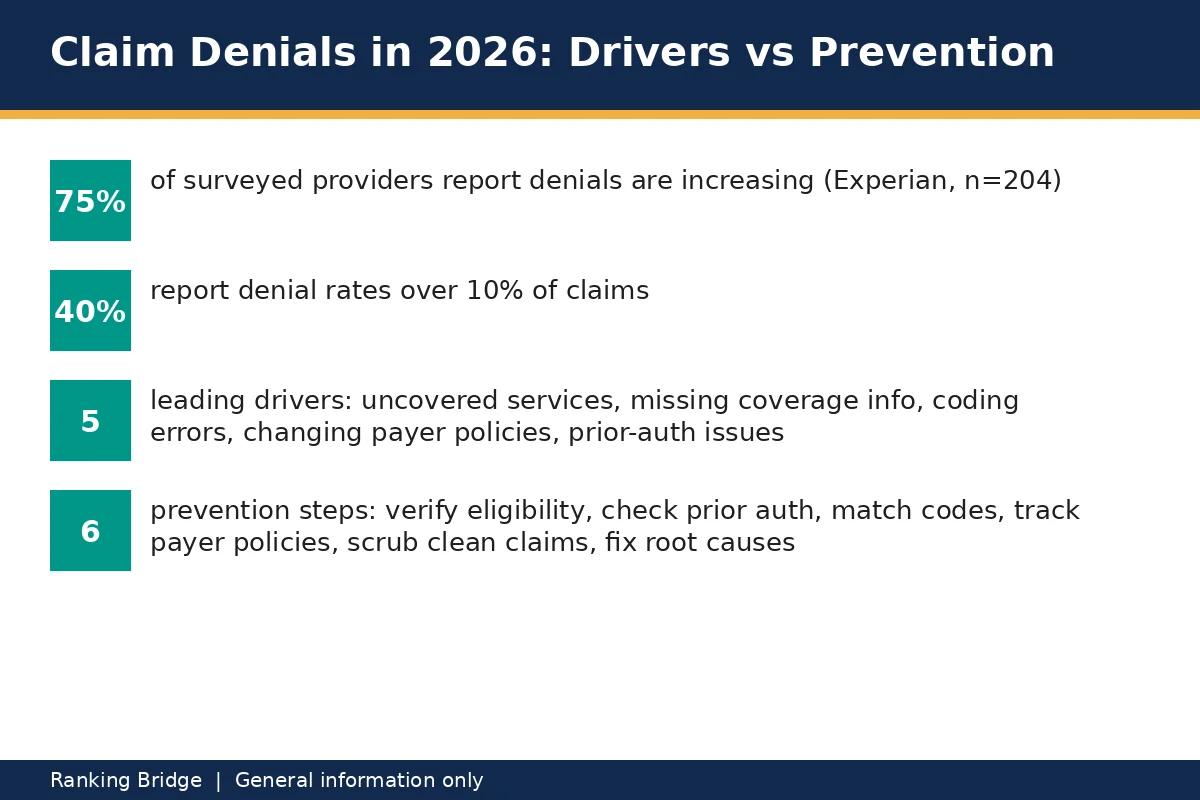
- 75% of providers surveyed report claim denials are increasing, and more than two-thirds (68%) say denial rates are higher than a year ago.
- 40% say denial rates exceed 10% of claims, largely unchanged from last year.
- 89% say reducing denials is a priority in 2026 — the highest level since the survey began.
- 79% say securing reimbursement has become more difficult, and 78% say payer policies are changing more frequently, up from 67% in the survey’s first edition in 2022.
- 65% say submitting clean claims has become more difficult over the past 12 months, and 64% say reimbursement timelines are growing longer.
A denial rate over 10% does not mean one in ten patients goes unpaid forever. Many denied claims are corrected and resubmitted. But every denial costs rework time, delays cash flow, and carries the risk that revenue is never recovered — which is why Experian Health’s chief operating officer, Mindy Fortson, is quoted in the release warning that denied revenue may never be recovered at all.
What Is Actually Driving Denials
The survey points to five leading drivers, and none of them is a mystery. They are the everyday failure points of the revenue cycle:
- Services not covered by insurance. The service was performed, but the patient’s plan did not cover it — or covered it only under conditions that were not met.
- Missing coverage information. Eligibility or coverage details were incomplete or out of date at the time of service.
- Coding errors. The wrong code, a missing modifier, or a code that does not match the documented diagnosis.
- Evolving payer policies. Rules that changed after the claim was built — a moving target that 78% of respondents say is moving faster.
- Prior-authorization issues. Authorizations missing, expired, or not matching the service actually delivered.
Notice what these drivers have in common: most of them are preventable before the claim is ever submitted. That is the difference between denial management — chasing denied claims after the fact — and denial prevention, which is where the money is. For the fundamentals, see our guide to denial management in medical billing.
Why This Lands on RCM Teams Right Now
Denials do not arrive in isolation. They compound with two other trends in the same survey: clean claims are harder to submit, and reimbursement timelines are longer. Together, that means more staff time per dollar collected, and a longer wait between service and payment.
It also lands at a moment when eligibility is about to be tested again. ACA open enrollment for 2027 opened 1 November, with new plans, new premiums, and changed subsidy rules — which means patients’ coverage details will change at the start of the year. A claim submitted in January to a plan that was not in effect on the date of service is a denial waiting to happen, which is why insurance verification before the first visit of the year matters so much. For the wider picture, see what RCM in healthcare covers.
What Teams Are Doing About It
Providers are not standing still. According to the survey, teams have already:
- Upgraded or replaced claims technology (48%) — the single most common step.
- Automated or expanded portal claim reviews (40%) — catching payer feedback faster instead of waiting for paper remits.
- Digitized registration and automated payer-policy tracking (37%) — attacking the missing-information and changing-policy drivers at the front end.
And many are looking at artificial intelligence: 84% believe AI can improve claims management in some capacity, 64% definitely or probably plan to invest in AI for claims and denial management, and 83% say they would replace current technology if it delivered a compelling return on investment.
That enthusiasm deserves an honest caveat: interest in AI is not proof of results. AI can help flag likely denials, draft appeals, and surface coding risks — but it cannot fix a missing prior authorization, an unverified eligibility record, or a payer policy nobody tracked. Technology amplifies a clean process; it does not replace one.
A Practical Denial-Prevention Checklist
Use this as a pre-submission pass, not just a post-denial routine:
- Verify eligibility and coverage before service — plan, coverage dates, and cost-sharing, confirmed at intake.
- Check prior authorization — required, obtained, and matching the service and date actually delivered.
- Match codes to documentation — diagnosis, procedure, and modifiers checked against the note before the claim goes out.
- Track payer-policy changes — assign ownership for policy updates, so a changed rule is caught before claims are built under it.
- Review clean claims before submission — a final scrub for the five drivers above, not a hope that the payer will catch errors for free.
- Work denials by root cause, not by volume — group denials by driver, fix the process that produced them, and measure whether that denial type falls next month.
Frequently Asked Questions About Claim Denials in 2026
What does a denial rate over 10% mean?
It means more than one in ten submitted claims was denied on first pass, according to the providers in this survey who reported that level. It does not mean 10% of revenue is lost — many denials are corrected and paid — but it does mean significant rework and delayed payment.
Will AI alone fix rising denials?
No. AI can help identify at-risk claims and speed up appeals, but the leading drivers — missing coverage information, coding errors, prior authorization, and changing payer policies — are process problems first. Fix the process, then let technology scale it.
What should RCM teams check first when denials rise?
Start with the denial reason codes, grouped by driver. If missing coverage information leads, the fix is at registration and eligibility verification. If coding leads, the fix is documentation and coding review. Chasing individual claims without fixing the pattern just repeats the same denials next month.
The Bottom Line
Denials are not a one-year spike that has passed. In 2026, three-quarters of surveyed providers say they are still rising, clean claims are harder, and reimbursement is slower. The teams making progress are the ones treating denials as a prevention problem — verified eligibility, checked authorizations, matched codes, tracked payer policies — and using technology to scale that discipline rather than to paper over it.
Further reading on Ranking Bridge:
- What Is Denial Management in Medical Billing?
- What Is RCM in Healthcare?
- What Is Insurance Verification in Healthcare?
Source: Experian Health, 2026 State of Claims survey (n=204), press release via Morningstar / Business Wire, 28 October 2026.
This article is general information about billing operations. It is not medical, financial, or insurance advice for any specific provider or patient.
