Best Medical Credentialing Companies in USA 2027
This voice experience is generated by AI.
Credentialing is the license to bill. A provider who is not credentialed cannot join a payer network. As a result, the practice cannot bill that payer for the provider’s visits. Yet the process takes months, and one missing document can stall an application for weeks.
The stakes keep rising. Claim denials are still rising in 2026, and uncredentialed providers sit behind many of them. For example, claims billed before a payer’s effective date get denied outright. Meanwhile, the Centers for Medicare & Medicaid Services (CMS) keeps tightening enrollment rules. Therefore, many practices now hand credentialing to specialists.
The five medical credentialing companies below suit different practices. This is a shortlist, not a ranking. The right choice depends on your payer mix, your setting, and whether you need credentialing alone or a full revenue-cycle partner.
How This Shortlist Was Put Together
This shortlist is editorial. It rests on public information about each company’s services, technology, and credentialing focus. Companies appear in no particular order. Five criteria guided the selection:
- Dedicated credentialing focus. Credentialing is a named service with its own team — not one line on a general billing menu. We looked for companies with dedicated credentialing pages and credentialing-trained staff.
- CAQH, PECOS, and NPPES coverage. Most commercial payers pull provider data from CAQH ProView. In addition, Medicare enrollment runs through PECOS, and every provider needs an NPI. We favored companies that manage all three under one workflow.
- Primary source verification depth. Payers verify licenses, education, and training directly with the issuing bodies. Therefore, we looked for teams that complete verification before any application goes out — ideally with NAMSS-certified specialists.
- Re-credentialing and maintenance. Credentialing never ends. CAQH needs re-attestation, Medicare needs revalidation, and every payer re-credentials on its own cycle. We favored companies that track every deadline and renew on time.
- Transparency and tracking. A provider’s start date depends on payer approvals. As a result, we looked for dashboards or portals that show each application’s status, effective date, and upcoming expirations.
Before you sign, request proposals from two or three of these companies. Ask for references from practices like yours. Then have each vendor review a sample of your pending applications — fit matters most.
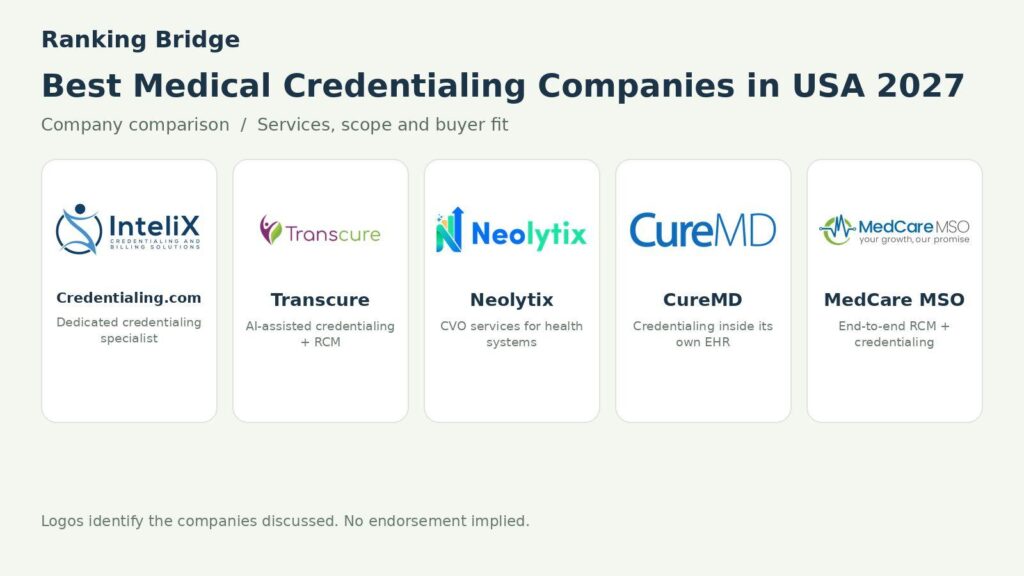
| Company | Best for | Model | Credentialing focus |
|---|---|---|---|
| Credentialing.com | Dedicated credentialing specialist | Managed service | Payer enrollment, CAQH, recredentialing |
| Transcure | AI-assisted credentialing + RCM | Managed service + platform | CredReady, CAQH/PECOS, 40+ specialties |
| Neolytix | CVO services for health systems | Managed service + platform | CVO, inCredibly, sanctions monitoring |
| CureMD | Credentialing inside its own EHR | Platform + specialists | CAQH/PECOS, licenses, DEA, CLIA |
| MedCare MSO | End-to-end RCM + credentialing | Managed service + software | CAQH, PECOS, DMEPOS, revalidation |
Credentialing.com: Best for a Dedicated Credentialing Specialist
Credentialing.com, based in Lynchburg, Virginia, is a physician-led company founded in 2008. Credentialing is its core business, not an add-on to billing. Its team handles payer enrollment, CAQH setup and maintenance, Medicare and Medicaid enrollment, and recredentialing across all 50 states. It also handles license verification, document preparation, and insurance contract negotiation.
The company covers behavioral health credentialing and nurse credentialing as named services. For example, it supports practice startups that need enrollment from scratch. Credentialing.com fits a practice that wants a credentialing-only specialist rather than a full RCM vendor. Ask how its team handles your payer mix and your highest-priority plans before you sign.
Transcure: Best for AI-Assisted Credentialing With Full RCM
Transcure, with offices in Woodbridge, New Jersey; Farmers Branch, Texas; and Oviedo, Florida, runs credentialing through its CredReady platform. The platform tracks every application, expirable, and revalidation deadline across the full payer panel. Its team submits applications to priority payers in parallel, rather than one payer at a time. Moreover, it covers credentialing and enrollment across 40-plus specialties, including facility and behavioral health enrollment.
NAMSS-certified specialists complete primary source verification before any application leaves the queue. In addition, the team manages CAQH ProView, PECOS, NPPES, and state Medicaid portals under one workflow. Verification follows NCQA credentialing standards. Transcure fits a practice that wants credentialing plus full revenue-cycle management from one vendor. Ask how its dashboard reports each provider’s effective dates before you sign.
Neolytix: Best for CVO Services for Health Systems and Multi-State Groups
Neolytix, based in Northbrook, Illinois, runs credentialing as a Credentialing Verification Organization (CVO). Its team verifies licenses, education, training, and certifications directly with the issuing bodies. In particular, it aligns its work with NCQA and Joint Commission standards. It also runs ongoing sanctions monitoring and re-credentialing for hospitals, IPAs, and multi-state groups.
Its inCredibly platform turns enrollment into a visible pipeline. The team enrolls providers with Medicare, Medicaid, and commercial payers, manages PECOS enrollment, and handles NPI registration and ERA/EFT enrollment. It also supports hospital privilege credentialing. Neolytix fits a health system or multi-state group that needs enterprise-grade credentialing at volume. Ask how its platform tracks each provider’s timeline across states before you sign.
CureMD: Best for Credentialing Inside Its Own EHR
CureMD, based in New York City, pairs credentialing with its own EHR. As a result, enrollment data, documents, and billing run in one system. Its team handles Medicare and Medicaid enrollment, DMEPOS enrollment, and multi-payer credentialing. It also manages NPI registration, CAQH profile setup and maintenance, and PECOS updates.
The service covers state license applications and renewals, DEA certificate processing, and CLIA registration. In addition, it handles revalidation and recredentialing on schedule. Finally, a dedicated account manager and provider portal show every application’s status. CureMD fits a practice already on CureMD’s EHR, or one that wants credentialing and clinical systems under one roof. Ask how enrollment data flows from your EHR into payer applications.
MedCare MSO: Best for End-to-End RCM With Credentialing Included
MedCare MSO, based in Irvine, California, runs credentialing as part of its end-to-end revenue cycle service. Its specialists handle primary source verification, CAQH profile registration and maintenance, and Medicare and Medicaid enrollment. They also manage DMEPOS enrollment, NPI registration, and revalidation with Medicare, Medicaid, and commercial insurers.
The team enrolls providers with major commercial payers, including Humana, Cigna, UnitedHealthcare, and Aetna. In addition, it manages re-credentialing cycles so providers stay in-network without staff tracking each payer’s timeline. MedCare MSO fits a practice that wants credentialing bundled with billing, coding, and denial management. Ask how its team handles your payer mix and your re-credentialing dates before you sign.
How to Choose Among Medical Credentialing Companies
1. Match the vendor to your payer mix. A practice heavy on Medicare needs PECOS expertise. A practice with many commercial plans needs CAQH depth. List your top payers first, then ask each vendor which ones it enrolls most often.
2. Ask who verifies your credentials. Primary source verification is the step payers check hardest. Ask whether specialists hold NAMSS credentials, how verification works, and what happens when a document does not match. The National Committee for Quality Assurance (NCQA) sets the credentialing standards most payers follow.
3. Check CAQH and PECOS handling. A lapsed CAQH attestation stops commercial enrollments cold. Similarly, a missed Medicare revalidation can suspend billing privileges. Ask who owns each profile, how often attestations happen, and how the vendor alerts you before a deadline.
4. Confirm re-credentialing and monitoring. Credentialing never ends, so ask what happens after approval. The best vendors track license expirations, DEA renewals, and payer re-credentialing cycles. In addition, ask whether sanctions monitoring is included or priced separately.
What to Check Before You Sign
5. Ask about timelines and tracking. Every vendor promises speed, but few show their work. Ask for a sample status report before you sign. A dashboard that shows each application’s status and effective date matters more than any sales claim. If denials are already a problem, start with what denial management is and how it fits the wider revenue cycle.
6. Read the contract, not just the sales page. Ask what the fee covers and what costs extra, how long the term runs, how you exit, and who owns your provider data and payer enrollments. Get the answers in the proposal, not in a phone call. Our shortlist of the best denial management companies covers specialists for the claims side, and our guide to the top medical coding companies covers the coding side.
7. Ask for references in your specialty. A reference from a primary care group means little to a behavioral health practice. Ask how long the client has been with the vendor, what changed after switching, and what reporting looks like week to week. The American Academy of Professional Coders (AAPC) also publishes credentialing and enrollment guidance for framing your questions.
Frequently Asked Questions
What does a medical credentialing company do?
It verifies a provider’s licenses, education, and training, then enrolls the provider with Medicare, Medicaid, and commercial payers. It also manages CAQH profiles, tracks re-credentialing dates, and keeps the provider in-network. Without credentialing, a practice cannot bill payers for that provider’s visits.
How long does credentialing take?
Most commercial payer enrollments take 60 to 120 days from a complete application. Medicare enrollment often takes 45 to 90 days through PECOS, although some enrollments run longer. Timelines vary by payer and by state, so start well before a provider’s first day. A vendor that submits applications in parallel, rather than one payer at a time, usually finishes sooner.
What is CAQH, and why does it matter?
CAQH ProView is the central database most commercial payers use to verify provider details. Payers pull license, education, and malpractice data straight from the profile. Therefore, a profile that is incomplete or past its attestation date stalls every enrollment that depends on it. CAQH asks providers to re-attest on a regular cycle — usually every 120 days.
Should a small practice outsource credentialing?
Often yes. A small practice rarely has a full-time credentialing specialist, and one missed deadline can suspend billing. Outsourcing gives the practice a trained team, deadline tracking, and payer follow-up without hiring. However, the practice should still review enrollment reports monthly and keep control of its CAQH and PECOS logins.
Bottom Line
The best medical credentialing companies are not interchangeable. A practice that wants a dedicated credentialing specialist will look at Credentialing.com. Meanwhile, a practice that wants AI-assisted credentialing plus full RCM will look at Transcure. A health system that needs CVO services will look at Neolytix. If credentialing inside its own EHR matters most, CureMD is the pick. Finally, a practice that wants credentialing bundled with end-to-end RCM will look at MedCare MSO. Shortlist two or three, ask for proposals and references from practices like yours, and choose the partner whose verification depth, deadline tracking, and reporting you can live with.
