Top Medical Coding Companies in USA 2027
This voice experience is generated by AI.
Every claim starts with a code. A coder reads the chart, picks the right ICD-10, CPT, and HCPCS codes, and turns a visit into a billable claim. When the code is wrong, the claim stalls. As a result, cash flow slows and staff spend hours on rework. Claim denials are still rising in 2026, and coding errors sit near the top of the causes. Undercoding leaves money behind. Overcoding invites audits and fines. So accuracy is not a nice extra. It is the whole job.
That is why so many hospitals and practices outsource coding. A good coding partner brings certified coders, audits, and technology that a short-staffed HIM department cannot build alone. The five medical coding companies below suit different organizations — a shortlist, not a ranking. The right choice depends on your setting, your chart types, and whether you need day-to-day coding, risk adjustment, or audit support.
How This Shortlist Was Put Together
This shortlist is editorial, based on public information about each company’s services, technology, and coding focus. Companies are listed in no particular order. Five criteria guided the selection:
- Coding as core work. Medical coding is the company’s main service or a named practice — not one line on a general billing menu. We looked for companies with dedicated coding pages, teams, and workflows.
- Certified coders. Coders should hold AAPC or AHIMA credentials and work in their specialty. We favored companies that state their certification standard and train coders continuously.
- Coverage across chart types. A hospital needs inpatient and emergency coding. A practice needs pro-fee and E/M coding. A health plan needs HCC coding. We looked for breadth across the chart types buyers actually send.
- Audits and quality checks. Every coding operation makes mistakes. We favored companies that audit their own work, report accuracy, and fix root causes instead of hiding errors.
- Technology with human review. Computer-assisted coding and AI can speed up the work. But a certified coder must still review the output before a claim goes out. We favored that combination.
Before signing, request proposals from two or three of these companies, ask for references from organizations like yours, and have them code a sample of your charts — fit matters most.
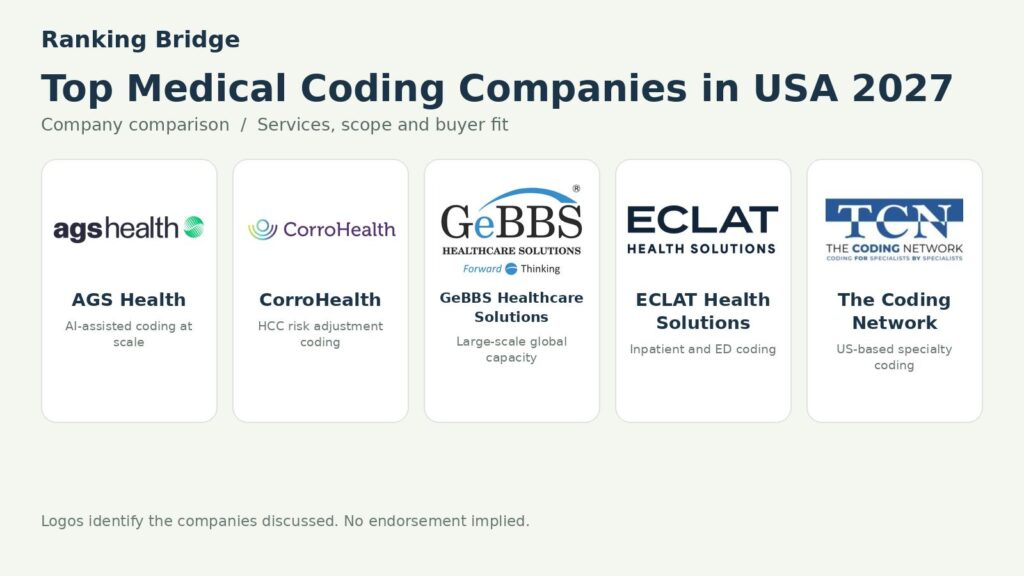
| Company | Best for | Model | Coding focus |
|---|---|---|---|
| AGS Health | AI-assisted coding at scale | Managed service + AI platform | Facility, pro-fee, HCC |
| CorroHealth | HCC risk adjustment coding | Managed service + automation | HCC, inpatient, ED |
| GeBBS Healthcare Solutions | Large-scale global capacity | Managed service + platform | Facility, pro-fee, DME |
| ECLAT Health Solutions | Inpatient and ED coding | Managed service | Inpatient, ED, CDI |
| The Coding Network | US-based specialty coding | Network, per-encounter | Specialty, audits, AI validation |
AGS Health: Best for AI-Assisted Coding at Scale
AGS Health, headquartered in Washington, DC, runs one of the largest coding operations in the group. Its coders handle facility coding across inpatient, outpatient, and emergency settings, plus professional fee coding for E/M, hospital medicine, and ambulatory surgery. Its risk adjustment team codes HCC conditions and supports RAF scoring for health plans and risk-bearing providers. The company also runs coding audits and clinical documentation improvement (CDI) alongside the coding work.
In addition, its AGS AI Platform adds computer-assisted coding to the human team. Clinical natural language processing reads the chart and suggests ICD-10-CM, PCS, and CPT codes, and a certified coder reviews each suggestion before it goes out. The company trains coders through its own Coding Academy, and its coders hold AAPC or AHIMA credentials. AGS Health also serves denials work — see our list of the best denial management companies for that side of the business.
AGS Health fits a hospital or health system that needs coding done at volume, across many chart types, with AI support and audit cover. Ask how its CAC platform handles your most complex charts and how audit findings reach your CDI team.
CorroHealth: Best for HCC Risk Adjustment Coding
CorroHealth, based in Plano, Texas, runs a large outsourced coding operation with more than 7,000 certified coders. Its teams code inpatient, pro-fee, HCC, and emergency department charts for hospitals and health systems. The company also runs one of the largest HCC coding operations in the country. Its teams run retrospective, concurrent, and prospective reviews for health systems and health plans, plus HEDIS abstraction backed by nurse practitioners.
Meanwhile, its autonomous coding product, Medical Savant, automates charges, CPTs, HCPCs, diagnoses, and E/M levels across hospitals, clinics, urgent care, radiology, and physician practices. Its PULSE platform adds coding automation on top of the human team. CorroHealth works with more than 11 million at-risk patients a year through its HCC work, which gives its coders deep exposure to complex chronic-condition charts.
CorroHealth fits a health system or plan that needs HCC coding done well. It also fits a hospital that wants autonomous coding layered over a human team. Ask how its retrospective and prospective reviews divide the work and how it reports risk-score impact back to you.
GeBBS Healthcare Solutions: Best for Large-Scale Global Coding Capacity
GeBBS Healthcare Solutions, headquartered in Marina del Rey, California, has coded charts for providers since 2005. Its 3,000-plus AHIMA and AAPC certified coders cover inpatient, outpatient, same-day surgery, E/M, multiple surgical specialties, emergency department, observation, and diagnostic and interventional radiology. The company also codes facility, pro-fee, risk adjustment, and DME charts, and it runs coding and documentation compliance audits.
Its proprietary iCode platform drives the workflow, and its iCode Assurance tool supports audit programs with workflow and analytics. For example, GeBBS codes more than 6 million charts a month across a global delivery model. In addition, its teams work inside the client’s EMR — Epic, Cerner, athenahealth, eClinicalWorks, and others. The company also serves payers with HCC coding for Medicare Advantage, ACA-Commercial, and Managed Medicaid.
GeBBS fits a large health system or billing company that needs serious coding volume handled fast, with audit tooling included. Ask how it staffs your specialty mix and how its QA process reports accuracy week to week.
ECLAT Health Solutions: Best for Inpatient and Emergency Department Coding
ECLAT Health Solutions, based in Herndon, Virginia, has served hospitals and health systems since 2008. Its coders cover acute care inpatient, emergency department, ambulatory surgery, radiology, outpatient diagnostics, E/M, observation, and recurring accounts. The company also runs ICD-10 auditing and clinical documentation improvement, so documentation gaps get fixed at the source instead of coded around.
Its evaire platform adds risk adjustment support for Medicare Advantage, ACA, and Medicaid. The platform uses natural language processing and machine learning for prospective and retrospective coding analysis. Pre-bill encounter checks then catch missing codes before the claim goes out. ECLAT’s coders hold AAPC or AHIMA certifications, and its teams work with Level 1 trauma, transplant, cardiac, and oncology charts.
ECLAT fits a hospital that needs strong inpatient and ED coding — especially a trauma or teaching hospital with complex charts. Ask how its coders handle your highest-acuity service lines and how its CDI team works with your physicians.
The Coding Network: Best for US-Based Specialty Coding, Flexible Per-Encounter
The Coding Network (TCN), based in Beverly Hills, California, works differently from the rest of this list. It runs a network of more than 800 credentialed coders across 55-plus specialties, and every coder lives and works in the United States. Each coder works in a single specialty and holds at least three years of specialty experience. Coders must also pass one of TCN’s 57 proficiency exams before they take cases.
In contrast, TCN sells coding per encounter, with no volume minimums and no long-term contracts. Its services cover physician and facility coding, including E/M, HCC and risk adjustment, and ambulance coding. It also runs coding compliance audits with ICD-10 gap analysis, validates AI-generated codes with human review, trains physicians on documentation, and runs a coding helpline. Coders work directly inside the client’s EHR or through a HIPAA-secure file share.
TCN fits a practice or hospital that wants US-based specialty coders on flexible terms. That covers day-to-day coding, backlog cover, or vacation coverage without hiring a full-time coder. Ask how it matches coders to your specialty and how quickly it can start on your backlog.
How to Choose Among Medical Coding Companies
1. Match the vendor to your chart types. Inpatient charts need different skills from pro-fee or HCC charts. A coder who excels at ED coding may struggle with complex inpatient stays. Ask each vendor which chart types its coders handle best — and which it does not. The details matter: for example, our guide to the J44.9 vs J44.0 vs J44.1 coding differences shows how one code family can trip up a generalist. Similarly, ICD-10 code J20.9 for acute bronchitis looks simple, yet coders must still check whether a more specific code applies.
2. Ask who codes your charts. A certified coder with specialty experience produces cleaner claims than a generalist. Ask whether coders hold AAPC or AHIMA credentials, how many years they have in your specialty, and whether the same coders stay on your account. The American Academy of Professional Coders (AAPC) sets the CPC standard most vendors follow.
3. Demand audits, not promises. Every vendor claims high accuracy. Ask how it audits its own work, how often, and what happens when an audit finds an error. Ask to see a sample audit report before you sign — the report tells you more than any sales claim.
What to Check Before You Sign
4. Check how AI fits in. Computer-assisted coding speeds up the work, but it can also bake in errors at scale. Ask whether a certified coder reviews every AI-suggested code, who signs off on the final code, and how the vendor validates AI output. Human review is the safety net.
5. Confirm it works inside your systems. Some vendors code inside your EHR; others run a separate platform. Ask how charts, queries, and status updates flow between your systems and theirs, and who owns each step. A smooth handoff matters more than a feature list.
6. Read the contract, not just the sales page. Ask whether fees are per chart, per encounter, or fixed. Then ask what audits and training cost extra, how long the term runs, and how you exit. Find out who owns your coding data — in the proposal, not in a phone call. The American Health Information Management Association (AHIMA) also publishes coding guidance for framing your questions.
If a vendor cannot answer these questions clearly, keep looking. However, the right partner explains its process in plain language and welcomes a trial batch of charts.
Frequently Asked Questions
What does a medical coding company do?
It assigns ICD-10, CPT, and HCPCS codes to patient visits so providers can bill payers. The Centers for Medicare & Medicaid Services (CMS) publishes the ICD-10 and HCPCS code sets that coders use every day. Most companies also run audits, fix documentation gaps, and handle specialty coding such as HCC risk adjustment.
Should we outsource coding or hire in-house?
Outsourcing fits organizations with coder shortages, backlogs, or seasonal volume swings. In-house coding, on the other hand, fits organizations with steady volume and a strong HIM team. Many providers mix both — in-house coders for routine charts, a vendor for backlogs and specialty work.
What is HCC coding, and why does it matter?
HCC stands for Hierarchical Condition Category. Health plans use HCC codes to set risk scores for Medicare Advantage members. Therefore, accurate HCC coding means the plan gets paid correctly for the patients it covers. Poor HCC coding leaves revenue behind and invites audits.
How do I check a coding company’s accuracy?
Ask for a trial batch of your own charts, coded and returned for your review. Then ask how it audits its work and how it reports errors. A vendor that welcomes a trial and shares audit reports is usually the safer choice.
Bottom Line
The best medical coding companies are not interchangeable. A health system that needs AI-assisted coding at volume will look at AGS Health. A plan or system that needs HCC coding done well will look at CorroHealth. A large organization that needs serious coding capacity will look at GeBBS Healthcare Solutions. A hospital with complex inpatient and ED charts will look at ECLAT Health Solutions. And a practice that wants US-based specialty coders on flexible terms will look at The Coding Network. Shortlist two or three, ask for proposals and references from organizations like yours, and choose the partner whose coders, audits, and reporting you can live with.
