Effective Home Remedies for Acne That Actually Work (and the Ones to Skip)
This voice experience is generated by AI.
Search for home remedies for acne and you will find hundreds of them. Tea tree oil, toothpaste, lemon juice, apple cider vinegar — every video promises a quick fix. Yet most of these ideas have little or no evidence behind them, and some can damage your skin. This guide sorts the remedies that genuinely help from the ones to skip, using dermatology guidance rather than viral trends.
One point matters before anything else. Home remedies can help mild acne, the kind with a few blackheads, whiteheads or small pimples. They cannot treat deep, painful or scarring acne, and they cannot replace a dermatologist when acne is severe. For that reason, this guide also explains when home care has reached its limit. To stop breakouts before they start, see our guide to preventing acne breakouts naturally. It covers the daily habits that keep pores clear.
The short answer
For mild acne, a few home remedies genuinely help. Diluted tea tree oil, aloe vera and green tea can calm inflammation. Salicylic acid and niacinamide clear pores and calm redness. Skip toothpaste, lemon juice and baking soda — they irritate skin. Give any remedy 6–8 weeks; see a dermatologist for cystic or scarring acne.
That split — works, helps a little, skip — is the whole point of this guide. Acne starts when oil and dead skin cells block a pore, and bacteria then grow inside it. Cleveland Clinic dermatologist Vickie Baker, MD, explains the chain reaction. Without oxygen, a normally harmless bacterium known as P. acnes grows inside the pore. The body then answers with inflammation. A remedy only helps if it tackles one of those steps: oil, blockage, bacteria or inflammation. The sections below judge the most popular home remedies for acne by that test.
Home remedies for acne that actually work
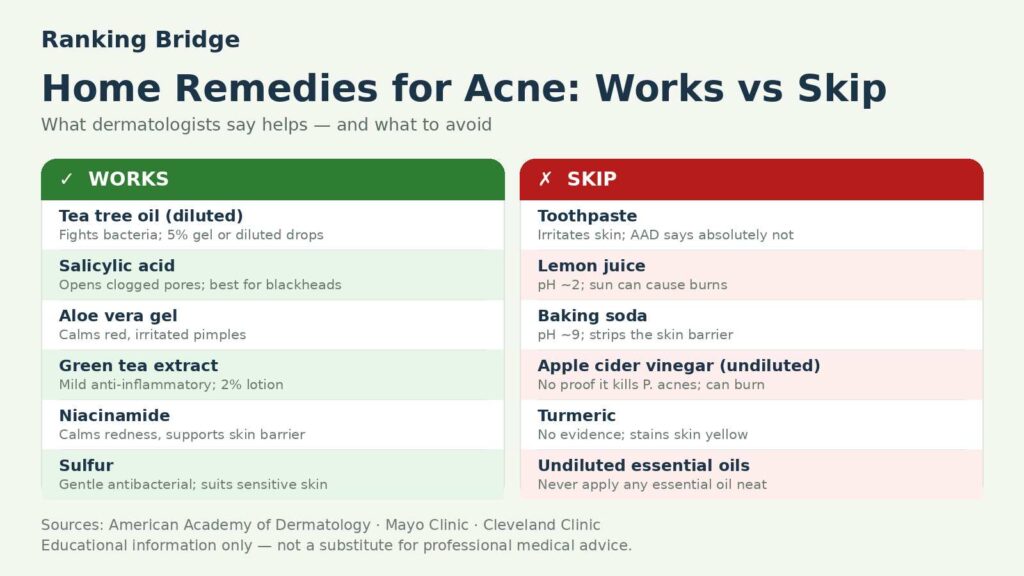
Five remedies have real evidence behind them, plus one pharmacy staple dermatologists rate highly. The table sums them up, and the notes below add the honest detail.
| Remedy | What it does | Best for | How to use |
|---|---|---|---|
| Tea tree oil (diluted) | Fights acne bacteria and calms inflammation | Mild inflamed pimples | 5% gel, or 2 drops diluted in 12 drops of witch hazel; spot test first |
| Salicylic acid | Opens clogged pores and exfoliates skin | Blackheads and whiteheads | Cleanser or leave-on product, once daily to start |
| Aloe vera gel | Soothes redness and supports healing | Red, irritated pimples | Pure gel as a spot treatment, or alongside a proven acne product |
| Green tea extract | Mild anti-inflammatory and antioxidant | Mild–moderate acne | 2% lotion; drinking green tea does not treat acne |
| Niacinamide (vitamin B3) | Calms redness, supports the skin barrier, helps balance oil | Oily, redness-prone skin | Serum or moisturiser with 5% or less |
| Sulfur | Antibacterial; peels away dead skin cells | Sensitive skin with mild acne | Cleanser first, then a leave-on product if skin tolerates it |
What the evidence really says
Tea tree oil deserves an honest note. Mayo Clinic reports that a 5% tea tree oil gel may match a 5% benzoyl peroxide lotion. It simply acts more slowly. However, the AAD’s 2024 guidelines say there is not enough evidence to recommend it outright. Harvard Health’s review of the evidence reaches the same conclusion. In other words, tea tree oil is a reasonable option for mild acne, not a proven treatment.
Green tea extract sits in a similar grey area. Mayo Clinic notes that a 2% green tea lotion reduced acne in two small studies. Both studies covered young people with mild to moderate acne. Cleveland Clinic, meanwhile, says topical green tea will not clear up acne on its own. Its mild anti-inflammatory effect can still support a moisturiser or serum. Aloe vera follows the same pattern. Its best evidence comes from a study that paired a 50% aloe gel with the prescription drug tretinoin. The combination beat tretinoin alone. On its own, aloe calms existing pimples but does not stop new ones forming.
Cleveland Clinic notes that niacinamide may strengthen the skin’s lipid barrier, calm redness and help regulate oil. It is useful support, although it is not an acne treatment on its own. Sulfur, meanwhile, is an effective acne treatment that is often gentler than benzoyl peroxide, and it suits sensitive skin.
What helps a little
These three home remedies for acne can ease breakouts, but they do not correct them. Think of them as support for a proven routine, not a routine on their own.
Honey
Raw honey is antibacterial and helps wounds heal, so a honey-based product can calm redness around a pimple. However, its antibacterial effect does not target P. acnes, and honey cannot get inside a clogged pore. As a result, it may soothe a spot without keeping new breakouts away.
Zinc
Topical zinc can help balance oil in the skin, and studies show results with products that contain 5% zinc. It suits mild acne best. Zinc supplements are a different matter. Talk to a healthcare provider first, since supplements can interfere with medicines and cause side effects.
Ice
Ice will not clear acne, but it can ease the pain of an inflamed spot. Wrap an ice pack in a washcloth and hold it gently against the spot for about 10 minutes. Never put ice directly on skin, and stop at once if the area hurts more or starts to go numb.
Home remedies for acne to skip — and why
Toothpaste
The American Academy of Dermatology is blunt: toothpaste is not an acne treatment. Asked whether it works for adult acne, the AAD’s dermatologists answer, “Absolutely not!” Toothpaste often contains abrasives like baking soda, whitening agents like peroxide, colour and flavour. None of these fight acne, and they can irritate or harm skin. Dr. Julie Harper, MD, FAAD, adds: keep toothpaste for your teeth.
Lemon juice
Lemon juice has a pH of around 2, while healthy skin sits near 4.5 to 5.5. Applied neat, it can irritate and damage the skin barrier. Sunlight makes it worse. Citrus juice contains compounds called furanocoumarins, which react with UV light and can cause a painful burn called phytophotodermatitis. Dark patches can follow and last for months. No trial has shown that lemon juice treats acne.
Baking soda
Baking soda sits at the opposite extreme, with a pH of around 9. It strips the skin’s natural acidity and leaves skin dry, red and stinging. As a scrub, it adds friction too. The AAD warns that scrubbing irritates skin and can make acne flare.
Undiluted apple cider vinegar
Apple cider vinegar is antibacterial, which is probably why people try it for acne. Unfortunately, there is no evidence that it can kill P. acnes. At pH 2.5, it is far more acidic than skin. As a result, it can strip the skin’s oils and barrier, causing burning or irritation. Dr. Baker warns that such acidity can dry and irritate skin, which could trigger more breakouts.
Turmeric
Turmeric sounds promising — it contains mild antibacterial and anti-inflammatory compounds. However, no study has shown that it can treat acne. It can also irritate skin and leave hard-to-wash yellow stains.
A simple 2–3 remedy routine
Two or three remedies are plenty. Stacking everything at once irritates skin and makes it impossible to tell what helps. A simple routine looks like this.
Morning: wash gently with a mild cleanser, then apply a niacinamide serum or a light moisturiser. Finish with a non-comedogenic sunscreen, since sunlight darkens the marks acne leaves behind.
Evening: wash again, then use one active — a salicylic acid product or a diluted tea tree oil spot treatment. Follow with aloe vera gel or moisturiser to calm the skin.
Add one product at a time, and spot test each new product on a small area for a week first. If a product seems to cause breakouts, remove it for two weeks and watch what happens. Give the routine 6–8 weeks before judging it. For the habits that stop breakouts forming in the first place, see our guide to preventing acne breakouts naturally. It covers gentle washing, hands off your face and non-comedogenic products.
When home remedies are not enough
Some acne sits beyond the reach of home care. See a dermatologist if your breakouts are deep, painful or cystic. The same applies if scars or dark spots are forming, or if nothing has improved after 6–8 weeks. Acne that affects your confidence or mood is also a good reason to get help.
Cleveland Clinic dermatologist Jonathan Braue, MD, is direct. “If you are living with true cystic acne, get a good dermatologist and don’t mess around with over-the-counter products.” Cystic acne forms deep under the skin, where home remedies cannot reach. Squeezing it or leaving it untreated can leave a scar. A dermatologist can step in before scarring or lasting dark marks set in.
Dermatologists often start with proven over-the-counter options. Benzoyl peroxide reduces acne-causing bacteria on the skin. The AAD advises starting with a 2.5% product to limit dryness and irritation. Adapalene, a retinoid gel, unclogs pores and helps prevent new breakouts. If those do not work, prescription treatments can take over. Either way, the right treatment can make all the difference — for your skin and for your confidence.
Frequently asked questions
How long do home remedies take to work?
Give any remedy 6–8 weeks of steady use before judging it. The AAD says it takes at least 6–8 weeks before you start to see fewer breakouts. Complete clearing generally takes 3–4 months. Home remedies for acne are gentler than proven treatments, so they rarely work faster. If nothing has changed after 6–8 weeks, try a proven product or see a dermatologist.
Can I use tea tree oil undiluted?
No — never use 100% tea tree oil on your skin. Undiluted oil can irritate skin and trigger contact dermatitis. Buy a 5% tea tree oil product, or dilute two drops of pure oil in 12 drops of witch hazel. Spot test on a small area first, and stop at once if your skin reacts.
Do home remedies work on cystic acne?
No. Cystic acne forms deep under the skin as large, painful lumps, and home remedies cannot reach it. Squeezing a cyst only leads to scarring, inflammation and more irritation. See a dermatologist instead — early treatment can prevent scars and dark marks. Meanwhile, a wrapped ice pack held on a painful spot for 10 minutes can ease the pain.
What should I stop doing while treating acne?
The AAD’s list of habits that worsen acne names three to stop. Never pop or squeeze spots. Do not scrub your skin. And do not switch to a new product every week. Wash your face twice a day, not all day. Remove makeup before bed, and skip astringents and rubbing alcohol. Each of these irritates skin, and irritated skin breaks out more.
This article shares general information only. It is not medical advice. If your acne is severe, painful or leaving scars, speak to a dermatologist.
