Best Exercises & Stretches for Lower Back Pain (That Actually Help)
This voice experience is generated by AI.
The best exercises for lower back pain are gentle, not gruelling. A short routine of stretching and core strengthening does more for most sore backs than rest alone. In fact, the NHS advises staying active and trying gentle exercises and stretches. Cleveland Clinic adds that rest only adds stiffness. This guide gives you a 15-minute home routine, with exact reps, holds and a stop rule for every move.
The six moves below come from guidance published by Mayo Clinic, Cleveland Clinic, the American Council on Exercise and the American Academy of Orthopaedic Surgeons. You need no equipment, only a mat or a carpeted floor.
The short answer: the best exercises for lower back pain in 15 minutes
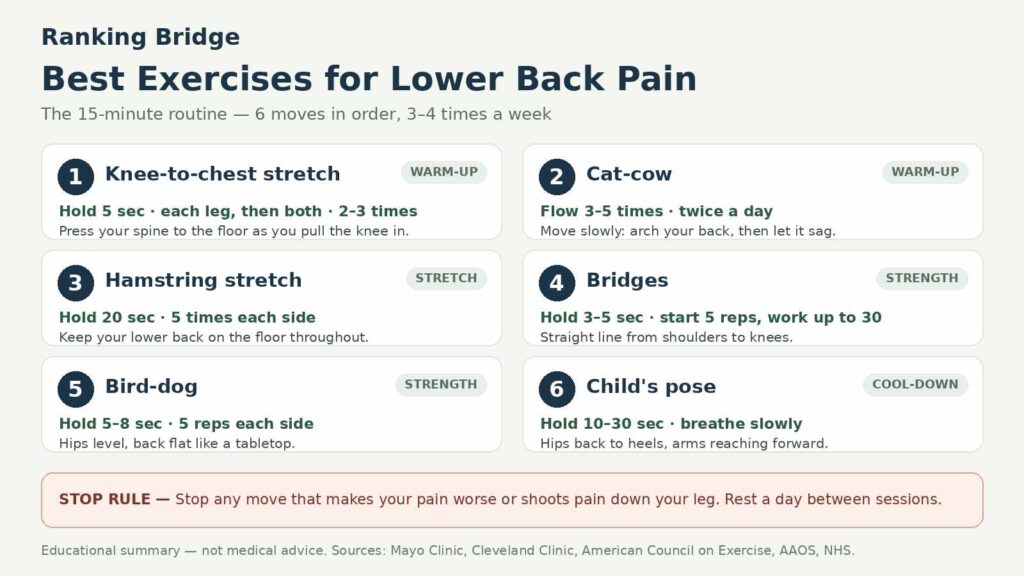
The best routine for most lower back pain is gentle stretching plus core and hip strengthening — knee-to-chest, cat-cow, bridges and bird-dog, done 3–4 times a week. Start slowly, stop any move that shoots pain down your leg, and check with a clinician or physiotherapist first if pain is chronic.
| Step | Move | Time | What it does |
|---|---|---|---|
| 1 | Knee-to-chest stretch | 2 min | Loosens the lower back |
| 2 | Cat-cow | 2 min | Warms up the spine |
| 3 | Hamstring stretch | 3 min | Eases tight backs of the thighs |
| 4 | Bridges | 3 min | Strengthens glutes and core |
| 5 | Bird-dog | 3 min | Trains spinal stability |
| 6 | Child’s pose | 2 min | Cool-down stretch |
Stretches come first because they loosen tight muscles and warm up the spine. Strength work follows while the muscles are warm, and child’s pose closes the session as a cool-down.
The routine, step by step
Do each move slowly, and breathe normally throughout. Mild tension is fine, but sharp pain is not. The NHS rule is simple: stop if your pain gets worse, and see a GP for advice.
1. Knee-to-chest stretch (warm-up)
Lie on your back with your knees bent and your feet flat on the floor. Using both hands, pull one knee toward your chest. At the same time, tighten the muscles in your belly and press your spine to the floor. Hold for five seconds, then switch legs. After both sides, pull both knees up together for the same hold. Mayo Clinic advises repeating each stretch two to three times.
Stop if: pulling your knee in increases your back pain. In that case, pull the knee only as far as feels comfortable.
2. Cat-cow (warm-up)
Get on your hands and knees, hands under shoulders, knees under hips. First, arch your back slowly, pulling your belly up toward the ceiling as you lower your head. Then let your back and belly sag gently toward the floor as you raise your head. Flow between the two positions three to five times, moving slowly. Mayo Clinic suggests repeating this cat stretch twice a day.
Stop if: either position sends pain down your leg, or the arching makes your back pain worse. In that case, make the movement smaller.
3. Hamstring stretch
Tight hamstrings tug on the pelvis and add strain to the lower back. The American Academy of Orthopaedic Surgeons includes this lying version in its low back exercise guide. Lie on your back with both legs bent. Hold one thigh behind the knee, then slowly straighten that knee until you feel a stretch in the back of your thigh. Hold for 20 seconds, relax, and repeat five times on each side. Keep the other knee bent and your lower back on the floor throughout.
Stop if: straightening the leg sends tingling or pain down the leg. That can mean the sciatic nerve is irritated, so bend the knee again and keep the stretch gentler.
4. Bridges (strength)
Bridges wake up the glutes, the large muscles in the buttocks. Weak glutes pass their work to the lower back, says the American Council on Exercise, so strengthening them takes load off the spine. Lie on your back with your knees bent and your feet flat on the floor. Tighten your belly and buttock muscles, then lift your hips until your body forms a straight line from your shoulders to your knees. Hold for three to five seconds, then lower slowly. Start with five repetitions a day. Mayo Clinic suggests working up to 30 as the move gets easier.
Stop if: your back arches instead of staying straight, or the lift causes sharp pain. In that case, lift only a few centimetres.
5. Bird-dog (strength)
The bird-dog trains the deep muscles that hold your spine steady. Start on your hands and knees, hands under shoulders, knees under hips. Tighten your belly muscles, then slowly extend one arm forward and the opposite leg back. Keep your hips level and your back flat, like a tabletop. Hold for five to eight seconds, then lower and switch sides. The American Council on Exercise calls it a safe way to develop the spinal extensors, and suggests working up to seven-to-eight-second holds. Start with five repetitions per side.
Stop if: your hips rock, your back sags, or the move causes pain. In that case, lift only the arm, or only the leg, until your balance improves.
6. Child’s pose (cool-down)
Child’s pose closes the routine with a gentle stretch for the whole back. Start on your hands and knees, touch your big toes together and spread your knees wide. Sit your hips back toward your heels and reach your arms forward along the floor. Hold for 10 to 30 seconds, breathing slowly. Cleveland Clinic lists this pose among its best lower back stretches. If kneeling is hard, rest your hands on a counter instead and hinge at the hips with a flat back.
Stop if: your knees hurt, or folding forward makes your back pain worse. In that case, place a cushion between your thighs and calves.
Stretches vs strengthening — why you need both
Stretching and strengthening do different jobs, and a sore back needs both. Stretching restores flexibility in tight muscles, while strengthening builds the support system around the spine. Mayo Clinic Health System puts it simply: stretching your back and strengthening your back and core muscles can support and protect your back. That is why the best exercises for lower back pain combine both halves in one routine.
Stretching alone leaves the spine unsupported. The National Institute of Neurological Disorders and Stroke notes that weak back and abdominal muscles may not properly support the spine. Strength work fills that gap: bridges build the glutes, and the bird-dog trains the deep spinal muscles. These core exercises for back pain are the reason the routine works.
If your pain runs down one leg, that pattern may be sciatica rather than a simple muscle strain. The same gentle moves are often the starting point, but the stop rule is stricter: stop any move that makes leg pain worse. Our guide to sciatica vs lower back pain explains how to tell the two apart.
Moves to avoid with acute pain
Not every exercise helps a sore back. While pain is acute — in the first days after it flares — some moves add stress instead of relieving it. Mayo Clinic Health System advises avoiding actions that further stress the back: bending from the waist, twisting the whole body, and high-impact exercise. In practice, that means:
- Standing toe touches. Bending from the waist to touch your toes loads the lower back through a deep forward bend. The lying hamstring stretch above gives you the same stretch without the load.
- Full sit-ups and crunches. These round the lower back under load, again and again. The bird-dog trains the same core muscles with a neutral spine instead.
- Heavy lifting and loaded twisting. Lifting a heavy weight while twisting combines three stresses at once. Leave it until the pain has settled.
- High-impact exercise. Running and jumping jar the spine. Walking gives you the same low-impact benefit without the jarring.
Skip them while pain is acute, then bring them back gradually once the back feels calmer.
How often, and how to progress
Three to four times a week is a good starting point. NHS physiotherapy guidance suggests exactly that, with at least one day off between sessions to allow for recovery. The gentler stretches can be done daily, and Mayo Clinic suggests its full routine morning and evening if possible. The best exercises for lower back pain are only useful if you do them regularly. Consistency matters more than intensity: Cleveland Clinic advises giving yourself a couple of weeks or more before expecting significant changes.
Progress slowly, one step at a time. First, add repetitions: bridges from five toward ten, then fifteen. Next, lengthen the holds: bird-dog from five seconds toward eight. Finally, add a session: from three days a week toward daily practice. Change one thing at a time, so you can tell what your back tolerates.
One rule governs the whole plan: if an exercise causes pain that lasts for more than two hours afterwards, decrease the repetitions. That is the clearest signal the dose was too high.
When exercise is not the answer
Exercise helps most everyday back pain, but not all of it. Some symptoms mean the back needs medical attention before any home routine. Our guide to sudden lower back pain lists the red flags and explains what to do in the first 48 hours. Read it before starting this routine if your pain came on suddenly or feels different from your usual backache.
Two other rules apply. If pain travels down your leg, or keeps getting worse, Cleveland Clinic advises seeing a healthcare provider rather than stretching through it. And if home care has not improved the pain after a few weeks, the NHS advises seeing a GP. Exercise is a strong tool, but it is not a substitute for a clinician’s judgement.
FAQs
How often should I do back exercises?
Three to four times a week, with at least one day off between sessions. That is the schedule NHS physiotherapy guidance recommends. Gentle stretches such as knee-to-chest and cat-cow can be done daily. Start with three sessions a week and build up.
Can exercise make back pain worse?
Yes, if you push through worsening pain or choose the wrong moves. The NHS rule is to stop if your pain gets worse and see a GP for advice. Cleveland Clinic puts it plainly: if things are hurting worse, that is an indicator to back off. The best exercises for lower back pain should never leave you worse the next day. If pain lasts more than two hours after exercise, decrease the repetitions next time.
Is walking good for lower back pain?
Yes. The NHS lists walking among the activities that may ease back pain, and Mayo Clinic Health System notes that walking and other low-impact aerobic activities can strengthen the back. The National Institute of Neurological Disorders and Stroke advises 30 minutes of low-impact exercise a day, such as brisk walking, after any period of inactivity. Start with short, comfortable walks and build up gradually.
How long before exercises help?
Give it at least a couple of weeks. Cleveland Clinic advises allowing a couple of weeks or more before expecting significant changes, and stresses that consistency matters. The American Academy of Orthopaedic Surgeons’ spine conditioning program runs for four to six weeks. If nothing has improved after a few weeks of steady practice, the NHS advises seeing a GP.
The best exercises for lower back pain are the ones you will actually do. Fifteen minutes, three or four times a week, builds the flexibility and strength your back needs. Start gently, follow the stop rules, and give it a few weeks.
This article is for general information only and is not medical advice. Talk to your doctor or a physical therapist before starting a new exercise routine, especially if you have an injury, a health condition, or pain that is severe, worsening, or accompanied by numbness or weakness.
