Best 5 Gastroenterology Billing Companies in USA 2027
This voice experience is generated by AI.
Gastroenterology billing is one of the most procedure-heavy areas of medical billing. In fact, a single day can mix screening colonoscopies, diagnostic EGDs, ERCPs, and capsule endoscopy. In addition, each procedure carries its own coding rules, modifiers, and payer policies. As a result, a general billing team often misses the details that decide whether a GI claim pays in full or denies. For that reason, many GI practices now compare the best gastroenterology billing companies before they outsource.
This guide compares five companies that each run a dedicated gastroenterology billing service. Specifically, every company below has its own GI billing page, real GI coding expertise, and a service built for digestive health practices. In addition, we explain what makes each one different, so you can match a partner to your practice size, procedure mix, and software. Overall, this is an editorial shortlist, not a ranking. Therefore, the best choice depends on your needs, not on the order below.
The five companies also differ in how much they take off your plate. For instance, some handle the full revenue cycle, while others focus on coding and claims alone. Meanwhile, a few bundle billing with EHR software or an ASC billing service. Because of that range, a side-by-side comparison helps you weigh real options before you request proposals. For a similar shortlist in another procedure-heavy specialty, see our guide to the best cardiology billing companies in USA 2027.
Best 5 Gastroenterology Billing Companies in USA 2027 — At a Glance
| Company | Headquarters | Best for | Key strength |
|---|---|---|---|
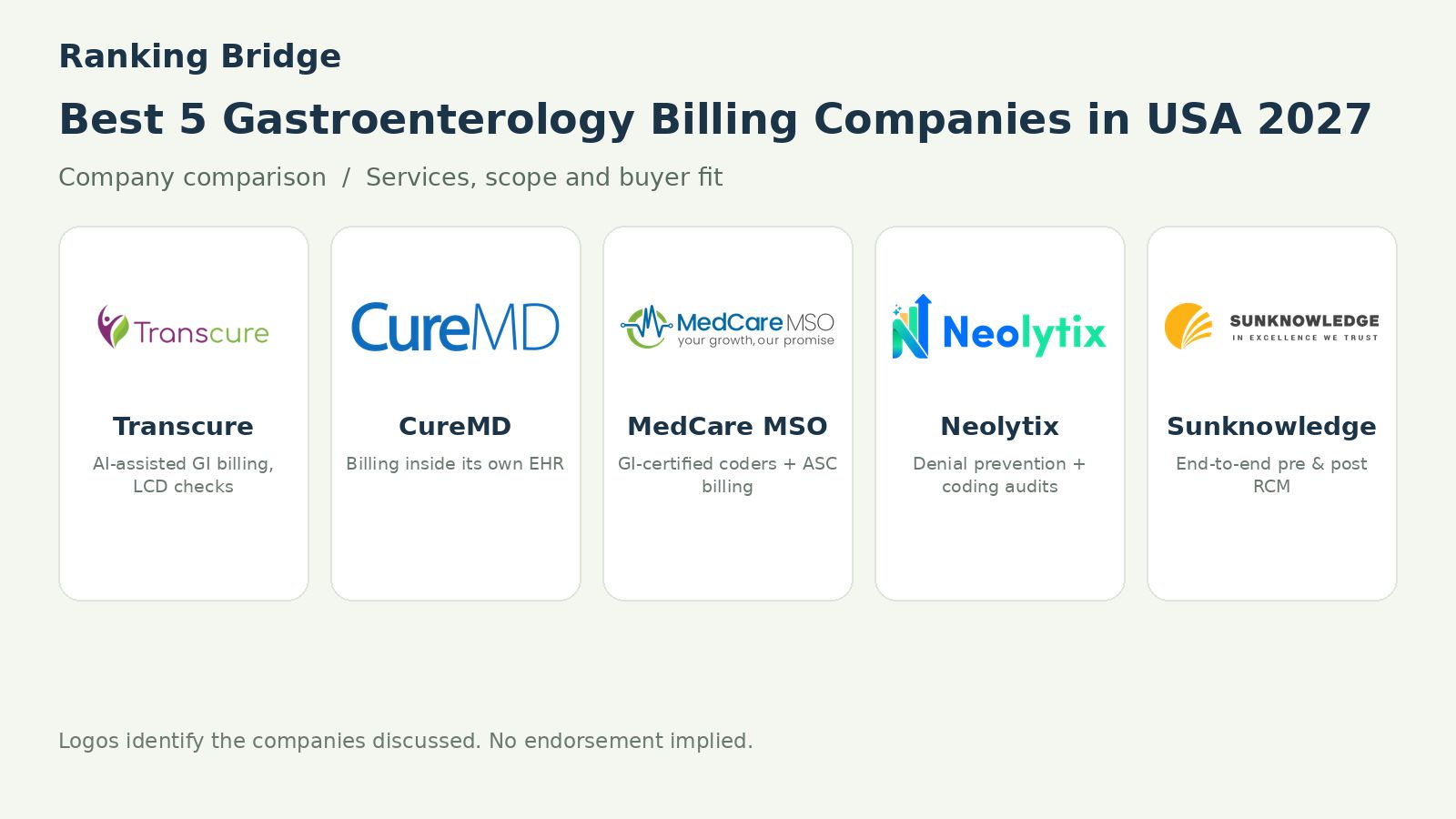
| Transcure | Offices in NJ, TX, FL | GI practices that want AI-assisted billing with LCD-level coding checks | GI-specific modifier and LCD expertise |
| CureMD | New York, NY | Practices that want billing built into their EHR | EHR-integrated billing with AI claim scrubbing |
| MedCare MSO | Irvine, CA | GI groups with an ASC or high endoscopy volume | Screening-colonoscopy and ASC coding depth |
| Neolytix | Northbrook, IL | Multi-site GI groups that need audits and denial prevention | Coding audits and denial prevention |
| Sunknowledge | New York, NY | Practices that want end-to-end pre- and post-billing support | Full pre-to-post RCM coverage |
Transcure — AI-Assisted GI Billing With LCD-Level Coding
Transcure pairs certified GI coders with AI agents for gastroenterology billing. In particular, its team codes EGD, colonoscopy, ERCP, and capsule endoscopy claims against payer-specific rules. Meanwhile, its claim-scrubbing checks each claim against Medicare local coverage determinations before submission. Consequently, coding errors get caught early, not after a denial arrives.
Transcure puts heavy focus on modifiers, where GI billing often fails. For example, a colonoscopy with polyp removal needs modifier 59 or XS to separate the billable components. If the coder misses it, Medicare bundles the procedures into one underpaid claim. In addition, Transcure appeals denials with supporting clinical notes and tracks every claim in real time. Its dashboards show pending, approved, and denied claims in one place. Furthermore, the company also offers ASC billing, which suits GI groups that run their own endoscopy center.
Transcure runs offices in Woodbridge, New Jersey; Farmers Branch, Texas; and Oviedo, Florida. Therefore, support spans several time zones. The company works with practices of many sizes, from independent GI clinics to larger groups. Among the best gastroenterology billing companies, Transcure stands out for pairing automation with LCD-level coding checks. Overall, it suits a GI practice that wants modern automation plus certified coders who know GI rules.
CureMD — GI Billing Inside Its Own EHR
CureMD brings billing and clinical software together on one platform. In fact, CureMD has served healthcare practices for over 29 years. Because billing lives inside its own EHR and practice management system, data moves between scheduling, charting, and claims without re-entry. As a result, fewer handoffs mean fewer chances for errors.
CureMD’s GI service covers colonoscopies, endoscopies, biopsies, and chronic GI conditions. For instance, its certified specialists code and bill across the full GI procedure list. In addition, AI-powered claim scrubbing flags common GI errors before claims go out, such as incorrect modifier use or incomplete documentation. The company also keeps up with gastroenterology-specific Medicare rules, which helps practices stay compliant and avoid audits. Furthermore, its billing specialists are available around the clock for claim questions.
CureMD keeps its headquarters in New York, NY. In short, it fits a GI practice that wants one vendor for both software and billing. Among the best gastroenterology billing companies, few match that single-platform depth. However, practices that already love their current EHR should check integration options before switching. For practices that want coding support alongside their own EHR, our guide to the top medical coding companies in USA 2027 covers that option.
MedCare MSO — GI-Certified Coders and ASC Billing Depth
MedCare MSO focuses on the coding traps that cost GI practices the most revenue. Specifically, its AAPC-certified GI coders handle the split between screening, diagnostic, and therapeutic colonoscopy. Because a screening colonoscopy can turn diagnostic mid-procedure, the coding must change with it. For example, modifier PT and the correct CPT code decide whether the claim pays as a screening or a diagnostic case.
MedCare MSO also covers the procedures around colonoscopy. In particular, its team codes polyp removal and biopsy cases, where polyp size, location, and removal technique all affect payment. In addition, it handles endoscopy bundling rules, so separately billable work does not get folded into one payment. Its ASC billing service covers facility claims for GI endoscopy centers, including place-of-service rules for ambulatory surgery centers. Furthermore, its AI ecosystem includes an EHR, practice management software, an AI scribe, and an AI coder.
MedCare MSO runs its main office from Irvine, California. Overall, it suits GI groups with high endoscopy volume or their own surgery center. Few billing firms match its screening-colonoscopy and ASC depth. In short, MedCare MSO fits a practice that wants deep GI coding plus ASC support under one roof.
Neolytix — Denial Prevention and Coding Audits for GI Groups
Neolytix builds its GI billing service around denial prevention and compliance. In fact, the company has served healthcare organizations for over 14 years. Its GI service covers the full billing cycle, from colorectal cancer screening claims to GI function studies. Because coding rules change often, its team runs compliance and coding audits that catch errors before payers do.
Neolytix pairs human coders with robotic process automation. For instance, automation handles repetitive claim tasks, while accredited coders review the complex cases. In addition, its monitoring and reporting dashboards show claims, denials, and AR in real time. The company works across diverse EHR platforms, so practices can usually keep their current software. Furthermore, Neolytix covers the full provider lifecycle, including credentialing, enrollment, and payer contract review. That breadth suits multi-site GI groups that need more than claims alone.
Neolytix is headquartered in Northbrook, Illinois. Overall, it fits a GI group that wants audits, denial prevention, and reporting in one service. Among the best gastroenterology billing companies, Neolytix stands out for its audit-first approach. If your practice also needs help with payer enrollment, our guide to the best medical credentialing companies in USA 2027 covers that side of the revenue cycle.
Sunknowledge — End-to-End Pre- and Post-Billing RCM
Sunknowledge covers gastroenterology billing from patient intake through payment posting. In particular, its team handles eligibility verification, charge entry, coding, claims management, and accounts receivable follow-up. Because GI billing mixes medical and surgical services, its coders work across the full procedure list. For example, they code diagnostic colonoscopy, EGD, and GI function studies with the right modifiers.
Sunknowledge puts strong focus on modifier accuracy. Specifically, its coders apply modifiers such as 51, 59, and 26 where GI rules require them. In addition, the team tracks category III codes for GERD treatment and other evolving GI codes. Its service also covers place-of-service rules and HCPCS codes, which matter when the same procedure happens in an office, an ASC, or a hospital. Furthermore, Sunknowledge offers credentialing, virtual medical assistants, and denial management alongside billing. Therefore, a practice can hand off most back-office work to one partner.
Sunknowledge is based in New York, NY. In short, it fits a GI practice that wants one team for the whole revenue cycle. Among the best gastroenterology billing companies, Sunknowledge stands out for its pre- and post-billing coverage. However, practices that only need coding should confirm the service scope before signing. Overall, it suits a practice that wants end-to-end support without managing several vendors.
How to Choose Among the Best Gastroenterology Billing Companies
Start with your procedure mix. For instance, a practice that runs mostly screening colonoscopies needs different coding support than one that does ERCPs and capsule endoscopy. In addition, check whether the company codes your highest-volume procedures every day, not just occasionally. Because GI coding changes with each payer, ask how the team tracks Medicare LCDs and commercial payer rules.
Next, look at the setting where you perform procedures. If you own an ASC, for example, your billing partner must handle facility claims and place-of-service rules alongside professional claims. Meanwhile, office-only practices need strong E/M and procedure coding instead. In addition, confirm which EHR the billing team supports, since a forced software switch adds cost and disruption.
Then check denial handling and reporting. A good partner appeals denials with clinical notes, not just resubmissions. Furthermore, live dashboards should show claim status, denial reasons, and AR aging without a monthly wait. The CY 2027 Medicare Physician Fee Schedule final rule also affects GI payment rates, so ask how the team tracks annual Medicare updates. For clinical guidance behind GI care, the American College of Gastroenterology publishes practice resources, while the American Society for Gastrointestinal Endoscopy covers endoscopy standards.
Finally, compare the service scope and the contract terms. Some firms bundle credentialing, eligibility checks, and prior authorization with billing. In contrast, others charge separately for each service. Therefore, compare the full scope, not just the headline service. In short, the right partner matches your procedures, your setting, and your software — and proves it with GI-specific references.
Frequently Asked Questions
What makes gastroenterology billing different from general medical billing?
GI billing is procedure-heavy and modifier-heavy at the same time. For example, a colonoscopy can change from screening to diagnostic to therapeutic during one visit. In addition, modifiers such as 25, 59, and PT decide whether each part of the visit pays separately. Because of that complexity, GI practices usually do better with coders who work on GI claims every day.
How should a GI practice handle screening vs. diagnostic colonoscopy billing?
The key is coding the procedure as it actually happened. If a screening colonoscopy finds a polyp and the physician removes it, for instance, the claim becomes diagnostic or therapeutic. In that case, modifier PT and the correct CPT code tell the payer what changed. Meanwhile, documentation must support the change, or the claim can deny. Therefore, the coder and the physician must work from the same procedure note.
Should a GI practice bill its ASC separately from the office?
Yes, in most cases. An ambulatory surgery center bills facility claims, while the physician bills professional claims for the same procedure. In addition, place-of-service codes differ between the two settings. Because of that split, a GI group with its own endoscopy center needs a billing partner that handles both claim types. Otherwise, facility revenue can slip through the cracks.
What should a practice check before signing with a GI billing company?
First, confirm the company runs a dedicated GI billing service with GI-trained coders. Next, ask for references from GI practices of a similar size and procedure mix. In addition, check reporting, denial handling, and EHR compatibility before you sign. Finally, review the contract terms, including the service scope and the notice period. In short, a careful check now prevents a painful switch later.
Conclusion
Gastroenterology billing rewards specialty knowledge. In fact, the difference between a paid claim and a denial often comes down to one modifier or one coding choice. The best gastroenterology billing companies in this guide each bring real GI expertise, from colonoscopy coding to ASC claims and denial management. In addition, each one runs a dedicated GI service, so your claims go to coders who know the specialty.
The right choice depends on your practice. For instance, a group with its own endoscopy center needs ASC billing depth, while a small office may value an all-in-one EHR and billing platform. Meanwhile, a multi-site group may need audits and denial prevention most. Therefore, compare the five options against your procedure mix, your setting, and your software. Then request proposals from the two or three that fit best, and let their GI-specific answers decide.
