
Best 5 Ophthalmology Billing Companies in USA 2027
This voice experience is generated by AI.
Ophthalmology billing is one of the most detail-heavy specialties in medical billing. Eye practices juggle routine exams, diagnostic testing, injections and surgery, and each service follows its own coding rules. In addition, a single visit can mix medical and routine vision care, so the same exam can bill to two different plans. Therefore, small coding errors turn into denials fast.
The coding choices alone show why specialty help matters. For example, an eye exam can use ophthalmology codes 92002–92014 or evaluation and management codes 99202–99215. The right choice depends on the visit type and the documentation. Similarly, cataract surgery involves IOL coding, modifiers and bundled services. As a result, general billing teams often miss details that eye-care coders catch.
This guide reviews the best ophthalmology billing companies in the USA for 2027. Each company below has a dedicated ophthalmology page on its own website, and we checked every page before writing. The list is an editorial shortlist, not a ranking. Therefore, the order does not mean one company beats another. Instead, each entry explains what the company does best and which practice fits it. This guide continues our specialty billing series, which already covers dermatology billing companies and urology billing companies.
Finally, payment pressure keeps growing. Under the CY 2027 Physician Fee Schedule final rule, CMS set conversion factors of $32.95 for qualifying APM participants and $32.63 for others. Consequently, accurate coding matters more than ever for eye practices.
Best ophthalmology billing companies at a glance
The table below compares the five best ophthalmology billing companies on headquarters, ophthalmology focus and best fit. After the table, each company gets a closer look.
| Company | Headquarters | Ophthalmology focus | Best for |
|---|---|---|---|
| MedCare MSO | Irvine, CA | Ophthalmology and optometry billing across subspecialties | Practices wanting subspecialty depth plus modern tools |
| AnnexMed | Salt Lake City, UT | End-to-end ophthalmology RCM, surgery to injections | Surgical and multi-subspecialty eye groups |
| Sunknowledge | New York, NY | Premium lens upgrades and cataract billing | Practices offering premium lens upgrades |
| CareCloud | Somerset, NJ | EHR, practice management and RCM in one platform | Practices wanting one platform for EHR and billing |
| MGSI | Tampa, FL | Modifier and diagnostic-test coding for eye care | Small and mid-size eye practices wanting experience |
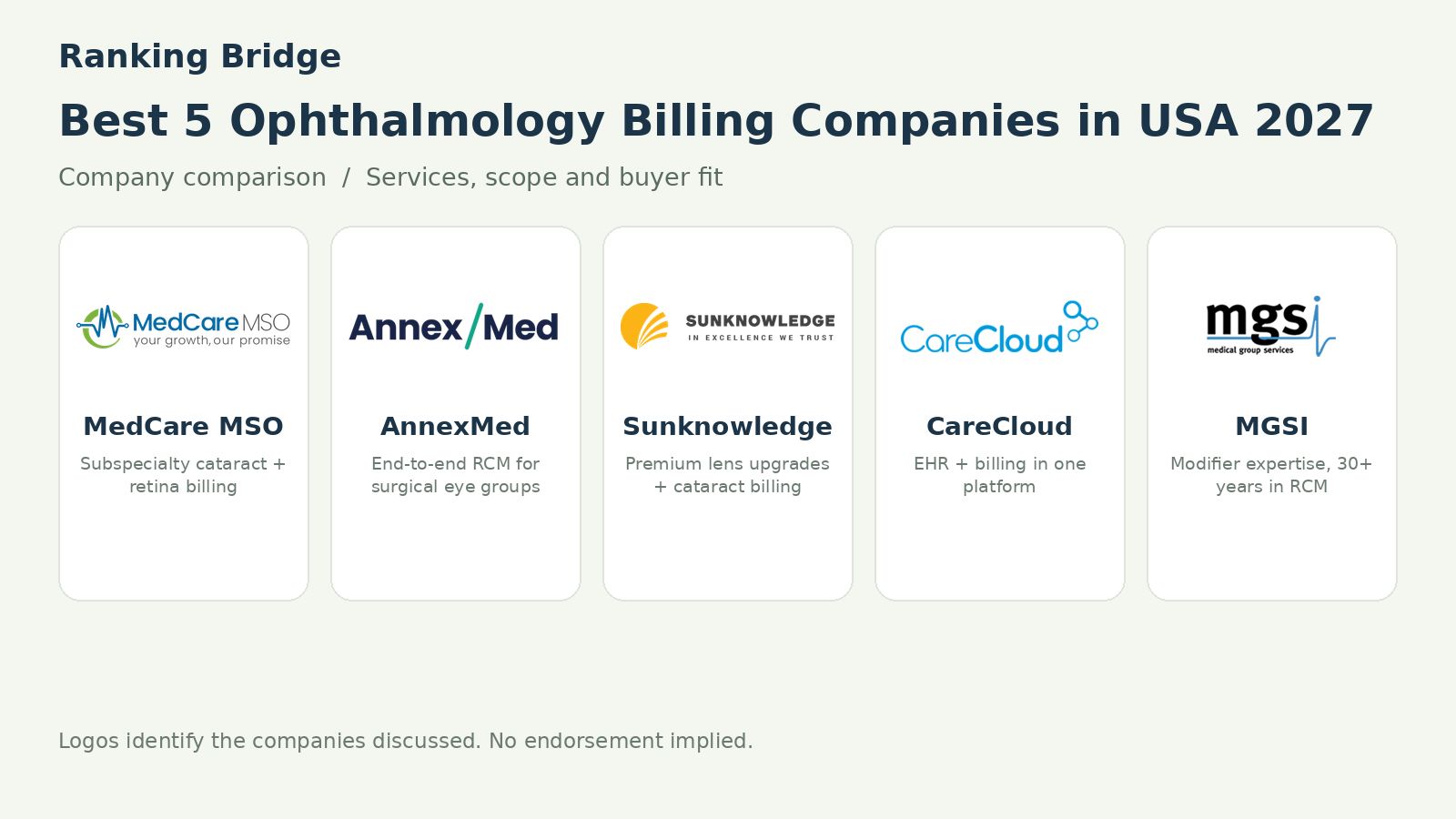
1. MedCare MSO — Best for subspecialty coverage across cataract and retina
MedCare MSO covers ophthalmology and optometry billing for practices of every size. Its page breaks eye care into subspecialties, so cataract, retina and anterior segment work each get dedicated coding attention. For example, the team codes cataract removal, IOL insertion and YAG capsulotomy, along with intravitreal injections and retinal detachment surgery. In addition, it handles bundled codes carefully, since eye procedures often bundle services that look separate on the chart.
The company pairs human coders with its own technology. Its HealUs EHR includes an AI scribe, while its AI coder and AI rule engine check claims before submission. As a result, practices get modern tooling alongside specialty coding. MedCare MSO also runs the full revenue cycle, from eligibility checks to AR follow-up. Therefore, a practice can hand over billing end to end instead of splitting it across vendors.
However, the service fits best when a practice wants one vendor for the whole revenue cycle. If your team only needs coding support, ask which services can stand alone before you sign. Overall, MedCare MSO suits eye practices that want subspecialty depth plus modern tools.
- Subspecialty range: cataract, retina, anterior segment and optometry billing.
- Technology: HealUs EHR with AI scribe, AI coder and AI rule engine.
- Scope: full revenue cycle, from eligibility to AR follow-up.
2. AnnexMed — Best for surgical and multi-subspecialty eye groups
AnnexMed delivers end-to-end revenue cycle management built specifically for ophthalmology. Its page covers the full code range: ophthalmic surgery (65091–68899), eye exams (92002–92014), diagnostics (92081–92287) and intravitreal injections (67028). In addition, the team manages J-code drugs, bilateral modifiers and technical and professional component splits. That depth matters because eye surgery claims fail most often on these exact details.
AnnexMed serves comprehensive ophthalmologists as well as retina, glaucoma, cornea, oculoplastics and pediatric specialists. Therefore, a multi-subspecialty group can keep all of its billing with one vendor. The company also separates medical and routine vision billing, which prevents one of the most common eye-care claim errors. Its coders hold AAPC, AHIMA and AAHAM certifications, and the company reports SOC 2 Type II compliance on its site.
The service fits groups that want deep coding expertise rather than a software platform. For example, a surgical eye group can hand over coding, billing and AR recovery in one engagement. However, practices that want an all-in-one EHR should compare AnnexMed with a platform vendor first. Overall, AnnexMed suits surgical groups that live or die by coding accuracy.
- Code coverage: surgery, exams, diagnostics and injections, with J-code management.
- Specialist range: retina, glaucoma, cornea, oculoplastics and pediatric eye care.
- Compliance: certified coders and SOC 2 Type II, per its own site.
3. Sunknowledge — Best for premium lens upgrades and cataract billing
Sunknowledge focuses its ophthalmology page on a problem many cataract practices face: premium lens upgrades. Surgery and lens upgrades bill differently, and mixing them up creates denials and unhappy patients. Therefore, Sunknowledge separates the surgical claim from the upgrade charge and verifies benefits before the practice discusses the final estimate. As a result, patients learn their costs before surgery, not after.
Beyond lens upgrades, the company runs end-to-end revenue cycle services. Its team handles prior authorization, eligibility verification, charge entry, coding, claims management and denial follow-up. In addition, it covers accounts receivable and patient collections. That range suits practices that want one vendor from intake to payment posting.
Sunknowledge works from New York and serves practices across the United States. For example, a cataract practice can outsource the full billing cycle while keeping scheduling and clinical work in-house. However, the premium-lens focus means retina-only or glaucoma-only practices should confirm the fit first. Overall, Sunknowledge suits cataract practices that bill lens upgrades alongside surgery.
- Lens upgrade focus: separates surgery claims from premium lens charges.
- Benefits checks: verifies coverage before the patient estimate.
- Scope: prior auth to AR, including denial management and collections.
4. CareCloud — Best for practices wanting one platform for EHR and billing
CareCloud pairs ophthalmology billing with its own cloud-based EHR and practice management system. Therefore, practices can run clinical, scheduling and billing work in one platform instead of three. Its ophthalmology page offers specialty templates, paperless charting and real-time eligibility verification. In addition, its billing rules sit inside the claim workflow, which helps catch errors before submission.
The revenue cycle side uses ophthalmology-specific RCM experts. For example, its team tracks reimbursement trends for cataract and glaucoma surgery through built-in analytics. CareCloud reports that KLAS recognized it as a top RCM provider for ambulatory practices. As a result, practices get both software and a managed billing team from the same vendor.
However, the platform works best for practices that want an all-in-one system. If your practice already runs a different EHR, ask how CareCloud connects with it before you commit. Overall, CareCloud suits eye practices that want billing, EHR and practice management under one roof.
- Platform fit: EHR, practice management and RCM in one system.
- Eye-care tools: specialty templates, real-time eligibility and claim rules.
- RCM strength: ophthalmology-specific experts, KLAS-recognized per its site.
5. MGSI — Best for small and mid-size eye practices wanting experience
MGSI brings more than 30 years of revenue cycle experience to ophthalmology billing, per its own site. Its ophthalmology page focuses on the modifiers that decide eye-care claims: RT, LT, 50, 59, 24 and 25. In addition, the team codes diagnostic exams such as OCT, fundus photography and visual field testing. That matters because diagnostic testing drives a large share of eye-practice revenue.
The service covers complete coding, insurance verification and prior authorization. For example, MGSI obtains pre-authorizations for procedures and testing before the visit, which reduces denials. Its coders hold Certified Professional Coder credentials, and the company describes HIPAA-compliant billing processes on its site. The team also posts payments, follows up on unpaid claims and generates patient statements.
MGSI serves independent ophthalmologists, group eye practices, retina and glaucoma specialists and ophthalmic surgical centers. Therefore, a small or mid-size practice can get specialty billing without hiring in-house coders. However, very large multi-state groups should confirm capacity and reporting depth first. Overall, MGSI suits eye practices that value long experience and modifier-level coding care.
- Modifier expertise: RT, LT, 50, 59, 24 and 25, plus laterality coding.
- Diagnostics: OCT, fundus photography and visual field testing.
- Experience: more than 30 years in revenue cycle work, per its own site.
How to choose an ophthalmology billing company
Start with coding depth. The best ophthalmology billing companies code eye care every day, not occasionally. First, ask whether the vendor codes ophthalmology every day or only handles it as one of many specialties. A team that works with 92002–92014 eye exam codes, cataract surgery and intravitreal injections will catch errors a general team misses. In addition, ask how the vendor handles modifiers and laterality, since RT, LT and bilateral claims cause many eye-care denials.
Second, check how the vendor separates medical and vision billing. Many eye visits involve both a medical plan and a vision plan. Therefore, the billing team must know which service goes to which plan. If the vendor cannot explain its vision-versus-medical workflow, keep looking.
Third, review prior authorization and denial handling. Retinal injections and some diagnostic tests need prior auth, so confirm the vendor obtains it before the visit. Similarly, ask how the team works denials and how fast it follows up. Finally, check references from eye practices of a similar size and subspecialty mix. A vendor that fits a solo cataract surgeon may not fit a ten-provider retina group. For a broader view of specialty billing, see our guide to the top medical coding companies in the USA.
Frequently asked questions
What is the difference between 92002–92014 and 99202–99215 codes?
Eye exam codes 92002–92014 cover ophthalmology-specific exams, while E/M codes 99202–99215 cover general evaluation and management visits. The right choice depends on the visit type, the exam elements and the documentation. In addition, payers apply different rules to each code set, so the billing team must document the choice clearly. The American Academy of Ophthalmology coding resources explain the current rules in detail.
Why do ophthalmology claims get denied?
Most denials come from a short list of causes. Common ones include wrong modifiers, missing laterality, medical-versus-vision plan confusion and missing prior authorization. In addition, bundled services often cause denials when the biller codes a bundled item separately. A specialty billing team checks these points before submission, which prevents many denials.
Should an eye practice outsource billing or keep it in-house?
Outsourcing fits practices that lack specialty coders or struggle with denials. In contrast, in-house billing works when the practice already employs experienced eye-care coders. Therefore, the choice depends on team size, claim volume and denial rates. Either way, the coding must stay specialty-specific.
What should an ophthalmology billing service include?
At a minimum, look for eligibility checks, specialty coding, prior authorization, clean-claim submission, denial management and AR follow-up. In addition, the best ophthalmology billing companies report clearly on denials and collections, so ask to see a sample report. Finally, confirm the team understands vision plans as well as medical plans.
Conclusion
Eye-care billing rewards specialty knowledge. The best ophthalmology billing companies in this guide all run dedicated ophthalmology pages and code eye care every day. MedCare MSO covers the widest subspecialty range, while AnnexMed suits surgical groups and Sunknowledge fits cataract practices with lens upgrades. CareCloud works best as an all-in-one platform, and MGSI brings long experience to smaller practices. Before you sign, ask each vendor for eye-practice references and a clear view of its coding and denial workflow. That short check protects your revenue far more than any sales claim.
