Top RCM Companies for Hospitals
This voice experience is generated by AI.
Hospital revenue cycles are the most complex in healthcare. A single health system juggles inpatient and outpatient billing, multiple facilities, thousands of payers, prior authorizations, clinical documentation, coding, and denials — and claim denials are still rising in 2026. Every percentage point of denied or underpaid revenue is millions of dollars. Meanwhile the Centers for Medicare & Medicaid Services (CMS) keeps updating payment rules — it just finalized the CY 2027 Physician Fee Schedule — which means hospital billing teams are always re-learning the edits.
That is why so many hospitals and health systems bring in an RCM partner — either to run the whole cycle or to supply the platform their own teams run on. The five RCM companies for hospitals below suit different organizations — a shortlist, not a ranking. The right choice depends on your size, your setting, and whether you want outsourcing, software, or both.
How This Shortlist Was Put Together
This shortlist is editorial, based on public information about each company’s services, technology, and hospital focus. Companies are listed in no particular order. Five criteria guided the selection:
- Hospital focus. Every company here serves hospitals and health systems as a core market — not small practices only. We looked for named hospital clients, hospital-specific products, and health-system scale.
- Full-cycle coverage. The strongest partners cover the cycle end to end — patient access, registration, authorization, clinical documentation, coding, billing, payment posting, A/R follow-up, and denial management — whether as a service or a platform.
- Denial and underpayment capability. Denials and underpayments are where hospital RCM partners earn their fee. We looked for denial prevention, appeals, and underpayment recovery, not just claims submission.
- Technology and EHR fit. AI-assisted prioritization, payer intelligence, and analytics help — but only when the platform works with the hospital’s own EHR rather than forcing a replacement.
- Scale match. A rural critical access hospital and a 20-hospital system need different partners. We included companies for large systems, mid-size hospitals, and rural and community hospitals.
Before signing, request proposals from two or three of these companies, ask for references from hospitals like yours, and have them review a sample of your aged receivables and denials — fit matters most.
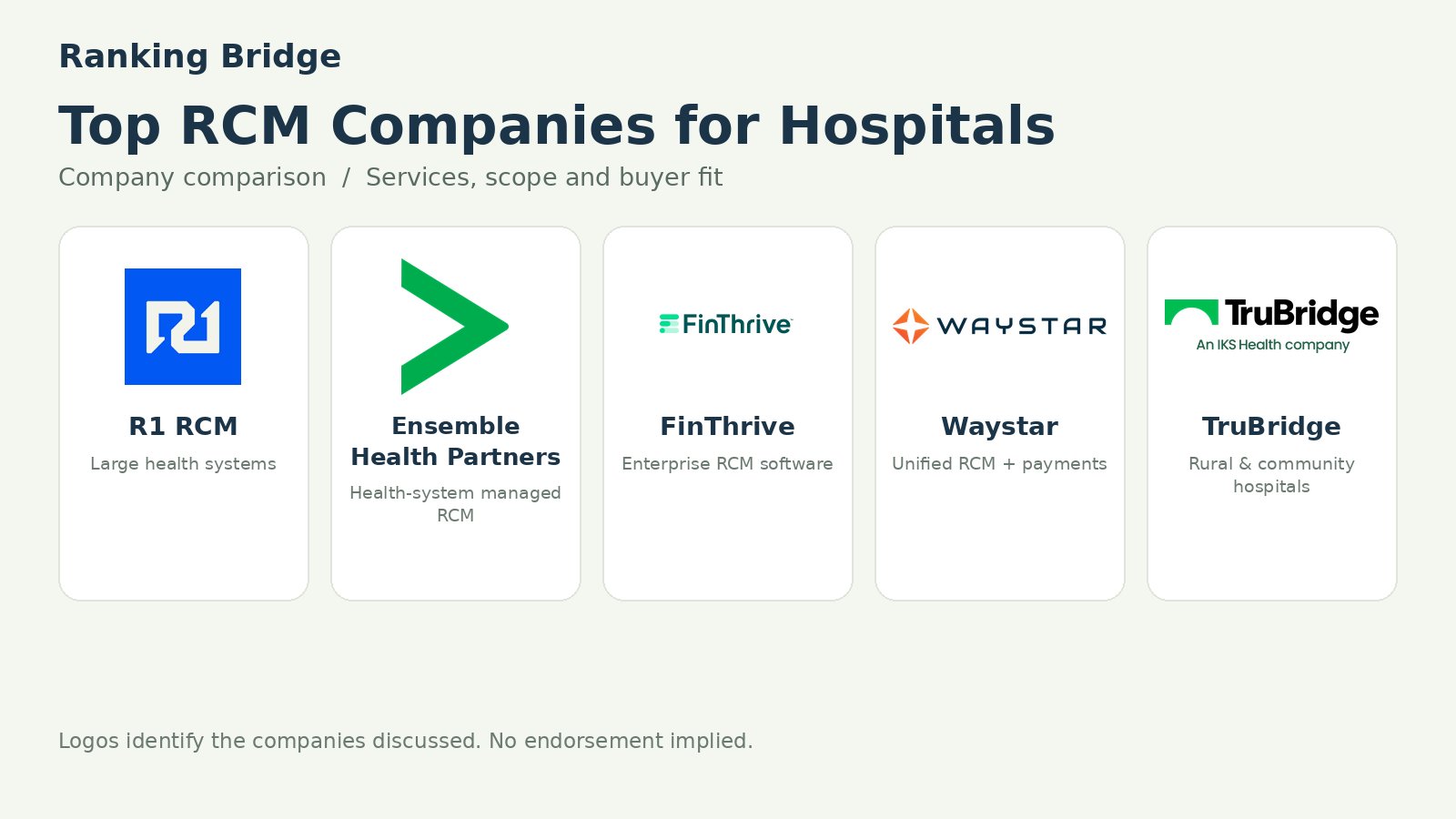
| Company | Best for | Model | Hospital focus |
|---|---|---|---|
| R1 RCM | Large health systems | End-to-end outsourcing | Top 100 health systems |
| Ensemble Health Partners | Health-system managed RCM | End-to-end outsourcing | 200+ hospitals |
| FinThrive | Enterprise RCM software | Platform | US hospitals & health systems |
| Waystar | Unified RCM + payments platform | Platform | Hospitals of all sizes |
| TruBridge | Rural & community hospitals | Outsourcing + EHR | Rural & community hospitals |
R1 RCM: Best for Large Health Systems
R1 RCM, based in Murray, Utah, runs the full revenue cycle for large health systems through its Phare OS platform — pre-bill work (registration, clearance, authorization, utilization management, clinical documentation improvement, coding, audit, and billing) and post-bill work (follow-up, denials, recovery, and service). The company says it manages more than $82 billion in net patient revenue across 95 of the top 100 U.S. health systems, and names Ascension and Intermountain Health among its partners. R1 was taken private in November 2024.
R1 fits a large health system that wants to outsource the entire revenue cycle to a single partner operating at national scale. Ask how its teams are organized by facility and service line, and how reporting separates performance by hospital, payer, and department.
Ensemble Health Partners: Best for Health-System Managed RCM
Ensemble Health Partners, based in Cincinnati, Ohio, provides end-to-end RCM managed services for hospitals and health systems: patient access, coding, claims management, denial prevention, A/R follow-up, and the patient financial experience, plus health information management, clinical documentation improvement, revenue integrity, and underpayment recovery. Its EIQ platform works on the client’s own EHR, reading the medical record to flag denial risk with rationale and recommendations inside existing workflows. The company says it provides end-to-end RCM for more than 200 hospitals, with more than $55 billion in net patient revenue under management, and has been named Best in KLAS for end-to-end RCM outsourcing six times.
Ensemble fits a health system that wants a managed RCM partner working inside its own EHR — denial prevention and recovery together, with embedded operators. Ask how its team integrates with your EHR and how root-cause findings flow back to registration, coding, and billing.
FinThrive: Best for an Enterprise RCM Software Platform
FinThrive, based in Plano, Texas, is a software-first RCM company: its Fusion platform covers patient access, revenue integrity (charge integrity), revenue optimization (claims, contracts, and underpayment recovery), AI and automation (denial prevention and intelligent appeals), enterprise analytics, and education, plus an Insurance Discover product for finding coverage. The company says three out of five U.S. hospitals and health systems rely on its solutions, with more than 200 million claims processed a year and more than 940 payer connections.
FinThrive fits a hospital or health system that wants to run its own revenue cycle on an enterprise platform rather than outsource it — software your team operates, with automation handling repetitive work. Ask which modules your agreement includes, how the platform integrates with your EHR, and how its denial-prevention tools handle your most common denial types.
Waystar: Best for a Unified RCM and Payments Platform
Waystar, headquartered in Lehi, Utah, and Louisville, Kentucky, offers a unified AI-powered RCM and payments platform covering financial clearance, patient financial care, clinical integrity and revenue capture, claim and payer payment management, denial recovery, and analytics and reporting, powered by its AltitudeAI. The company says it serves more than 30,000 clients and over a million providers, including 16 of the 20 hospitals on the U.S. News Best Hospitals list, processing more than 7.5 billion transactions a year with over 5,000 payer connections and 500-plus EHR and practice-management integrations. Waystar was formed in 2017 through a merger and is listed on the Nasdaq.
Waystar fits a hospital that wants one platform for claims, payments, and denial recovery across its facilities — especially one that values broad payer connectivity and EHR integration. Ask how its platform connects to your EHR and which of your payers are covered by its network.
TruBridge: Best for Rural and Community Hospitals
TruBridge, based in Mobile, Alabama, serves rural and community hospitals and health systems with an RCM suite, a Complete Business Office (full RCM outsourcing), an Extended Business Office (A/R and denials), medical coding services, and denial and audit management — plus an EHR built for small hospitals. Its RCM, complete business office, and coding services are HFMA Peer Reviewed. The company says it has more than 45 years of healthcare experience and is trusted by over 1,500 clients. TruBridge was founded as CPSI in 1979 and rebranded as TruBridge in 2024.
TruBridge fits a rural or community hospital — including critical access hospitals — that wants a partner built for its scale, with the option of outsourcing the business office, the coding, or the whole cycle. Ask how its team handles your payer mix and whether its EHR or your existing system is the better fit.
How to Choose Among RCM Companies for Hospitals
1. Decide outsourcing vs platform first. Some hospitals want a partner to run the cycle; others want software their own team runs. Outsourcing moves headcount and accountability; a platform keeps control in-house. The two models cost and feel very different — decide which your organization actually wants before comparing vendors.
2. Match the vendor to your scale. A vendor built for 20-hospital systems may be too heavy for a single community hospital, and a rural specialist may lack the depth a large system needs. Ask for references from hospitals your size, in your setting.
3. Ask who works denials and underpayments. Denial prevention and recovery are where hospital RCM partners earn their fee. Ask how denials are categorized by cause, how appeals are built and by whom, and how underpayments are detected — and request a sample report. If you are weighing a dedicated denial partner instead, see our shortlist of the best denial management companies.
4. Confirm EHR integration in writing. Some vendors work inside your EHR; others run a separate platform or require a migration. A forced switch costs time, retraining, and disruption — get the integration answer in the proposal, not in a phone call.
5. Check coding and clinical depth. Hospital coding — inpatient DRGs, clinical documentation, charge capture — is specialist work. Ask whether coding is done by AAPC-certified or AHIMA-certified coders and how clinical documentation improvement is staffed.
6. Read the contract, not just the sales page. Ask what is included and what costs extra, how fees are structured, how long the term runs, how you exit, and who owns your data and enrollments. The Healthcare Financial Management Association (HFMA) also publishes revenue cycle guidance for framing your questions.
We publish similar shortlists across the revenue cycle, including the best AI-powered RCM companies and the best medical billing companies in Florida — the same checks apply wherever you outsource.
Conclusion
The top RCM companies for hospitals are not interchangeable. A large health system wanting full outsourcing will look at R1 RCM; a health system wanting managed RCM inside its own EHR will look at Ensemble Health Partners; a hospital wanting enterprise software for its own team will look at FinThrive; one wanting a unified claims and payments platform will look at Waystar; and a rural or community hospital will look at TruBridge. Shortlist two or three, ask for proposals and references from hospitals like yours, and choose the partner whose model, integration, and denial process fit your organization.
