ICD-10 Code Z12.11: Colon Cancer Screening Coding
ICD-10 code Z12.11 means “Encounter for screening for malignant neoplasm of colon.” It is a billable Z code used when a patient with no signs or symptoms of colon cancer is tested to detect the disease or its precursors. Unlike many Z codes, Z12.11 can be first-listed — and for a true screening encounter it should be — because the screening itself is the reason for the visit.
Colorectal screening claims turn on one question: was this screening, or was it diagnostic? This guide explains how to tell the difference and code each scenario.
What Z12.11 Means
Z12.11 belongs to category Z12, “Encounter for screening for malignant neoplasms,” in Chapter 21 of ICD-10-CM. Screening, by the official definition, is testing for disease or disease precursors in seemingly well or asymptomatic individuals, so early detection and treatment can be offered to those who test positive.
That definition does the heavy lifting. Z12.11 describes the intent of the encounter: a planned check in a person with no current complaint pointing to colon disease. It is a complete, billable code, and it is paired with a procedure code — for a colonoscopy or a stool-based test — showing what screening was performed.
When Z12.11 Is the Right Code
Asymptomatic screening encounters
Use Z12.11 when an asymptomatic patient presents for screening: an average-risk adult completing routine colorectal cancer screening, or a patient having a screening colonoscopy or a stool-based screening test ordered as screening. Z12.11 is first-listed, with additional codes appended as needed.
When screening finds something
A screening colonoscopy does not stop being a screening when a polyp is found and removed. Per ICD-10-CM guidance, when a screening examination turns up a condition, the screening code remains first-listed and the finding is added — for example K63.5 (polyp of colon) or a benign neoplasm code from D12.- for an adenomatous polyp. The procedure coding may change to reflect the intervention, but the screening intent established before the procedure began is preserved.
Family history is additional
A patient screened earlier or more often because of family history still receives Z12.11. Add Z80.0, “Family history of malignant neoplasm of digestive organs,” as a secondary code to explain the increased risk and any shortened interval.
When NOT to Use Z12.11
When symptoms or signs are present
If the patient presents with rectal bleeding, a change in bowel habit, abdominal pain, iron-deficiency anemia, or a similar sign or symptom, the examination is diagnostic, not screening. Code the symptom or condition that prompted the workup, and do not report Z12.11. Calling the order a “screening colonoscopy” does not make it one.
Surveillance after personal history of colon cancer
Follow-up for a patient previously treated for colon cancer is surveillance, not screening of a well person. These encounters are generally coded with Z08, “Encounter for follow-up examination after completed treatment for malignant neoplasm,” plus Z85.038, “Personal history of other malignant neoplasm of large intestine.” Z12.11 is not the right lead code there, so check the documented reason for the visit.
Neighboring codes are not interchangeable
- Z12.12 — screening for malignant neoplasm of rectum.
- Z12.10 — screening for malignant neoplasm of intestinal tract, unspecified; use only when the record cannot support the more specific colon code.
Documentation Tips for Z12.11
Screening claims are won or lost on documentation written before the test. The record should show:
- Screening intent, stated up front. The order should say “screening” before the procedure; intent recorded afterwards looks like an afterthought to auditors.
- Absence of symptoms. A brief statement that the patient is asymptomatic protects the screening designation.
- Risk context. Average- versus high-risk status, screening interval, and the previous screening’s date or result.
- Family history. Affected relatives and their relationship, to support Z80.0.
- Findings. Polyps or other findings recorded precisely, so they can be coded additionally without displacing Z12.11.
Why Z12.11 Matters for RCM
The screening-versus-diagnostic distinction is also a coverage distinction. Preventive screening is commonly covered under preventive benefit rules, often with little or no patient cost sharing for eligible patients, whereas a diagnostic examination is usually processed under standard medical benefits with deductibles and coinsurance. Coding a true screening as diagnostic can leave the patient with an unexpected bill; coding a symptomatic workup as screening invites denials and audit exposure.
For Medicare patients, screening colonoscopy is reported with dedicated HCPCS codes — G0105 for high-risk screening colonoscopy and G0121 for screening colonoscopy in patients not meeting high-risk criteria — with Z12.11 as the supporting diagnosis. Frequency, risk, and cost-sharing rules vary by payer, so verify the individual policy. Teams already dealing with rising claim denials should make “Is this patient having symptoms?” a formal intake checkpoint before any colorectal claim is coded.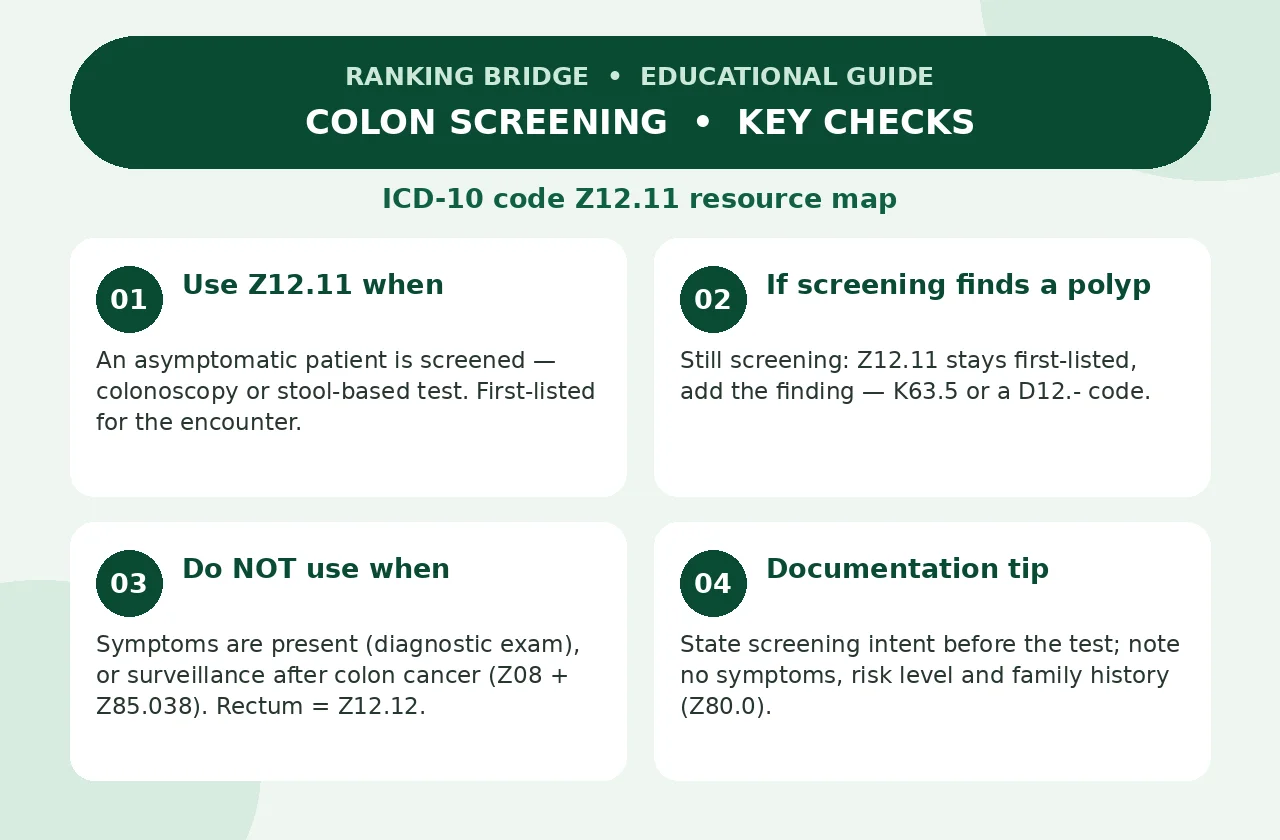
Frequently Asked Questions
Can Z12.11 be the first-listed diagnosis?
Yes. For a screening encounter it is appropriately first-listed, because screening is the reason for the visit.
A screening colonoscopy found a polyp. Does the code change?
No. Z12.11 stays first-listed, and the finding — such as K63.5 or a D12.- code — is added.
The patient has a strong family history. Is it still screening?
Yes, if asymptomatic. Use Z12.11 and add Z80.0 for family history of malignant neoplasm of digestive organs.
What if the patient previously had colon cancer?
That is surveillance, not screening. Look to Z08 with Z85.038, personal history of malignant neoplasm of large intestine.
Z12.11 or Z12.12?
Z12.11 covers screening for malignant neoplasm of the colon; Z12.12 covers the rectum.
Sources
- ICD-10-CM Official Guidelines for Coding and Reporting, Section I.C.21 and related Z code guidance (CMS and National Center for Health Statistics).
- ICD-10-CM Tabular List, Chapter 21, category Z12.
Disclaimer: This article is educational information for coding and billing professionals, not coding, billing, or legal advice. Coverage varies by payer and plan. Always code from the current ICD-10-CM code set, official guidelines, and the provider’s documentation for the specific encounter.
