ICD-10 Code R07.9: Chest Pain Unspecified Explained
Introduction
Chest pain is one of the most common reasons for emergency and outpatient visits — and one of the most coded symptoms in ICD-10-CM. R07.9, Chest pain, unspecified, is the code for chest pain when the provider documents chest pain but does not specify a more precise type or cause. It is a symptom code, not a diagnosis of a heart condition, and that distinction shapes everything about how it should be used.
What R07.9 means
R07.9 sits in Chapter 18 (R00–R99), Symptoms, signs and abnormal clinical and laboratory findings, not elsewhere classified. Chapter 18 codes describe what the patient reports or what is found, when a definitive diagnosis has not been established. “Unspecified” here means the chest pain itself is not further characterised in the documentation — not that the clinician failed to investigate it.
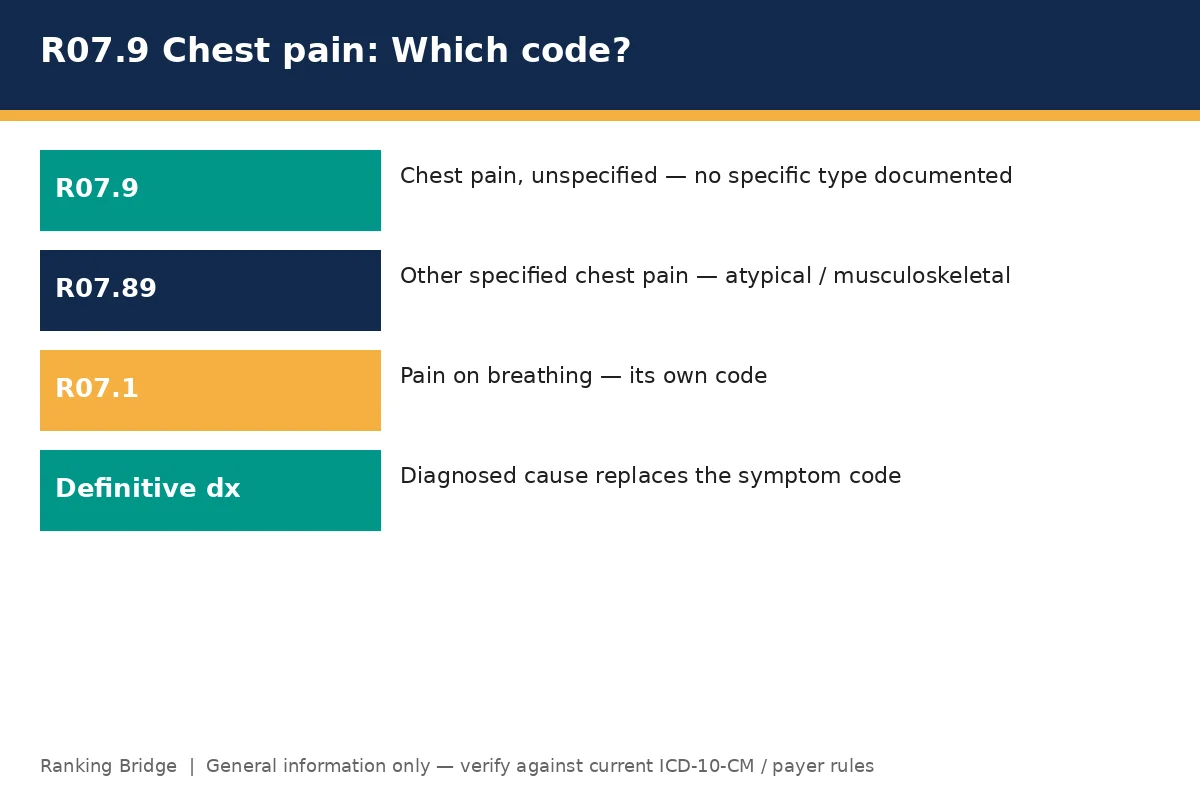
In the ICD-10-CM index, “Pain, chest (central)” leads to R07.9. More specific chest pain descriptions — anterior wall, atypical, musculoskeletal, non-cardiac, or pain on breathing — map to other R07 codes, such as R07.89 or R07.1, and ischaemic chest pain maps to the circulatory chapter (for example, I20.9 for angina). R07.9 is the fallback when none of those specifics is documented.
When R07.9 is the right code
Use R07.9 when:
- The provider documents “chest pain” without a more specific descriptor
- No definitive diagnosis explaining the pain has been established for that encounter
- The encounter is being coded on symptoms because the workup is incomplete, inconclusive or still in progress
This is common in emergency settings, where a patient is evaluated, serious causes are ruled out or remain under investigation, and the chart closes on the presenting symptom.
When R07.9 is NOT the right code
A specific type of chest pain is documented: If the note specifies atypical, musculoskeletal, non-cardiac or anterior wall chest pain, code to that specificity (R07.89) rather than defaulting to R07.9.
A definitive diagnosis is established: Once a cause is diagnosed — angina, myocardial infarction, costochondritis, GERD-related pain, pulmonary embolism or another condition — code the definitive diagnosis, not the symptom. Symptom codes are replaced when the underlying cause is known, unless the guidelines direct otherwise.
The pain is on breathing: Pain on breathing has its own code, R07.1. Do not collapse it into R07.9.
The pain is not chest pain at all: Shortness of breath, for example, is R06.02, not R07.9. Coding a symptom the patient did not report is a documentation error, not a specificity shortcut.
Documentation tips
- Capture the provider’s own words: “chest pain,” “chest discomfort,” or a more specific descriptor — do not upgrade vague documentation into a specific code.
- Check the assessment and plan, not just the chief complaint. A chief complaint of chest pain with a final diagnosis of angina should not stay on R07.9.
- If the workup is pending at coding time, follow your organisation’s policy on holding versus coding symptoms — and correct the code if a definitive diagnosis later emerges.
- Note associated symptoms separately where documented, such as shortness of breath or diaphoresis, rather than folding them into the chest pain code.
RCM and denial risks
Chest pain claims are scrutinised because they sit at the boundary between symptom and cardiac diagnosis. Two patterns draw attention: routine R07.9 on claims where a definitive cardiac diagnosis was documented elsewhere in the record, and specific cardiac codes on claims supported only by “chest pain” in the note. Both directions create medical-necessity and audit risk. Clean symptom coding — R07.9 only when the record truly supports unspecified chest pain — protects the claim and the patient record alike. For the broader denial picture, see our analysis of rising claim denials in 2026 (rising claim denials in 2026).
FAQ
Is R07.9 a diagnosis of heart disease? No. R07.9 is a symptom code for unspecified chest pain. It does not state that the patient has heart disease, angina or any cardiac condition.
Can R07.9 be the principal diagnosis? Yes, when chest pain is the reason for the encounter and no definitive diagnosis has been established. That is exactly what symptom codes are for.
What is the difference between R07.9 and R07.89? R07.9 is chest pain, unspecified. R07.89 covers other specified chest pain, including atypical, musculoskeletal, non-cardiac and anterior wall chest pain. Specificity in the note determines which applies.
Should I code R07.9 if the patient also has shortness of breath? Code each documented symptom separately where appropriate — for example, R07.9 for chest pain and R06.02 for shortness of breath — rather than merging them.
Does R07.9 need a procedure or test code alongside it? Not inherently. Procedures and tests are coded on their own merits. R07.9 supports the reason for the encounter; it does not automatically justify any particular test.
Sources and further reading
- ICD-10-CM index guidance for chest pain (R07.9, R07.89, R07.1)
- Ranking Bridge, Claim Denials Are Still Rising in 2026: Claim Denials Are Still Rising in 2026
- Ranking Bridge, What Is a Superbill: What Is a Superbill
Disclaimer: This article provides general coding information only. It is not medical advice or billing advice for any specific patient or claim. Coders should verify every code against the current ICD-10-CM guidelines, the full medical record, and applicable payer rules.