
Best 5 OB/GYN Billing Companies in USA 2027
This voice experience is generated by AI.
OB/GYN billing is one of the most complex specialties in medical billing, and the best ob-gyn billing companies know exactly where claims go wrong. A single pregnancy spans months of prenatal visits, ultrasounds, delivery, and postpartum care, each with its own coding rules. In addition, a routine well-woman visit can turn into a problem visit mid-exam, which changes the codes entirely. Therefore, small coding errors turn into denials fast.
The timing makes specialty help even more important. On January 1, 2027, the AMA is retiring the global obstetric package codes — 59400, 59510, 59610, and 59618 — and maternity care moves to four separately billed phases instead. CMS adopted the change in its CY 2027 Physician Fee Schedule final rule, so there is no global option left for Medicare. As a result, OB/GYN practices need a billing partner that is ready for the unbundled model, not one still built around the old bundle.
This guide reviews the best ob-gyn billing companies in the USA for 2027. Each company below has a dedicated OB/GYN page on its own website, and we checked every page before writing. The list is an editorial shortlist, not a ranking. Therefore, the order does not mean one company beats another. Instead, each entry explains what the company does best. This guide continues our specialty billing series, which already covers pediatric billing companies and dermatology billing companies.
Finally, payment pressure keeps growing: under the CY 2027 Physician Fee Schedule final rule, CMS set conversion factors of $32.95 for qualifying APM participants and $32.63 for others.
Best ob-gyn billing companies at a glance
The table below compares the five best ob-gyn billing companies on headquarters, best fit, and key strength. After the table, each company gets a closer look.
| Company | Headquarters | Best for | Key strength |
|---|---|---|---|
| Transcure | Offices in NJ, TX, FL | Global OB accuracy and modifier 25 know-how | Global package and bundling expertise |
| MedCare MSO | Irvine, CA | AAPC-certified coders and ultrasound splits | Ultrasound splits and modifier 25/33 accuracy |
| CureMD | New York, NY | Billing inside its own OB/GYN EHR | EHR-integrated billing with AI documentation |
| CareCloud | Somerset, NJ | One platform for EHR, PM, and RCM | OB/GYN workflows in a single cloud platform |
| Sunknowledge | New York, NY | End-to-end RCM with prior auth strength | Full revenue cycle plus credentialing support |
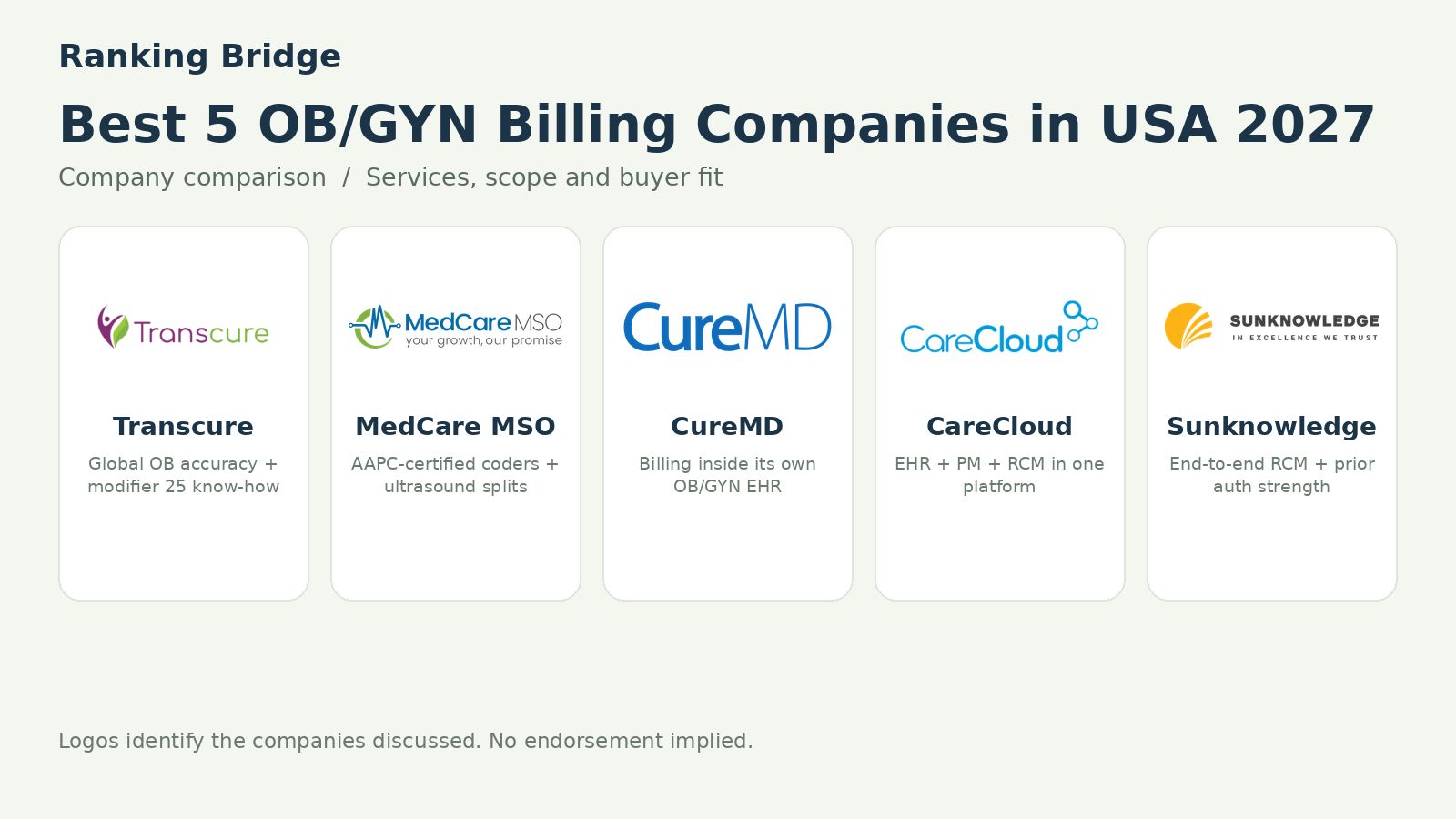
1. Transcure — Best for global OB package accuracy and modifier 25 know-how
Transcure builds its OB/GYN billing service around the global maternity package. Its team codes routine antepartum care, delivery, and postpartum visits under the global codes, including CPT 59400 and 59510. In addition, it tracks which add-on services fall outside the bundle, such as anesthesia, pain management, and ancillary labs. That distinction matters because the two are easy to confuse, and confusion leads to denials.
Modifier 25 is a second strength. The modifier marks a significant, separately identifiable E/M service on the same day as another procedure. For example, a routine prenatal visit can surface a new problem during the same appointment. Transcure trains its team on modifier 25 criteria, so the extra work gets billed when the documentation supports it. As a result, practices avoid both underbilling and the audit risk that comes from overusing the modifier.
Transcure runs offices in Woodbridge, New Jersey; Farmers Branch, Texas; and Oviedo, Florida. Therefore, support spans several time zones. Overall, Transcure suits a practice that wants deep global-package knowledge plus careful modifier work.
- Global OB focus: antepartum, delivery, and postpartum coding under one episode.
- Modifier 25 care: billed only when the documentation supports a separate E/M service.
- Bundling checks: add-on services separated from the global package.
2. MedCare MSO — Best for AAPC-certified OB/GYN coders and ultrasound splits
MedCare MSO runs its OB/GYN billing service with AAPC-certified coders who work on obstetric claims every day. Its team manages the full global OB range, from 59400 to 59622, including vaginal delivery, cesarean delivery, VBAC, and cesarean after an attempted VBAC. In addition, it handles obstetric ultrasound splits, coding the technical and professional parts of each scan correctly — a common denial trigger for general billing teams.
Preventive and problem-visit coding is another strength. MedCare MSO applies modifier 33 for genuinely preventive services and modifier 25 when a problem visit and a preventive visit fall on the same day. For example, a well-woman exam that uncovers a problem needs both codes reported correctly, or the claim pays only in part. The team also codes gynecology procedures and prenatal care across the full maternity lifecycle. Furthermore, its HealUs EHR includes an AI scribe, which helps documentation stay complete enough to support the codes.
MedCare MSO runs its main office from Irvine, California. Overall, it suits OB/GYN practices that want certified coders plus modern tooling.
- Certified coders: AAPC-certified team focused on OB/GYN claims.
- Ultrasound splits: technical and professional components coded separately.
- Modifier accuracy: modifier 33 for preventive care, modifier 25 for same-day problem visits.
3. CureMD — Best for billing inside its own OB/GYN EHR
CureMD pairs OB/GYN billing with its own cloud-based EHR and practice management platform. Therefore, practices that already use CureMD software can keep clinical and billing workflows in one system. The company has served healthcare practices for over 29 years. Its OB/GYN service covers prenatal visits, ultrasounds, IUD placements, C-sections, well-woman exams, and routine screenings. In addition, its billing team builds customized fee schedules for common OB/GYN services, so practices can see what each service should capture.
The EHR connection is the real advantage. CureMD connects its OB/GYN EHR directly to its billing system, so patient data moves from charting to claims without re-entry. As a result, fewer handoffs mean fewer chances for errors. AI-powered documentation supports the coding team as well, which helps claims go out with the right codes the first time.
CureMD is based in New York, NY. In short, it fits an OB/GYN practice that wants one vendor for both software and billing. Overall, CureMD suits groups that want billing and clinical software under one roof.
- Platform fit: billing, EHR, and practice management in one system.
- Code range: prenatal care, ultrasounds, IUD placements, C-sections, and screenings.
- Track record: over 29 years in healthcare technology, per its own site.
4. CareCloud — Best for an all-in-one EHR, PM, and RCM platform
CareCloud offers OB/GYN practices a single cloud platform for electronic health records, practice management, and patient engagement. Its OB/GYN solution is built around obstetrics and gynecology workflows, so scheduling, charting, and billing sit in one system instead of three. In addition, CareCloud runs a revenue cycle management service alongside the platform, which handles claims and collections for practices that want billing help too.
One honest note: CareCloud’s OB/GYN page presents a specialty software platform rather than a standalone OB/GYN billing service. Therefore, it fits best when a practice wants the platform first and billing support with it. For example, a growing OB/GYN group can add providers without adding billing systems. However, practices that only need billing help should ask about standalone RCM services before signing.
CareCloud is headquartered in Somerset, New Jersey. Overall, it suits OB/GYN practices that want software and billing from one vendor.
- Platform fit: EHR, practice management, and patient engagement in one system.
- RCM service: claims and collections available alongside the platform.
- Workflow design: built around obstetrics and gynecology practice needs.
5. Sunknowledge — Best for end-to-end RCM with prior auth strength
Sunknowledge offers one of the widest service menus in this shortlist. Beyond OB/GYN billing, it covers prior authorization, eligibility verification, charge entry, coding, claims management, accounts receivable, and denial management. As a result, a practice can hand over the full revenue cycle to one vendor instead of juggling several. Its team also handles credentialing and virtual assistant support, so help extends beyond billing alone.
Its OB/GYN work covers the full range of the specialty. The team codes prenatal bundles and global billing alongside high-volume gynecological procedures. For example, its coders work with established-patient office visits (99213–99215), routine obstetric services (59400), and total abdominal hysterectomy (58150). In addition, the team knows bundled from unbundled coding, which decides whether a claim pays in full or denies. The company serves practices across all 50 states, with payer and Medicaid rules handled per state.
Sunknowledge is based in New York, NY, at Carnegie Hall Tower. Overall, it suits OB/GYN practices that want one team for the whole revenue cycle. However, a wide menu only helps if the team knows OB/GYN well, so ask for OB/GYN-specific references before you sign.
- Service range: billing, prior auth, eligibility, AR, and denial management.
- Code coverage: office visits, global obstetrics, and gynecologic surgery.
- Extra support: credentialing and virtual assistants from the same vendor.
How to choose among the best ob-gyn billing companies
Start with 2027 readiness. The best ob-gyn billing companies are already preparing for the January 1, 2027 unbundling, when the global obstetric codes disappear and maternity care is billed in four phases. First, ask each vendor how it will code antepartum visits, labor management, delivery, and postpartum care under the new model. The 2027 unbundling guide from the Policy Center for Maternal Mental Health explains what practices should expect.
Second, check ultrasound and procedure coding. Obstetric ultrasounds are separately billable when medically necessary, but payers apply frequency limits and documentation rules. Therefore, ask how the vendor handles ultrasound splits and documents medical necessity. Similarly, ask about gynecologic surgery coding, including hysterectomy and in-office procedures such as colposcopy.
Third, review preventive versus problem-visit handling. Many OB/GYN visits mix a well-woman exam with a problem the patient raises on the day. The billing team must know when to report both, and which modifiers apply.
Finally, check references from OB/GYN practices of a similar size and payer mix. A vendor that fits a solo practitioner may not fit a ten-provider group, and the reverse is also true. Practices that also need coding-only support can compare the top medical coding companies in the USA. The right choice depends on your volume, your payer mix, and how much of the revenue cycle you want to outsource.
Frequently Asked Questions
What happens to the global OB codes in 2027?
The global obstetric package codes — 59400, 59510, 59610, and 59618 — are deleted effective January 1, 2027. In their place, maternity care is billed in four separately billable phases: antepartum care, labor management, delivery, and postpartum care. Antepartum and postpartum visits move to ordinary E/M codes, and ACOG recommends the TH modifier to flag pregnancy-related visits. Gynecology services are unaffected, since this change covers maternity care only.
How should an OB/GYN practice bill ultrasounds?
Obstetric ultrasounds are billed separately from the global package when they are medically necessary and properly documented. However, payers apply frequency limits, so routine scans beyond the allowed number can deny. In addition, the technical and professional components are coded separately when different providers perform and interpret the scan.
What is the difference between a well-woman visit and a problem visit?
A well-woman visit is preventive care, such as an annual exam and screening, while a problem visit addresses a specific complaint or condition. The two use different code sets, and a single appointment can include both. In that case, the coder reports the preventive service and the problem-oriented E/M service together, with modifier 25 on the E/M code when the problem work is significant and separately identifiable. Modifier 33 marks services that are preventive under the Affordable Care Act.
Should a small OB/GYN practice outsource billing?
Often, yes. Small practices rarely have a full-time billing team, so outsourcing can cut overhead and speed up collections. However, the vendor must fit your size. Ask for references from practices with a similar volume before you decide, and start with a short trial period if the vendor offers one.
Conclusion
OB/GYN billing rewards specialists. The five companies above are among the best ob-gyn billing companies for US practices, and each one fits a different type of practice. Transcure suits groups that want global-package accuracy, while MedCare MSO fits practices with high ultrasound volume. CureMD works well for groups that want billing inside their EHR, CareCloud fits practices that want one platform, and Sunknowledge covers the full revenue cycle.
Before you sign, request proposals from at least two vendors and check references from OB/GYN practices like yours. Ask each one how it is preparing for the January 2027 unbundling. The right partner pays for itself through cleaner claims and faster payments.
