Best 5 Endocrinology Billing Companies in USA 2027
This voice experience is generated by AI.
Choosing among the best endocrinology billing companies starts with knowing what makes hormone care claims different. One diabetes patient can need visits, glucose monitoring, lab work, and chronic care in a single year. In addition, each service follows its own coding rules, frequency limits, and payer policies. As a result, a general billing team often misses the details that decide whether a claim pays or denies. For that reason, many practices now compare specialist firms before they outsource.
The CDC reports that 38.4 million Americans live with diabetes, and thyroid care adds millions more. This guide compares five specialist firms that each run a dedicated endocrinology billing service. Specifically, every company below has its own endocrinology billing page and real coding expertise. In addition, we explain what makes each one different, so you can match a partner to your practice. Overall, this is an editorial shortlist, not a ranking, so the best choice depends on your needs.
The five companies differ in how much they take off your plate. For instance, some handle the full revenue cycle, while others focus on device billing. Meanwhile, a few bundle billing with EHR software or AI coding tools. Because of that range, a side-by-side comparison helps before you request proposals. For a similar shortlist in another chronic-care specialty, see our guide to the best cardiology billing companies in USA 2027.
Finally, the rules changed this year. Since January 1, 2026, Medicare pays for remote monitoring when a patient sends data on just 2 to 15 days, under new code 99445. In addition, new code 99470 covers the first 10 minutes of management time. Both codes come from the CY 2026 Physician Fee Schedule rule. Consequently, a partner that still applies the old 16-day rule leaves revenue unbilled.
Best endocrinology billing companies at a glance
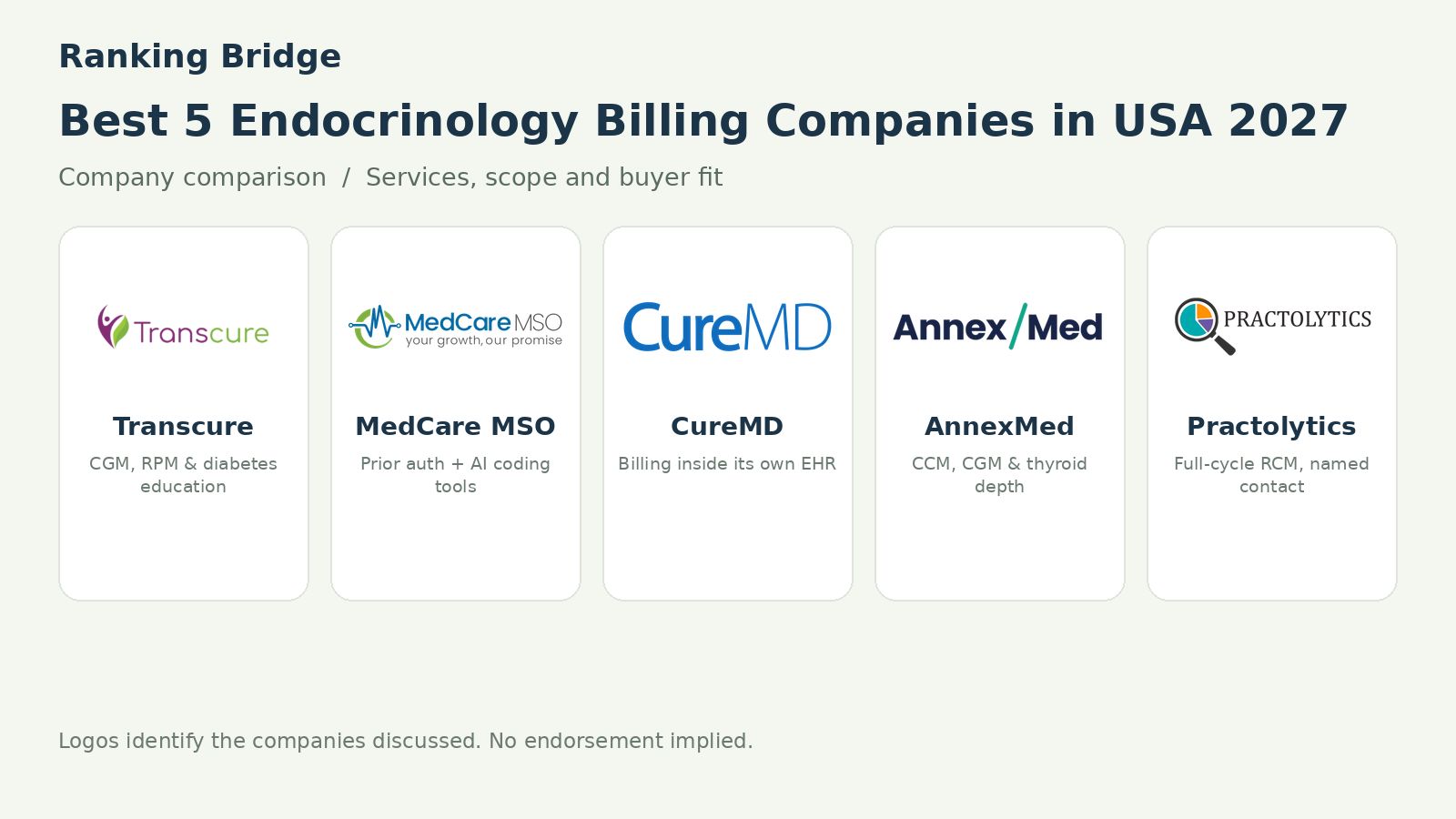
The table below compares the five companies on headquarters, best fit, and key strength. After the table, each company gets a closer look.
| Company | Headquarters | Best for | Key strength |
|---|---|---|---|
| Transcure | Offices in NJ, TX, FL | CGM, RPM and diabetes education billing | Device rules, DSMT and AI claim checks |
| MedCare MSO | Irvine, CA | Prior auth for devices and GLP-1 drugs | Dedicated team plus AI coding tools |
| CureMD | New York, NY | Billing inside its own EHR platform | AI claim scrubbing and fee schedules |
| AnnexMed | Salt Lake City, UT | Chronic care and multi-service coding | CCM, CGM and thyroid procedure depth |
| Practolytics | Columbia, SC | Full-cycle RCM for solo and group practices | Dedicated account manager and clear reporting |
Transcure — Best for CGM, RPM and diabetes education billing
Transcure runs one of the deepest endocrinology billing services in this shortlist. Its team bills CGM sensor placement and interpretation under 95250 and 95251, and it tracks remote monitoring data days and minutes for 99445, 99454, and 99457. In addition, it handles diabetes self-management training under G0108 and G0109, with referrals and hour caps checked before each claim. Meanwhile, its coders handle A1C point-of-care tests and add modifier 25 when a visit includes a procedure. As a result, device and education claims go out with the documentation payers expect.
The company puts heavy focus on the front end of the claim. For example, its AI eligibility agent checks coverage for CGM, diabetes education, and pump supplies before each visit. In addition, its prior authorization agent requests and tracks approvals for insulin pumps and CGM sensors. Its team also secures equipment approvals before the visit, so supply claims clear medical necessity review. Furthermore, its coders match every diabetes and thyroid visit to the right E/M, lab, and ICD-10 codes. They also review notes so a vague diabetes code gives way to the specific code the chart supports.
Transcure runs offices in Woodbridge, New Jersey; Farmers Branch, Texas; and Oviedo, Florida. Therefore, support spans several time zones. The company works with practices of many sizes, from independent endocrinologists to larger diabetes centers. Among the best endocrinology billing companies, Transcure stands out for device-rule depth. Overall, it suits a practice whose revenue leans on CGM, remote monitoring, and diabetes education.
MedCare MSO — Best for prior authorization and device billing
MedCare MSO builds its endocrinology service around prior authorization and dedicated support. Specifically, it assigns a dedicated team of AAPC-certified billers to each client, so one team always knows the status of every claim. In addition, its team manages the full authorization cycle for CGM devices, insulin pumps, GLP-1 medications, and growth hormone therapy. Because high-cost endocrine treatments need approval before they start, that workflow protects both care and cash flow.
The coding side covers the full range of endocrine conditions. For example, its team codes thyroid ultrasound and fine needle aspiration by lesion count and guidance method. In addition, it handles diabetes, adrenal disorders, PCOS, hormone imbalances, and osteoporosis with the right ICD-10 detail. Its coders also apply modifier 25, professional and technical splits, and NCCI logic when a visit and a procedure share the same day. Furthermore, its AI ecosystem adds another layer: an EHR with an AI scribe, an AI coder, and an AI rule engine that checks claims before submission.
MedCare MSO runs its main office from Irvine, California, with a second office in Santa Fe, New Mexico. Overall, it suits an endocrinology practice that wants a dedicated team and tight authorization control. Few billing firms match its device and drug authorization depth. In short, MedCare MSO fits a practice that wants to know exactly who owns its claims each day.
CureMD — Best for billing inside its own EHR
CureMD pairs its endocrinology billing service with its own EHR and practice management platform. Its team handles claim creation and submission, follow-ups, denial management, appeals, payment posting, and performance reporting. In addition, AI-driven code scrubbing finds and fixes errors before submission, which helps complex endocrine claims go out clean. Because billing lives inside the same system as charting, patient data moves from the note to the claim without re-entry. As a result, fewer handoffs mean fewer chances for errors on multi-service visits.
The service covers the coding traps that cost endocrine practices the most revenue. For instance, its coders work with complex ICD-10 combination codes and apply the right modifiers for hormone therapy and metabolic disorders. In addition, real-time eligibility verification confirms coverage for endocrine tests, medications, and procedures before the visit. Its team also manages fee schedules for insulin pump therapy, thyroid scans, and metabolic panels. Furthermore, it maps procedures and diagnoses accurately, from diabetes management to thyroid biopsies and hormone therapies.
CureMD keeps its headquarters in New York, NY. In short, it fits an endocrinology practice that wants one vendor for both software and billing. Among the best endocrinology billing companies, few match that single-platform depth. However, practices that already love their current EHR should check integration options before switching. For practices that want coding support alongside their own EHR, our guide to the top medical coding companies in USA 2027 covers that option.
AnnexMed — Best for chronic care and multi-service coding
AnnexMed focuses on the chronic, recurring side of endocrinology billing, where small misses compound month after month. Its team runs a complete chronic care management program, with time tracking, consent documentation, and care plan checks for codes 99490, 99439, and 99491. In addition, it bills CGM services across the full range, from device fitting and training to data interpretation and supply billing. Its coders also handle insulin pump billing, with pump candidacy records, titration notes, and supply tracking.
The company also tackles the multi-service encounters that fill an endocrine schedule. For example, a single visit can mix an E&M exam, a lab panel, an injection, and a monitoring review. Its team applies modifier 25 and bundling analysis so each distinct service pays. In addition, it codes thyroid fine needle aspiration by site, imaging method, and number of passes, plus DEXA scans with strict frequency rules. Its coders hold AAPC, AHIMA, and AAHAM certifications, and the company reports SOC 2 Type II compliance on its site.
AnnexMed runs its corporate office from Salt Lake City, Utah, and says it supports more than 100 healthcare providers. Its service covers general endocrinologists, diabetologists, thyroidologists, reproductive endocrinologists, and pediatric endocrinologists. Overall, AnnexMed suits a practice whose biggest billing risk sits in chronic care capture and multi-service visits. In short, it fits a group that wants coding depth across every endocrine sub-specialty.
Practolytics — Best for full-cycle RCM with dedicated support
Practolytics runs end-to-end revenue cycle management for endocrine practices, from patient intake to final payment. Its team checks eligibility, captures charges, validates codes, submits claims, posts payments, and follows up on every open balance. In addition, it manages patient balances and gives clients reporting with full visibility into collections and denials. Its service scales from solo clinics to multi-location groups, so a growing practice keeps the same billing partner.
The coding coverage spans the conditions an endocrine practice sees every day. For example, its team handles diabetes billing for Type 1 and Type 2 patients under ICD-10 E10 and E11, with insulin management records and diabetes education review. In addition, it codes thyroid disorders, hormone therapy, PCOS, and pediatric endocrinology with the right diagnosis detail. Its team also manages prior authorization for CGM devices, lab tests, and specialty treatments, with follow-up and appeal support when a payer pushes back. Furthermore, it assigns a dedicated account manager to each practice.
Practolytics runs its main office from Columbia, South Carolina, with a second office in Duluth, Georgia. Overall, it suits an endocrinology practice that wants one team for the whole revenue cycle plus a named contact. In short, Practolytics fits a practice that values clear reporting and steady support over a software-heavy platform.
How to choose among the best endocrinology billing companies
Start with device billing depth. The best endocrinology billing companies bill CGM every day, not occasionally. First, ask whether the vendor handles 95250 and 95251 as core work, and how it tracks RPM data days under the 2026 rules. A team that codes devices daily will catch frequency errors a general team misses. In addition, ask how the vendor documents remote monitoring time, since Medicare covers CGM only for patients who use insulin or have problematic hypoglycemia, with visit rules attached.
Second, check how the vendor handles prior authorization. CGM devices, insulin pumps, GLP-1 drugs, and growth hormone all need approvals before treatment. Therefore, the billing team must secure authorizations fast, or care stalls and cash flow follows. If the vendor cannot explain its authorization workflow, keep looking.
Third, review same-day billing and chronic care capture separately. Endocrine visits often mix an exam, a lab test, and a procedure in one encounter. Similarly, ask how the team bills chronic care management codes, since many practices miss that recurring revenue. Finally, check whether the vendor tracks payment policy changes. Under the CY 2027 Physician Fee Schedule final rule, CMS set conversion factors of $32.95 for qualifying APM participants and $32.63 for others, and the G2211 add-on code becomes modifier B1. For a broader view of specialty billing, see our guide to the best neurology billing companies and the best denial management companies.
Frequently Asked Questions
Why is endocrinology billing harder than general medical billing?
Endocrinology billing is harder because the specialty mixes chronic care, devices, labs, and education in a single patient relationship. Each service carries its own codes, frequency limits, and documentation rules. In addition, payers bundle many endocrine services, so one wrong modifier can trigger a denial. As a result, general billing experience is rarely enough.
What are the CGM billing codes 95250 and 95251?
CPT 95250 covers CGM sensor placement, hook-up, calibration, and patient training. In contrast, CPT 95251 covers the interpretation and report of at least 72 hours of CGM data. Both codes carry frequency limits, so the billing team must track when each code was last billed. In addition, Medicare ties CGM coverage to insulin use or problematic hypoglycemia.
What changed for remote patient monitoring billing in 2026?
CMS added two codes in the CY 2026 Physician Fee Schedule final rule. CPT 99445 covers device supply when a patient sends data on 2 to 15 days in a 30-day period. Meanwhile, CPT 99470 covers the first 10 minutes of management time in a month. Before 2026, the device code needed 16 days of data and the management code needed 20 minutes. Therefore, practices that still apply the old thresholds miss billable months.
What should an endocrinology billing service include?
At a minimum, look for eligibility checks, specialty coding, prior authorization, clean-claim submission, denial management, and AR follow-up. In addition, the best endocrinology billing companies report clearly on denials and collections, so ask to see a sample report. Finally, confirm the team understands CGM, DSMT, RPM, and chronic care codes before you sign.
Conclusion
Endocrinology billing rewards specialists. The five companies above are among the best endocrinology billing companies for US endocrine practices, and each one fits a different type of practice. Transcure suits groups whose revenue leans on devices and diabetes education, while MedCare MSO fits practices that want tight authorization control. CureMD works well for groups that want billing inside their EHR, AnnexMed covers chronic care and multi-service coding, and Practolytics leads on full-cycle support with a named contact.
Before you sign, request proposals from at least two vendors and check references from endocrinology practices like yours. The right partner pays for itself through cleaner claims and faster payments.
