ICD-10 Code I10: Essential Hypertension — Coding Guide for 2027
This voice experience is generated by AI.
ICD-10 code I10 is the code for essential (primary) hypertension. It covers high blood pressure with no stated cause and no related heart or kidney disease. In addition, it is the only code for primary hypertension in ICD-10-CM. There are no subdivisions, so coders report I10 exactly as written. The code is billable and valid for FY2027. However, I10 is not always the right choice. When hypertension comes with heart disease, chronic kidney disease, or a known secondary cause, a different code applies. Therefore, the coder’s first job is to check the record for those conditions. This guide walks through each decision in order.
What ICD-10 Code I10 Covers
First, I10 stands for essential (primary) hypertension. In plain terms, it means high blood pressure with no identified underlying cause. The provider has diagnosed hypertension, and the record shows no related heart disease, no chronic kidney disease, and no secondary cause.
In addition, the inclusion terms under I10 are broad. They cover high blood pressure and hypertension described as arterial, benign, essential, malignant, primary, or systemic. As a result, those words in the note do not change the code. A patient with “benign essential hypertension” and a patient with “malignant hypertension” both map to I10. In ICD-9, those words mattered. Coders chose between 401.0, 401.1, and 401.9. In ICD-10, all three map to the single code I10.
I10 also has no controlled-versus-uncontrolled split. The FY2027 Official Guidelines assign controlled and uncontrolled hypertension to the appropriate code from categories I10–I15. In other words, “uncontrolled hypertension” is still I10 when no heart or kidney disease is documented. There is no separate code for it.
Finally, note the exclusions. I10 does not cover hypertensive disease complicating pregnancy, childbirth, or the puerperium (O10–O11, O13–O16). It also does not cover essential hypertension involving vessels of the brain (I60–I69) or vessels of the eye (H35.0-). When the record points to one of those, use the excluded code instead.
When NOT to Use I10: The Decision Flow
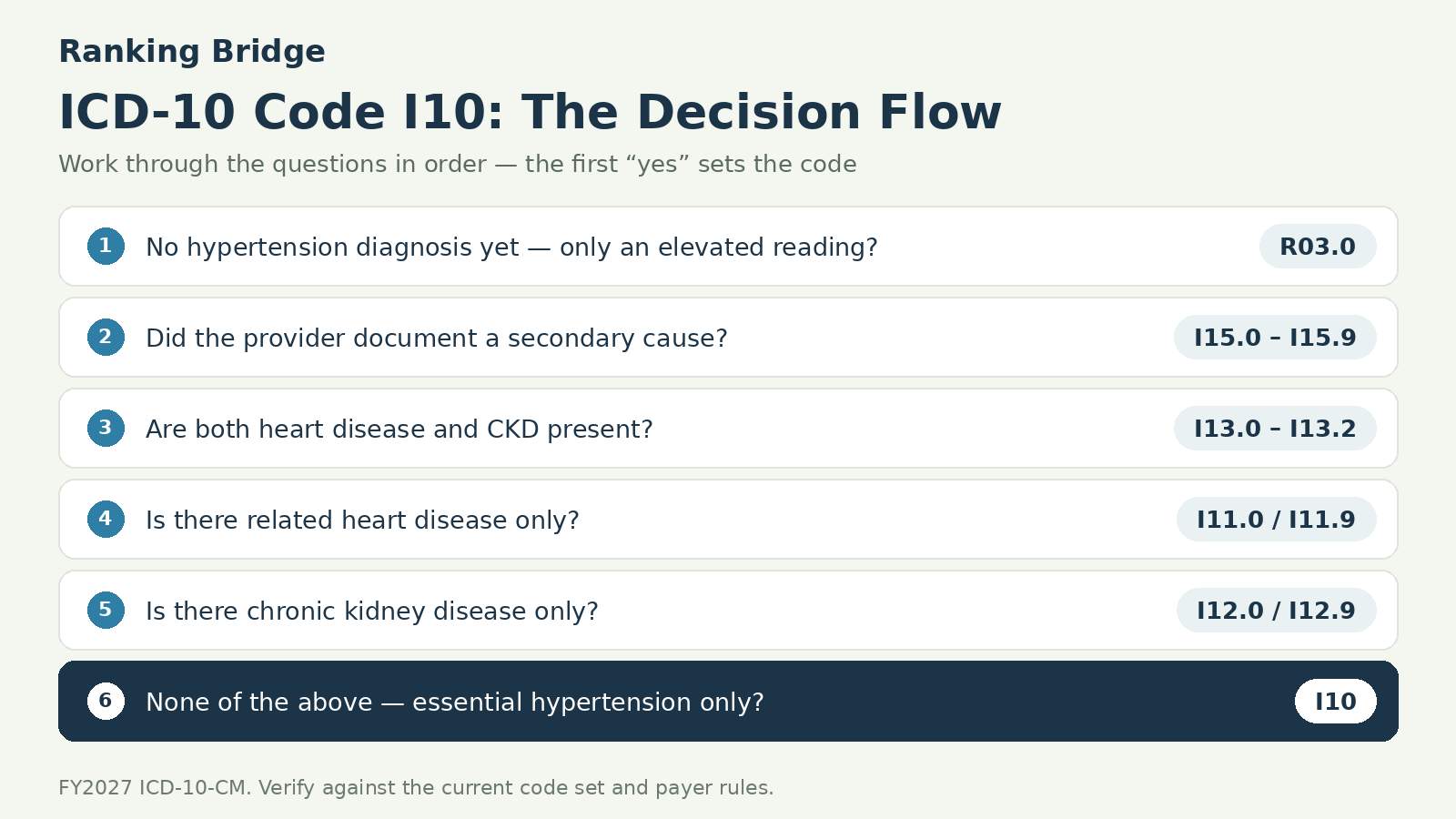
I10 is the default, not the answer for every hypertension case. Before assigning it, work through four questions. Each “yes” moves the case to a different code.
1. Does the provider document a secondary cause? If so, use a code from category I15, secondary hypertension. Renovascular hypertension is I15.0. Hypertension secondary to other renal disorders is I15.1. Hypertension secondary to endocrine disorders is I15.2. Other secondary hypertension is I15.8. When the cause is documented as secondary but not specified, use I15.9, secondary hypertension, unspecified.
2. Does the patient have both heart disease and CKD? If so, use category I13, hypertensive heart and chronic kidney disease. With heart failure and stage 1–4 or unspecified CKD, use I13.0. Without heart failure and the same CKD stages, use I13.10. Without heart failure but with stage 5 CKD or ESRD, use I13.11. With both heart failure and stage 5 CKD or ESRD, use I13.2. Do not use I11 or I12 codes alongside I13.
3. Does the patient have heart disease related to the hypertension? If so, use category I11, hypertensive heart disease. Use I11.0 for hypertensive heart disease with heart failure, and I11.9 without heart failure. In addition, add a code for the type of heart failure (I50.-) when heart failure is present. Note that chest pain reported alongside hypertension is coded separately — see our guide to ICD-10 code R07.9 for chest pain, unspecified.
4. Does the patient have chronic kidney disease? If so, use category I12, hypertensive chronic kidney disease. For stage 5 CKD or end-stage renal disease, use I12.0. For stage 1 through 4 CKD or unspecified CKD, use I12.9. In addition, always add the CKD stage code from category N18.-, because the I12 code alone does not state the stage.
| Situation | Code |
|---|---|
| Essential hypertension, no heart or kidney disease | I10 |
| Secondary cause documented | I15.0–I15.9 |
| Hypertension with heart disease | I11.0 / I11.9 (+ I50.- for heart failure type) |
| Hypertension with CKD | I12.0 / I12.9 (+ N18.- for CKD stage) |
| Hypertension with heart disease and CKD | I13.0 / I13.10 / I13.11 / I13.2 |
| Elevated reading, no hypertension diagnosis | R03.0 |
The Presumed-Link Rule
In fact, one guideline drives most of the decisions above. ICD-10-CM presumes a causal relationship between hypertension and heart involvement, and between hypertension and kidney involvement. The link is presumed even when the provider has not written “due to hypertension” in the note. Therefore, a patient with hypertension and heart failure is coded I11.0, not I10 plus a separate heart failure code.
There is one exception. When the provider documents that the heart or kidney condition is unrelated to the hypertension, the presumption does not apply. In that case, code each condition separately and sequence by the reason for the encounter. As a result, the provider’s wording matters. A single word — “unrelated” — changes the code set. Coders should query the provider when the relationship is unclear, rather than guessing.
This rule also explains why I10 disappears so often in complex patients. Hypertension rarely travels alone. When it arrives with heart disease or CKD, the combination code replaces I10 entirely. I10 is never reported alongside I11, I12, or I13 for the same patient.
Documentation Requirements
The first rule of I10 is simple. The provider must document hypertension. A coder never assigns I10 from a vital sign alone. A single high reading, or even several high readings, is not a diagnosis until the provider says so.
When the record shows an elevated reading but no hypertension diagnosis, use R03.0, elevated blood-pressure reading without diagnosis of hypertension. This code covers borderline, transient, and white-coat elevation, as well as an isolated incidental finding. For example, a patient with no hypertension history who shows an elevated reading at a preventive visit gets R03.0, not I10.
Similarly, do not code suspected hypertension in the outpatient setting. If the provider suspects hypertension but has not confirmed it, report only what is known at the end of the encounter. That usually means R03.0 for the elevated reading. A query to the provider can resolve the question for the next visit.
Overall, the documentation bar for I10 is low. The note needs a provider statement of hypertension, essential hypertension, high blood pressure, or a synonym included under I10. In addition, the record should show that no heart disease or CKD was identified, so the coder can be confident I10 is the right code. Type 2 diabetes often appears alongside hypertension, but it is coded separately with E11 and does not change the I10 decision.
Common I10 Coding Errors
Coding I10 together with I11, I12, or I13. In fact, this is the most frequent error. The combination codes already include the hypertension. Adding I10 on top of them is redundant and can trigger a denial. Choose one code family and stop there.
Coding I10 from vitals alone. In fact, a blood pressure reading is a measurement, not a diagnosis. Without a provider statement of hypertension, the correct code is R03.0. This error is common in preventive-visit coding, where the vitals are prominent and the diagnosis is absent.
Using I10 for secondary hypertension. When the provider documents a cause — renal artery stenosis, an endocrine disorder, or another renal condition — I15 applies. I10 means no cause was found. Using it for a known secondary cause misstates the patient’s condition.
Looking for a code for uncontrolled hypertension. In short, there is none. Controlled and uncontrolled hypertension both map to the same code family. “Uncontrolled” changes the treatment plan, not the code.
Forgetting the add-on codes. For example, I11.0 needs an I50.- code for the heart failure type. I12 and I13 need an N18.- code for the CKD stage. Without them, the claim is incomplete and the patient’s severity is understated.
Mixing up the letter I and the number 1. Finally, hypertension codes run from I10 to I15, and there is no I14. In some fonts, the capital I and the numeral 1 look identical. Double-check every hypertension code before submitting the claim.
Related Hypertension Codes
| Code | Descriptor |
|---|---|
| I10 | Essential (primary) hypertension |
| I11.0 | Hypertensive heart disease with heart failure |
| I11.9 | Hypertensive heart disease without heart failure |
| I12.0 | Hypertensive chronic kidney disease with stage 5 CKD or ESRD |
| I12.9 | Hypertensive chronic kidney disease with stage 1–4 CKD or unspecified CKD |
| I13.0 | Hypertensive heart and CKD with heart failure and stage 1–4 or unspecified CKD |
| I13.10 | Hypertensive heart and CKD without heart failure, with stage 1–4 or unspecified CKD |
| I13.11 | Hypertensive heart and CKD without heart failure, with stage 5 CKD or ESRD |
| I13.2 | Hypertensive heart and CKD with heart failure and stage 5 CKD or ESRD |
| I15.0 | Renovascular hypertension |
| I15.1 | Hypertension secondary to other renal disorders |
| I15.2 | Hypertension secondary to endocrine disorders |
| I15.8 | Other secondary hypertension |
| I15.9 | Secondary hypertension, unspecified |
| R03.0 | Elevated blood-pressure reading, without diagnosis of hypertension |
Atrial fibrillation often co-occurs with hypertension, and it has its own coding rules — see our guide to ICD-10 code I48.91.
RCM Note: What I10 Does (and Does Not) Do for Reimbursement
I10 is a straightforward code, but its reimbursement profile has limits. First, I10 is neither a CC nor an MCC in MS-DRG v44, so it does not add severity weight to an inpatient stay on its own. Second, I10 does not carry a risk-adjustment weight under the CMS-HCC V28 model for Medicare Advantage. Heart failure and advanced CKD do carry weight, which is one more reason to code I11, I12, and I13 correctly when they apply. Third, I10 on its own rarely justifies inpatient admission.
Nevertheless, none of this makes I10 unimportant. Clean hypertension coding supports accurate problem lists, supports chronic care management, and keeps the claim consistent with the record. For the wider 2027 policy picture, including Medicare payment changes that affect these patients, see our Medicare Changes 2027 guide.
Frequently Asked Questions
What is the ICD-10 code for essential hypertension?
I10, essential (primary) hypertension. It is the single billable code for hypertension with no stated cause and no related heart or kidney disease.
Is I10 billable?
Yes. I10 is a billable ICD-10-CM code, valid for HIPAA-covered claims in FY2027 (1 October 2026 – 30 September 2027). It has no subdivisions, so report it exactly as I10.
What is the difference between I10 and I11?
I10 is essential hypertension with no related heart disease. I11 is hypertensive heart disease — hypertension with a related heart condition. Use I11.0 when heart failure is present and I11.9 when it is not. Add an I50.- code for the heart failure type.
Can I code I10 from a high blood pressure reading alone?
No. A coder never assigns I10 from a vital sign alone. The provider must document hypertension. When the record shows only an elevated reading with no diagnosis, use R03.0 instead.
What code do I use for uncontrolled hypertension?
The same code as controlled hypertension. ICD-10-CM has no separate code for uncontrolled hypertension. Use I10 (or I11–I15 when heart disease, CKD, or a secondary cause applies).
When should I use R03.0 instead of I10?
Use R03.0 when the patient has an elevated blood pressure reading but no formal diagnosis of hypertension. This covers borderline, transient, and white-coat elevation, as well as an isolated incidental finding. Once the provider diagnoses hypertension, I10 replaces R03.0.
Sources
- CMS, ICD-10 Clinical Concepts for Family Practice — I10 descriptor; ICD-9 401.9 crosswalk
- AAFP, “How to Document and Code for Hypertensive Diseases in ICD-10” (FPM) — I11/I12/I13 descriptors; no I14
- AAFP, “Coding for Hypertension: Painting a Picture of the Severity of Illness” (FPM, March/April 2020) — R03.0 scenarios; never code from vitals alone
- ICD-10-CM Official Guidelines for Coding and Reporting, FY2027, Section I.C.9.a — presumed causal relationship; controlled/uncontrolled hypertension
