CPT 2027 Code Changes: 453 Updates, the End of Global OB Billing
This voice experience is generated by AI.
CPT 2027 code changes take effect on January 1, 2027. The AMA released the new code set on September 9, 2026. It holds 453 editorial changes in total: 299 new codes, 74 revisions, and 80 deletions. The biggest change retires the global maternity package. As a result, CPT 59400 and 16 other OB codes disappear. Practices must bill each phase of maternity care on its own.
This guide covers every change that matters for coders and billers. First, it walks through maternity, sleep, speech, and ABA in detail. Next, it explains the transition rule most roundups miss. Finally, it ends with a checklist your team can run before January 1.
CPT 2027 at a Glance: 453 Changes on January 1, 2027
Overall, the CPT 2027 code changes are a large annual update. For example, they touch maternity, sleep, speech, ABA, and several smaller families at once. The table below shows the headline counts from the AMA’s release.
| Change | Count |
|---|---|
| New codes | 299 |
| Revised codes | 74 |
| Deleted codes | 80 |
| Total editorial changes | 453 |
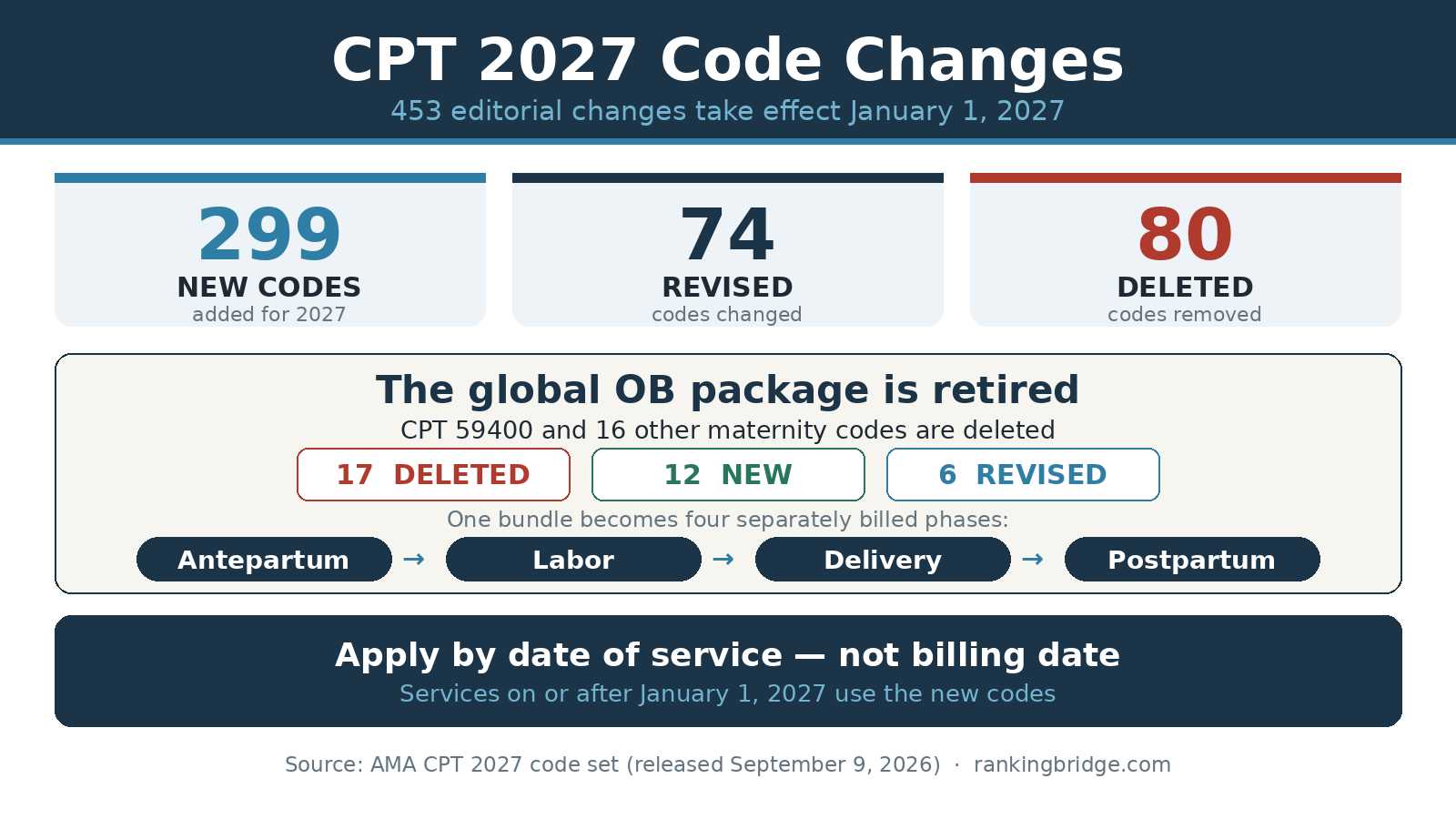
Above all, one rule governs the whole transition. Apply the new codes by date of service, not by billing date. In other words, services on or after January 1, 2027 use CPT 2027. Services through December 31, 2026 keep their 2026 codes, even if you bill them in 2027. This matters most for maternity care, because a single episode can span both years.
Maternity Care: The Global OB Package Is Retired
The headline change in CPT 2027 is maternity care. The AMA deleted 17 maternity codes, added 12 new ones, and also revised 6 more. Its maternity guidance appeared on September 17, 2026. Before 2027, the old model bundled antepartum care, labor, delivery, and postpartum care into one global package. CPT 2027 ends that bundle. Instead, CPT 2027 bills four phases separately: antepartum, labor management, delivery, and postpartum.
Antepartum and postpartum care now move to per-encounter E/M codes. Coders report them under ordinary E/M rules, by setting: office, hospital, or telemedicine. Report labor management once per calendar date. The code differs for the initial day versus a later day, and for straightforward versus complex care. Delivery codes cover delivery only. Routine postpartum care on the delivery day stays inside the delivery code.
CMS adopted the restructured codes in its CY 2027 Physician Fee Schedule final rule. At the same time, it declined to finalize 15 proposed HCPCS G-codes. Those codes would have preserved a global-style pathway. As a result, no global OB option remains for anyone on January 1, 2027. AMS Solutions’ review of the final rule adds that CMS set no maximum number of antepartum or postpartum visits.
Deleted maternity codes (17)
The AMA deleted these 17 codes. The four global packages are 59400, 59510, 59610, and 59618. Antepartum-only codes 59425 and 59426 go too, along with postpartum-only code 59430.
59050, 59400, 59409, 59410, 59425, 59426, 59430, 59510, 59514, 59515, 59525, 59610, 59612, 59614, 59618, 59620, 59622.
New maternity codes (12)
| Code | What it covers |
|---|---|
| 59080 / 59081 | Labor management, initial day — straightforward / complex |
| 59082 / 59083 | Labor management, subsequent day — straightforward / complex |
| 59431 | Vaginal delivery, with or without episiotomy |
| 59432 | Vaginal delivery after a previous cesarean (VBAC) |
| 59433 / 59434 | Repair of third-degree / fourth-degree laceration or episiotomy |
| 59502 / 59503 | Cesarean delivery — primary / repeat |
| 59504 | Hysterectomy following a cesarean (stand-alone code) |
| 59623 | Uterine tamponade |
The AMA revised six codes rather than replacing them: 59412, 59051, 59414, 59300, 59898, and 59899.
For OB practices that outsource billing, the change is also a vendor question. Our list of the best OB/GYN billing companies in the USA for 2027 can help. Use it if you need a partner that has the new codes loaded.
What Replaces CPT 59400?
Short answer: no single code replaces it. Instead, each phase of care gets its own code. Antepartum visits become E/M encounters. Labor management becomes 59080–59083. Delivery becomes 59431, 59432, 59502, or 59503. Postpartum visits become E/M encounters again.
For example, take a patient with five antepartum visits in 2026. Under the 2026 rules, four to six visits bill as 59425. She then has four more visits in January 2027. Each of those is a separate E/M encounter. She delivers vaginally in late January. Then the practice bills 59431 for the delivery, plus 59080 or 59081 for labor management. Her postpartum visits bill as E/M encounters too.
First, bill 2026 antepartum care at the end of 2026 or early in 2027, once the visit count is certain. Do not hold it until delivery. Second, a delivery in November or December 2026 still uses the 2026 global code, such as 59400. Postpartum visits in 2027 may then bill as E/M encounters.
Labor can also straddle the year boundary. If labor starts on December 31 and continues into a January 1 delivery, report labor management once on January 1. Use 59080 or 59081. If labor is not continuous, the AMA says December 31 may be an initial hospital E/M visit (99221–99223). In that case, contact the payer for its rule. As the AAFP puts it, a patient pregnant in 2026 and delivering in 2027 needs codes from both code sets.
The Transition Rule Most Roundups Miss: CMS’s Enforcement Discretion
On October 30, 2026, HHS issued a Statement of Enforcement Discretion for maternity CPT codes. Under it, HIPAA covered entities may keep using the CPT 2026 maternity codes for part of 2027. Specifically, the window runs January 1 through December 31, 2027. It covers only episodes of care that begin in 2026 and end in 2027.
Payers may issue business rules that allow the 2026 codes, but nothing forces them to. However, each payer decides for itself. Its rules should phase out the old codes as soon as practical in 2027. HHS will hold off on HIPAA enforcement against entities that follow a payer’s published rules. However, this letter is not payment policy. It does not guarantee that any payer will accept the 2026 codes. The discretion ends on December 31, 2027, with no extension announced.
Therefore, confirm each payer’s rules in writing before January 1. Do not assume a payer will accept 2026 codes just because HHS allows it. The full letter is on the CMS website (PDF).
Sleep Testing: 95800, 95801 and 95806 Become Six Tiered Codes
The home sleep testing family gets a full rebuild. CPT 2027 deletes 95800, 95801, and 95806. Instead, six new codes take their place. They split into technical codes and professional codes, and each side has three tiers: low, moderate, and high. Specifically, the tier depends on two counts: channels recorded, and parameter categories generated. Complexity follows the lower of the two counts.
| Tier | Channels / categories | Technical | Interpretation + report |
|---|---|---|---|
| Low | 3–4 channels, 3–5 categories | 95843 | 95847 |
| Moderate | 5–10 channels, 6–8 categories | 95844 | 95848 |
| High | 11+ channels, 9+ categories | 95846 | 95849 |
First, 95845 does not exist: the numbering skips straight from 95844 to 95846. Second, the crosswalk is partial. Codes 95843 and 95847 map from deleted 95800, while 95844 and 95848 map from deleted 95806. AASM states no crosswalk for 95846 or 95849, so do not assume one.
On payment, CMS raised the final work value for 95849 to 1.50, up from a proposed 1.42. However, the RUC had recommended 1.60. Meanwhile, attended sleep studies stay as they are: codes such as 95810 and 95811 do not change. Pair the new codes with the diagnosis side too — for example, ICD-10 code G47.33 for obstructive sleep apnea.
Medicare’s HCPCS home sleep codes G0398–G0400 do not appear in the final rule. However, CMS has not said whether they end. Therefore, check with your MAC before assuming either way.
Speech Therapy: 92507 Replaced by 10 Timed Codes
Speech-language pathology gets the most detailed rebuild of the year. CPT 2027 deletes 92507, the workhorse treatment code. It stays in effect through December 31, 2026. Ten timed codes replace it, numbered 92654 through 92663. Five are base codes for the first 30 minutes. In addition, five are add-on codes for each extra 15 minutes.
| Service | Base (first 30 min) | Add-on (each +15 min) |
|---|---|---|
| Fluency disorders | 92654 | +92655 |
| Speech sound production disorders | 92656 | +92657 |
| Language comprehension and expression disorders | 92658 | +92659 |
| Combined speech sound production + language disorders | 92660 | +92661 |
| Voice, upper airway dysfunction, and/or resonance disorders | 92662 | +92663 |
Specifically, time thresholds decide which code fits. Report the base code at 16 to 37 minutes. Add the add-on code at 8 to 22 minutes beyond the base. However, group treatment keeps its own code: 92508 stays, revised as a stand-alone untimed code for two or more patients.
CMS adopted the RUC-recommended work values and practice-expense inputs for all 10 codes without changes. It also added all 10 to the permanent Medicare Telehealth Services List. In addition, CMS finalized a Medicare-specific pediatric code for individual SLP treatment, G0903. ASHA had recommended withdrawing that code, but CMS finalized it anyway.
ABA: Six New Category I Codes
Applied behavior analysis moves from temporary codes to permanent ones. CPT 2027 adds six new Category I codes. It also revises 97151 through 97158. CPT 2027 permanently deletes Category III codes 0362T and 0373T, with no grace period.
| Code | What it covers | Unit |
|---|---|---|
| 97148 | Supporting assessment of harmful behavior: two technicians, customized setting, QHP on site | Per 15 min |
| +97149 | Each extra technician during 97148 (third through fifth) | Per 15 min |
| 97159 | Treatment of harmful behavior: two technicians, customized setting, QHP on site | Per 15 min |
| +97160 | Each extra technician during 97159 (third through fifth) | Per 15 min |
| 97173 | Direct treatment with analysis, in person by a physician or QHP, face-to-face with one patient | Per 15 min |
| 97180 | Non-face-to-face QHP work: data and note review, target decisions, planning, technician training | Per 15 min |
Code 97155 narrows to one role: direction of a technician with analysis. Direct treatment by the QHP moves to 97173. The wording across the family changes too. “protocol modification” becomes “analysis.” “Guardian(s)/caregiver(s)” becomes “caregiver(s).” Similarly, every code in the set bills in 15-minute units. Note that 97180 is reportable once per week, summing the time spent.
CMS proposed contractor pricing for the six new codes. No final pricing had appeared at the time of writing, so check your MAC’s fee schedule before quoting rates.
What Else Changed in CPT 2027
The CPT 2027 code changes reach beyond the four big families. Vestibular testing, biofeedback, and head-and-neck MRA also see changes this year. The exact code numbers sit in the codebook, so verify them there before billing. The AMA also restructured the prostate biopsy family. Also, diaphragmatic hernia repair gains nine new codes. Ventricular assist devices gain three. Finally, AI services gain 10 new codes, bringing the total to 43.
Still, check the full code set for your specialty before January 1.
CPT 2027 Implementation Checklist for Practices
About six weeks is not much time for the CPT 2027 code changes, so start now. Use this checklist to get ready before January 1.
- Load the 2027 code set into your EHR and charge master. Retire deleted codes from superbills and order sets.
- Update claim scrubber edits for the new families — maternity, sleep, speech, and ABA first.
- Re-check authorizations tied to deleted codes: 59400, 92507, 95800, 95801, 95806, 0362T, and 0373T.
- Confirm payer repricing for the new codes, especially the four-phase maternity model.
- Train coders on the new rules: timed-code thresholds for speech and ABA, and the labor-management calendar-day rule.
- Keep 2026 codes live in the system for 2026 dates of service.
- Finally, ask each payer for its enforcement-discretion business rules in writing, for maternity episodes that span the year.
Pair this list with our CY 2027 Medicare Physician Fee Schedule RCM checklist. It covers the payment side of the same January 1 deadlines. If the 453-change load is more than your team can absorb, outside help is an option. See the top medical coding companies in the USA for 2027.
Frequently Asked Questions
How many CPT codes changed in 2027?
453 in total. The CPT 2027 code changes add 299 new codes, revise 74, and delete 80. It takes effect January 1, 2027.
Is CPT 59400 deleted in 2027?
Yes. CPT 2027 deletes CPT 59400 along with 16 other maternity codes. Its replacement is not one code but four phases. Antepartum and postpartum visits bill as E/M encounters. Labor management bills once per calendar date. Delivery bills under the new delivery-only codes.
What replaces the global OB package in 2027?
Four-phase billing replaces it. Antepartum and postpartum visits bill as E/M encounters. Labor management bills once per calendar date. Delivery bills under the new delivery-only codes. CMS also declined to finalize HCPCS G-codes that would have kept a global-style option, so no global pathway remains.
Can I still use the 2026 maternity codes in 2027?
Only in a narrow window. HHS enforcement discretion lets HIPAA covered entities use the 2026 maternity codes through December 31, 2027. Specifically, it covers only episodes that began in 2026. Each payer decides whether to allow it, so confirm your payer’s rules in writing first.
What replaces CPT 92507 for speech therapy?
Ten timed codes, 92654 through 92663. Five cover the first 30 minutes of treatment, and five are add-ons for each extra 15 minutes. However, group treatment stays on 92508, which CPT 2027 keeps as a stand-alone untimed code.
What are the new home sleep test codes for 2027?
Six tiered codes, 95843 through 95849. Three cover the technical side, and three cover interpretation and reporting. Each side has low, moderate, and high tiers, set by channels recorded and parameter categories generated. Note that 95845 does not exist.
Sources
- AMA, “AMA releases CPT 2027 code set” (press release, September 9, 2026)
- AMA, “CPT 2027 Maternity Care Services code changes” (September 17, 2026)
- CMS / HHS, Statement of Enforcement Discretion: maternity care services CPT guidance (letter, October 30, 2026)
- AASM, “CMS finalizes payment values for new unattended sleep testing codes” (November 6, 2026)
- AASM, “New 2027 CPT guidance for unattended sleep testing now available” (October 30, 2026)
- ASHA, “Speech-Language Pathology Treatment Codes Replacing 92507”
- ASHA, “CMS Proposes Medicare Payment for New Speech-Language Pathology Treatment Codes” (November 2026)
- ABA Coding Coalition, “2027 CPT Code Conversion Crosswalk” (September 11, 2026)
- AAFP, “Maternity care and obstetrical services CPT codes”
General information about CPT coding changes, not individual billing advice. Code numbers come from the AMA CPT 2027 code set; confirm coverage and payment with your payer and Medicare Administrative Contractor.
