Sudden Lower Back Pain: Causes, When to Worry & What to Do
This voice experience is generated by AI.
Sudden lower back pain can arrive without warning. One moment you bend to tie a shoe, and the next moment your lower back locks up. Or lower back pain came on suddenly overnight, and you wake up barely able to stand straight. Either way, the pain feels alarming, yet most cases have a simple cause. This guide covers the usual causes, the warning signs that need urgent care, and the first-48-hours plan.
The short answer
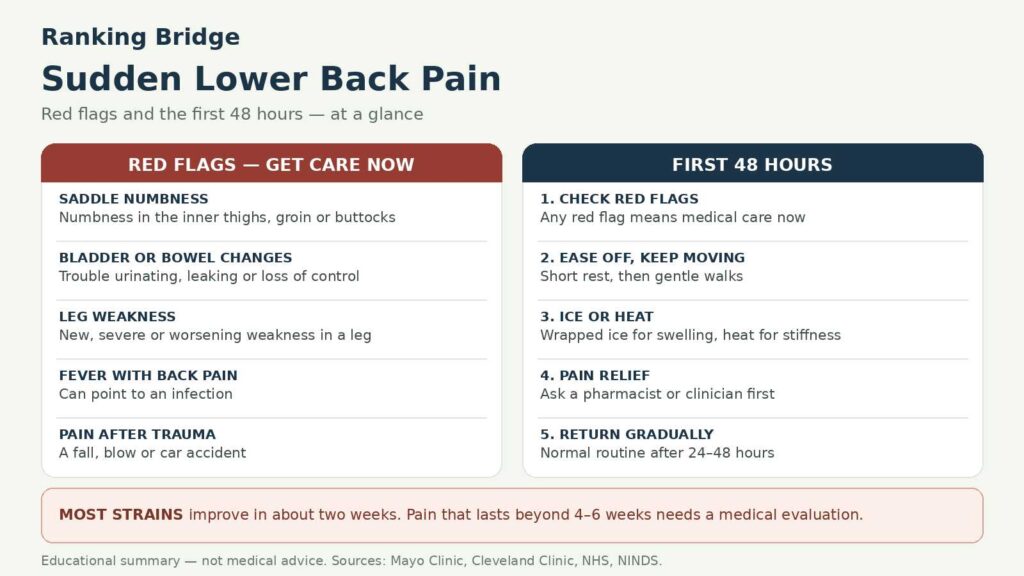
Sudden lower back pain is most often a muscle strain or ligament sprain. An awkward lift, a twist, or sleeping badly can trigger it. In most cases, it eases within a few days to two weeks. Get urgent care if you have numbness in the saddle area, bladder or bowel changes, or leg weakness. Also seek care at once for fever or pain after a fall.
In fact, Mayo Clinic notes that most back pain improves with home treatment and self-care, often within a few weeks. About 80% of adults in the U.S. will experience low back pain at some point, according to Mayo Clinic. Still, a small number of cases do need fast medical care, so the red flags in this guide matter.
Common causes of sudden lower back pain
So what causes sudden back pain? In most cases, sudden lower back pain comes from a strain or sprain. The cause is usually mechanical — something in the way the back moves and bears weight went wrong, rather than a disease. The National Institute of Neurological Disorders and Stroke (NINDS) explains that most acute back pain is mechanical in nature. Sprains and strains account for most acute back pain — for example, after a twist, a heavy lift, or an overstretch.
Muscle strain and ligament sprain
A strain is a tear in a muscle or tendon. A sprain is a stretched or torn ligament. Both injuries can happen in a single moment. Mayo Clinic explains that repeated heavy lifting or a sudden awkward movement can strain back muscles and spinal ligaments. In people in poor physical condition, constant strain on the back can cause painful muscle spasms. Strains often feel like a sudden stabbing pain in one spot. The pain usually worsens when you contract the muscle or twist. In addition, redness, swelling, or bruising can appear.
Everyday triggers that add up
Not every strain comes from heavy lifting. Prolonged sitting can load the lower back for hours. Cleveland Clinic lists it among the causes of low back pain. A poor sleeping position can also contribute, according to NINDS. Then a small movement can tip an already tired back into spasm — reaching for a dropped pen, for example. NINDS also notes that too little exercise followed by a strenuous workout can cause back pain. In short, the trigger is often small, while the build-up took days or weeks.
Sudden back pain with no injury
Sometimes there is no clear trigger at all. Mayo Clinic notes that back pain often develops without a cause that tests or imaging can show. Stress can play a part as well. NINDS lists stress among the factors that may contribute to low back pain. NHS guidance notes that back pain can worsen with stress and anxiety. When stress keeps muscles tense for hours, the back tires faster and strains more easily. If stress or low mood plays a part, see our guide to the early signs of mental health problems.
Less common causes
A bulging or herniated disc can also cause sudden pain when disc material presses on a nerve. However, Mayo Clinic notes that a bulging or ruptured disk might not cause back pain at all. Arthritis can affect the lower back as well, and discs lose fluid and flexibility with age. As a result, the spine cushions impact less well over time.
Sciatica vs muscle strain — how they feel different
Pain that travels down the leg usually points to a nerve, not just a sore muscle. When sudden lower back pain shoots into the buttock or leg, sciatica is often the reason. Sciatica is nerve pain from injury or irritation to the sciatic nerve, the largest nerve in the body. In contrast, a muscle strain usually stays in the back. The table below sums up the main differences.
| Feature | Muscle strain | Sciatica |
|---|---|---|
| Where it hurts | Mainly the lower back, sometimes the buttocks | Buttock and down one leg, often below the knee |
| Pain feel | Dull ache, sharp stab, or stiffness in one spot | Sharp, burning, or electric shock |
| Nerve symptoms | Rare — feeling in the leg usually stays normal | Numbness, tingling, or weakness are common |
| What makes it worse | Contracting the muscle, twisting, bending | Coughing, sneezing, sitting for a long time |
| Typical course | Often improves in about two weeks | Often improves in a few weeks to a few months |
Sciatica usually affects one side of the body, and the pain often follows the path of the sciatic nerve down one leg. It can also bring numbness, tingling, or weakness in the leg or foot. A herniated disc causes most cases, when disc material presses on a nerve root. Our full comparison of sciatica vs lower back pain explains the symptoms, causes, and treatment in detail.
Red flags: get care now
Most sudden lower back pain is harmless, but a small number of cases need urgent care. The warning signs below all mean the same thing: do not wait it out. Call emergency services or go to urgent care at once if you notice any of them.
- Numbness in the saddle area — the inner thighs, groin, and buttocks. Along with bladder or bowel changes, this can signal cauda equina syndrome, a rare emergency where the nerve bundle at the base of the spine is under pressure.
- New bladder or bowel problems — trouble starting to urinate, leaking, or loss of control.
- Leg weakness — in particular, weakness that is new, severe, or getting worse.
- Fever with back pain — this can point to an infection.
- Pain after a fall, blow, or car accident — trauma can fracture or injure the spine.
Cauda equina syndrome is rare, yet it needs emergency care because delayed treatment can leave lasting nerve damage. Mayo Clinic lists new bowel or bladder problems, fever, and pain after an injury as reasons to seek immediate care. In short, new bladder or bowel changes with back pain always deserve same-day care.
See a clinician soon if…
Some signs need a prompt appointment rather than emergency care. Contact your healthcare professional if your pain lasts longer than a few weeks, or if it spreads down one or both legs, especially below the knee. The same applies to weakness, numbness, or tingling in a leg, and to unexplained weight loss. Pain that stays constant or intense, especially at night or when you lie down, also deserves a prompt visit. If you have a history of cancer, tell your clinician about any new back pain.
What to do in the first 48 hours
The first 48 hours after sudden lower back pain starts set the tone for recovery. Cleveland Clinic describes treatment in two phases. First, the goal is to reduce pain, spasm, and swelling. Then, after 24 to 48 hours, the goal shifts to a gradual return to normal routines.
- Check the red flags first. If any red flag from the section above applies, get medical care now instead of starting home care.
- Ease off, but keep moving. Rest briefly if the pain is sharp, then move gently — short walks and light tasks beat lying still. Cleveland Clinic warns that extended bed rest prolongs symptoms and delays recovery.
- Use ice or heat. The NHS suggests an ice pack wrapped in a tea towel to reduce pain and swelling. A heat pack or hot water bottle, also wrapped, can relieve stiffness or muscle spasms.
- Consider pain relief. Over-the-counter pain medicines often help, according to Mayo Clinic. The NHS notes that anti-inflammatory medicine like ibuprofen may not suit everyone. Check with a pharmacist or clinician before taking anything new.
- Return to normal activities gradually. After the first day or two, resume your usual routine as your back allows. The NHS advises staying active and continuing with daily activities. Avoid heavy lifting and twisting until the pain settles.
What not to do
The mistakes below are common, so avoid them while your back heals.
- Do not stay in bed for days. Bed rest is not recommended, according to Mayo Clinic. The NHS gives the same advice: do not stay in bed for long periods.
- Do not jump back into heavy lifting. Give the strain a few days before you test it with heavy loads or intense exercise.
- Do not rely on painkillers alone. Pain relief can help you stay active, yet it does not heal the strain on its own. NHS guidance pairs pain relief with gentle heat, relaxation, and exercise.
- Do not ignore new symptoms. If numbness, weakness, or bladder changes appear, they change the picture.
- Do not expect a scan to explain everything. Back pain often develops without a cause that shows up in a test or imaging study, according to Mayo Clinic. For that reason, clinicians usually diagnose a mild strain from your history and a physical exam.
When it becomes chronic
Cleveland Clinic notes that most people with back strains improve in about two weeks. However, pain that persists beyond four to six weeks needs further medical evaluation. At that point, a clinician can check for an underlying cause and discuss the next steps. Clinicians usually explore non-surgical options first, such as physical therapy. If pain keeps returning, a clinician can also look at habits that load the back — long sitting, weak core muscles, or poor lifting form — and suggest changes. In short, pain that outlasts a few weeks deserves a proper check, not just more waiting.
FAQs
Is sudden back pain without injury normal?
Yes, it is common. Back pain often develops without a cause that tests or imaging can show, according to Mayo Clinic. Stress, poor sleeping position, and posture can all contribute, according to NINDS. For example, a back already tired from a long day of sitting can seize up from a simple bend. That said, pain with fever, bladder or bowel changes, or leg weakness needs urgent care.
How long should sudden lower back pain last?
Most strains improve in about two weeks, according to Cleveland Clinic. If pain has not improved after a week of home treatment, call your healthcare professional. Pain that persists beyond four to six weeks needs further medical evaluation. In short, steady improvement over days is the usual pattern.
Should I rest or keep moving?
Do both, in that order. Rest briefly while the pain is sharp, then move gently as soon as you can. Bed rest is not recommended, according to Mayo Clinic. Cleveland Clinic advises resuming normal routines after the first 24 to 48 hours, because extended bed rest prolongs symptoms. Avoid heavy lifting and twisting until the pain settles.
When is sudden back pain an emergency?
Get emergency care at once for back pain with new bladder or bowel problems, numbness in the saddle area, or new leg weakness. The same applies to back pain with a fever, or pain after a fall or another injury. These signs can point to a serious problem, such as cauda equina syndrome or a spinal infection. Mayo Clinic lists them as reasons to seek immediate care. Do not wait to see whether they pass on their own.
Sudden lower back pain is frightening, but most cases are simple strains that heal with time and gentle movement. Learn the red flags, act fast if they appear, and give your back a few days of sensible care.
This article is educational information, not medical advice. It cannot diagnose or treat any condition. If back pain worries you, speak to a clinician.
