Best 5 General Surgery Billing Companies in USA 2027
This voice experience is generated by AI.
General surgery billing is one of the most complex specialties to bill correctly, and choosing among the best general surgery billing companies starts with knowing what makes surgical claims different. A single operation can mix a pre-op decision visit, the procedure itself, and 90 days of follow-up care. In addition, each part follows its own global period, modifier, and bundling rules. As a result, a general billing team often misses the details that decide whether a surgical claim pays in full or denies. For that reason, many surgical practices now compare specialist firms before they outsource.
This guide compares five companies that each run a dedicated surgical billing service. Specifically, four of them publish a dedicated general surgery billing page, and the fifth runs a broad surgical billing service. In addition, we explain what makes each one different, so you can match a partner to your case mix, volume, and software. Overall, this is an editorial shortlist, not a ranking. Therefore, the best choice depends on your needs, not on the order below.
The five companies also differ in how much they take off your plate. For instance, some handle the full revenue cycle, while others focus on modifier accuracy and global-period tracking. Because of that range, a side-by-side comparison helps you weigh real options before you request proposals. For a similar shortlist in another procedure-heavy specialty, see our guide to the best orthopedic billing companies in USA 2027.
Finally, payment pressure keeps growing. Under the CY 2027 Physician Fee Schedule final rule, CMS set conversion factors of $32.95 for qualifying APM participants and $32.63 for others. Consequently, accurate coding matters more than ever for surgical practices.
Best general surgery billing companies at a glance
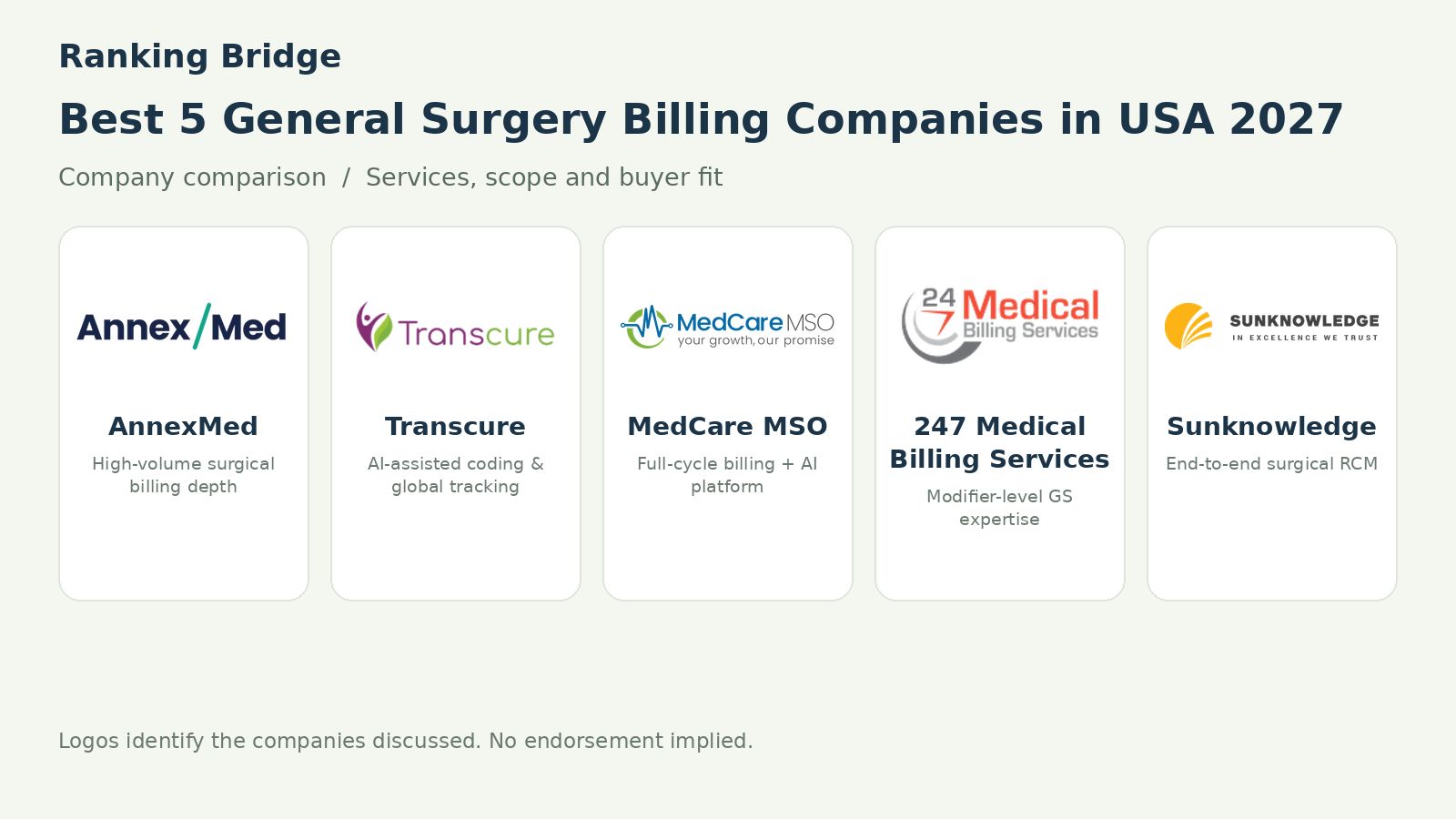
The table below compares the five best general surgery billing companies on headquarters, best fit, and key strength. After the table, each company gets a closer look.
| Company | Headquarters | Best for | Key strength |
|---|---|---|---|
| AnnexMed | Salt Lake City, UT | High-volume surgical billing depth | Full CPT range, global periods and modifier logic |
| Transcure | Offices in NJ, TX, FL | AI-assisted coding and global-period tracking | AI claim scrubbing plus co-surgeon billing |
| MedCare MSO | Irvine, CA | Full-cycle billing with an AI platform | Operative-note coding and ASC billing |
| 247 Medical Billing Services | Lewes, DE | Modifier-level general surgery expertise | 24/25/57/58/78/79 and co-surgeon claims |
| Sunknowledge | New York, NY | End-to-end surgical RCM on any platform | Pre- and post-surgery billing with same-day claims |
AnnexMed — Best for high-volume surgical billing depth
AnnexMed runs one of the deepest general surgery billing services in this shortlist. Its team covers hernia repair, appendectomy, cholecystectomy, laparoscopic procedures, and the full general surgery CPT range from 10xxx through 49xxx. In addition, it handles acute care, trauma, bariatric, breast, and oncological surgery programs. Meanwhile, its coders also serve ambulatory surgery centers, so facility and professional billing stay aligned. As a result, a high-volume practice can keep all of its surgical billing with one vendor.
The company puts heavy focus on the rules that drive surgical denials. For example, its team manages global surgical periods of 0, 10, and 90 days, so follow-up care inside the window never bills twice. In addition, it handles multiple procedure payment reductions, which cut payment on secondary procedures in the same session. Its coders also separate open from laparoscopic CPT codes and capture laparoscopic-to-open conversions, which prevents downcoding. Furthermore, it handles assistant and co-surgeon billing with the right modifiers for each case.
AnnexMed runs its corporate office from Salt Lake City, Utah. Its coders hold AAPC, AHIMA, and AAHAM certifications, and the company reports SOC 2 Type II compliance on its site. Among the general surgery billing companies in this guide, AnnexMed stands out for procedural breadth. Overall, it suits a surgical group that runs dozens of cases a week and needs billing built for that volume.
Transcure — Best for AI-assisted coding and global-period tracking
Transcure pairs AAPC-certified coders with AI-driven RCM tools for general surgery billing. Its platform checks coding accuracy, verifies eligibility in real time, and automates prior authorization for scheduled surgeries. In addition, its AI claim scrubbing flags coding, modifier, and NCCI errors before submission. Because surgical claims carry so many modifier rules, that pre-check catches errors a manual review often misses.
The service covers the full general surgery revenue cycle. For example, its team tracks the 10-day and 90-day global periods, so follow-up visits bill correctly inside each window. In addition, it applies modifiers 51, 59, and 22 for multiple procedures and increased procedural services. Its coders also handle assistant and co-surgeon billing with modifiers 80, 81, and 62.
Transcure runs offices in Woodbridge, New Jersey; Farmers Branch, Texas; and Oviedo, Florida. Therefore, support spans several time zones. The company reports HIPAA and ISO 27001 compliance on its site. In short, it fits a surgical practice that wants certified coders plus AI checks on every claim. Among the general surgery billing companies here, Transcure stands out for automation depth.
MedCare MSO — Best for full-cycle billing with an AI platform
MedCare MSO builds its general surgery service around careful operative-note coding and full-cycle follow-up. Specifically, its AAPC-certified coders read the full operative note before assigning CPT and ICD-10-CM codes and modifiers. In addition, its team enters charges within 24 hours and checks each one against NCCI edits, LCDs, and payer rules before release. Because general surgery spans emergency appendectomies, scheduled hernia repairs, and bariatric programs, that note-level care matters across the case mix.
The service covers every step between the operative report and the posted payment. For example, it verifies benefits and secures authorizations before the procedure, with payer-specific packets for bariatric and elective cases. In addition, it traces every denial to its root cause and appeals with operative documentation. Its team also follows up on aged accounts receivable and posts ERAs and EOBs daily. Furthermore, its AI ecosystem adds an EHR with an AI scribe, an AI coder, and an AI rule engine that checks claims before submission. Its ASC facility billing also covers implant, modifier, and out-of-network claims.
MedCare MSO runs its main office from Irvine, California, with a second office in Santa Fe, New Mexico. Overall, it suits a surgical practice that wants one team from coding through collections. For practices that want coding support alongside their own EHR, our guide to the top medical coding companies in USA 2027 covers that option.
247 Medical Billing Services — Best for modifier-level general surgery expertise
247 Medical Billing Services runs a general surgery billing service built around modifier accuracy. Its team tracks the 0-, 10-, and 90-day global periods and applies the E/M and staged modifiers that decide whether in-window care pays. For example, it uses modifier 57 for the decision visit, 25 for a significant same-day E/M, and 58, 78, and 79 for staged, complication, and unrelated returns. In addition, it handles co-surgeon and assistant claims with modifiers 62, 80, 81, 82, and AS. Because it scrubs every claim against NCCI procedure-to-procedure and Medically Unlikely Edits before submission, fewer claims bounce on bundling rules.
The service covers laparoscopic surgery, hernia repair, breast surgery, and trauma surgery. Its coders hold AAPC and AHIMA credentials and follow HBMA-aligned processes. In addition, each client gets a dedicated account manager and a free 360-degree reporting dashboard, so every claim stays visible. The company reports HIPAA compliance and SOC 2 Type II controls on its site.
247 Medical Billing Services works from Lewes, Delaware, and says it has billed surgical practices since 2005. Note that this is the Delaware firm, not a similarly named New York company. In short, it fits a general surgery practice whose biggest billing risk sits in modifier and global-period rules. Overall, it suits groups that want a specialist team watching every modifier on every case.
Sunknowledge — Best for end-to-end surgical RCM on any platform
Sunknowledge covers surgical billing from patient intake through payment posting. In particular, its team handles eligibility and authorization verification, prior authorization, medical coding, charge posting, claims submission, payment posting, denial management, and accounts receivable follow-up. Because surgical billing mixes pre-op and post-op work, it takes complete pre- and post-surgery billing responsibility. For example, it creates, submits, and follows up on surgery claims the same day, then posts payments as they arrive.
Sunknowledge puts strong focus on claim accuracy before submission. Specifically, its team reviews every charge for accuracy and scrubs each claim before it goes out. In addition, it handles ERA and EOB payment posting, patient responsibility, and secondary balances. Its coders hold ICD-10 certification, and the team works across all major billing platforms, including Kareo, AdvancedMD, and NextGen, plus proprietary EHR and practice management systems.
Sunknowledge works from New York, NY, and reports nearly two decades in business on its site. One honest note: its page covers surgical billing broadly rather than general surgery alone. Therefore, ask for general-surgery-specific references before you sign. In short, it fits a surgical practice that wants one team for the whole revenue cycle on whatever system it already runs.
How to choose among the best general surgery billing companies
Start with global-period fluency. The best general surgery billing companies track 0-, 10-, and 90-day global periods every day, not occasionally. First, ask whether the vendor assigns the correct global period per procedure and tracks what falls inside each window. A team that lives in surgical billing will catch bundled follow-up visits a general team bills by mistake. In addition, ask how the vendor handles the return-to-OR modifiers, since CMS global surgery rules treat staged, complication, and unrelated returns differently.
Second, check modifier depth. General surgery claims turn on modifiers 24, 25, 57, 58, 78, and 79, plus co-surgeon and assistant modifiers. Therefore, ask the vendor to walk through a staged case and an unplanned return to the OR. If the team cannot explain when 58 restarts a global period and 78 does not, keep looking. Similarly, ask how it handles multiple procedures in one session, since NCCI edits bundle code pairs that Medicare treats as one service.
Third, review ASC and facility billing separately. Many general surgery cases now run through ambulatory surgery centers, which follow their own payment rules. For that reason, ask whether the vendor handles ASC facility claims alongside professional claims. The CMS ambulatory surgical center payment rules set separate rates and covered-procedure lists, so the team must know both sides. Finally, check denial follow-through. Ask how the vendor appeals bundled-care denials and whether it updates its rules after each one. For a broader view of specialty billing, see our guide to the best denial management companies and the best oncology billing companies.
Frequently Asked Questions
What is a global surgical period?
A global surgical period is a window of time during which Medicare bundles related pre-op, intra-op, and routine post-op care into one payment for the procedure. CMS assigns each surgical CPT code a global period of 0, 10, or 90 days. For example, most major general surgery procedures carry a 90-day period: one pre-op day, the day of surgery, and 90 days after. In addition, routine follow-up visits inside that window are already paid, so billing them separately can trigger a denial.
What do modifiers 58, 78, and 79 mean?
Modifier 58 covers a staged or related procedure planned during the post-op period, and it starts a new global period. For an unplanned return to the operating room for a related complication, modifier 78 applies, paying only the intra-operative portion without restarting the global period. Modifier 79 covers an unrelated procedure by the same surgeon during the post-op period, and it starts a new global period. Therefore, the operative reason decides which modifier fits, and the wrong one can cost the claim.
Should a general surgery practice outsource billing or keep it in-house?
Outsourcing fits practices that lack specialty coders or struggle with global-period and modifier denials. In contrast, in-house billing works when the practice already employs experienced surgical coders. Therefore, the choice depends on team size, case volume, and denial rates. Either way, the coding must stay specialty-specific.
What should a general surgery billing service include?
At a minimum, look for eligibility checks, specialty coding, prior authorization, clean-claim submission, denial management, and AR follow-up. In addition, the best general surgery billing companies report clearly on denials and collections, so ask to see a sample report. Finally, confirm the team understands global periods, modifiers, and ASC billing before you sign.
Conclusion
General surgery billing rewards specialists. The five companies above are among the best general surgery billing companies for US surgical practices, and each one fits a different type of practice. AnnexMed suits high-volume groups, while Transcure fits practices that want AI checks on every claim. MedCare MSO works well for groups that want full-cycle billing with an AI platform, 247 Medical Billing Services leads on modifier expertise, and Sunknowledge covers the full revenue cycle on any system.
Before you sign, request proposals from at least two vendors and check references from general surgery practices like yours. The right partner pays for itself through cleaner claims and faster payments.
