
Best 5 Chiropractic Billing Companies in USA 2027
This voice experience is generated by AI.
Chiropractic billing looks simple at first glance. After all, a short list of manipulation codes repeats visit after visit. In reality, it runs on some of Medicare’s strictest coverage rules. This guide compares the best chiropractic billing companies in the USA for 2027. Each company below runs a dedicated chiropractic billing service or a chiropractic-specific platform.
The coding pressure starts with the adjustment itself. For example, Medicare pays for manual manipulation of the spine to correct a subluxation — and nothing else a chiropractor performs. Therefore, exams, x-rays and therapies fall outside Medicare coverage. In addition, the code depends on the regions treated. Code 98940 covers one or two spinal regions, 98941 covers three or four, and 98942 covers five. Meanwhile, extraspinal manipulation (98943) is not covered at all. As a result, one wrong code or one missing modifier can deny a routine visit.
The modifier rules add another layer. Specifically, every active-treatment claim carries the AT modifier, which certifies that the care is corrective and medically necessary. In contrast, maintenance care is never covered by Medicare. It is billed without AT, with a GA modifier when a signed ABN is on file. Consequently, the billing must change the moment a patient plateaus. A general billing team often misses that transition.
This list is an editorial shortlist, not a ranking. Each entry explains what the company does best and which practice fits it. We checked every company against its own website for a dedicated chiropractic billing page or a chiropractic service. This guide continues our specialty billing series, which already covers orthopedic billing companies and physical therapy billing companies.
The CY 2027 Physician Fee Schedule final rule set CMS conversion factors of $32.95 for qualifying APM participants and $32.63 for others. Consequently, accurate coding matters more than ever.
Best chiropractic billing companies at a glance
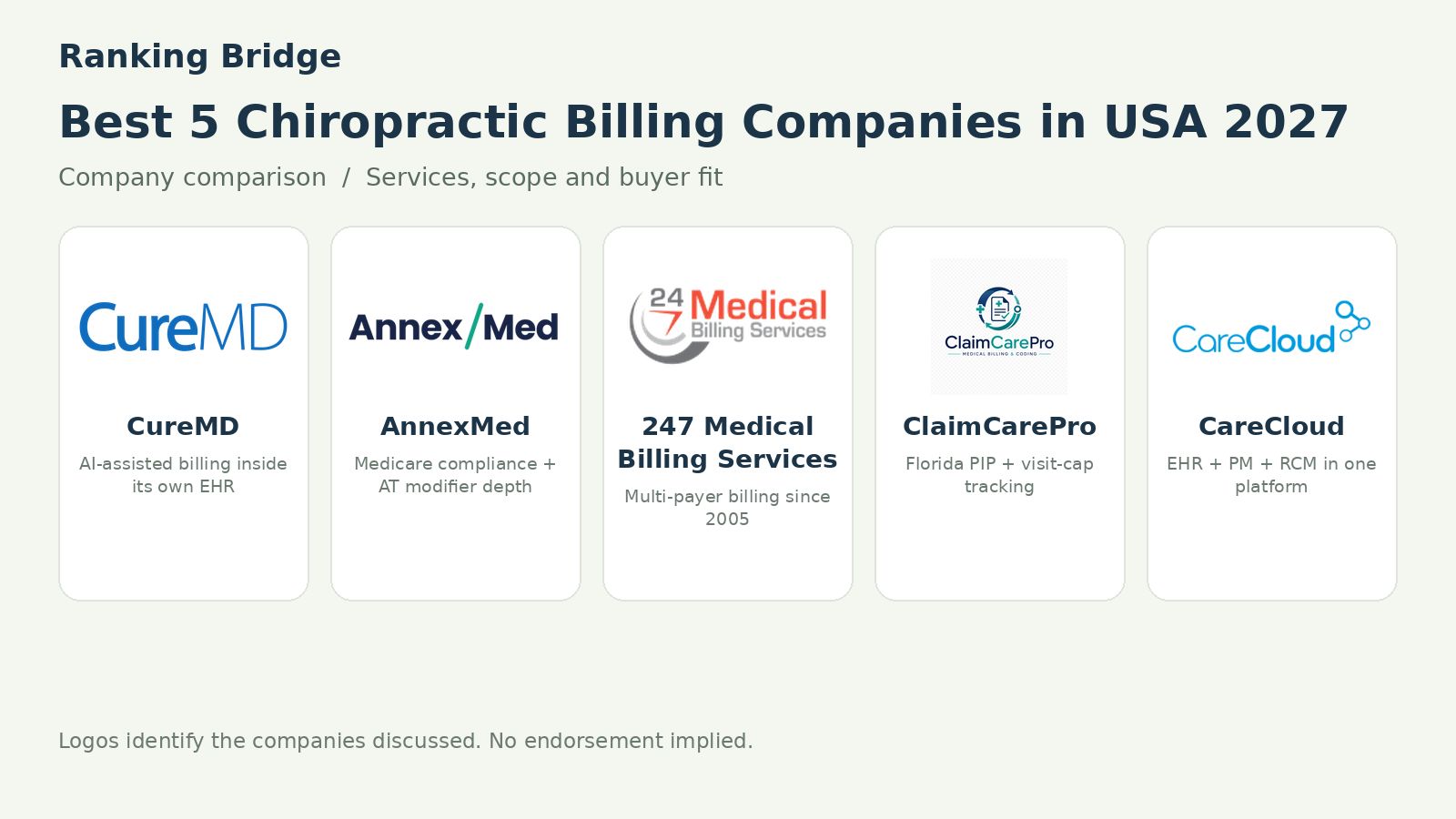
The table below compares the five companies. After the table, each company gets a closer look.
| Company | Headquarters | Best for | Key strength |
|---|---|---|---|
| CureMD | New York, NY | AI-assisted billing inside its own EHR | Dedicated chiropractic team + AI claim scrubbing |
| AnnexMed | Salt Lake City, UT | Medicare compliance depth | AT modifier + active-vs-maintenance rules |
| 247 Medical Billing Services | Lewes, DE | Multi-payer practices | Specialist-run since 2005 |
| ClaimCarePro | Clearwater, FL | Florida practices + PIP billing | Florida PIP + visit-cap tracking |
| CareCloud | Somerset, NJ | One platform for EHR + billing | Chiropractic EHR/PM with automated billing |
1. CureMD — Best for AI-assisted billing inside its own EHR
CureMD pairs a dedicated chiropractic billing team with its own cloud-based EHR and practice management platform. Therefore, practices that already use CureMD software can keep clinical and billing workflows in one system. The company has over 29 years of experience in healthcare technology. Its billing team manages every step of the revenue cycle, from claim creation to payment posting.
The billing service leans on AI tools built for chiropractic coding. In particular, smart code validation flags coding issues before claims go out, while automated claim scrubbing cleanses claims for common errors. In addition, real-time insurance verification confirms patient eligibility before the visit. The team also applies modifiers 25 and 59 carefully, so separate services stay distinct and denials stay low.
For instance, its platform integrates with chiropractic EHRs, so practices can keep their current charting system while CureMD handles billing. However, the platform works best for practices that want an all-in-one system. The company is based in New York, NY.
- Billing scope: full revenue cycle, from claim creation to payment posting.
- AI tools: smart code validation, automated claim scrubbing, real-time eligibility checks.
- Track record: over 29 years in healthcare technology, per its own site.
2. AnnexMed — Best for Medicare compliance depth
AnnexMed delivers a purpose-built revenue cycle system for chiropractic practices, with Medicare compliance at its core. Its team enforces medical necessity, applies correct CMT coding, manages AT modifier compliance, and handles personal-injury and workers’ compensation claims. In addition, the service covers Medicare frequency limits and visit caps, which trigger denials when a practice exceeds them.
The company builds compliance checks into every billing step. For example, every claim passes AT modifier validation, CMT level verification for 98940–98942, and modality bundling checks before submission. Similarly, the team classifies each encounter as active or maintenance care before billing, since Medicare does not cover maintenance care. As a result, non-covered claims are caught before submission instead of after a denial.
AnnexMed suits practices that want deep coding expertise rather than a software platform. For instance, a practice struggling with Medicare denials can hand over coding, billing and denial management in one engagement. Its coders hold AAPC, AHIMA and AAHAM certifications, and the company reports SOC 2 Type II compliance on its site.
- Medicare focus: AT modifier compliance, CMT level selection, visit-cap management.
- Pre-submission checks: AT validation, CMT verification, modality bundling checks.
- Certifications: AAPC-, AHIMA- and AAHAM-certified coders; SOC 2 Type II.
3. 247 Medical Billing Services — Best for multi-payer chiropractic practices
247 Medical Billing Services bills chiropractic care across Medicare, carved-out commercial plans, personal-injury, workers’ compensation and cash-pay wellness. Therefore, a practice running several payer models in one office can keep all of its billing with one vendor. A dedicated account manager runs the revenue cycle, with a free 360° dashboard showing every claim in real time.
The service centers on the active-versus-maintenance transition. Specifically, the same adjustment is covered while it is expected to produce functional improvement, and non-covered the moment the patient plateaus. The company puts that transition at the center of its workflow: the record triggers it, not an audit. Consequently, maintenance visits are billed without AT and with an ABN on file.
The team also handles timed-therapy bundling. For example, manual therapy and other timed services fold into the adjustment under national edits. They pay separately only with a documented distinct region or session and the correct modifier. In addition, the service covers charge entry, eligibility, prior authorization, submission, posting, denials, appeals, AR follow-up and credentialing. The company is based in Lewes, Delaware.
- Payer range: Medicare, commercial, personal-injury, workers’ comp and cash-pay.
- Compliance focus: active-vs-maintenance transition driven by the record.
- Experience: specialist-run since 2005; HIPAA-compliant, SOC 2 Type II.
4. ClaimCarePro — Best for Florida practices and PIP billing
ClaimCarePro is a family-owned billing company founded in 2010 and based in Clearwater, Florida. Its chiropractic service covers CMT and therapy coding, AT, GA and GP modifiers, Medicare documentation, visit-cap tracking, Florida PIP billing and credentialing. In addition, most of the practices it bills for are chiropractic, physical therapy and injury practices.
Florida personal-injury protection (PIP) billing is its standout strength. For instance, the team prices PIP claims to the Florida §627.736 fee schedule, tracks the $10,000 PIP benefit, and bills PIP on the signed note to meet the 35-day billing clock. Similarly, it tracks the 14-day treatment window that shapes the entire plan of care. The company also handles specialty benefit managers such as American Specialty Health and Optum Physical Health. It checks which entity manages the benefit before the first visit and tracks approved visits against the plan cap.
ClaimCarePro offers the service on its own or paired with its own EHR, where chiropractic is the first specialty pack. However, the company is Florida-focused, so practices outside Florida should confirm coverage before signing.
- PIP expertise: Florida §627.736 pricing, $10,000 benefit tracking, 35-day clock.
- Modifier compliance: AT, GA and GP, plus Medicare documentation checks.
- Roots: family-owned, founded 2010 in Clearwater, Florida, per its own site.
5. CareCloud — Best for practices wanting one platform for EHR and billing
CareCloud offers chiropractic practices a single cloud platform for EHR, practice management and patient experience, with revenue cycle services alongside. Its chiropractic workflows include smart charting templates, paperless charting, customizable patient summaries and automated billing. In addition, patient engagement tools send balance reminders and support secure online payments.
One point needs stating plainly. CareCloud’s chiropractic page is a specialty software page, not a standalone chiropractic billing service. In other words, the page sells the platform first; its RCM services are a separate general offering. Therefore, a practice that wants a dedicated chiropractic billing team should ask how CareCloud’s RCM team handles chiropractic-specific rules — the AT modifier, active-versus-maintenance classification and therapy bundling — before signing.
CareCloud fits practices that want software and billing from one vendor. However, practices that only need billing help should ask about standalone RCM services and confirm the chiropractic depth. The company is headquartered in Somerset, New Jersey.
- Platform fit: EHR, practice management and patient experience in one cloud system.
- Chiropractic tools: smart charting templates, paperless charting, automated billing.
- Billing support: RCM services available; confirm chiropractic-specific depth first.
How to choose among the best chiropractic billing companies
Start with Medicare rules, since they shape most chiropractic denials. The best chiropractic billing companies know that Medicare covers only manual manipulation of the spine to correct a subluxation. CMS sets out that rule in its Benefit Policy Manual: exams, x-rays and therapies are not covered when a chiropractor provides them. First, ask whether the vendor checks the AT modifier and the treatment note on every Medicare claim. A team that works with chiropractic claims daily will catch a missing AT modifier or a maintenance visit billed as active care.
Second, check modifier and bundling expertise. Timed therapies fold into the adjustment under CMS national bundling edits. They pay separately only with a documented distinct region or session and the correct modifier. In addition, ask how the vendor handles modifier 25 on same-day exams and modifier GP on therapy claims. If the vendor cannot explain its bundling workflow, keep looking.
Third, match the vendor to your payer mix. Many chiropractic offices bill Medicare, commercial plans, personal-injury and workers’ compensation side by side. Each channel has its own fee schedule and documentation demands. Therefore, ask which channels the vendor handles every week.
Finally, check denial handling and references. Ask how the team works denials, how fast it follows up, and what its reports show. In addition, ask for references from chiropractic practices of a similar size and payer mix. Practices that need coding-only support can compare the top medical coding companies in the USA. The right choice depends on your volume, your payer mix and how much of the revenue cycle you want to outsource.
Frequently Asked Questions
What does Medicare pay a chiropractor for?
Medicare pays only for manual manipulation of the spine to correct a subluxation, reported with CPT codes 98940–98942 and the AT modifier for active treatment. In contrast, exams, x-rays, therapies and extraspinal manipulation (98943) are not covered by Medicare. The American Chiropractic Association’s CMT coding guidance explains the code selection and modifier rules in detail.
What is the AT modifier, and when is it used?
The AT modifier certifies that a chiropractic adjustment is active, corrective treatment for a documented subluxation. Every Medicare claim for active treatment carries AT. However, once a patient plateaus and care becomes maintenance, the claim must drop AT — maintenance care is never covered by Medicare. If the patient has signed an ABN, the claim carries the GA modifier instead. A missing AT modifier denies the claim, while an AT modifier on a maintenance visit invites an audit.
Why do chiropractic claims get denied?
Most denials come from a short list of causes. Common ones include a missing or wrong AT modifier and maintenance care billed as active treatment. Timed therapies bundled into the adjustment without a distinct modifier also deny, as do notes that cannot show medical necessity. In addition, visit caps and frequency limits trigger denials when a practice exceeds them. A specialty billing team checks the modifier, the note and the visit count before submission.
Should a chiropractic practice outsource billing or keep it in-house?
Outsourcing fits practices that lack specialty coders or struggle with denials. In contrast, in-house billing works when the practice already employs experienced chiropractic billers who know the Medicare rules. Therefore, the choice depends on team size, claim volume and denial rates. Either way, the coding must stay specialty-specific.
Conclusion
Chiropractic billing rewards specialists. The five companies above are among the best chiropractic billing companies for US practices, and each one fits a different type of practice. CureMD suits practices that want AI-assisted billing inside their EHR, while AnnexMed fits practices where Medicare compliance is the top worry. 247 Medical Billing Services covers the widest payer mix, ClaimCarePro leads on Florida PIP billing, and CareCloud works best as an all-in-one platform.
Before you sign, request proposals from at least two vendors and check references from chiropractic practices like yours. Ask each vendor how it handles the AT modifier, the active-to-maintenance transition and therapy bundling.
