Top 10 EHR Software Companies in USA
This voice experience is generated by AI.
Your EHR is the system your whole practice runs on. It holds every chart, every order, every lab result, and every claim. In addition, it shapes how fast clinicians document, how patients book and message, and how cleanly claims go out. As a result, the wrong choice costs time every single day.
The stakes keep rising. Claim denials are still rising in 2026, and weak documentation sits behind many of them. Meanwhile, the Centers for Medicare & Medicaid Services (CMS) keeps tightening interoperability and data-sharing rules. Therefore, an EHR is no longer just a charting tool. It is the backbone of the revenue cycle.
The ten EHR software companies below suit different settings. This is a shortlist, not a ranking. Overall, the right choice depends on your size, your specialty, and whether you need inpatient depth, ambulatory speed, or billing built in.
How This Shortlist Was Put Together
This shortlist is editorial. In particular, it rests on public information about each company’s EHR product, scope, and buyer fit. Companies appear in no particular order. Five criteria guided the selection:
- Real EHR depth. The EHR is a named product with its own roadmap — not a module bolted onto billing software. For example, we looked for full charting, orders, e-prescribing, and results management.
- Setting fit. A hospital EHR and a small-practice EHR solve different problems. In addition, we checked whether each product serves inpatient, ambulatory, or both settings.
- Interoperability. Records must move between systems. Therefore, we favored vendors with FHIR APIs, health information exchange connections, and proven record-sharing.
- Patient tools. Portals, scheduling, and messaging now shape the patient experience. We looked for vendors that treat patients as users, not as an afterthought.
- Billing and RCM integration. Documentation becomes revenue only when charges flow cleanly. As a result, we favored EHRs with built-in billing or tight RCM links.
Before you sign, request demos from two or three of these companies. Then ask for references from organizations like yours. Finally, have each vendor show how a real chart becomes a real claim — fit matters most.
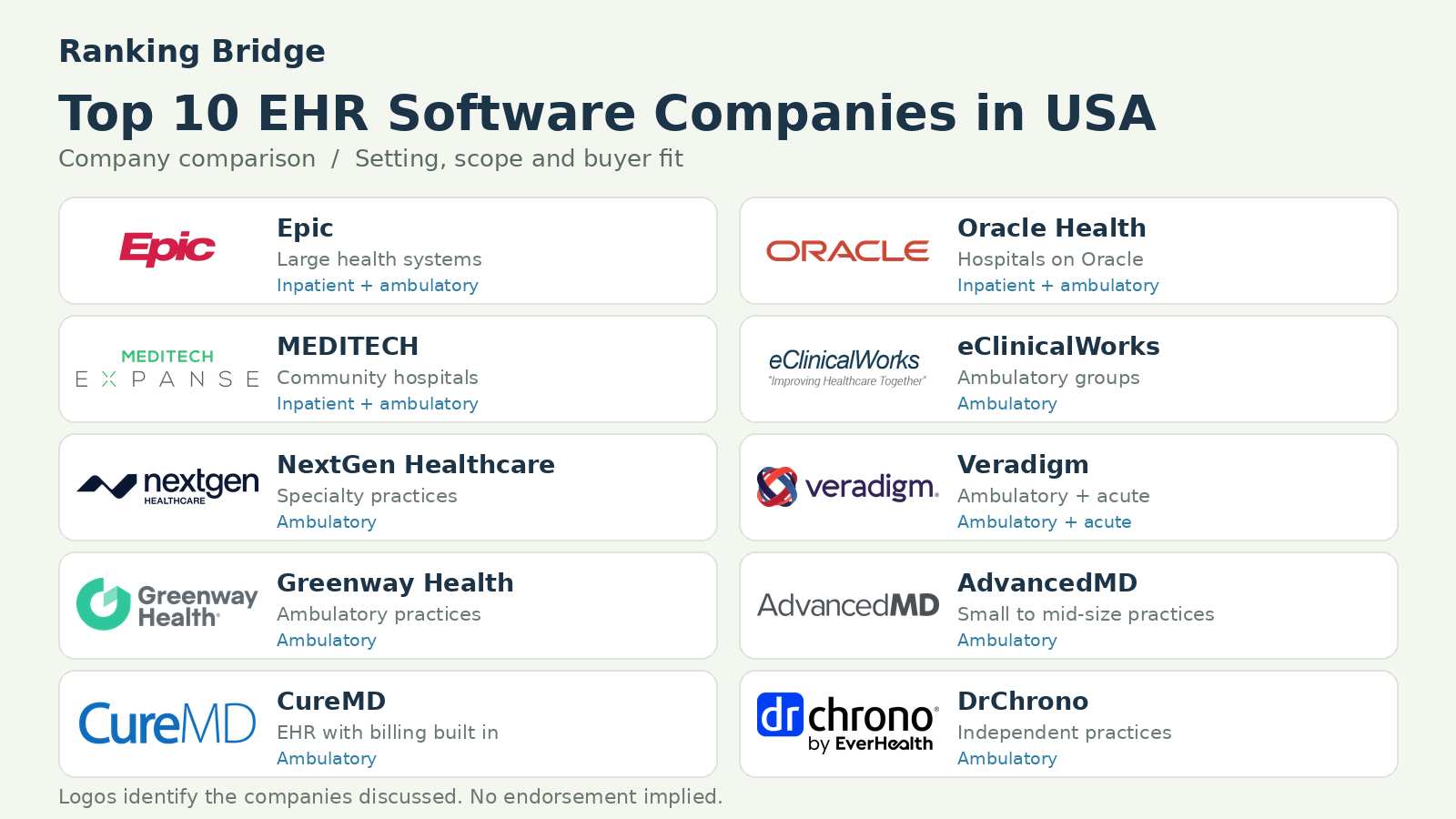
| Company | Best for | Setting | EHR focus |
|---|---|---|---|
| Epic | Large health systems | Inpatient + ambulatory | Full-suite EHR, MyChart portal |
| Oracle Health | Hospitals on Oracle | Inpatient + ambulatory | Millennium EHR on Oracle Cloud |
| MEDITECH | Community hospitals | Inpatient + ambulatory | Expanse EHR, mid-size hospitals |
| eClinicalWorks | Ambulatory groups | Ambulatory | Cloud EHR, AI scribe, healow |
| NextGen Healthcare | Specialty practices | Ambulatory | Enterprise EHR, Mirth Connect |
| Veradigm | Ambulatory + acute | Ambulatory + acute | Veradigm EHR, payer data network |
| Greenway Health | Ambulatory practices | Ambulatory | Novare cloud EHR, AI workflows |
| AdvancedMD | Small to mid-size practices | Ambulatory | Cloud EHR + PM + billing suite |
| CureMD | EHR with billing built in | Ambulatory | Cloud EHR, specialty templates |
| DrChrono | Independent practices | Ambulatory | All-in-one EHR, mobile charting |
Epic: Best for Large Health Systems
Epic, based in Verona, Wisconsin, sells the most widely used hospital EHR in the United States. Its system covers inpatient, ambulatory, emergency, and specialty care in one record. In addition, the MyChart patient portal lets patients schedule, message, view results, and pay bills. Its interoperability network shares records across organizations, so a patient’s chart follows them between Epic sites.
The depth shows in the details. For example, Epic offers specialty modules for oncology, cardiology, pediatrics, and surgery, plus population health and revenue cycle tools. Its implementation is a major project, and it suits organizations with the staff to run it. Overall, Epic fits a large health system or academic medical center that wants one record across every site. Ask how long implementation takes for an organization your size before you sign.
Oracle Health: Best for Hospitals Standardizing on Oracle
Oracle Health, based in North Kansas City, Missouri, runs the EHR formerly known as Cerner Millennium. Oracle acquired Cerner in 2022 and rebuilt the platform on Oracle Cloud. Its EHR covers inpatient and ambulatory care, with clinical, financial, and population health tools in one system. In addition, Oracle’s cloud and AI tools now sit behind documentation, scheduling, and analytics.
The Oracle connection matters most for hospitals already on Oracle systems. In particular, clinical and supply-chain data can share one cloud platform. Its team also supports large, multi-facility rollouts. Oracle Health fits a hospital or health system that wants its EHR on the same cloud as the rest of its enterprise software. Ask how the cloud migration works for your current Millennium version before you sign.
MEDITECH: Best for Community and Mid-Size Hospitals
MEDITECH, based in Westwood, Massachusetts, has built hospital software for more than five decades. Its current platform, MEDITECH Expanse, is a web-based EHR for inpatient and ambulatory care. It covers clinical documentation, orders, pharmacy, labs, and revenue cycle in one system. In addition, its Traverse tool pulls outside records into the chart, so clinicians see a fuller patient history.
The community-hospital focus shows in the details. For example, Expanse suits mid-size hospitals that need a full EHR without the scale of the largest systems. In addition, its implementation is lighter than the biggest platforms. MEDITECH fits a community or mid-size hospital that wants a proven inpatient EHR with ambulatory coverage. Ask how Expanse handles your specialty clinics before you sign.
eClinicalWorks: Best for Ambulatory Groups
eClinicalWorks, based in Westborough, Massachusetts, is one of the largest ambulatory EHR vendors in the country. Its cloud EHR covers charting, e-prescribing, orders, and population health for outpatient practices. In addition, its Sunoh.ai scribe turns visit conversations into draft notes. Its healow patient portal handles scheduling, messaging, and telehealth.
The ambulatory depth shows in the details. For example, the system offers specialty-specific templates and workflows for dozens of specialties. Meanwhile, its PRISMA tool searches outside records and pulls them into the chart. eClinicalWorks fits an ambulatory group or multi-specialty practice that wants a cloud EHR built for outpatient speed. Ask how Sunoh.ai handles your highest-volume visit types before you sign.
NextGen Healthcare: Best for Specialty Practices
NextGen Healthcare, based in Atlanta, Georgia, builds ambulatory EHR and practice management software. Its NextGen Enterprise EHR offers specialty-specific templates for practices such as orthopedics, behavioral health, and ophthalmology. In addition, its Mirth Connect engine links the EHR to labs, imaging, and other systems. Its smaller NextGen Office product suits practices that want a lighter cloud setup.
The specialty focus shows in the details. For example, templates follow each specialty’s workflow rather than forcing one generic chart. In addition, its team supports federally qualified health centers and community clinics. NextGen fits a specialty practice or ambulatory group that wants templates shaped around its own workflows. Ask how the templates cover your specialty’s procedures before you sign.
Veradigm: Best for Ambulatory and Acute Care With Payer Data
Veradigm, based in Chicago, Illinois, is the company formerly known as Allscripts. Its Veradigm EHR serves ambulatory practices and acute care, with clinical, practice management, and revenue cycle tools. In addition, its payer and data network links clinical records with claims and payer data. Its FollowMyHealth portal gives patients access to records, scheduling, and messaging.
The data network sets it apart. For example, practices can see payer insights alongside clinical data, which helps with value-based care contracts. In addition, its EHR supports multi-specialty groups. Veradigm fits an organization that wants its EHR connected to payer data and population health tools. Ask how the network covers your payer mix before you sign.
Greenway Health: Best for Ambulatory Practices That Want AI Workflows
Greenway Health, based in Tampa, Florida, sells cloud EHR software for ambulatory practices. Its current platform, Novare, uses AI-built workflows to cut documentation and handoffs. It covers clinical charting, practice management, revenue cycle, and patient engagement in one system. In addition, its analytics tools turn clinical and financial data into practice insights.
The ambulatory focus shows in the details. For example, Greenway has served outpatient practices for more than 40 years. Overall, its platform suits practices that want modern cloud tools without hospital-scale complexity. Greenway fits an ambulatory practice that wants an AI-forward EHR with billing and engagement built in. Ask how Novare handles your specialty’s templates before you sign.
AdvancedMD: Best for Small to Mid-Size Practices
AdvancedMD, based in South Jordan, Utah, sells a cloud suite of EHR, practice management, and billing software. Its EHR covers charting, e-prescribing, and orders for small to mid-size practices. In addition, its practice management and billing tools share the same data, so charges flow from the chart without re-entry. Its patient tools cover scheduling, reminders, and online payments.
The suite approach shows in the details. For example, a practice can run scheduling, charting, and billing in one login. Finally, its cloud setup avoids servers and local installs. AdvancedMD fits a small or mid-size practice that wants one vendor for EHR, scheduling, and billing. Ask how the billing tools handle your payer mix before you sign.
CureMD: Best for EHR With Billing Built In
CureMD, based in New York City, pairs its cloud EHR with billing and practice management. As a result, clinical notes, charge capture, and claims run in one system. Its EHR offers specialty-specific templates and AI-driven code validation before submission. Its team also handles billing services for practices that want to outsource the revenue cycle. In addition, its portal covers scheduling, messaging, and patient payments.
The one-system design shows in the details. For example, a charge raised in the chart flows straight into the claim without a separate billing step. In addition, its coders are AAPC- and AHIMA-certified. CureMD fits a practice that wants its EHR and billing under one roof. Ask how charge capture flows from your notes into claims before you sign.
DrChrono: Best for Independent Practices and Mobile Charting
DrChrono, based in Sunnyvale, California, sells a cloud all-in-one EHR for independent and specialty practices. It combines EHR, practice management, and billing in one platform. Its charting works well on iPad and mobile, so clinicians can document at the bedside or on the move. In addition, its EverHealth Scribe turns visit conversations into structured notes.
The mobile-first design shows in the details. For example, a solo physician can run the whole practice from a tablet. In addition, its platform covers e-prescribing, labs, and patient messaging. DrChrono fits an independent or small specialty practice that wants a light, mobile EHR with billing included. Ask how the mobile charting handles your visit volume before you sign.
How to Choose Among EHR Software Companies
1. Match the EHR to your setting. A hospital needs inpatient depth. A small practice needs speed and simplicity. For example, list your care settings — inpatient, outpatient, telehealth — and ask each vendor which ones its EHR serves best.
2. Check interoperability first. Your EHR must share records with labs, imaging, hospitals, and payers. In addition, ask about FHIR APIs, health information exchange links, and how outside records land in the chart. The Office of the National Coordinator for Health IT (ONC) sets the federal standards for data sharing.
3. Test the charting workflow. Clinicians live in the chart all day. Therefore, ask for a live demo with your own visit types, and time how long a note takes. A system that slows documentation will cost you every day. The Healthcare Information and Management Systems Society (HIMSS) publishes EHR usability guidance that can help you frame these questions.
4. Confirm billing integration. Documentation becomes revenue only when charges flow cleanly. For instance, ask how codes move from the chart into claims, who scrubs them, and how denials come back. If you are new to the revenue cycle, start with what denial management is and how it fits the wider picture.
What to Check Before You Sign
5. Ask about implementation and support. EHR rollouts take months, not weeks. As a result, ask who trains your staff, how data migrates from your old system, and what support looks like after go-live. Our shortlist of the best denial management companies covers specialists for the claims side if denials rise during the switch.
6. Read the contract, not just the sales page. Ask what the fee covers and what costs extra, how long the term runs, how you exit, and who owns your data. In short, get the answers in the proposal, not in a phone call. The American Academy of Professional Coders (AAPC) also publishes coding guidance that matters when you judge a vendor’s billing tools.
7. Ask for references in your setting. A reference from a hospital means little to a solo practice. For example, ask how long the client has used the EHR, what changed after switching, and what the vendor’s support looks like week to week.
We publish similar shortlists across the revenue cycle, including the top medical coding companies in USA 2027 — the same checks apply wherever you outsource.
Frequently Asked Questions
What does EHR software do?
It holds the patient’s full clinical record in one digital system. For example, that includes visit notes, orders, labs, imaging, e-prescriptions, and billing charges. Modern EHRs also cover scheduling, patient portals, and data sharing with other providers.
How much does EHR software cost?
Pricing varies by vendor, setting, and practice size. Most vendors charge per provider per month, often with setup and training fees. In addition, some charge for add-on modules. Always request a written proposal that lists what the fee covers, what costs extra, and how you can exit the contract.
What is the difference between EHR and EMR?
An EMR is the digital record inside one practice. An EHR shares that record across providers, hospitals, and payers. In practice, most vendors now sell EHRs, and the terms are often used interchangeably. The key question is whether the system shares data outside your own walls.
Should a small practice buy a hospital-grade EHR?
Usually not. A hospital EHR brings depth a small practice will never use, plus a longer rollout and higher cost. A cloud ambulatory EHR fits most small practices better. However, the practice should still check interoperability, so its records can move to hospitals and specialists when needed.
Conclusion
The best EHR software companies are not interchangeable. A large health system will look at Epic. A hospital standardizing on Oracle will look at Oracle Health. Meanwhile, a community hospital will look at MEDITECH. An ambulatory group will look at eClinicalWorks or NextGen. A practice that wants payer data will look at Veradigm. For AI workflows, a practice will look at Greenway. A small practice will look at AdvancedMD, CureMD, or DrChrono. Shortlist two or three, ask for demos and references from organizations like yours, and choose the system whose charting, sharing, and billing you can live with.
