Best Orthopedic Billing Companies in USA 2027
This voice experience is generated by AI.
Orthopedic billing is one of the hardest corners of the revenue cycle. A single joint replacement can involve global-period rules, surgical modifiers, implant charges, and a prior authorization — and one coding error can stall the whole claim. For example, a missing modifier can turn a clean surgical claim into a denial. Claim denials are still rising in 2026, and orthopedic practices feel that pressure first. Surgical claims carry high dollar values, so every denial costs real money.
That is why many orthopedic groups hand billing to specialists. A general billing company can submit claims, but orthopedics needs coders who know the musculoskeletal CPT range, the global surgery package, and payer rules for implants and durable medical equipment (DME). The five orthopedic billing companies below suit different practices — a shortlist, not a ranking. The right choice depends on your procedure mix, your setting, and whether you need a full billing partner or a platform with billing support.
How This Shortlist Was Put Together
This shortlist is editorial, based on public information about each company’s services, technology, and orthopedic focus. Companies are listed in no particular order. Five criteria guided the selection:
- Dedicated orthopedic work. Orthopedic billing is a named service with its own pages, coders, and processes — not one line on a general billing menu. We looked for companies with dedicated orthopedic billing pages and specialty-trained teams.
- Surgical coding depth. Joint replacements, spine surgery, and arthroscopy need coders who understand global periods, staged procedures, and modifiers. We favored companies whose coders hold AAPC certifications and work on orthopedic cases every day.
- Implant and DME capture. Implants, hardware, braces, and orthotics carry real revenue, and payers demand exact documentation. We looked for companies that reconcile implants against the operative report and bill DME as part of the service.
- Prior authorization strength. Joint procedures, spine surgery, and advanced imaging need authorizations before the case. We favored companies with dedicated prior-auth workflows for orthopedic procedures.
- Technology and transparency. AI-assisted coding checks, clean-claim scrubbing, and readable reporting help — but only when a human reviews the work before a claim goes out.
Before signing, request proposals from two or three of these companies. Ask for references from orthopedic practices like yours. Have them review a sample of your denied claims — fit matters most.
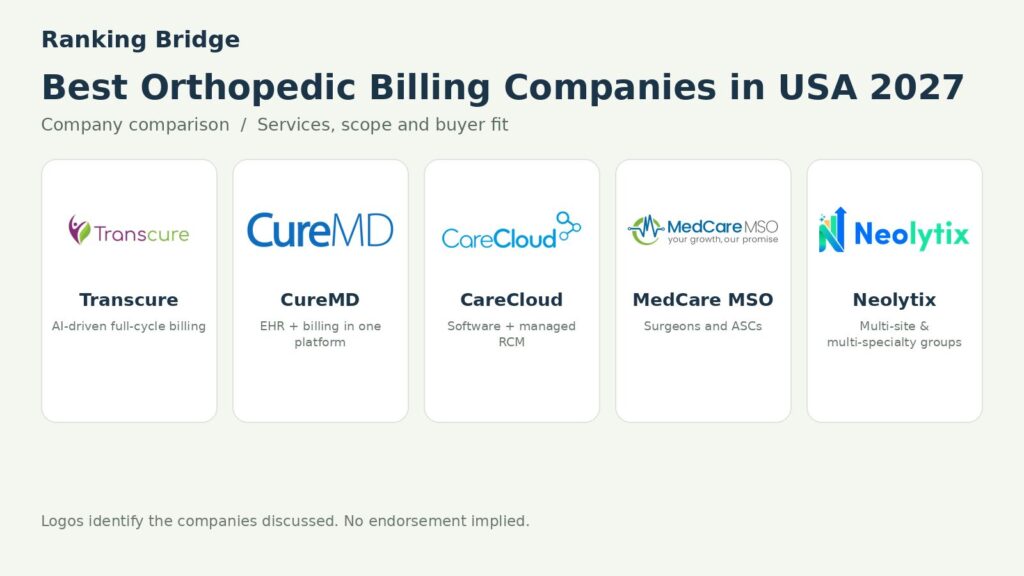
| Company | Best for | Model | Orthopedic focus |
|---|---|---|---|
| Transcure | AI-driven full-cycle ortho billing | Managed service | Joint replacement & spine coding |
| CureMD | EHR + billing in one platform | Platform + managed service | Surgical coding & DME |
| CareCloud | Software + managed RCM | Platform + managed service | Orthopedic workflows & dashboards |
| MedCare MSO | Surgeons and ASCs | End-to-end RCM | Arthroplasty, spine & workers’ comp |
| Neolytix | Multi-site & multi-specialty groups | Managed service | Multi-site ortho & surgery billing |
Transcure: Best for AI-Driven Full-Cycle Orthopedic Billing
Transcure, with offices in Woodbridge, New Jersey; Farmers Branch, Texas; and Oviedo, Florida, runs the full revenue cycle for orthopedic practices, surgery centers, and hospital-employed groups. Its team includes more than 1,100 certified billers and coders across 40-plus specialties. For orthopedics, the work covers joint replacements, spine surgery, fracture care, and rehabilitation. Coding covers the musculoskeletal CPT range and modifiers such as 58, 78, and 79 inside the global period.
Seven AI agents run the cycle. One clears prior authorizations on joint replacement and spine cases. Another reads the operative note and applies the right modifiers, and it flags bundling issues on arthroscopy before submission. The team also scrubs implant charge capture against the operative report, so high-value hardware does not go unbilled. In addition, Transcure handles prior authorization for DME braces and biologics. With an office in Farmers Branch, Texas, it is a natural fit for practices in the state — see also the best medical billing companies in Texas.
Transcure fits an orthopedic practice that wants the whole cycle handled — coding, authorizations, denials, A/R, and posting — with AI checks on every claim. Ask how its team handles your most common procedures and which payers it works with most often.
CureMD: Best for EHR and Billing in One Platform
CureMD, headquartered in New York, New York, pairs its cloud-based EHR and practice management platform with managed orthopedic billing services. Its AAPC-certified coders work with ICD-10, CPT, and HCPCS guidelines from CMS and the AMA. They code procedures such as arthroscopies, pain pump insertions, and ligament reconstructions. They also handle the full billing process — claim submission, coding, denial management, payment posting, patient billing, and revenue reporting.
The platform angle matters for practices that want one vendor. CureMD’s billing team works inside the same system as the clinical record, so documentation and coding stay connected. The company also supports provider credentialing and contracting, and it serves hospitals, physician practices, and billing companies across the United States. Its platform is used by more than 25,000 providers.
CureMD fits an orthopedic practice that wants software and billing from one company, with certified coders behind the claims. Ask how its billing team handles your surgical volume and whether its EHR templates cover your subspecialties.
CareCloud: Best for Software Plus Managed RCM
CareCloud, based in Somerset, New Jersey, combines a cloud platform — EHR, practice management, patient engagement, and telehealth — with Concierge, its managed revenue cycle service. Its orthopedics specialty page covers the procedure-heavy workflows of orthopedic practices, and the platform supports more than 80 specialties. The RCM service handles eligibility verification, charge capture, claim submission, denial management and appeals, payment posting, and A/R follow-up.
The strength here is visibility. Live reporting dashboards show claims activity in real time, so practice administrators can see where revenue stands without waiting for a monthly report. CareCloud is a publicly traded company on Nasdaq, and its billing teams work alongside the platform rather than as a separate add-on. As a result, practices can keep their clinical workflow and their billing in one place.
CareCloud fits a mid-size orthopedic practice that wants structured workflows, live dashboards, and a managed billing team behind the software. Ask how its dashboards track your surgical claims and how its team handles your payer mix.
MedCare MSO: Best for Surgeons and Ambulatory Surgery Centers
MedCare MSO, headquartered in Irvine, California, offers end-to-end orthopedic billing for surgeons, hospital orthopedic departments, and ambulatory surgery centers (ASCs). Its AAPC-certified coders cover arthroplasty, fracture care, spine procedures, and arthroscopy, with global period tracking, implant documentation, and workers’ compensation expertise across all 50 states. Joint replacement billing covers total knee and total hip arthroplasty, while spine billing covers cervical, thoracic, and lumbar fusions with instrumentation and biologics.
The ASC angle sets MedCare MSO apart. Its surgery-center billing reconciles the materials log against every device-heavy claim, so implants match a charge line and an invoice before the claim goes out. In addition, it handles DME billing for orthotics, braces, and prosthetics, with HCPCS coding and prior authorization. The company runs AI-assisted workflows that validate claims before submission, and it holds SOC 2 Type II-assessed security controls.
MedCare MSO fits an orthopedic surgery group or ASC with heavy implant and device billing. Ask how it captures implants on your highest-volume cases and how it handles workers’ comp claims in your states.
Neolytix: Best for Multi-Site and Multi-Specialty Groups
Neolytix, based in Northbrook, Illinois, delivers managed orthopedic billing for practices and groups nationwide, with 24/7 service and AAPC-certified coders. Its orthopedic billing covers insurance verification, coding, claim submission, denial management, and patient billing. The coders work with CPT, HCPCS, and ICD-10-CM codes, and they stay current on code changes through continuous training.
The company organizes its teams by specialty, so orthopedic clients get billers who know orthopedic denial codes, CPT considerations, and payer quirks. For example, its surgery billing page lists orthopedic surgery as a core specialty. Its billing teams work inside the client’s existing systems — Epic, athenahealth, AdvancedMD, eClinicalWorks, and others — with no migration required. Neolytix serves more than 270 healthcare organizations across the United States.
Neolytix fits a multi-site orthopedic group or a multi-specialty practice that wants one billing standard across every location. Ask how it keeps coding consistent across your sites and how its dashboards report performance by location.
How to Choose Among Orthopedic Billing Companies
1. Match the vendor to your procedure mix. Joint replacement, spine surgery, sports medicine, and fracture care all bill differently. Ask each vendor which procedures it handles most — and which it handles least. A company strong on office visits may struggle with complex spine cases.
2. Ask who codes the surgeries. An orthopedic claim needs a coder who knows global periods, staged procedures, and modifiers. Ask whether coders hold AAPC certifications, how many orthopedic cases they code each week, and who reviews complex surgical claims before submission.
3. Check implant and DME capture. Implants and braces are easy to lose in the billing process. Ask how the vendor reconciles implants against the operative report, how it bills DME, and what documentation it requires from your team. The American Academy of Orthopaedic Surgeons (AAOS) publishes coding resources that can help you frame these questions.
4. Confirm prior-authorization handling. Joint replacements, spine fusions, and advanced imaging need authorizations before the case. Ask who owns the authorization workflow, how the vendor tracks approvals, and what happens when a payer denies an authorization request.
5. Confirm it works inside your systems. Some vendors work inside your EHR; others run a separate platform. Ask how claims, documents, and status updates flow between your systems and theirs, and who owns each step. If denials are already a problem, start with what denial management is and how it fits the wider revenue cycle. For specialists in that area, see the best denial management companies.
6. Ask for references in orthopedics — and read the contract. A reference from a primary-care practice means little to an orthopedic group. Ask how long the client has been with the vendor, what changed after switching, and what reporting looks like week to week. Then read the proposal: ask what is included and what costs extra, how long the term runs, how you exit, and who owns your data and payer enrollments.
Frequently Asked Questions
What makes orthopedic billing different from general medical billing?
Orthopedic billing involves high-value surgical claims with strict rules. Global surgery packages bundle post-operative visits into the procedure payment. Modifiers control payment for staged and related procedures. Implants need separate documentation and coding. As a result, generalist billers miss revenue that orthopedic specialists capture.
Do these companies handle DME billing for braces and orthotics?
Most of them do. For example, MedCare MSO and CureMD both list DME billing as part of their orthopedic services, and Transcure handles prior authorization for DME braces. Ask each vendor whether DME billing is included in the base service or priced separately.
Can a billing company work inside our existing EHR?
Yes, in most cases. Neolytix works inside Epic, athenahealth, AdvancedMD, and other systems with no migration. CareCloud and CureMD offer their own EHR platforms, but their billing teams can also work with outside systems. Confirm your EHR is supported before you sign.
How should an orthopedic practice compare billing vendors?
Shortlist two or three companies, then ask each one for a proposal and for references from orthopedic practices like yours. Have them review a sample of your denied claims. Compare who codes the surgeries, how implants and DME are captured, how prior authorizations are handled, and what the reporting looks like — not just the sales page.
Conclusion
The best orthopedic billing companies are not interchangeable. A practice that wants AI-driven full-cycle billing will look at Transcure. One that wants EHR and billing from one vendor will look at CureMD. A mid-size practice that wants software plus managed RCM will look at CareCloud. A surgery group or ASC with heavy implant billing will look at MedCare MSO. Finally, a multi-site group that wants one standard across locations will look at Neolytix. Shortlist two or three, ask for proposals and references from orthopedic practices like yours, and choose the partner whose surgical coding, implant capture, and reporting you can live with.
