Best Cardiology Billing Companies in USA 2027
This voice experience is generated by AI.
Cardiology billing is one of the hardest specialties to get right. A single patient visit can mix diagnostic tests, imaging, procedures, and device checks. Each piece has its own codes, modifiers, and payer rules. One wrong modifier can turn a high-value claim into a denial.
The pressure is rising. Claim denials are still rising in 2026, and cardiology feels it first. Prior-authorization rules keep tightening. Meanwhile, the Centers for Medicare & Medicaid Services (CMS) keeps updating payment rules for cardiac care. As a result, many cardiology practices now hand billing to specialists.
The five cardiology billing companies below suit different practices. This is a shortlist, not a ranking. The right choice depends on your procedure mix, your EHR, and whether you want a full outsourcing partner or a platform with billing built in.
How This Shortlist Was Put Together
This shortlist is editorial. It rests on public information about each company’s services, technology, and cardiology focus. Companies appear in no particular order. Five criteria guided the selection:
- Dedicated cardiology focus. Cardiology billing is a named service with its own team — not one line on a general specialty list. We looked for companies with dedicated cardiology pages and cardiology-trained staff.
- Cardiology coding depth. Cardiac claims need coders who know the CPT families for cath, echo, EP, and devices. They also need ICD-10 combination codes and cardiac modifiers. We favored companies whose coders carry AAPC or AHIMA credentials.
- Prior-authorization strength. High-cost cardiac procedures need approval before the date of service. We looked for teams that secure authorizations for ablations, devices, stress tests, and imaging — not after a denial.
- Denial and A/R follow-through. Bundling and medical-necessity denials are common in cardiology. The best partners trace denials to their root cause and fix the workflow, not just resubmit the claim.
- EHR fit. Some vendors work inside your existing EHR. Others bring their own integrated system. Either way, charge capture must flow cleanly from documentation into claims.
Before you sign, request proposals from two or three of these companies. Ask for references from cardiology practices like yours. Then have each vendor review a sample of your recent claims — fit matters most.
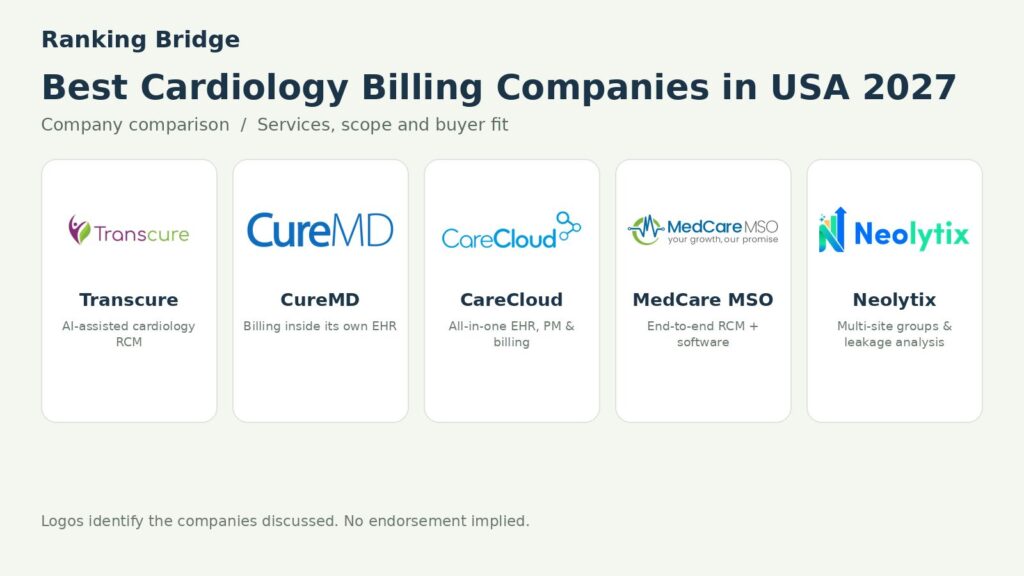
| Company | Best for | Model | Cardiology focus |
|---|---|---|---|
| Transcure | AI-assisted cardiology RCM | Managed service + AI agents | Cath lab, EP, nuclear, remote monitoring |
| CureMD | Billing inside its own EHR | Platform + specialists | Echo, stress, device, tele-cardiology |
| CareCloud | All-in-one EHR, PM & billing | Platform + managed RCM | CPT/modifier coding, prior auth, denials |
| MedCare MSO | End-to-end RCM with software | Managed service + software | Cath lab, EP, echo, nuclear, devices |
| Neolytix | Multi-site groups & leakage analysis | Managed service | Full charge-to-payment, all cardiology subspecialties |
Transcure: Best for AI-Assisted Cardiology Billing
Transcure, with offices in Woodbridge, New Jersey; Farmers Branch, Texas; and Oviedo, Florida, runs cardiology billing as a dedicated service line. Its AAPC-certified coders work by procedure family — cath lab, electrophysiology, nuclear studies, echo, and remote monitoring — rather than by claim volume. Seven AI agents cover eligibility, prior authorization, coding, claim scrubbing, payment posting, and A/R recovery. In addition, the company integrates with more than 40 EHR and practice management systems, including Epic and eClinicalWorks.
The cardiology focus shows in the details. Transcure’s team works the three failure points that cost cardiac practices money: component splits on diagnostic tests, bundling inside the cath lab, and reporting windows on remote monitoring. It serves general and interventional cardiology groups, electrophysiology clinics, and pediatric and adult congenital heart programs. Transcure fits a cardiology group that wants AI-assisted workflows plus certified human coders. Ask how its coders handle your highest-volume procedure families before you sign.
CureMD: Best for Billing Inside Its Own EHR
CureMD, based in New York City, pairs cardiology billing with its own EHR. As a result, clinical notes, charge capture, and billing run in one system. Its team handles claims, follow-up, denials, appeals, payment posting, and reporting for cardiology practices. AI-driven code scrubbing checks complex cardiac procedures before submission. Its coders are AAPC- and AHIMA-certified and trained on cardiology combination codes and CMS modifier rules.
The service covers echo studies, stress testing, device management, and tele-cardiology visits. It also covers prior authorization for cardiac surgery. Practices already on CureMD’s EHR get the most benefit, since documentation and billing share one workflow. CureMD fits a cardiology practice that wants billing and clinical systems under one roof. Ask how charge capture flows from your notes into claims.
CareCloud: Best for All-in-One EHR, Practice Management, and Billing
CareCloud, headquartered in Somerset, New Jersey, offers cardiology EHR, practice management, and billing as one integrated platform. It also offers a fully managed RCM option for practices that want the vendor to run billing end to end. Its cardiology tools include specialty CPT, ICD-10, and modifier coding, payer-specific prior authorization support, and proactive claim review with denial management. The platform supports multi-location groups as well.
Cardiology templates cover evaluations, procedures, and follow-up visits. The system also connects providers, labs, hospitals, and imaging centers through HIPAA-compliant data exchange. CareCloud fits a cardiology practice that plans to change its EHR anyway and wants billing in the same system. Ask whether the managed RCM service or the software-only option matches your staffing.
MedCare MSO: Best for End-to-End Cardiology RCM With Software and Staff
MedCare MSO, based in Irvine, California, runs end-to-end cardiology revenue cycle management. Its services cover eligibility and benefits verification, prior authorization, cardiology CPT and ICD-10 coding, charge entry, and denial management — backed by its own claims software. Its coders handle cath lab, EP, echo, and nuclear studies, including cardiac-specific modifiers. The team secures authorizations for ablations, implantable devices, stress tests, and advanced imaging before the procedure date.
The service covers the professional and technical sides of echo, stress, and SPECT/PET studies. It also covers pacemaker and defibrillator checks and remote heart monitoring between visits. A senior biller scrubs every claim before submission. MedCare MSO fits a cardiology practice that wants a staffed billing team plus its own software in one package. Ask how its team handles your payer mix and your highest-denial procedure codes.
Neolytix: Best for Multi-Site Groups and Revenue Leakage Analysis
Neolytix, based in Northbrook, Illinois, has provided cardiology billing for more than 13 years. It serves general cardiology, interventional cardiology, electrophysiology, nuclear cardiology, cardio-thoracic surgery, and transplant cardiology. Its team runs the full charge-to-payment cycle — charge capture, claim submission, payment posting, denial management, A/R follow-up, and patient statements — inside the practice’s existing EHR, including Epic, athenahealth, and eClinicalWorks.
A revenue leakage analysis reviews billing processes to find lost revenue. The company also handles credentialing and payer contract work. Specialty-trained teams cover cardiology CPT families such as echocardiograms and percutaneous coronary interventions. Neolytix fits a multi-site cardiology group that wants billing run as one managed operation across locations. Ask how its leakage analysis works on a sample of your recent claims.
How to Choose Among Cardiology Billing Companies
1. Match the vendor to your procedure mix. A cath lab group needs different coding skills than a diagnostic imaging practice. List your top procedure families — cath, echo, EP, devices, nuclear — and ask each vendor which ones its coders handle most.
2. Ask who codes your claims. Cardiology coding is too complex for generalists. Ask whether coders are AAPC-certified, whether they work only on cardiology accounts, and how the vendor trains them on new code sets. The American Academy of Professional Coders (AAPC) sets the certification standard most vendors use.
3. Check prior-authorization handling. High-cost cardiac procedures live or die on authorizations. Ask who requests them, how far ahead, and how the vendor tracks approvals. A vendor that waits for a denial has already cost you time.
4. Confirm EHR compatibility. Some vendors work inside your EHR. Others need you to switch systems. Ask how claims, documents, and status updates flow between your systems and theirs — and who owns each step. If you are new to outsourcing, start with what denial management is and how it fits the wider revenue cycle.
5. Ask about denial management. Cardiology denials often come from bundling and medical necessity. Ask how the vendor appeals them, whether clinicians review appeals, and how it reports root causes back to your team. Our shortlist of the best denial management companies covers specialists in this area.
6. Read the contract, not just the sales page. Ask what the fee covers and what costs extra, how long the term runs, how you exit, and who owns your data and payer enrollments. Get the answers in the proposal, not in a phone call.
7. Ask for references in cardiology. A reference from a primary care group means little here. Ask how long the cardiology client has been with the vendor, what changed after switching, and what the vendor’s reporting looks like week to week. The Healthcare Financial Management Association (HFMA) also publishes revenue cycle guidance for framing your questions.
We publish similar shortlists across the revenue cycle, including the best medical billing companies in Florida — the same checks apply wherever you outsource.
Frequently Asked Questions
What does a cardiology billing company do?
It handles the full revenue cycle for a cardiac practice. That includes eligibility checks, prior authorizations, cardiology coding, claim submission, payment posting, denial management, and A/R follow-up. The best vendors use cardiology-trained coders who know cardiac CPT families and modifiers.
How much does cardiology billing cost?
Pricing varies by model and practice size. Most vendors charge a share of collections or a flat monthly fee. Some charge per claim. Always request a written proposal that lists what the fee covers, what costs extra, and how you can exit the contract.
Which codes do cardiology billers handle most?
Common families include ECG codes, echocardiograms such as 93306, stress tests, percutaneous coronary interventions such as 92941–92944, electrophysiology studies, and device checks. Diagnosis coding uses the ICD-10 circulatory chapter (I00–I99). Coders also apply cardiac-specific modifiers for professional and technical components.
Should a small cardiology practice outsource billing?
Often yes. A small practice rarely has a full-time cardiology coder, and one vacancy can stall cash flow. Outsourcing gives the practice a trained team, denial follow-up, and reporting without hiring. However, the practice should still review reports monthly and keep control of its payer enrollments.
Conclusion
The best cardiology billing companies are not interchangeable. A group that wants AI-assisted workflows will look at Transcure. A practice that wants billing inside its own EHR will look at CureMD. A practice planning an EHR change will look at CareCloud. A practice that wants staffed billing plus software will look at MedCare MSO. And a multi-site group that wants one managed operation will look at Neolytix. Shortlist two or three, ask for proposals and references from cardiology practices like yours, and choose the partner whose coding depth, authorization work, and reporting you can live with.
