Best Denial Management Companies
Denied claims are the most expensive problem in the revenue cycle — and they are getting worse. Claim denials are still rising in 2026, driven by prior-authorization requirements, medical-necessity reviews, and coding edits that vary by payer. Every denied claim costs staff time to research, appeal, and rework, and a share of denied dollars is never recovered at all. Meanwhile the Centers for Medicare & Medicaid Services (CMS) keeps updating payment rules — it just finalized the CY 2027 Physician Fee Schedule — which means denial patterns keep shifting.
That is why so many hospitals and practices hand denial work to specialists. The five denial management companies below suit different organizations — a shortlist, not a ranking. The right choice depends on your denial mix, your setting, and whether you need appeals firepower, prevention, or a full revenue-cycle partner.
How This Shortlist Was Put Together
This shortlist is editorial, based on public information about each company’s services, technology, and denial focus. Companies are listed in no particular order. Five criteria guided the selection:
- Dedicated denial focus. Denial management is the company’s core work or a named practice — not one line on a general billing menu. We looked for companies with dedicated denial pages, teams, and processes.
- Clinical depth. Medical-necessity and level-of-care denials need clinicians, coders, and sometimes attorneys — not just follow-up staff. We favored companies whose appeals are built by clinical and coding professionals.
- Prevention, not just recovery. The best partners trace denials to their root cause — registration, authorization, documentation, coding — and fix the workflow so the same denial stops recurring.
- Denial-type coverage. A company strong on technical denials may be weak on clinical ones. We looked for coverage across the denial types hospitals and practices actually face: clinical, technical, authorization, and underpayments.
- Technology and transparency. AI-assisted prioritization, payer-intelligence, and readable reporting help — but only when a human reviews the work before an appeal goes out.
Before signing, request proposals from two or three of these companies, ask for references from organizations like yours, and have them review a sample of your aged denials — fit matters most.
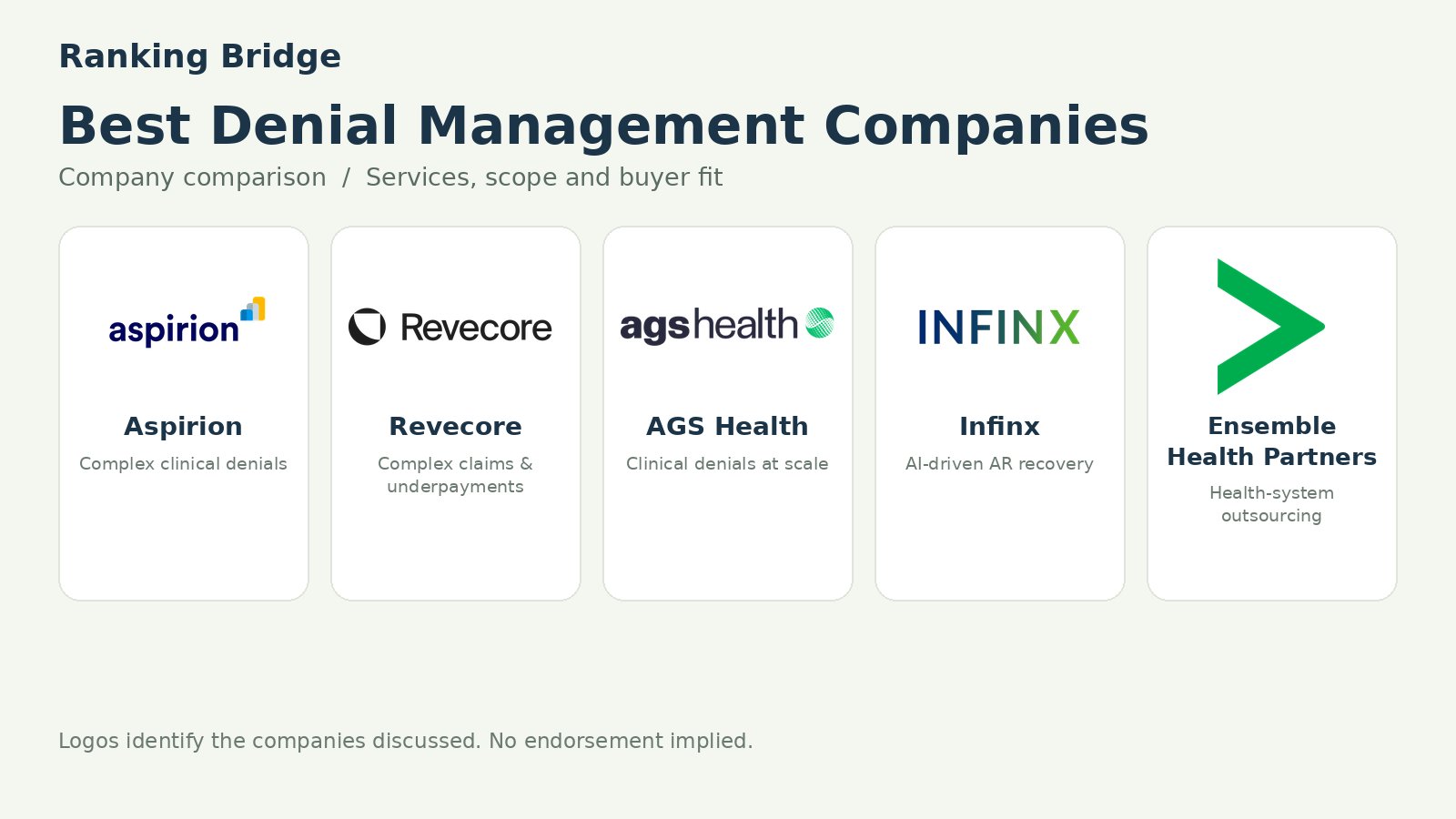
| Company | Best for | Model | Denial focus |
|---|---|---|---|
| Aspirion | Complex clinical denials | Managed service | Clinical + technical denials |
| Revecore | Complex claims & underpayments | Managed service | Denials + complex claims |
| AGS Health | Clinical denials at scale | Managed service | Clinical denials & appeals |
| Infinx | AI-driven AR recovery | Platform + specialists | Denial prevention + AR |
| Ensemble Health Partners | Health-system outsourcing | End-to-end RCM | Prevention + recovery |
Aspirion: Best for Complex Clinical Denials
Aspirion, based in Columbus, Georgia, manages denials across commercial, government, managed-care, and third-party payers — clinical, technical, and administrative — alongside underpayment recovery, payment-variance recovery, zero-balance review, and aged A/R. It also handles complex claims such as motor-vehicle, third-party-liability, workers’ compensation, and VA/TRICARE cases.
Its appeals are built by attorneys, clinicians, coders, and AI engineers, supported by proprietary AI platforms: DocIQ generates appeals from cited clinical evidence in the medical record, and ClinIQ surfaces documentation gaps and denial trends for clinical-documentation and utilization-management teams. A workflow system routes each claim to the right specialist, and the company works on a contingency-based model. Aspirion was named Best in KLAS for Denials Management in 2024 and 2025 and is HITRUST r2 certified.
Aspirion fits a hospital facing complex clinical denials that need clinician and attorney review behind every appeal. Ask how its teams handle your most common denial types and which payers they work most often.
Revecore: Best for Complex Claims and Payer Underpayments
Revecore, based in Franklin, Tennessee, runs a “denial-to-cash” lifecycle: day-one intake and AI-assisted appeals through receivables follow-up, escalation, cash posting, and reconciliation. It handles clinical and medical-necessity denials, aged and legacy denials, overflow and day-one denials, and underpayment recovery including zero-balance claims, plus complex claims such as motor-vehicle, third-party-liability, workers’ compensation, and VA cases. The company says it has more than 26 years of revenue recovery experience and serves over 1,300 hospital clients.
Licensed registered nurses, certified coders, and attorneys are aligned to denial complexity, and its AI-powered ReClaim platform prioritizes work with machine learning, a proprietary rules engine, and payer intelligence. Root-cause analysis runs across payers and denial types so the same errors stop repeating.
Revecore fits a hospital with a heavy load of complex claims and underpayments — the cases that need clinical review and legal escalation, not just resubmission. Ask how it prioritizes your aged inventory and how it reports root causes back to your team.
AGS Health: Best for Clinical Denials and Appeals at Scale
AGS Health, founded in 2011 and headquartered in Washington, DC, offers two dedicated denial practices: denial management and prevention, and clinical denials and appeals. Its teams identify, analyze, categorize, and prioritize denials by payer, filing limit, amount, and aging; write and submit appeals; and run root-cause analysis and trend reporting. Clinical denials cover medical necessity, MS-DRG and APR-DRG downgrades, length of stay, and level of care, with physician-led appeals and correspondence on documentation.
Its proprietary Intelligent RCM Engine uses AI, machine learning, and analytics under defined quality controls, with human review for complex matters. AGS Health was named the 2026 Top Clinical Denial and Appeal Management Services Vendor by Black Book Research.
AGS Health fits a hospital or health system that needs clinical denial appeals handled at volume, with prevention built in. Ask how its physician-led appeals model works for your most denied service lines and how trend reporting reaches your clinical teams.
Infinx: Best for AI-Driven Denial Management and A/R Recovery
Infinx, based in San Jose, California, offers denial management and A/R recovery as part of its RCM Plus service: A/R recovery, denials management, appeals, denial prevention, underpayment management, and denial trend and payer-wise analysis, with front-end prevention through prior authorization and eligibility verification.
Its AI-powered A/R Optimizer prioritizes claims using propensity-to-pay prediction — claim value, payer behavior, and aging — and automates follow-ups, giving specialists a ranked work order with progress tracking. Analytics dashboards show denial trends, and the platform integrates with EHRs via API, HL7, FHIR, and X12. Infinx holds HITRUST i1 certification for its RCM and patient access platforms.
Infinx fits a specialty practice or mid-size provider — radiology, cardiology, imaging, labs — that wants AI-driven prioritization plus human specialists rather than a fully outsourced back office. Ask how its prioritization model handles your payer mix and whether its automation covers your most common denial codes.
Ensemble Health Partners: Best for Full Revenue-Cycle Outsourcing for Health Systems
Ensemble Health Partners, based in Cincinnati, Ohio, is an end-to-end RCM outsourcing company for hospitals and health systems, with denial prevention and recovery inside its managed-services model. Its denial work covers root-cause identification and resolution, clinical denials, prior-authorization denial prediction and prevention, appeals and recovery, and underpayment detection and prevention.
Its proprietary EIQ technology reads the medical record to flag denial risk with rationale and recommendations inside existing workflows, and AI predicts and prevents prior-authorization denials from real payer behavior. Clinically trained denial specialists handle appeals, and embedded operators work inside the client’s own EHR with EIQ layered on top. The company says it manages end-to-end RCM for more than 200 hospitals.
Ensemble fits a health system that wants denial work handled as part of a central business office — prevention and recovery together, with operators embedded in its own systems. Ask how its team integrates with your EHR and how root-cause findings flow back to registration, coding, and billing.
How to Choose Among Denial Management Companies
1. Match the vendor to your denial mix. Clinical denials need clinicians and coders; technical denials need workflow fixes; authorization denials need front-end prevention. Ask each vendor which denial types it handles best — and which it does not. If you are new to the topic, start with what denial management is and how it fits the wider revenue cycle.
2. Ask who builds the appeals. An appeal written by a clinician or certified coder carries more weight than one assembled by follow-up staff alone. Ask whether appeals are reviewed by registered nurses, certified coders, or attorneys before submission — and whether AI drafts are always human-reviewed.
3. Demand root-cause work, not just recovery. A vendor that only chases denied dollars leaves the leak open. Ask how it traces denials back to registration, authorization, documentation, or coding — and how it reports those findings so your team can fix the source.
4. Confirm it works inside your systems. Some vendors work inside your EHR; others run a separate platform. Ask how claims, documents, and status updates flow between your systems and theirs, and who owns each step.
5. Read the contract, not just the sales page. Ask whether fees are contingency-based or fixed, what is included and what costs extra, how long the term runs, how you exit, and who owns your data and payer enrollments — in the proposal, not in a phone call.
6. Ask for references in your setting. A hospital reference means little to a specialty practice and vice versa. Ask how long the client has been with the vendor, what changed after switching, and what the vendor’s reporting actually looks like week to week. The Healthcare Financial Management Association (HFMA) also publishes revenue cycle guidance for framing your questions.
We publish similar shortlists across the revenue cycle, including the best AI-powered RCM companies and the best medical billing companies in Florida — the same checks apply wherever you outsource.
Conclusion
The best denial management companies are not interchangeable. A hospital facing complex clinical denials will look at Aspirion; one buried in complex claims and underpayments will look at Revecore; a health system needing clinical appeals at volume will look at AGS Health; a specialty practice wanting AI-driven prioritization will look at Infinx; and a health system wanting denial work inside a full outsourcing model will look at Ensemble Health Partners. Shortlist two or three, ask for proposals and references from organizations like yours, and choose the partner whose appeals process, prevention work, and reporting you can live with.
