ICD-10 Code J06.9: Acute Upper Respiratory Infection, Unspecified — 2027 Guide
ICD-10 code J06.9 is the code for acute upper respiratory infection, unspecified. It covers an acute infection of the upper airways when the infection spans more than one site, or when the provider does not pin it to a single site. In other words, J06.9 is the catch-all code for the undifferentiated cold or viral URI visit. The code is billable and valid for FY2027, which runs from 1 October 2026 through 30 September 2027. However, J06.9 is not a shortcut around documented detail. When the record names a single site, a strep infection, or influenza, a more specific code takes its place. Therefore, the coder’s first job is to check what the note actually says. This guide walks through each decision in order.
What ICD-10 Code J06.9 Covers
First, ICD-10 code J06.9 sits in Chapter 10, Diseases of the respiratory system (J00–J99). It belongs to section J00–J06, Acute upper respiratory infections, and to category J06, Acute upper respiratory infections of multiple and unspecified sites. Category J06 itself is a non-billable header, so coders never report plain J06 on a claim. Instead, the category holds two billable codes: J06.0 for acute laryngopharyngitis and J06.9 for the unspecified infection.
In addition, the inclusion terms under J06.9 are short and clear. They cover “upper respiratory disease, acute” and “upper respiratory infection NOS.” As a result, a note that says “acute URI” or “upper respiratory infection” with no site named maps straight to J06.9. The Alphabetic Index points the same way. For example, “tracheopharyngitis (acute)” and “respiratory tract disease, upper, acute” both index to J06.9. In practice, this is the everyday cold visit: congestion, cough, and sore throat arriving together, with no single structure identified as the site.
J06.9 also has a long, stable history. It entered ICD-10-CM on 1 October 2015, replacing ICD-9 code 465.9, and no annual update has changed it since. The FY2027 code set carries it forward with the same description and the same notes. For inpatient claims, J06.9 as a principal diagnosis groups to MS-DRG 11 through 13 and 152 through 153, depending on complications. Most J06.9 volume, however, comes from outpatient urgent care and family practice, where the undifferentiated URI is a daily encounter.
When NOT to Use J06.9: The Decision Flow
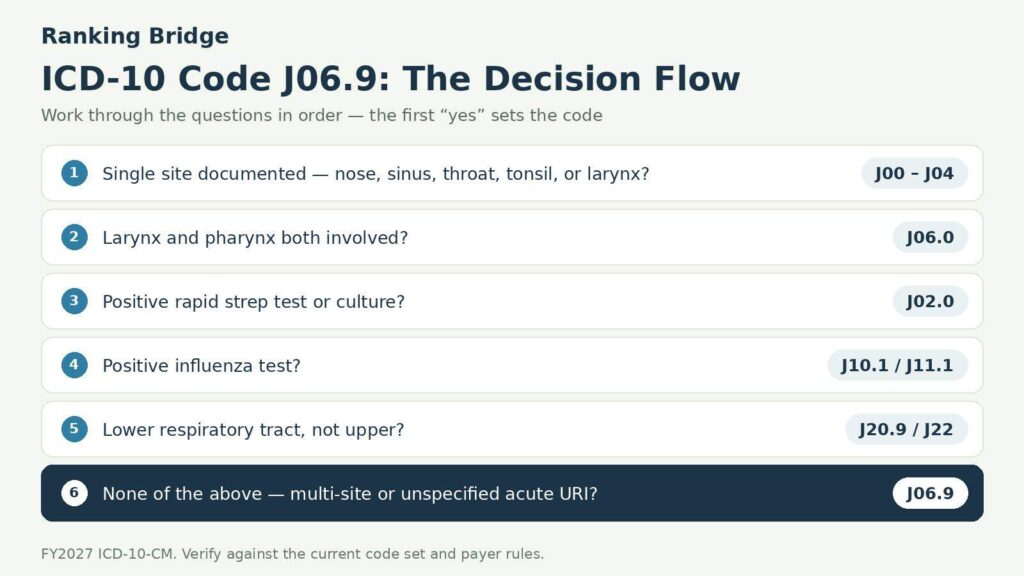
J06.9 is the default, not the answer for every upper respiratory visit. Before assigning it, work through five questions. Each “yes” moves the case to a different code.
1. Does the note document a single site? If so, use the code for that site. Acute nasopharyngitis, the common cold, is J00. Sinusitis maps to J01, pharyngitis to J02, tonsillitis to J03, and laryngitis and tracheitis to J04. A note that clearly identifies pharyngitis, tonsillitis, or laryngitis leaves no room for J06.9.
2. Are the larynx and pharynx both involved? If so, use J06.0, acute laryngopharyngitis. This code covers the two-site case where both structures are named. J06.9 covers infections that span sites without naming them, or that stay unspecified. When the provider names larynx plus pharynx, J06.0 is the more specific choice.
3. Did the strep test come back positive? If so, use J02.0, streptococcal pharyngitis. A confirmed strep result replaces J06.9 entirely. The two codes can never appear on the same claim, because an Excludes1 note under category J06 forbids the pairing.
4. Did the flu test come back positive? If so, use the influenza code that matches the virus. J10.1 covers influenza due to an identified virus with other respiratory manifestations. J11.1 covers influenza due to an unidentified virus with other respiratory manifestations. J09.X2 covers influenza due to an identified novel influenza A virus with other respiratory manifestations. For help telling the three winter viruses apart, see our comparison of flu vs COVID vs RSV.
5. Is the infection in the lower respiratory tract? If so, leave the J00–J06 block behind. Acute bronchitis, unspecified organism, is J20.9, and unspecified acute lower respiratory infection is J22. Our guide to ICD-10 code J20.9 for acute bronchitis explains the upper-versus-lower split in detail.
J06.9 Decision Flow at a Glance
| Situation | Code |
|---|---|
| Single site documented (nose, sinus, throat, tonsil, larynx) | J00–J04 |
| Larynx and pharynx both involved | J06.0 |
| Positive rapid strep test or culture | J02.0 |
| Positive influenza test | J10.1 / J11.1 (J09.X2 for novel influenza A) |
| Lower respiratory tract infection | J20.9 / J22 |
| Multi-site or unspecified acute URI, none of the above | J06.9 |
The Excludes1 Traps
The Excludes1 note under category J06 names three conditions that can never ride on the same claim as J06.9. An Excludes1 note means the two codes are mutually exclusive for the same encounter. The only exception applies when the two conditions are genuinely unrelated, which almost never happens with a single URI visit.
Streptococcal pharyngitis (J02.0). A positive rapid strep test or culture turns the encounter into a specific throat infection. At that point, the unspecified URI code no longer fits. Code J02.0 alone and drop J06.9.
Influenza with other respiratory manifestations (J09.X2, J10.1, J11.1). A positive flu test sends the claim to the influenza family. Note the wording: the note excludes influenza with other respiratory manifestations, not every influenza code. In practice, a flu-positive URI visit lands on J10.1 or J11.1, and J06.9 drops off the claim.
Acute respiratory infection NOS (J22). J22 is the unspecified code for the lower respiratory tract. It excludes J06.9, and J06.9 excludes it. The two codes describe different anatomic territory, so they never belong together. When the note gives no site at all and no acute infection is clearly upper or lower, query the provider rather than guessing between them.
One more exclusion sits a level up. The J00–J06 block carries an Excludes1 for COPD with acute lower respiratory infection (J44.0). When a COPD patient presents with an acute lower respiratory infection, J44.0 takes the claim instead of any J00–J06 code. Our guide to J44.9 vs J44.0 vs J44.1 walks through those COPD distinctions.
The Organism Code: B95–B97
ICD-10 code J06.9 carries a “use additional code” note. It directs coders to B95–B97 to identify the infectious agent, when known. Sequence the organism code second: J06.9 stays first and the B code follows.
The tabular list names one example: respiratory syncytial virus, or RSV, is B97.4. In the Alphabetic Index, “Virus, viral respiratory syncytial (RSV) upper respiratory infection” indexes to J06.9 with B97.4 as the additional code. In other words, an RSV-positive upper respiratory infection gets two codes: J06.9 for the infection and B97.4 for the virus.
Add the organism code only when the agent is known and documented. A suspected organism does not count, and a negative or pending test does not support a B code either. When the lab result arrives after the visit, the coder updates the claim with the organism code if the record supports it. When no organism is ever identified, J06.9 stands alone, and that is correct coding.
Documentation Requirements
The first rule of ICD-10 code J06.9 is simple. The note must support an acute infection of the upper respiratory tract. A coder never assigns J06.9 from symptoms alone. Cough, congestion, and sore throat are findings, not a diagnosis. The provider must document the infection itself, with acute onset in the current episode.
Second, the note should support that no single site was identified. “Unspecified” reflects the documented clinical picture, not an inadequate exam. A provider who examines the ears, nose, and throat and finds diffuse involvement across sites has documented exactly what J06.9 describes. On the other hand, a note that names acute pharyngitis in the exam and then writes “URI” in the assessment creates a conflict. In that case, query the provider before coding.
Third, watch for test results that change the code. A rapid strep test or flu swab ordered at the visit may return after the note is signed. When a positive result lands, the code changes to J02.0 or J10.1/J11.1, and J06.9 drops off. Coders who finalize the claim before results return should hold or correct the claim when the result arrives. As a result, a quick check of pending labs is part of clean J06.9 coding.
Finally, do not code J06.9 for a chronic or recurring condition. The descriptor says “acute,” and the code belongs to the current episode. A long-standing sinus problem or a chronic cough needs a different code family entirely.
Common Errors
Coding J06.9 with J02.0. This is the most frequent J06.9 error. A positive strep test means the infection has a specific site and a specific cause, so J02.0 replaces J06.9. The Excludes1 note makes the pairing an edit failure, and payers will deny or downcode the claim.
Coding J06.9 with J10.1 or J11.1. The same logic applies to influenza. A flu-positive result moves the encounter to the influenza family. J06.9 and an influenza code on one claim trigger the same Excludes1 edit as the strep pairing.
Using J06.9 when a site is documented. When the exam clearly identifies pharyngitis, tonsillitis, sinusitis, or laryngitis, that code wins. J06.9 is not a shortcut around documented specificity. Coders who default to J06.9 for every URI visit undercode the encounter and lose the detail payers and quality programs expect.
Stacking J06.9 with J02.9. No Excludes note bars this pair, but stacking them is still wrong. J02.9 is acute pharyngitis, unspecified, so it already describes an unspecified infection of the pharynx. Reporting both codes for one sore throat reads as imprecise coding. Report only the single code that matches the documented site.
Reporting plain J06 on a claim. Category J06 is a non-billable header. Claims need J06.0 or J06.9, never the three-character category alone. An encoder that accepts J06 will still produce a rejected claim.
Using J22 as a substitute. When the note is vague, some coders reach for J22, unspecified acute lower respiratory infection. That code describes the lower tract, not the upper tract, and it carries a reciprocal Excludes1 against J06.9. A vague note needs a query, not a different unspecified code.
Related Codes at a Glance
| Code | What it covers | Relationship to J06.9 |
|---|---|---|
| J00 | Acute nasopharyngitis (common cold) | Single-site cold; use instead of J06.9 when only the nasopharynx is involved |
| J01 | Acute sinusitis | Single-site sinus infection; use instead of J06.9 |
| J02.0 | Streptococcal pharyngitis | Excludes1 — never code with J06.9 |
| J02.9 | Acute pharyngitis, unspecified | Use instead of J06.9 when the pharynx is the documented site; do not stack |
| J03 | Acute tonsillitis | Single-site tonsil infection; use instead of J06.9 |
| J04 | Acute laryngitis and tracheitis | Single-site larynx/trachea infection; use instead of J06.9 |
| J06.0 | Acute laryngopharyngitis | Two named sites (larynx + pharynx); use instead of J06.9 |
| J06.9 | Acute upper respiratory infection, unspecified | Multi-site or unspecified acute URI |
| J09.X2, J10.1, J11.1 | Influenza with other respiratory manifestations | Excludes1 — never code with J06.9 |
| J22 | Unspecified acute lower respiratory infection | Lower tract; Excludes1 — never code with J06.9 |
Frequently Asked Questions
ICD-10 code J06.9 is the ICD-10-CM code for acute upper respiratory infection, unspecified. It is billable and valid for FY2027, from 1 October 2026 through 30 September 2027. Use it when the infection spans multiple upper respiratory sites or when the provider does not identify a single site.
Yes. J06.9 is a billable ICD-10-CM code and is valid for submission on HIPAA-covered claims. Its parent category, J06, is a non-billable header, so claims must carry J06.9 (or J06.0) rather than the three-character category code.
J00 covers acute nasopharyngitis, the common cold, as a single-site infection of the nose and pharynx. J06.9 covers an acute upper respiratory infection that spans multiple sites or has no single site documented. In addition, J00 carries its own Excludes1 note for acute pharyngitis (J02.-) and acute sore throat NOS (J02.9). When the note points to the nasopharynx alone, use J00. When the infection is diffuse or unspecified, use J06.9.
No. The Excludes1 note under category J06 lists streptococcal pharyngitis (J02.0), so the two codes can never appear on the same claim for the same encounter. A positive strep test means the encounter belongs to J02.0 alone.
Use the influenza code that matches the virus. J10.1 covers influenza due to an identified virus with other respiratory manifestations. J11.1 covers influenza due to an unidentified virus with other respiratory manifestations. J09.X2 covers influenza due to an identified novel influenza A virus with other respiratory manifestations. In each case, J06.9 drops off the claim, because the Excludes1 note bars the pairing.
Add an organism code when the infectious agent is known and documented. J06.9 carries a “use additional code” note pointing to B95–B97, with RSV (B97.4) as the named example. Sequence J06.9 first and the organism code second. When no organism is identified, J06.9 stands alone.
Sources
- ICDList, J06.9 — Acute upper respiratory infection, unspecified (FY2027) — billable status, FY2027 validity, chapter/section/category placement, MS-DRG grouping, use-additional-code note; data sourced from the CMS FY2027 ICD-10-CM dataset.
- ICDList, J06 — Acute upper respiratory infections of multiple and unspecified sites (FY2027) — category Excludes1 notes (J22; influenza J09.X2, J10.1, J11.1; J02.0) and block-level J44.0 exclusion; data sourced from the CMS FY2027 ICD-10-CM dataset.
- AAPC, “Focus on a Single Code for Unspecified Acute Respiratory Infections” — J06.9 as the single unspecified-URI code replacing ICD-9 465.9; J06 Excludes1 notes.
- Urgent Care Bill Co, J06.9 ICD-10 Code: Urgent Care Billing Guide 2026 — Excludes1 traps, J06.9 vs J02.9, B95–B97 organism code, FY2027 unchanged.
- CDC, ICD-10-CM codes for influenza and acute respiratory illness (EID appendix table) — J09.X2, J10.1, and J11.1 descriptors; J00–J06 category descriptors.
