ICD-10 Code D64.9: Anemia, Unspecified — Coding Guide for 2027
ICD-10 code D64.9 is the billable code for anemia, unspecified. Coders use it when the provider documents anemia without naming its type or underlying cause. In addition, it sits in category D64 (Other anemias) within Chapter 3 of ICD-10-CM, which covers diseases of the blood and blood-forming organs (D50–D89). The code is valid for FY2027 (1 October 2026 – 30 September 2027). However, D64.9 is a fallback, not a routine choice. When the record names a cause, a more specific code replaces it. Therefore, the coder’s first job is to check whether the documentation supports something better. This guide walks through each decision in order.
When D64.9 Is Correct — and Why It Is a Fallback, Not a Default
First, ICD-10 code D64.9 applies in one narrow situation. The provider has documented anemia, and the record names no type and no cause. “Unspecified” means the provider has not documented a cause. In other words, it says nothing about what the coder suspects from the labs or the history. If the note says only “anemia,” D64.9 is correct.
In addition, D64.9 is one of the most scrutinised codes on a claim. Payer review teams flag it because it often signals incomplete documentation. As a result, defaulting to D64.9 when the record supports a more specific code leads to preventable denials. In practice, most charts contain enough detail for a better code. The issue is usually that the coder does not query the provider when the documentation is vague.
Finally, treat D64.9 as the last resort. Before assigning it, search the record for a documented type, a cause, or a related condition. If the provider names iron deficiency, chronic kidney disease, or chemotherapy, use the specific code instead. Only when nothing more specific is documented does D64.9 stand.
The Documentation Rule: Provider Attestation, Not Lab Values
The first rule of anemia coding is simple. The provider must document the type of anemia. A coder never assigns a specific anemia code from lab values alone. A low hemoglobin with low ferritin strongly suggests iron deficiency, for example, but it does not produce D50.9 by itself. Without the provider’s attestation, D64.9 remains the correct choice even when the labs point clearly toward a specific cause.
Similarly, do not code a suspected type in the outpatient setting. If the provider suspects iron deficiency but has not confirmed it, report only what is known at the end of the encounter. That usually means D64.9 for the anemia as documented. A query to the provider can resolve the question for the next visit.
In addition, the query is the coder’s best tool here. When the labs suggest a cause but the note is silent, ask the provider to document the type. A short query — “Does the anemia reflect iron deficiency, CKD, or another cause?” — often turns an unspecified code into a specific one. As a result, the claim is cleaner, the denial risk drops, and the patient’s record is more accurate. For the wider ICD-10 framework these rules sit in, see our ICD-10 overview for medical groups.
The Replacement Map: Which Code Takes Over Once a Cause Is Documented
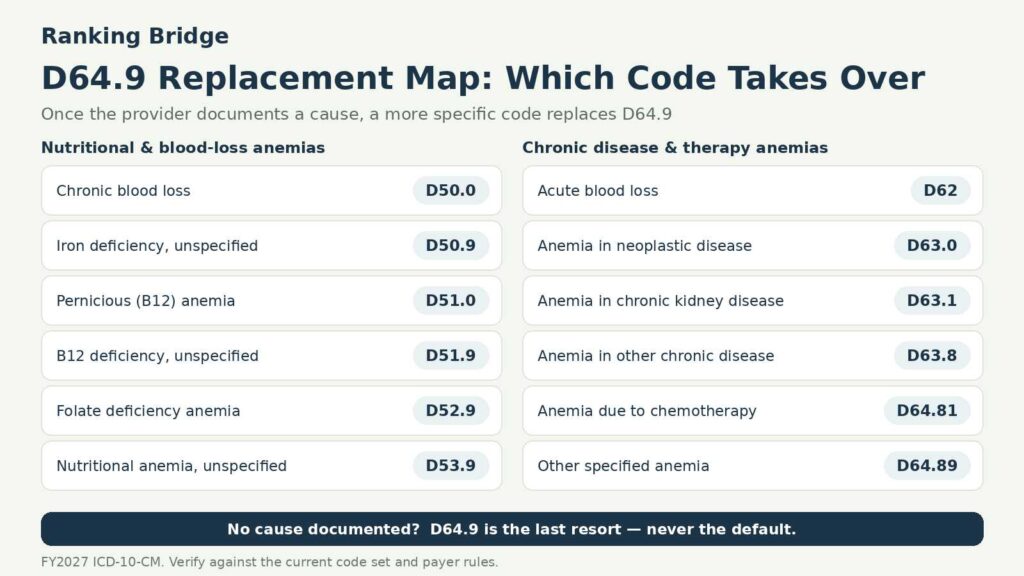
Once the provider documents a cause, D64.9 steps aside. The table below maps each documented cause to the code that replaces it. Work through it from the top of the chart down: nutritional causes first, then blood loss, then chronic disease and therapy-related causes.
| Documented cause | Code | Descriptor |
|---|---|---|
| Iron deficiency from chronic blood loss | D50.0 | Iron deficiency anemia secondary to blood loss (chronic) |
| Iron deficiency, type not stated | D50.9 | Iron deficiency anemia, unspecified |
| Pernicious anemia (intrinsic factor deficiency) | D51.0 | Vitamin B12 deficiency anemia due to intrinsic factor deficiency |
| Vitamin B12 deficiency, unspecified | D51.9 | Vitamin B12 deficiency anemia, unspecified |
| Folate deficiency | D52.9 | Folate deficiency anemia, unspecified |
| Nutritional anemia, unspecified | D53.9 | Nutritional anemia, unspecified |
| Acute blood loss (trauma, surgery, GI bleed) | D62 | Acute posthemorrhagic anemia |
| Anemia caused by the malignancy itself | D63.0 | Anemia in neoplastic disease |
| Anemia caused by chronic kidney disease | D63.1 | Anemia in chronic kidney disease |
| Anemia caused by another chronic disease | D63.8 | Anemia in other chronic diseases classified elsewhere |
| Anemia caused by antineoplastic chemotherapy | D64.81 | Anemia due to antineoplastic chemotherapy |
| Other specified anemia (including many drug-induced anemias) | D64.89 | Other specified anemias |
Two notes complete the map. First, D50.1 (sideropenic dysphagia) and D50.8 (other iron deficiency anemias) cover the remaining iron deficiency presentations. Second, for drug-induced anemia coded to D64.89, add a T-code identifying the drug responsible. The infographic below shows the same map at a glance.
Sequencing Rules: Who Goes First
Sequencing determines which diagnosis code appears first on the claim, and anemia sequencing varies with the cause. The core rule is straightforward. Whenever anemia is secondary to an underlying condition, that condition is sequenced first. The anemia code follows as a manifestation.
Anemia in neoplastic disease (D63.0). Code the malignancy first (C00–D49), then D63.0. This applies when the encounter is for management of anemia associated with the malignancy and only the anemia is treated. In other words, the cancer caused the anemia, so the cancer leads the claim.
Anemia in chronic kidney disease (D63.1). Code the CKD first, using the stage-specific code from category N18.-, then D63.1. For example, CKD stage 4 with anemia of CKD is coded N18.4 followed by D63.1. Note that type 2 diabetes is a common cause of CKD, so diabetic CKD cases often carry an E11.22 code ahead of the N18.- stage code as well.
Anemia in other chronic diseases (D63.8). Code the underlying disease first. The tabular list names examples such as hypothyroidism (E00–E03.9), tuberculosis (A18.89), malaria (B50–B54), and hookworm disease (B76.0–B76.9). In addition, anemia linked to rheumatoid arthritis or another chronic inflammatory condition falls here, with the underlying disease sequenced first.
Finally, D63.0, D63.1, and D63.8 are manifestation codes. They can never be the first-listed or principal diagnosis. A claim that lists one of them first will fail edits, so build a scrubber rule that flags any D63 code in the first position.
The Chemotherapy Exception: D64.81 Goes First
Anemia due to chemotherapy (D64.81) — the exception. Here the sequencing flips. When the encounter is for management of anemia caused by chemotherapy, immunotherapy, or radiation therapy, and only the anemia is treated, the anemia code goes first. The sequence is D64.81, then the neoplasm code, then the adverse-effect code T45.1X5- (adverse effect of antineoplastic and immunosuppressive drugs, with the correct 7th character for the encounter). As a result, D64.81 is the one anemia code that leads the claim rather than following the underlying condition.
The Excludes1 Traps
Excludes1 notes mean “not coded here.” The excluded code is never reported together with the code above the note, unless the two conditions are unrelated. Two Excludes1 traps catch anemia coders most often.
D50.0 vs D62: acute or chronic blood loss. D50.0 (iron deficiency anemia secondary to blood loss, chronic) carries an Excludes1 note for D62 (acute posthemorrhagic anemia). In addition, D62 carries a matching Excludes1 note for D50.0. The two codes are mutually exclusive for the same episode. Therefore, the coder must decide whether the blood loss is acute or chronic from the provider’s documentation. If the note says “anemia secondary to chronic GI blood loss,” code D50.0. If it documents “acute blood loss anemia following surgery,” code D62. When the record is unclear, query the provider rather than guessing, because the choice changes the code entirely.
Refractory anemia: never D64.9. The Excludes1 note at category D64 sends refractory anemia to D46.- (myelodysplastic syndromes) and refractory anemia with excess blasts in transformation [RAEB T] to C92.0-. In other words, a patient with documented refractory anemia never gets D64.9, even though the anemia itself is the presenting problem. Code the myelodysplastic syndrome or leukaemia code instead.
One more distinction matters. D63.0 is for anemia caused by the malignancy itself. When chemotherapy causes the anemia, D64.81 applies instead, with the flipped sequencing described above. Mixing up the two is a common error, and it changes both the code and the sequence.
Common D64.9 Coding Errors
Defaulting to D64.9 without querying. In fact, this is the most frequent error. The chart often holds enough detail for a specific code, or a short provider query would supply it. Using D64.9 as a habit, rather than as a last resort, understates the patient’s condition and invites payer review.
Coding the type from labs alone. In fact, lab values are evidence, not a diagnosis. A low ferritin does not make the case D50.9. Only the provider’s documented type changes the code. When the labs suggest a cause, query the provider and code from the answer.
Missing the code-first rule. For example, reporting D63.1 before the CKD stage code, or D63.0 before the malignancy code, violates the tabular instructions. The manifestation code always follows its underlying condition. The only exception is D64.81, which leads when the encounter is for managing chemotherapy-related anemia.
Reporting D50.0 and D62 together. The Excludes1 notes on both codes forbid it for the same episode. Choose one based on whether the provider documented acute or chronic blood loss.
Using D64.9 for refractory anemia. The D64 Excludes1 note routes it to D46.- or C92.0-. D64.9 is never the right code for a documented refractory anemia.
Confusing D64.81 with D63.0. Finally, remember the cause. If the cancer itself caused the anemia, use D63.0 with the malignancy first. If the chemotherapy caused it, use D64.81 first, followed by the neoplasm and T45.1X5-.
RCM Note: What D64.9 Does (and Does Not) Do for Reimbursement
D64.9 is billable and acceptable as a principal diagnosis, but its reimbursement profile has limits. First, D64.9 is neither a CC nor an MCC in the FY2027 MS-DRG grouping, so it does not add severity weight to an inpatient stay on its own. Second, a present-on-admission (POA) indicator is required when D64.9 appears on an inpatient claim. Third, payer scrutiny is the practical risk: unspecified codes draw review, and review costs time and money even when the claim ultimately pays.
Nevertheless, none of this makes D64.9 unusable. When the provider genuinely documents no type or cause, D64.9 is the honest, correct code. The RCM goal is not to avoid D64.9 at all costs. It is to make sure every D64.9 on a claim is there because the documentation truly supports nothing more specific. For a sibling example of the same discipline applied to another single-code topic, see our guide to ICD-10 code I10 for essential hypertension.
Related Codes
| Code | Descriptor |
|---|---|
| D50.0 | Iron deficiency anemia secondary to blood loss (chronic) |
| D50.1 | Sideropenic dysphagia |
| D50.8 | Other iron deficiency anemias |
| D50.9 | Iron deficiency anemia, unspecified |
| D51.0 | Vitamin B12 deficiency anemia due to intrinsic factor deficiency |
| D51.9 | Vitamin B12 deficiency anemia, unspecified |
| D52.9 | Folate deficiency anemia, unspecified |
| D53.9 | Nutritional anemia, unspecified |
| D62 | Acute posthemorrhagic anemia |
| D63.0 | Anemia in neoplastic disease |
| D63.1 | Anemia in chronic kidney disease |
| D63.8 | Anemia in other chronic diseases classified elsewhere |
| D64.81 | Anemia due to antineoplastic chemotherapy |
| D64.89 | Other specified anemias |
| D64.9 | Anemia, unspecified |
Frequently Asked Questions
D64.9, anemia, unspecified. It is the billable ICD-10-CM code used when the provider documents anemia without naming its type or underlying cause. It is valid for FY2027 (1 October 2026 – 30 September 2027).
Yes. D64.9 is a billable, specific ICD-10-CM code and can appear on a claim as a valid diagnosis. It is also acceptable as a principal diagnosis. However, it is neither a CC nor an MCC, so it adds no severity weight to an inpatient stay on its own.
Use D50.9 when the provider documents iron deficiency anemia without further detail. Use D64.9 only when the provider documents anemia with no type at all. In other words, D50.9 already names a cause (iron deficiency), so it replaces D64.9 whenever the record supports it.
No. A coder never assigns a specific anemia code from lab values alone. The provider must document the type. When the labs suggest iron deficiency but the note is silent, the correct code is D64.9 — and the right next step is a query to the provider.
D63.1, anemia in chronic kidney disease. Code the CKD first, using the stage-specific code from category N18.-, then D63.1. For example, CKD stage 4 with anemia of CKD is N18.4 followed by D63.1.
Payers flag D64.9 because an unspecified code often signals incomplete documentation. Review teams look for cases where the record supports a more specific code that the coder did not use. As a result, frequent D64.9 use can trigger audits and denials. The fix is documentation: query the provider when the type is unclear, and reserve D64.9 for cases where no cause is genuinely documented.
Sources
- ICD-10-CM FY2027 Tabular List, category D64 — icdlist.com — D64.9 descriptor, billable status, FY2027 validity, Excludes1 to D46.-/C92.0-
- ICD-10-CM FY2027, D64.9 — icdlist.com — FY2027 validity (1 Oct 2026 – 30 Sep 2027), MS-DRG 811–812, ICD-9 crosswalk 285.9
- D64.9 ICD-10-CM — KadenMed — FY2027 claim edits: not a CC or MCC, POA indicator required, acceptable as principal diagnosis
- D50.0 ICD-10-CM — KadenMed — D50.0 Excludes1: acute posthemorrhagic anemia (D62)
- AAPC, “Sequence Anemia in Order of Events” — malignancy-first sequencing for D63.0; D64.81 first, then neoplasm, then T45.1X5-
- AAPC, “Up the Ante on Your Anemia Coding” — D50.0 vs D62 Excludes1; query the provider when acute vs chronic is unclear
- MedHeave, “Anemia ICD-10 Codes — D64.9, D50, D63 and More” — D64.9 fallback warning; D50/D63 sequencing; labs-alone rule
- PracticeMate, “Anemia ICD 10 Codes 2026: D64.9, D50, D63 & More” — FY2026 code set; D63.0/D63.1/D63.8 code-first rules
- Pabau, “ICD-10 Code D64.9: Anemia, unspecified” — billable status; D64 Excludes1 to D46.-/C92.0-; labs-alone rule
- ICD-10-CM Official Guidelines for Coding and Reporting, FY2027, Section I.C.2 — neoplasm complication sequencing (anemia associated with malignancy vs chemotherapy)
