ICD-10 Code F43.10: PTSD, Unspecified (2027 Coding Guide)
ICD-10 code F43.10 is the billable ICD-10-CM code for post-traumatic stress disorder, unspecified. In short, use it when a clinician diagnoses PTSD but the note does not yet state the duration. As a result, F43.10 is mainly an intake code. It fits the first evaluation, when the clinician is still establishing the timeline. Once the clinician knows the duration, a more specific code takes its place.
F43.10 sits in Chapter 5, Mental, Behavioral and Neurodevelopmental disorders (F01–F99). It falls in block F43, Reaction to severe stress, and adjustment disorders. It remains valid for FY2027, which runs from 1 October 2026 to 30 September 2027. The FY2027 addenda made no changes to the F43 block. The parent code F43.1 (Post-traumatic stress disorder) is not billable on its own. Every PTSD claim therefore needs one of the three fifth-digit codes below.
F43.10, F43.11, F43.12 at a Glance: One Variable — Time
The three PTSD codes differ in exactly one respect: how long the symptoms have lasted. All three share the same diagnostic criteria. The choice between them comes down to what the provider documented about duration.
| Code | Descriptor | When to use it |
|---|---|---|
| F43.10 | Post-traumatic stress disorder, unspecified | PTSD criteria are met, but the duration is not (yet) documented |
| F43.11 | Post-traumatic stress disorder, acute | PTSD criteria are met, and symptoms have lasted less than 3 months |
| F43.12 | Post-traumatic stress disorder, chronic | PTSD criteria are met, and symptoms have lasted 3 months or more |
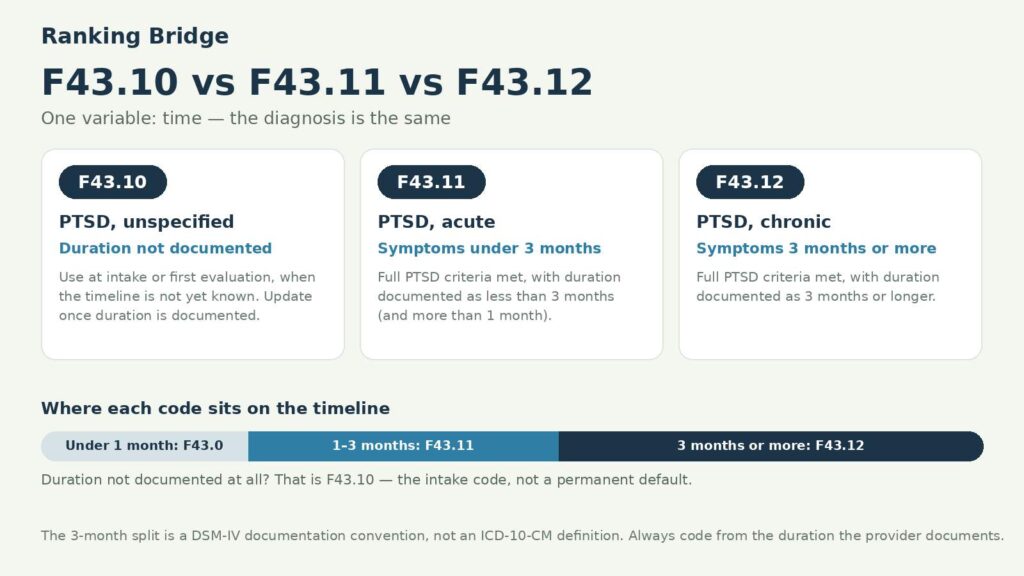
Notice what the table does not say. None of the three codes reflects symptom severity. None reflects the type of event involved, either. Duration is the only variable. So the coding question is always the same: what does the note say about duration?
When F43.10 Is the Correct Code
F43.10 is correct whenever the provider has diagnosed PTSD and the note does not yet state a duration. In practice, that happens most often at intake. It also happens at a first evaluation, while the clinician is still gathering the history. For example, a patient may present for an initial assessment after early signs of mental health problems were noticed. The clinician may then need more than one visit to pin down when the symptoms began. In that situation, F43.10 is the honest code. It reports what is known and does not guess at what is not.
Similarly, F43.10 fits when a patient cannot provide a clear timeline. Some patients are unsure when their symptoms started, and others have records that do not establish an onset date. As long as the clinician documents the PTSD diagnosis itself, F43.10 carries the claim correctly.
There is one more legitimate use: the transfer patient. When incoming records confirm PTSD but say nothing about duration, F43.10 is the right starting point. The receiving clinician can then update the code once the history is established. For behavioral-health practices, this intake pattern is routine. It is one reason mental health billing needs coders who understand the F43 block. Our shortlist of the best mental health billing companies in the USA for 2027 shows how specialist billers handle these claims.
When F43.10 Stops Being Correct
F43.10 has a shelf life. The moment the clinical note documents how long the symptoms have been present, F43.10 is no longer the right code. Instead, the coder must switch codes. Use F43.11 when the duration is under 3 months, and F43.12 when it is 3 months or more. Continuing to report F43.10 after the duration is known is an unspecified-code error. It is also the most common PTSD coding mistake.
This matters for a practical reason. Most patients with established PTSD qualify for F43.11 or F43.12, not F43.10. Their history is usually documented by the second or third visit. Payers also scrutinise unspecified codes on repeat claims. An F43.10 carried visit after visit reads as incomplete documentation. It can draw denials or audit attention, even when the diagnosis itself is sound.
Therefore, treat F43.10 as a bridge, not a destination. At intake, it is the correct code. At follow-up, the note should confirm the duration, so the code can move to F43.11 or F43.12. Or it should state plainly that the duration is still being established. Either way, the code follows the documentation — never the other way round.
The 3-Month Rule Is a Convention, Not an ICD-10-CM Definition
Here is the point most coding guides get wrong. ICD-10-CM does not define “acute” or “chronic” anywhere in the F43.1 code titles. The 3-month split comes from the DSM-IV specifier framework. DSM-IV defined acute PTSD as symptoms lasting less than 3 months, and chronic PTSD as symptoms lasting 3 months or more. DSM-5 dropped both specifiers entirely. Under DSM-5 and DSM-5-TR, a PTSD diagnosis requires symptoms lasting more than 1 month. No acute-versus-chronic distinction remains. DSM-5-TR itself lists PTSD under F43.10.
ICD-10-CM, however, kept the acute and chronic codes. As a result, coders still use F43.11 and F43.12. Yet the 3-month boundary they apply is a documentation convention inherited from DSM-IV, not a rule written into ICD-10-CM. That distinction matters because it changes what a coder may do. Since no ICD-10-CM definition exists, a coder must never infer duration from the clinical picture. The only valid source is the duration the provider documents in the note.
The 1-month floor deserves a note of its own. PTSD requires symptoms lasting more than 1 month. Because of that floor, the acute window effectively runs from just over 1 month to just under 3 months. If fewer than 30 days have passed since the event, PTSD cannot yet be the diagnosis. That points to a different code entirely, as the next section explains.
F43.10 vs F43.0: Acute Stress Reaction
F43.0, Acute stress reaction, is the code coders most often confuse with the F43.1x family. The two sit side by side in the F43 block, but they describe different points on the timeline. F43.0 covers the immediate, transient reaction in the first days and weeks after an event. DSM-5-TR uses it for acute stress disorder, where symptoms run from 3 days to 1 month. Its Applicable To terms include acute crisis reaction, combat fatigue, crisis state, and psychic shock.
By contrast, PTSD codes apply only once symptoms have lasted more than 1 month. Therefore, the boundary is a matter of timing, not of severity. A severe reaction in the first week is still F43.0. A milder presentation at six weeks is F43.11, provided the full PTSD criteria are met. In addition, the two codes point to different follow-up paths. If symptoms persist past the 1-month mark and the PTSD criteria are met, the diagnosis changes. The code then changes with it, from F43.0 to the F43.1x family.
For coders, the practical check is simple. First, ask how long it has been since the event. If the answer is under a month, F43.0 is the candidate code. If the answer is over a month, the F43.1x codes come into play. The choice among them then depends on the documented duration.
F43.10 vs F43.2x: Adjustment Disorders
Adjustment disorders (F43.20–F43.29) are the second boundary coders need to watch. They sit in the same F43 block and also follow a stressful event. At first glance, the two families look similar. The difference is clinical rather than temporal, and it belongs to the provider. Coders should still understand it well enough to spot a mismatch.
Adjustment disorders centre on depressed mood, anxiety, or disturbed conduct in response to a stressor. They do not require the full PTSD criteria. In particular, the stressor behind an adjustment disorder may not meet the threshold for a traumatic event. Or the patient’s presentation may not satisfy the PTSD criteria, even though distress is clearly present. In those cases, the provider documents an adjustment disorder, and the coder reports the matching F43.2x code. For example, F43.21 covers adjustment disorder with depressed mood, and F43.22 covers adjustment disorder with anxiety.
The key point for coders is that the two families are not interchangeable. If the provider’s diagnosis is PTSD, the code comes from F43.1x. If the diagnosis is an adjustment disorder, the code comes from F43.2x. When the note is ambiguous, the right move is a provider query, not a guess. Similarly, when a depressive episode is documented alongside PTSD, code it separately. See our guide to ICD-10 code F32.0 for the depressive-episode code.
What the Documentation Must Say
A clean F43.10 claim rests on two documented facts: the PTSD diagnosis and the status of the duration. The note should state the diagnosis clearly. It should also record what is known about symptom duration — including when the answer is “not yet established.” That second statement is what makes F43.10 defensible: it shows the unspecified code is a deliberate choice, not an oversight.
At intake, a short line is enough. For example: “PTSD diagnosed; symptom onset and duration still being established; will clarify at follow-up.” At the next visit, the note should update the picture. Either the duration is now known, so the code moves to F43.11 or F43.12. Or it remains unclear, and the note should say so again. A coder who sees F43.10 on a third or fourth visit should check the note for duration. If it is missing, send a query rather than carrying the code forward silently.
A useful query is short and specific: “The chart documents PTSD without a symptom duration. Please confirm whether symptoms have lasted less than 3 months, or 3 months or more.” Queries like this protect the claim twice over. They produce a more specific code, and they create a record showing the coder sought the detail.
Common F43.10 Coding Errors
Using F43.10 as a permanent default. This is the most frequent error, and it is also the most avoidable. F43.10 is correct at intake, but it becomes incorrect the moment the note documents a duration. Coders who leave it in place visit after visit invite denials and audits, even when the underlying diagnosis is right.
Coding from severity instead of duration. Some coders reach for F43.12 when the presentation looks severe, or for F43.11 when it looks mild. That is not how the codes work. Severity does not appear in any F43.1x descriptor; only duration separates the three codes. If the note says nothing about duration, the answer is F43.10 — regardless of how the patient presents.
Confusing F43.0 with the F43.1x codes. As noted above, the split is timing. F43.0 covers the first month, while the F43.1x codes start after it. Coding F43.11 for a reaction two weeks after an event is wrong, because PTSD cannot be diagnosed that early. Equally, leaving F43.0 on the claim after symptoms have persisted for months misses the change in diagnosis.
Reporting F43.1 without a fifth digit. F43.1 is a non-billable parent code. A claim carrying F43.1 alone will not process; it needs F43.10, F43.11, or F43.12. This error usually comes from an EHR pick-list that shows the parent code first. It is worth checking the claim before submission.
Related Codes in the F43 Block
| Code | Descriptor | Note |
|---|---|---|
| F43.0 | Acute stress reaction | First days to 1 month after the event; includes acute crisis reaction and combat fatigue |
| F43.10 | Post-traumatic stress disorder, unspecified | PTSD criteria met; duration not documented |
| F43.11 | Post-traumatic stress disorder, acute | PTSD criteria met; symptoms under 3 months |
| F43.12 | Post-traumatic stress disorder, chronic | PTSD criteria met; symptoms 3 months or more |
| F43.20–F43.29 | Adjustment disorders | Depressed mood, anxiety, conduct disturbance, or mixed presentations |
| F43.81 | Prolonged grief disorder | Persistent grief response following bereavement |
| F43.89 | Other reactions to severe stress | Other specified reactions to severe stress |
| F43.9 | Reaction to severe stress, unspecified | Unspecified trauma and stressor-related disorder |
Frequently Asked Questions
The ICD-10 code for PTSD is F43.10 (post-traumatic stress disorder, unspecified) when the duration is not documented. However, if the provider documents the duration, the code changes. It becomes F43.11 for symptoms under 3 months, or F43.12 for symptoms of 3 months or more. In other words, F43.10 is the starting code, not the only PTSD code.
Yes. F43.10 is a billable, specific ICD-10-CM code that can be used to indicate a diagnosis for reimbursement purposes. It is valid for FY2027 (1 October 2026 – 30 September 2027). By contrast, the parent code F43.1 is not billable and cannot appear on a claim on its own.
Duration is the only difference. All three codes describe the same diagnosis: PTSD with the same criteria. They differ only in what the note says about how long the symptoms have lasted. F43.10 means the duration is not documented. F43.11 means symptoms have lasted less than 3 months, and F43.12 means 3 months or more.
Under the DSM-IV convention that coders still apply, chronic PTSD means symptoms have lasted 3 months or more. Keep in mind that this 3-month boundary is a documentation convention, not a definition in ICD-10-CM. Always code from the duration the provider documents, and never infer it from the clinical picture.
Timing separates them. F43.0 covers the immediate reaction in the first days to 1 month after an event. F43.10 applies once the PTSD criteria are met, after symptoms have lasted more than 1 month. If fewer than 30 days have passed since the event, PTSD cannot yet be the diagnosis. F43.0 is the candidate code in that window.
Only while the duration genuinely remains undocumented. Once the note states how long the symptoms have been present, F43.10 is no longer correct. The claim must then move to F43.11 or F43.12. Payers scrutinise unspecified codes on repeat claims, so carrying F43.10 forward without a documented reason is a denial risk. If the duration is still unclear at follow-up, the note should say so explicitly.
Sources
- ICD10Data.com, 2027 ICD-10-CM Diagnosis Code F43.10 — Post-traumatic stress disorder, unspecified
- ICD10Data.com, ICD-10-CM Diagnosis Code F43.11 — Post-traumatic stress disorder, acute
- ICD10Data.com, ICD-10-CM Diagnosis Code F43.12 — Post-traumatic stress disorder, chronic
- ICD10Data.com, ICD-10-CM Diagnosis Code F43.0 — Acute stress reaction
- ICD10Data.com, ICD-10-CM Diagnosis Code F43.89 — Other reactions to severe stress
- Journal of the American Academy of Psychiatry and the Law, PTSD Criteria in DSM-IV-TR versus DSM-5 (acute/chronic specifiers dropped in DSM-5)
- Substance Abuse and Mental Health Services Administration, DSM-5 Changes (NCBI Bookshelf): DSM-IV acute/chronic specifiers dropped in DSM-5
- Behave Health, “PTSD ICD-10 Codes: F43.10, F43.11, F43.12 Guide”
- Mentalyc, “PTSD ICD-10 Code F43.1”
- Mental Note, “Anxiety, PTSD and Adjustment Disorder ICD-10 Codes”
