Telehealth Coding 2027: POS 02 vs 10, Modifiers 95/93/GT — and the New BB/BC Modifiers
This voice experience is generated by AI.
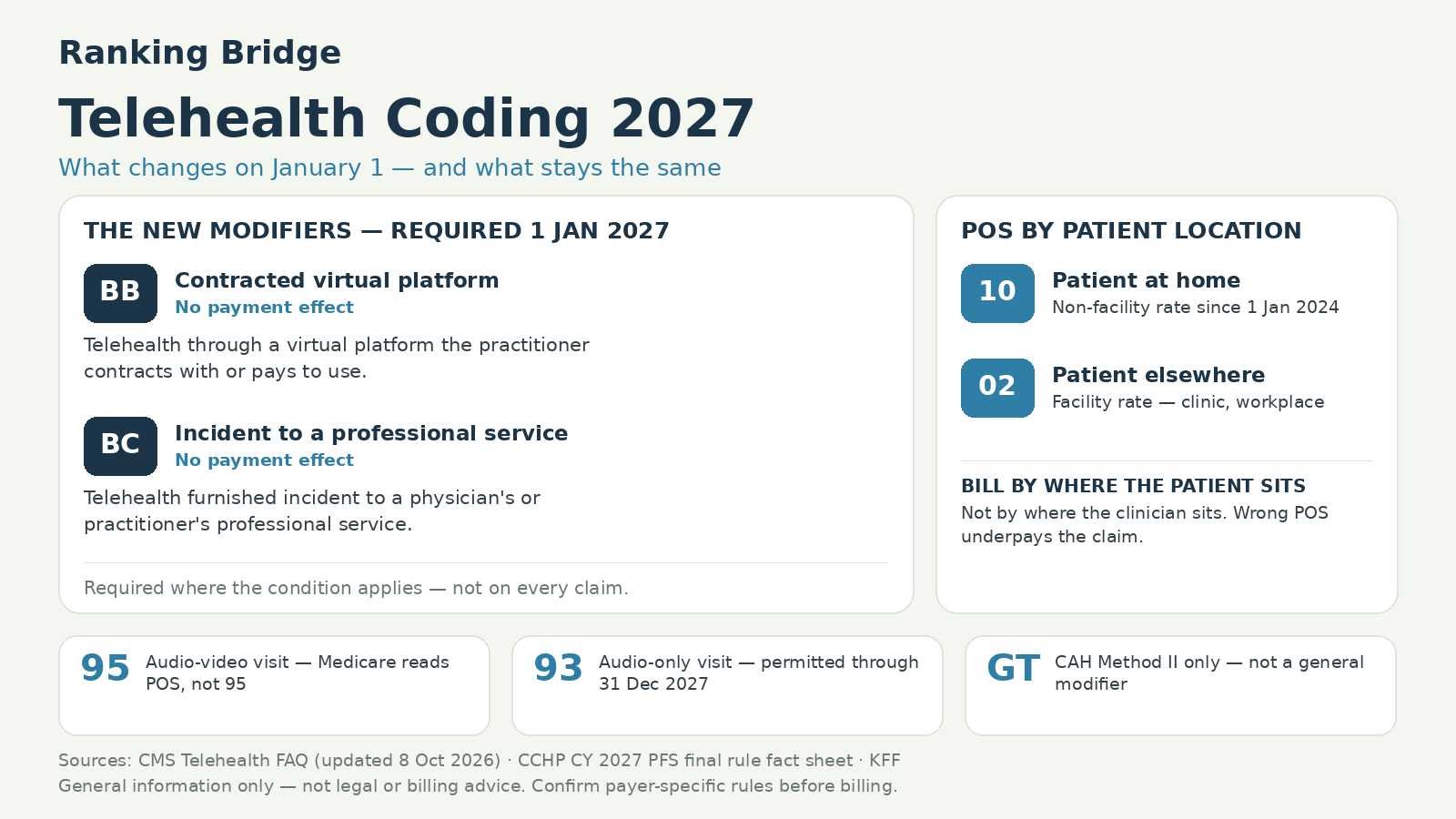
Telehealth coding 2027 brings one hard deadline. From January 1, 2027, Medicare requires two new modifiers on telehealth claims where they apply. Modifier BB flags telehealth delivered through a contracted virtual platform. Modifier BC flags telehealth furnished incident to a physician’s or practitioner’s professional service. Neither modifier changes what Medicare pays. The rest of the claim stays familiar. Bill the same CPT code as for the in-person visit, add the place-of-service code for where the patient sits, and use modifier 95 for audio-video or 93 for audio-only. That is the core of telehealth coding 2027.
CMS added BB and BC to its Telehealth FAQ on October 8, 2026. It then finalized them in the CY 2027 Physician Fee Schedule final rule on November 4, 2026. Congress directed CMS to create the two modifiers in the Consolidated Appropriations Act, 2026. They exist so Medicare can see how telehealth is delivered, not to cut payment. This guide covers the new modifiers first. Next, it walks through POS 10 vs 02 and the 95, 93 and GT rules. Finally, it ends with a worked claim line and a checklist your billing team can run before January. This post covers the claim line only. For the clinical side, see our guide on whether virtual care counts as physician oversight.
Telehealth Coding 2027 at a Glance: BB and BC Become Required on January 1
The headline change is simple. Two new HCPCS modifiers join the telehealth claim on January 1, 2027. They apply by date of service, not by billing date. In other words, a visit on December 31, 2026 does not need them, even if you bill it in January. A visit on January 1, 2027 does, where the condition for each modifier is met.
| What changes | Effective date | Payment effect |
|---|---|---|
| Modifier BB (contracted virtual platform) | January 1, 2027 | None |
| Modifier BC (incident to a professional service) | January 1, 2027 | None |
| POS 10 vs 02 rules | No change | Non-facility vs facility rate |
| Modifiers 95 and 93 | No change | None |
| Medicare telehealth flexibilities | Through December 31, 2027 | See below |
Above all, remember that BB and BC are reporting flags. CMS states plainly that neither modifier has payment implications. They tell Medicare how the visit was delivered. They do not raise or lower the rate. That distinction matters, because the most common misunderstanding in the first wave of coverage is that the new modifiers cut pay. They do not.
January 1 is a busy deadline day for RCM teams. The CPT 2027 code changes take effect the same morning, with 453 updates including the end of global OB billing. Treat the telehealth modifier update as part of the same January 1 work, not as a separate project.
Modifier BB: The Contracted-Platform Flag
Modifier BB marks a specific delivery arrangement. It applies to telehealth furnished through a virtual platform by a physician or practitioner who contracts with the entity that owns the platform, or who has a payment arrangement with an entity for use of the platform. In plain terms, BB turns on the platform relationship, not on video versus audio.
A typical BB case is easy to spot. Your clinicians see patients through a telehealth platform owned by a vendor. Your practice contracts with that vendor, or pays for use of its platform. In that case, add BB to the claim from January 1, 2027.
The edge case needs more care. Some practices run video visits through their own licensed system, with no contract or payment arrangement with the platform’s owner. CMS has published the definition and nothing more on that scenario. As a result, confirm with your Medicare Administrative Contractor or billing adviser before January if your setup falls in that gap. Do not guess, and do not assume BB applies to every video visit. It does not.
One more caution: CMS may issue further instructions through subregulatory guidance rather than formal rulemaking. Details can therefore change between now and January. Check the CMS telehealth page again before your first January claim run.
Modifier BC: The Incident-To Flag
Modifier BC marks telehealth furnished incident to a physician’s or practitioner’s professional service. Incident-to billing covers services that auxiliary staff furnish as part of a physician’s plan of care, under the physician’s direct supervision. BC is now the flag for the telehealth version of that arrangement.
Incident-to rules already exist outside telehealth. They sit in the federal regulation at 42 CFR 410.26. In general, the service must be an integral part of the physician’s professional service. The physician must furnish the initial service and remain involved in the patient’s care. The auxiliary staff member furnishes the service under the physician’s direct supervision, which means the physician is present in the office suite and immediately available.
BC does not change any of that. It only labels the claim so Medicare can see that the telehealth service was furnished incident to a professional service. Like BB, it carries no payment effect. If your practice does not bill incident-to services, BC will rarely appear on your claims. If it does, add BC to the modifier table alongside BB before January.
POS 10 vs POS 02: Bill by Where the Patient Sits
Place of service is the field Medicare reads to identify a telehealth claim. Telehealth coding 2027 leaves the place-of-service rules unchanged. The rule is simple: bill by where the patient sits during the visit, not by where the clinician sits.
POS 10 means the patient was at home. Medicare pays home telehealth at the non-facility rate, and it has done so since January 1, 2024. The non-facility rate is the higher rate, because it assumes the practice carries the overhead of the encounter.
POS 02 means the patient was somewhere other than home. That could be a workplace, a satellite clinic, or another care site. Medicare pays those claims at the facility rate, which is lower.
The gap between the two rates makes this field worth getting right. Billing POS 02 out of habit when the patient was actually at home underpays the claim every time. The fix is a front-desk habit, not a coding degree: document the patient’s location in the visit note, and let the note drive the POS code. Wrong POS codes are also a common denial driver. For the appeal side of that problem, see our guide to denial management in medical billing.
Modifiers 95, 93 and GT: What Each One Still Does
In telehealth coding 2027, modifier 95 still marks a synchronous audio-video visit. It is the modifier most billers reach for first. For Medicare fee-for-service professional claims, however, the place-of-service code already identifies the visit as telehealth. Medicare therefore does not require modifier 95 on most professional claims, including claims billed with POS 10. Appending 95 anyway does not cause a denial. It is simply not the field Medicare reads.
Commercial payers are different. Many Medicare Advantage plans and commercial payers still require 95 alongside the POS code. As a result, build the modifier logic per payer. Do not drop 95 everywhere just because Medicare does not need it. Check each payer’s published rule, and make the rule a field on the payer record rather than a note in someone’s head.
Modifier 93 marks a synchronous audio-only visit, such as a telephone visit. Use 93 whenever the visit runs on audio only. Audio-only telehealth remains permitted through December 31, 2027 under the current flexibilities. Two niche modifiers sit alongside 93: FQ marks audio-only telehealth for mental health services, and GQ marks asynchronous telehealth in limited settings. Most practices will rarely use either one.
Modifier GT is the trap. GT now applies only to Critical Access Hospital Method II institutional claims. It is not a general telehealth modifier anymore. Using GT on an ordinary professional telehealth claim is a common error, and it will not survive a scrubber that knows the current rules. If GT still sits in your charge master as a default telehealth modifier, remove it before January.
A Complete 2027 Telehealth Claim Line
A telehealth coding 2027 claim line has four parts: the same CPT code as the in-person service, the place-of-service code for the patient’s location, the modality modifier (95 or 93), and BB or BC where the condition applies. The three examples below show how the parts fit together.
| Scenario | CPT | POS | Modifiers |
|---|---|---|---|
| Established patient, video visit from home, vendor-owned platform | 99213 | 10 | 95, BB |
| Established patient, phone visit from home, incident to the physician | 99213 | 10 | 93, BC |
| Established patient, video visit from a satellite clinic, own platform | 99214 | 02 | 95 |
In the first example, the patient is at home, so POS 10 applies with the non-facility rate. The visit runs on video, so modifier 95 applies. The practice contracts with the vendor that owns the platform, so BB applies too.
In the second example, the visit runs on audio only, so modifier 93 replaces 95. The service is furnished incident to the physician, so BC applies. The patient is at home, so POS 10 stays.
In the third example, the patient sits at a satellite clinic, so POS 02 applies with the facility rate. The practice runs the visit on its own platform with no vendor arrangement, so BB does not apply. The service is furnished directly, so BC does not apply either. This is the case to confirm with your MAC if your platform setup is unclear.
What Stays Extended Through December 31, 2027 — and What Returns January 1, 2028
Telehealth coding 2027 sits inside a wider extension. The Consolidated Appropriations Act, 2026, signed February 3, 2026, extended the Medicare telehealth flexibilities through December 31, 2027. The flexibilities briefly lapsed at the end of January 2026 and were then restored retroactively, so claims from the lapse period were paid.
Through December 31, 2027, the flexibilities cover:
- No geographic or originating-site restrictions: the patient can be at home anywhere in the United States.
- An expanded practitioner list, including physical therapists, occupational therapists, speech-language pathologists and audiologists.
- Federally Qualified Health Centers and Rural Health Clinics as distant sites.
- Audio-only telehealth for certain services.
- A delay of the in-person visit requirement for tele-mental-health services.
From January 1, 2028, the old rules return for everyone outside behavioral health unless Congress acts again. Most patients must then be in a rural medical facility to receive Medicare telehealth. Physical therapists, occupational therapists, speech-language pathologists and audiologists can no longer furnish Medicare telehealth. For tele-mental-health services, the in-person visit requirement takes effect after December 31, 2027, which means the requirement is delayed to January 1, 2028 rather than removed.
Two related deadlines sit outside this coding guide. The DEA permission to prescribe controlled substances by telehealth without an in-person visit expires December 31, 2026. Federally Qualified Health Centers and Rural Health Clinics stopped billing G2025 on October 1, 2026. Both are covered in our companion Medicare telehealth policy post.
Telehealth Billing Checklist: What to Change Before Your First January Claim
Telehealth coding 2027 rewards preparation. Run this checklist before your first claim with a January 2027 date of service. Most items take an afternoon. All of them beat a January denial queue.
- Add BB and BC to the modifier table in your billing system, with the effective date set to January 1, 2027.
- Update your superbills and encounter forms so BB and BC appear as options on telehealth lines. See our explainer on what a superbill is if your team needs a refresher.
- Update your claim scrubber edits: flag any January Medicare telehealth claim that is missing BB or BC where the condition applies.
- Review every telehealth platform contract and note which arrangements trigger BB. Confirm the unclear cases with your MAC now, not in January.
- Train the front desk to document the patient’s location at check-in, so POS 10 vs 02 follows the note.
- Remove GT as a default telehealth modifier from your charge master, unless you bill Critical Access Hospital Method II claims.
- Check each commercial payer’s modifier 95 rule and record it per payer, since Medicare’s rule does not generalize.
- Run one test claim per scenario in the table above and confirm the clearinghouse accepts the modifier combinations.
- Pair this work with the other January 1 deadline: the CMS prior authorization rule for 2027 brings new decision clocks and FHIR API requirements the same morning.
FAQs
What are the new Medicare telehealth modifiers BB and BC for 2027?
BB marks telehealth furnished through a virtual platform by a practitioner who contracts with the entity that owns the platform, or who has a payment arrangement with an entity for use of the platform. BC marks telehealth furnished incident to a physician’s or practitioner’s professional service. Both are required on Medicare telehealth claims for dates of service on or after January 1, 2027, where the condition for each modifier is met. Neither modifier changes what Medicare pays.
Does modifier BB change how much Medicare pays?
No. CMS states plainly that neither BB nor BC has payment implications. The modifiers are data flags that tell Medicare how the visit was delivered. The rate still comes from the CPT code, the place-of-service code, and the fee schedule. Do not treat BB or BC as a rate change in your revenue forecasts.
What is the difference between POS 10 and POS 02 for telehealth?
POS 10 means the patient was at home during the visit. Medicare pays it at the non-facility rate, which has applied since January 1, 2024. POS 02 means the patient was somewhere other than home, such as a workplace or another clinic. Medicare pays it at the facility rate, which is lower. Bill by where the patient sits, and document the location in the visit note.
Do I still need modifier 95 with POS 10?
Not for Medicare fee-for-service. Medicare reads the place-of-service code to identify the telehealth claim, so it does not require modifier 95 on claims billed with POS 10. Many Medicare Advantage plans and commercial payers still require 95, however. Check each payer’s rule and record it per payer rather than applying one rule everywhere.
When do the Medicare telehealth flexibilities expire?
The flexibilities run through December 31, 2027 under the Consolidated Appropriations Act, 2026. From January 1, 2028, the pre-pandemic rules return for most telehealth unless Congress acts again. That means originating-site restrictions come back and several practitioner types lose Medicare telehealth. The in-person visit requirement for tele-mental-health services is delayed to January 1, 2028.
What is modifier GT used for now?
Modifier GT now applies only to Critical Access Hospital Method II institutional claims. It is no longer a general telehealth modifier. Using GT on an ordinary professional telehealth claim is a common error. Use modifier 95 for audio-video visits and 93 for audio-only visits instead, with POS 10 or 02 by patient location.
This guide is general information for billing teams, not legal or billing advice. Confirm payer-specific rules with each payer and your Medicare Administrative Contractor, and check the CMS telehealth page again before your first January claim run.
