
What Is a Superbill?
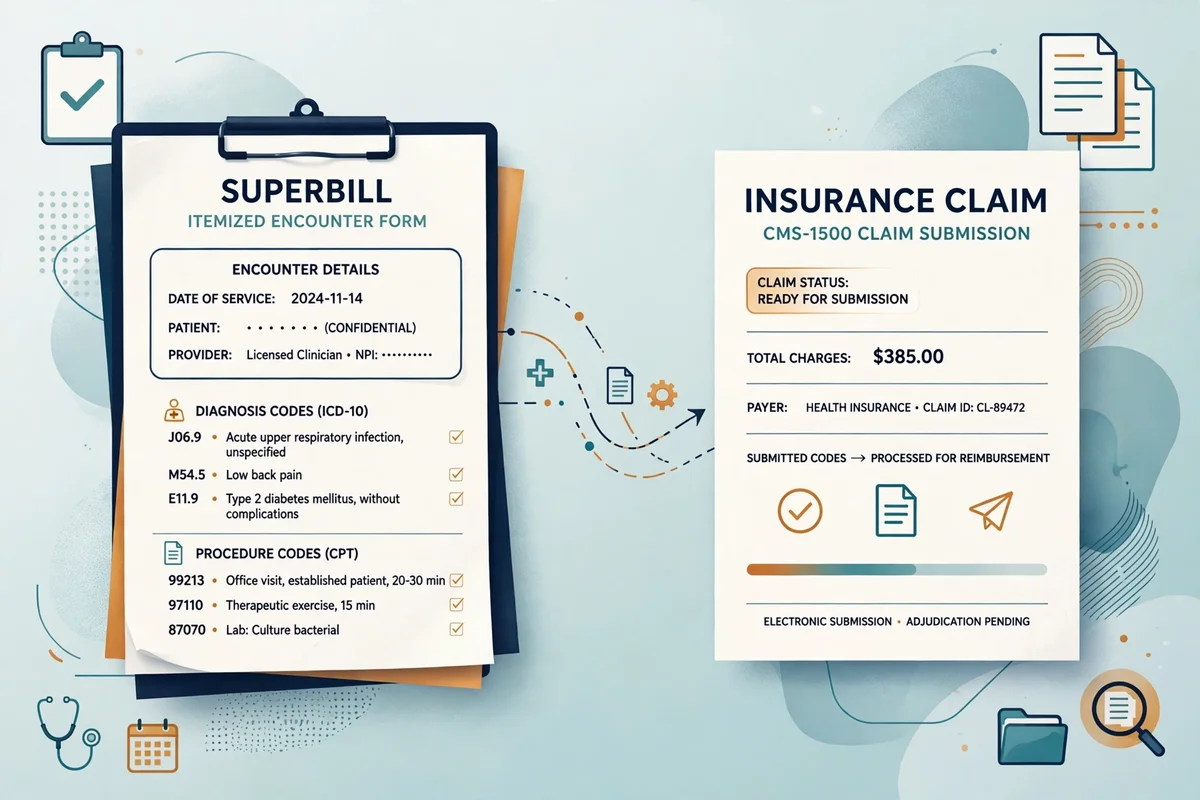
A superbill, also known as an encounter form, charge slip, or fee ticket, is an itemised document that records the services provided during a patient visit, along with the codes and details needed to bill for those services.
Think of it as the bridge between clinical care and the insurance claim. The clinician documents what happened during the visit. The superbill captures that visit in a structured, billable form. The billing team then uses the superbill to create a claim and submit it to the payer for reimbursement.
A superbill is not, strictly speaking, a bill to the patient, and it is not the claim itself. It is the source document that makes an accurate claim possible.
What Does a Superbill Include?
A complete superbill typically includes three groups of information:
Patient Information
- Patient name and date of birth
- Date of service
- Insurance information, where relevant
- Patient payments or copay collected, where relevant
Provider Information
- Provider name and signature
- Practice name and location
- National Provider Identifier (NPI)
- Referring provider, where relevant
Visit Information
- Reason for the visit and diagnosis codes (ICD-10-CM)
- Procedures and services performed, with procedure codes (CPT)
- Modifiers, where applicable
- Units, time, or other details needed to support the codes
- Provider notes or comments to justify medical necessity
In electronic systems, much of this is pre-populated or selected from templates. In paper practices, it is checked off on a printed form. Either way, the principle is the same: if it is not captured on the superbill, it is very easy for it to be missed on the claim.
How Does a Superbill Become a Claim?
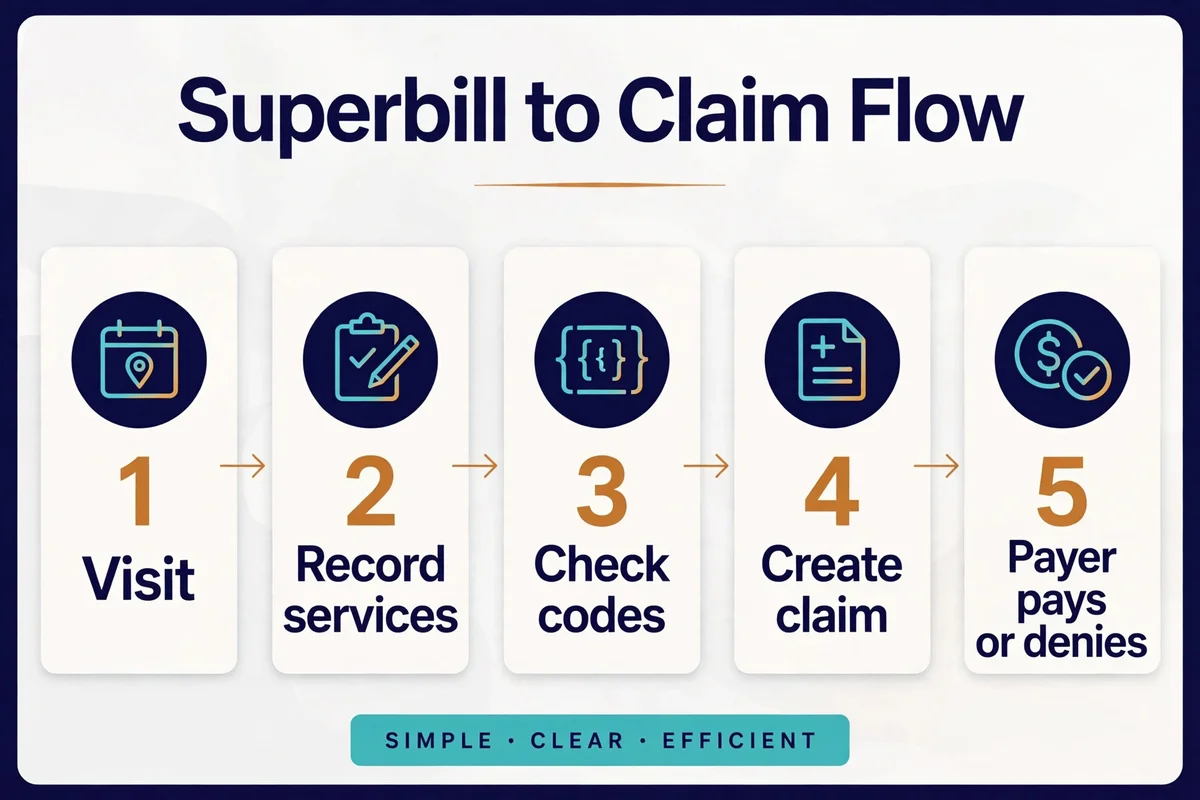
The journey from visit to payment usually follows these steps:
- The visit happens. The clinician examines the patient, makes a diagnosis, and provides treatment.
- Services are recorded. The clinician, or a trained staff member, records the diagnoses and procedures on the superbill or encounter form.
- Codes are checked. The billing team, or the practice management system, checks that the diagnosis codes support the procedure codes, and that modifiers and units are correct.
- The claim is created. Information from the superbill is translated into a formal insurance claim, usually an electronic 837 claim, and submitted to the payer.
- The payer adjudicates. The payer checks eligibility, medical necessity, coding, and contract terms, then pays, partially pays, or denies the claim.
- Follow-up happens. If the claim is denied or underpaid, the billing team investigates, corrects where appropriate, and resubmits or appeals.
A clean superbill makes every later step easier. A messy superbill creates rework at every later step.
Superbill vs Claim vs Patient Statement: Don’t Confuse Them
- Superbill / encounter form: An internal, itemised record of what happened at the visit, used to create a claim. It is a communication tool between clinicians and billers.
- Insurance claim: The formal request for payment sent to the payer, in the payer’s required format.
- Patient statement: The bill sent to the patient for any balance they owe after insurance has processed the claim.
Confusing these three is a common source of errors, especially for new billing staff and for patients who receive a superbill for out-of-network reimbursement. A patient with out-of-network benefits may submit the superbill to their insurer themselves, to seek reimbursement — but the superbill itself is not proof of payment, and it does not replace the medical record.
Why Superbills Still Matter in an Electronic World
Many practices are now largely paperless, and it is tempting to assume superbills are obsolete. They are not — the form has changed, but the function has not.
Even in a fully electronic practice, someone still has to capture, in a structured way:
- What diagnosis was addressed
- What procedure was performed
- Who performed it, where, and when
- What should be billed, and what should not
Electronic health record and practice management systems now do much of this automatically, but they still rely on clinicians selecting the right codes and documenting the right details. The “superbill” is now often a screen in the EHR rather than a sheet of paper, but a missing code on that screen causes exactly the same problem as a missing tick on a paper form: a missed charge, a denied claim, or an audit finding.
Common Superbill Mistakes — and How to Fix Them
Missing or Vague Diagnosis Codes
A procedure without a supporting diagnosis is a denial waiting to happen. Fix: require a diagnosis for every billed procedure, and review the link between diagnosis and procedure before submission.
Copying Forward Without Review
Copying a previous visit’s codes is fast, but dangerous if the current visit was different. Fix: treat every superbill as a new record, even when the patient and condition look familiar.
Unchecked Modifiers and Units
A missing modifier, or a wrong unit count, can change payment or trigger a denial. Fix: build modifier and unit checks into the billing workflow, especially for common procedures in your specialty.
Illegible or Incomplete Paper Forms
If billing staff cannot read the form, they cannot bill accurately. Fix: move to electronic encounter forms where possible, and standardise paper forms with clear, specialty-specific code lists.
Treating the Superbill as the Medical Record
The superbill is a billing communication tool. It is not a substitute for a signed, complete medical record. In an audit, payers will validate the claim against the medical record itself, not just the superbill. Fix: make sure clinical documentation supports every code on the superbill.
How to Design a Better Superbill
A good superbill, paper or electronic, should be:
- Specialty-specific. It should list the diagnoses and procedures your practice actually uses, not a generic list.
- Easy to complete. Clinicians should be able to complete it quickly, without hunting through irrelevant codes.
- Regularly updated. Codes change every year. A superbill that still lists retired codes will create denials.
- Checked before submission. A quick pre-submission review — diagnosis supports procedure, modifiers correct, units correct — catches most avoidable errors.
- Connected to denial feedback. If the same code combination keeps getting denied, the superbill template, not just the individual claim, may need fixing.
For practices struggling with repeated denials, the superbill is often the first place to look. See our guide to denial management in medical billing for what to do once a denial has occurred, and What Is RCM in Healthcare? for how charge capture fits into the wider revenue cycle.
Superbills and Out-of-Network Care
Superbills are especially important for out-of-network providers and for patients who pay out of pocket and seek reimbursement themselves.
In that scenario, the practice gives the patient an itemised superbill, and the patient submits it to their insurer. The insurer then processes it under the patient’s out-of-network benefits, which may be less generous than in-network benefits, and may involve a deductible or coinsurance.
Practices that serve many out-of-network patients should make their superbills especially clear: complete provider and patient details, correct codes, dates of service, and amounts paid. An incomplete superbill in this setting does not just delay the practice’s payment — it delays the patient’s reimbursement too.
Frequently Asked Questions About Superbills
Is a superbill the same as a receipt?
Not quite. A superbill is an itemised record of services and codes, used to create a claim. A receipt simply confirms payment. A superbill may show an amount paid, but its main purpose is billing, not payment confirmation.
Do all practices still use superbills?
Most practices still use the concept, even if the form is electronic. Some fully integrated systems capture charges automatically from clinical documentation, but the underlying charge-capture step is the same.
Can a patient use a superbill to get reimbursed?
Yes, commonly for out-of-network care. The patient submits the superbill to their insurer, which processes it under their plan’s out-of-network rules.
What happens if a superbill has the wrong code?
The claim created from it will likely be wrong too — leading to a denial, an underpayment, or, if the error is in the practice’s favour, a compliance risk. Correcting the superbill and the claim, and checking the underlying documentation, is essential.
The Bottom Line
A superbill is a small document with an outsized impact. It is where clinical care becomes billable revenue, and where small errors become denied claims, delayed payment, and audit risk.
Practices that treat charge capture as a core discipline — with specialty-specific templates, regular code updates, pre-submission checks, and feedback from denial patterns — tend to have cleaner claims and steadier cash flow. Practices that treat it as an afterthought tend to spend far more time chasing the revenue they already earned.
Get the superbill right, and much of the rest of revenue cycle management gets easier.
Further reading on Ranking Bridge:
- What Is RCM in Healthcare?
- What Is Denial Management in Medical Billing?
- What Is an EOB in Medical Billing?
- What Is an EOR in Medical Billing?
- What Is Coordination of Benefits (COB) in Medical Billing?
Authoritative sources:
- AAPC, What Is Medical Billing (explaining how information from the superbill is used to prepare a claim): http://aapc.com/resources/what-is-medical-billing?srsltid=AfmBOork-xWnq9jse6eMLqbBl2-MgDQ-pGZGYEWyK0YiHV5PSC8FgVc1
This article is general information about medical billing workflows. It is not billing, coding, or compliance advice. Practices should verify current coding rules, payer requirements, and documentation standards for their specialty.