
Best 10 Physical Therapy Billing Companies in USA
This voice experience is generated by AI.
Physical therapy billing runs on the clock. Most PT codes bill in 15-minute units, and Medicare’s 8-minute rule decides how many units a visit can support. One miscounted session can underbill the visit — or overbill it and invite an audit. In addition, modifiers like GP, KX, and CQ must land on the right claims, and authorizations must arrive before the visit, not after.
The pressure keeps rising. Claim denials are still rising in 2026, and therapy claims feel it first. Meanwhile, the Centers for Medicare & Medicaid Services (CMS) keeps updating therapy payment rules, including the multiple procedure payment reduction. As a result, many PT practices now hand billing to specialists who know the specialty’s rules.
The ten physical therapy billing companies below suit different practices. This is a shortlist, not a ranking. Overall, the right choice depends on your visit volume, your documentation system, and whether you want a full outsourcing partner or a platform with billing built in.
How This Shortlist Was Put Together
This shortlist is editorial. In particular, it rests on public information about each company’s services, technology, and physical therapy focus. Companies appear in no particular order. Five criteria guided the selection:
- Dedicated physical therapy focus. PT billing is a named service with its own team — not one line on a general specialty list. For example, we looked for companies with dedicated PT billing pages and therapy-trained staff.
- Timed-code and 8-minute-rule depth. PT claims need coders who know timed versus untimed codes, unit counts, and the 8-minute rule. In addition, they need GP, KX, and CQ modifier rules. We favored companies whose coders carry AAPC or AHIMA credentials.
- Authorization and visit-limit tracking. Many payers cap visits or require authorization after a set number. Therefore, we looked for teams that track authorizations and visit counts before the visit happens.
- Denial and A/R follow-through. Unit mismatches and medical-necessity denials are common in PT. As a result, the best partners trace denials to their root cause and fix the workflow, not just resubmit the claim.
- Documentation-to-claims fit. Charge capture starts in the therapist’s note. We favored vendors whose billing connects cleanly to documentation, so units and modifiers flow from the note into the claim.
Before you sign, request proposals from two or three of these companies. Then ask for references from PT practices like yours. Finally, have each vendor review a sample of your recent claims — fit matters most.
The 10 Companies at a Glance
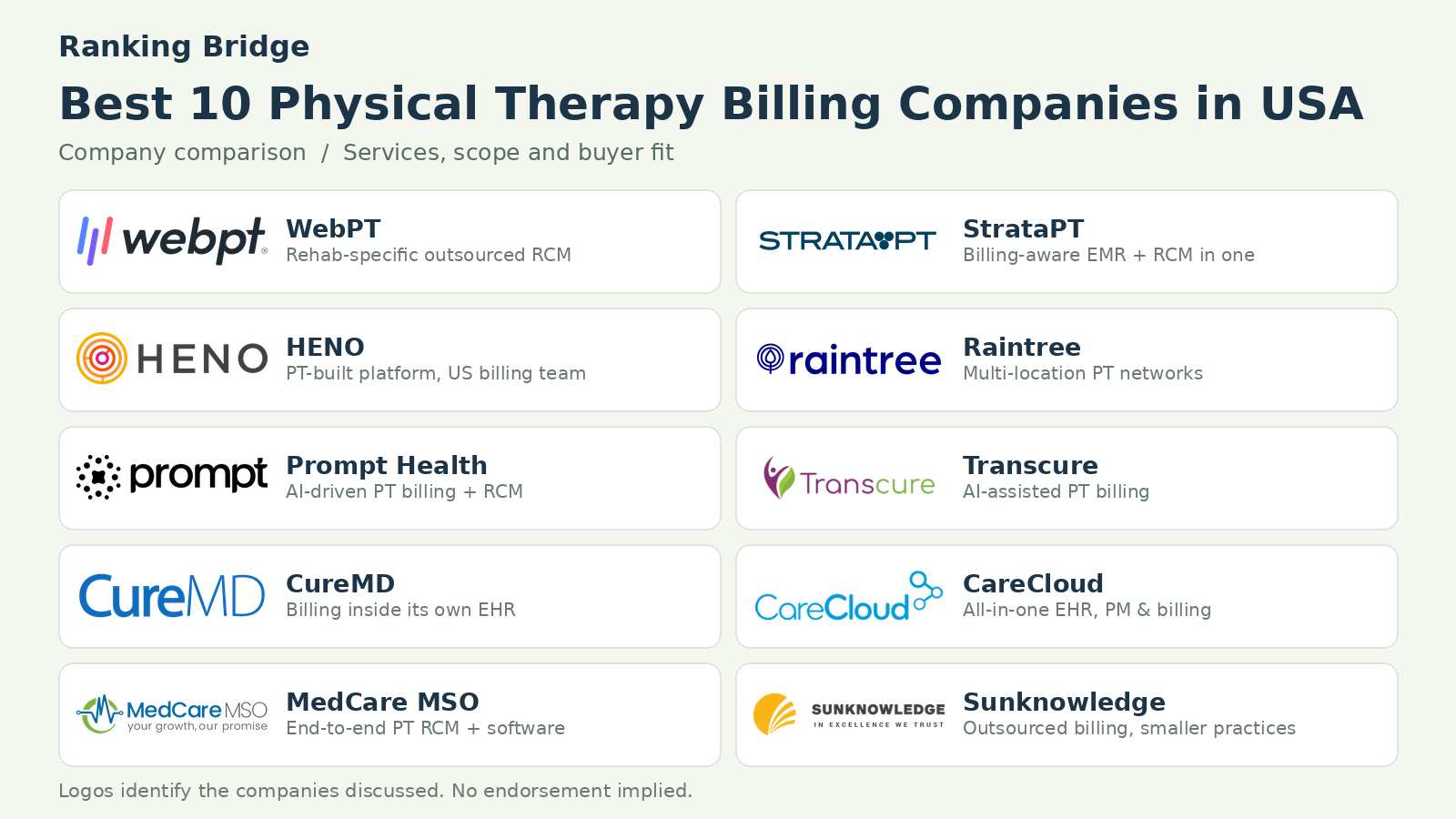
| Company | Best for | Model | PT focus |
|---|---|---|---|
| WebPT | Rehab-specific outsourced RCM | Platform + managed RCM | RevServe RCM, Therabill, hybrid RevEquip |
| StrataPT | Billing-aware EMR + RCM in one | Platform + managed RCM | Note scrubbing, 24-hour claim submission |
| HENO | PT-built platform with US billing team | Platform + managed billing | KX automation, AI EOB, patient statements |
| Raintree | Multi-location PT networks | Platform + RCM services | Centralized billing, payer rules, enterprise reporting |
| Prompt Health | AI-driven PT billing + RCM | Platform + managed RCM | Payer rules, KX triggers, auto claim checks |
| Transcure | AI-assisted PT billing | Managed service + AI agents | 8-minute rule, timed codes, 40+ EHRs |
| CureMD | Billing inside its own EHR | Platform + specialists | GP/CQ/KX modifiers, AI code validation |
| CareCloud | All-in-one EHR, PM & billing | Platform + managed RCM | PT templates, claim scrubbing, prior auth |
| MedCare MSO | End-to-end PT RCM with software | Managed service + software | AI coder, eligibility, denial management |
| Sunknowledge | Outsourced billing for smaller practices | Managed service | Eligibility, charge entry, A/R follow-up |
WebPT: Best for Rehab-Specific Outsourced RCM
WebPT, based in Phoenix, Arizona, serves rehab therapy only. Its full-service RCM option, RevServe, puts a dedicated team of rehab billing specialists on the account. The team handles claim submission, scrubbing, denials, payment posting, and patient collections from start to finish. In addition, WebPT offers two in-house billing products — Therabill for smaller clinics and WebPT Billing for larger groups — for practices that keep billing in-house.
The rehab focus shows in the details. For example, its teams work with therapy modifiers and payer rules every day, not as an occasional specialty. A hybrid option, RevEquip, lets a clinic keep credentialing, verification, and A/R in-house while outsourcing scrubbing, paper bills, and payment processing. Overall, WebPT fits a PT practice that wants a rehab-only billing partner with deep therapy experience. Ask how its team handles your payer mix and your highest-denial codes before you sign.
StrataPT: Best for a Billing-Aware EMR With RCM in One System
StrataPT, based in Fredericksburg, Virginia, combines its EMR with billing and revenue cycle management in a single system. Its platform scrubs every note against payer rules before billing, so documentation problems get caught before the claim goes out. In addition, claims go out within 24 hours of the therapist finishing documentation. The company’s billing and collections team then works the full cycle for PT, OT, and speech clinics.
The single-system design matters for clinics that have struggled with separate EMR and billing tools. For example, there is no handoff between documentation and billing, because both live in the same platform. StrataPT fits an outpatient therapy clinic that wants documentation and billing under one roof. Therefore, ask how its team coordinates with your front desk on eligibility and authorizations before you sign.
HENO: Best for a PT-Built Platform With a US Billing Team
HENO, based in Orlando, Florida, was built by a physical therapist and a software engineer. Its all-in-one platform covers scheduling, documentation, billing, and patient communication for PT, OT, and speech practices. In addition, its US-based billing team handles claims, denials, payment posting, patient statements, and A/R follow-up. Patients can also use a toll-free billing hotline for questions and payments.
The PT focus shows in the details. For example, the platform automates billing rules such as KX modifiers, and AI tools extract payment data from paper EOBs. Claim notes and follow-up dates stay visible inside the system, so nothing hides in a separate billing queue. HENO fits a PT clinic that wants its software and its billing team working in the same system. Ask how its team reports on your claims week to week before you sign.
Raintree: Best for Multi-Location PT Networks
Raintree, based in Temecula, California, builds its EMR and revenue cycle platform for rehab therapy organizations. Its RCM services and billing software cover the full cycle for PT, OT, and speech practices, from authorizations to payment posting and follow-up. In addition, automated coding edits and billing rules adjust by payer, location, and provider. Enterprise reporting gives finance staff one view across every clinic.
The multi-location design matters for groups that run several sites. For example, centralized billing lets operators manage claims, denials, and collections across locations instead of reconciling separate systems for each clinic. Raintree fits a PT network that needs consolidated billing and reporting across sites. Ask how its platform handles payer rules that differ by location before you sign.
Prompt Health: Best for AI-Driven PT Billing and RCM
Prompt Health, based in Hoboken, New Jersey, runs an AI-powered EMR and practice management platform built only for outpatient rehab therapy. Its full-service RCM offering puts a dedicated US-based team on billing, claims, denials, and patient collections inside the same system as the clinic’s EMR. In addition, AI claim processing checks claims before submission and flags the ones that need a human review.
The billing depth shows in the details. For example, payer-specific rules stop a claim from going out without a required authorization, and visit caps and KX triggers are handled automatically. A built-in clearinghouse connects claims directly to payers. Prompt Health fits a growing PT clinic that wants automation plus a staffed billing team in one platform. Ask how its team separates reporting by location if you run more than one clinic.
Transcure: Best for AI-Assisted Physical Therapy Billing
Transcure, with offices in Woodbridge, New Jersey; Farmers Branch, Texas; and Oviedo, Florida, lists physical therapy as a named specialty billing service. Its AAPC-certified coders work by specialty rather than by claim volume. In addition, seven AI agents cover eligibility, prior authorization, coding, claim scrubbing, payment posting, and A/R recovery. The company also integrates with more than 40 EHR and practice management systems.
The AI-assisted model suits practices that want automation plus human coders. For example, its team applies timed-code unit rules and modifier checks before submission, so unit errors get caught early. It serves solo therapists, group practices, and multi-location PT groups. Overall, Transcure fits a PT practice that wants AI-assisted workflows plus certified human coders. Ask how its coders handle your highest-volume timed codes before you sign.
CureMD: Best for Billing Inside Its Own EHR
CureMD, based in New York City, pairs physical therapy billing with its own EHR. As a result, clinical notes, charge capture, and billing run in one system. Its PT billing team handles claim preparation and submission, follow-ups, denials and appeals, payment processing, and financial reporting. In addition, AI-driven code validation checks PT procedures before submission. Its coders are trained on PT coding rules, including CPT codes, modifiers, and units.
The service covers modifier handling in detail. For example, its team applies GP, CQ, and KX modifiers so claims meet payer requirements. It also provides documentation guidance, so each claim reflects the treatment given and its medical necessity. Practices already on CureMD’s EHR get the most benefit, since documentation and billing share one workflow. Therefore, CureMD fits a PT practice that wants billing and clinical systems under one roof. Ask how charge capture flows from your notes into claims.
CareCloud: Best for All-in-One EHR, Practice Management, and Billing
CareCloud, headquartered in Somerset, New Jersey, offers physical therapy EHR, practice management, and billing as one integrated platform. It also offers a fully managed RCM option for practices that want the vendor to run billing end to end. Its PT tools include specialty templates, billing rules, and payer-specific prior authorization support. In addition, AI-driven claim scrubbing with human review catches errors before submission. The platform supports multi-location groups as well.
PT templates cover evaluations, treatments, and follow-up visits. Meanwhile, billing rules and seamless integration between the EHR and practice management help keep units and modifiers consistent. CareCloud fits a PT practice that plans to change its EHR anyway and wants billing in the same system. Finally, ask whether the managed RCM service or the software-only option matches your staffing.
MedCare MSO: Best for End-to-End PT RCM With Software and Staff
MedCare MSO, based in Irvine, California, runs end-to-end physical therapy revenue cycle management. Its services cover eligibility and benefits verification, prior authorization, PT CPT and ICD-10 coding, charge entry, and denial management — backed by its own software. Its tools include an EHR, a practice management system, an AI medical coder, and an AI scribe. In addition, an AI rule engine checks billing workflows for errors before claims go out.
The service covers the full claim cycle for PT practices of different sizes. For example, a senior biller scrubs every claim before submission, and the team follows up on denials and unpaid balances. It also covers credentialing and payer enrollment. Overall, MedCare MSO fits a PT practice that wants a staffed billing team plus its own software in one package. Ask how its team handles your payer mix and your highest-denial procedure codes.
Sunknowledge: Best for Outsourced Billing for Smaller PT Practices
Sunknowledge, based in New York City, offers physical therapy billing as an outsourced service. It suits practices that want the whole cycle handled. For instance, its team covers eligibility verification, charge entry, medical coding, claims management, payment posting, and A/R follow-up. It also handles denial management and patient collections. As a result, a small practice can hand off billing without hiring in-house coders.
Overall, the service suits PT practices that want a straightforward outsourcing partner. Sunknowledge works the full claim cycle from eligibility to payment posting. As a result, the practice keeps one vendor for the whole process. Sunknowledge fits a smaller PT practice that wants reliable outsourced billing at a manageable scale. Ask how its team reports on your claims week to week before you sign.
How to Choose Among Physical Therapy Billing Companies
1. Match the vendor to your visit mix. An outpatient orthopedic clinic needs different coding skills than a pediatric or aquatic therapy practice. For example, list your top services — therapeutic exercise, manual therapy, gait training, modalities — and ask each vendor which ones its coders handle most.
2. Ask who codes your claims. PT coding is too detailed for generalists. In addition, ask whether coders are AAPC-certified, whether they work only on therapy accounts, and how the vendor trains them on new code sets. The American Academy of Professional Coders (AAPC) sets the certification standard most vendors use.
3. Check 8-minute-rule and unit handling. Timed-code unit counts are where PT claims most often go wrong. Therefore, ask how the vendor counts units, how it applies the 8-minute rule, and who reviews unit totals before submission. The American Physical Therapy Association (APTA) publishes billing guidance that can help you frame these questions.
4. Confirm authorization and visit tracking. Many payers cap visits or require authorization after a set number. For instance, ask who tracks visit counts, who requests authorizations, and how the vendor alerts you before a limit is reached. If you are new to outsourcing, start with what denial management is and how it fits the wider revenue cycle.
What to Check Before You Sign
5. Ask about denial management. PT denials often come from unit mismatches, modifiers, and medical necessity. As a result, ask how the vendor appeals them, whether clinicians review appeals, and how it reports root causes back to your team. Our shortlist of the best denial management companies covers specialists in this area.
6. Read the contract, not just the sales page. Ask what the fee covers and what costs extra, how long the term runs, how you exit, and who owns your data and payer enrollments. In short, get the answers in the proposal, not in a phone call.
7. Ask for references in physical therapy. A reference from a primary care group means little here. For example, ask how long the PT client has been with the vendor, what changed after switching, and what the vendor’s reporting looks like week to week. The Healthcare Financial Management Association (HFMA) also publishes revenue cycle guidance for framing your questions.
We publish similar shortlists across the revenue cycle, including the best orthopedic billing companies in USA 2027 — the same checks apply wherever you outsource.
Frequently Asked Questions
What does a physical therapy billing company do?
It handles the full revenue cycle for a PT practice. For example, that includes eligibility checks, prior authorizations, PT coding, claim submission, payment posting, denial management, and A/R follow-up. The best vendors use therapy-trained coders who know timed codes, unit rules, and PT modifiers.
How does the 8-minute rule work in physical therapy billing?
Medicare requires at least 8 minutes of direct one-on-one contact before one unit of a timed code can be billed. For example, 8 to 22 minutes supports one unit, and 23 to 37 minutes supports two. Untimed codes, such as evaluations, bill as one unit regardless of time. In addition, most commercial payers follow their own unit rules, so a good biller tracks both.
Which codes do physical therapy billers handle most?
Common timed codes include therapeutic exercise (97110), manual therapy (97140), therapeutic activities (97530), neuromuscular reeducation (97112), and gait training (97116). Evaluations use 97161–97163, and re-evaluations use 97164. In particular, coders must apply the GP modifier to outpatient PT claims and the KX modifier when services pass Medicare’s therapy threshold.
Should a small physical therapy practice outsource billing?
Often yes. A small practice rarely has a full-time PT coder, and one vacancy can stall cash flow. Outsourcing gives the practice a trained team, denial follow-up, and reporting without hiring. However, the practice should still review reports monthly and keep control of its payer enrollments.
Conclusion
The best physical therapy billing companies are not interchangeable. A practice that wants a rehab-only billing partner will look at WebPT. A clinic that wants its EMR and billing in one system will look at StrataPT. Meanwhile, a practice that wants a PT-built platform with a US billing team will look at HENO. A multi-location network will look at Raintree. Meanwhile, a growing clinic that wants AI-driven billing will look at Prompt Health. For AI-assisted workflows, a practice will look at Transcure. For billing inside its own EHR, a practice will look at CureMD. A practice planning an EHR change will look at CareCloud. A practice that wants staffed billing plus software will look at MedCare MSO. And a smaller practice that wants straightforward outsourcing will look at Sunknowledge. Shortlist two or three, ask for proposals and references from PT practices like yours, and choose the partner whose coding depth, unit accuracy, and reporting you can live with.
