CY 2027 OPPS Final Rule: 340B, Site-Neutral Imaging and 637 Services Off the Inpatient-Only List — What Billing Teams Should Check
On 4 November 2026, CMS issued the calendar year (CY) 2027 Hospital Outpatient Prospective Payment System (OPPS) and Ambulatory Surgical Center (ASC) final rule (CMS-1850-F), effective 1 January 2027. It is the companion to the CY 2027 Medicare Physician Fee Schedule final rule — and for hospital outpatient billing teams, it is the one with the bigger operational changes. The rule affects about 3,500 hospitals and 6,400 ASCs, and CMS estimates total OPPS payments of approximately $114.4 billion in CY 2027, about $10.7 billion above CY 2026.
This post is a checklist, not a rule summary. Each section below ends with what to check or do before 1 January 2027 — and one item has a second deadline, 31 December 2027, that is easy to miss.
At a Glance: The Key Changes
| Change | What happens | Effective |
|---|---|---|
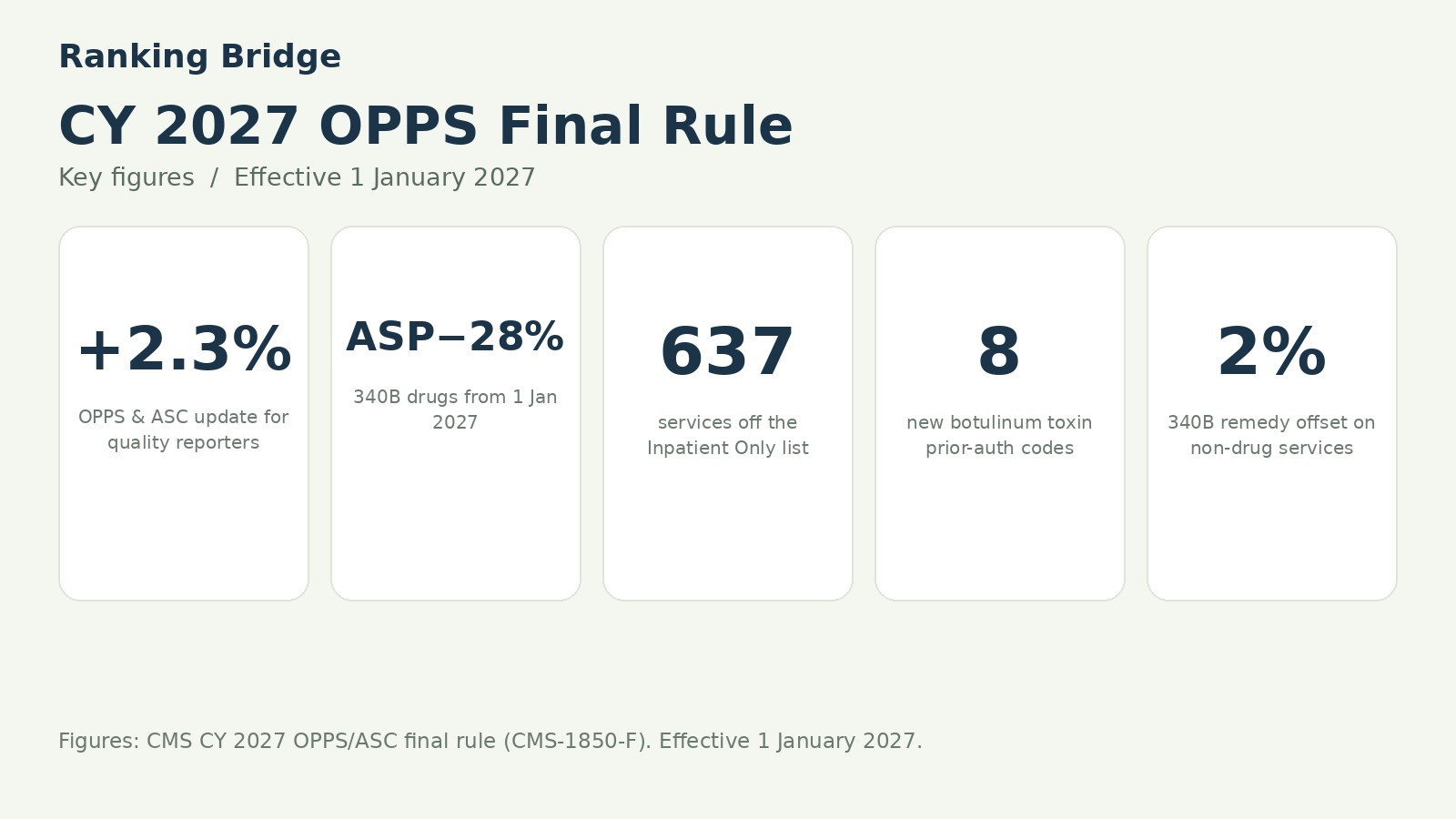
| OPPS and ASC update | +2.3% for hospitals and ASCs meeting quality reporting | 1 Jan 2027 |
| 340B-acquired drugs | Paid at ASP minus 28% (was ASP plus 6%) | 1 Jan 2027 |
| 340B remedy offset | Non-drug conversion-factor reduction rises 0.5% → 2% | CY 2027 |
| Site-neutral imaging | Imaging without contrast at excepted off-campus departments paid at the PFS-equivalent rate (about 40% of OPPS) | 1 Jan 2027 |
| Inpatient Only list | 637 services removed, year two of the three-year phase-out | 1 Jan 2027 |
| Prior authorization | 8 additional botulinum toxin injection codes added | CY 2027 |
| SaMS | Software as a Service renamed Software as a Medical Service; assigned to New Technology APCs | CY 2027 |
| Off-campus attestation | Separate NPI + provider-based attestation required for each off-campus department | 1 Jan 2028 |
The 2.3% Update — and the Quality-Reporting Condition
CMS finalized a 2.3% OPPS payment update for hospitals that meet applicable quality reporting requirements, built from a 3.2% hospital market basket increase minus a 0.9 percentage point productivity adjustment. The ASC update factor is also 2.3%, on the same market basket and productivity figures, for ASCs meeting their quality reporting requirements.
The condition is the part to check. Hospitals that do not meet Hospital Outpatient Quality Reporting (OQR) requirements receive a two percentage point reduction in their annual payment update — which turns a 2.3% increase into a 0.3% one. ASCs must meet all ASC Quality Reporting requirements to receive their full update. CMS also finalized the removal of the Appropriate Follow-Up Interval for Normal Colonoscopy in Average Risk Patients measure from both quality reporting programs, beginning with the CY 2027 reporting period.
Check: confirm your OQR/ASCQR reporting status now, not in January. A missed submission costs two points on every OPPS payment for the year.
340B Drugs Move to ASP Minus 28%
From 1 January 2027, separately payable 340B-acquired drugs are paid at average sales price (ASP) minus 28%, down from ASP plus 6%. CMS based the change on its 2026 hospital drug acquisition cost survey, which found that in some cases the beneficiary’s 20% cost-sharing alone was more than the hospital had paid for the drug. The final rate is softer than the ASP minus 33.4% CMS proposed in July — do not model the proposal.
CMS estimates the change will reduce Original Medicare drug payments by $4.35 billion and beneficiary drug payments by $1.1 billion in the first year, with the average beneficiary receiving a qualifying drug in the hospital outpatient department saving about $900 in CY 2027. The policy is budget neutral by statute, so OPPS payments for non-drug services rise by an equivalent amount. Exempt from the new rate: rural sole community hospitals, PPS-exempt cancer hospitals, and children’s hospitals. Hospitals that do not acquire drugs through 340B stay at ASP plus 6%.
Check: re-price every 340B drug line at ASP minus 28% and re-run your 2027 drug revenue model — then model the offsetting non-drug increase separately, so the two effects are never confused. Confirm whether your hospital is in an exempt category before assuming the new rate applies.
The 340B Remedy Offset Rises to 2%
Separate from the drug rate itself, CMS finalized an increase in the annual offset applied to the OPPS conversion factor for non-drug items and services, from 0.5% to 2%, effective CY 2027. The offset recoups the $7.8 billion of excess non-drug payments made from CY 2018 through CY 2022 under the earlier 340B policy; CMS estimates the recovery will complete in CY 2031. Hospitals that enrolled in Medicare after 1 January 2018 are excluded. CMS estimates the 2% offset will reduce overall OPPS payments by $1.6 billion in CY 2027.
Check: apply the 2% reduction to your non-drug OPPS revenue forecast, and check your Medicare enrollment date — hospitals enrolled after 1 January 2018 do not take this cut.
Site-Neutral Imaging Without Contrast at Excepted Off-Campus Departments
CMS finalized the extension of its volume-control method to imaging without contrast — certain bone density scans, x-rays, ultrasounds, CT scans and MRIs — furnished in excepted off-campus provider-based departments. Those services will be paid at the Physician Fee Schedule (PFS)-equivalent rate, which CMS sets through the PFS relativity adjuster at 40% of the amount that would otherwise be paid under OPPS. The policy covers HCPCS codes in imaging-without-contrast APCs 5521–5524 and composite APCs 8004, 8005 and 8007. Rural sole community hospitals are exempt.
CMS estimates the provision will reduce Medicare Part B expenditures by approximately $260 million in the first year — about $190 million in Part B savings and $70 million in reduced beneficiary premiums — with beneficiary cost-sharing obligations falling by about $70 million. Unlike the 340B change, CMS does not pair this one with an offsetting increase elsewhere: it is scored as a straight reduction in Part B spending.
One caution on the 40% figure: the relativity adjuster is designed to approximate the overall relationship between OPPS and PFS payment, and CMS acknowledges it can produce amounts higher or lower than the PFS technical component for individual services. Model the 40% rate as the planning figure, but check your highest-volume imaging codes individually.
Check: pull your CY 2026 imaging-without-contrast volume at excepted off-campus departments, re-price it at 40% of the OPPS rate, and confirm which of your sites are excepted off-campus departments versus on-campus or non-excepted — the policy only touches the excepted off-campus sites.
637 Services Come Off the Inpatient Only List
CMS is continuing the three-year phase-out of the Inpatient Only (IPO) list. For year two, it finalized the removal of 637 services across the auditory, digestive, endocrine, female genital, hemic and lymphatic, integumentary, male genital, maternity care and delivery, mediastinum and diaphragm, respiratory, and urinary clinical families. Those services can now be paid by Medicare in the hospital outpatient setting when determined to be clinically appropriate.
Check: review the 637 removed services against your inpatient case mix and identify procedures your physicians can appropriately move outpatient. Confirm payer policies and documentation requirements for the site-of-service decision — the rule permits outpatient payment, it does not make every case outpatient-appropriate. And if denials follow the shift, our shortlist of the best denial management companies covers the specialists who handle clinical denials and appeals.
Eight Botulinum Toxin Codes Added to Prior Authorization
CMS identified an unexplained increase in the volume of botulinum toxin injection procedures in the hospital outpatient setting and finalized a requirement for prior authorization for eight additional botulinum toxin injection codes, using the prior authorization process established in the CY 2020 OPPS/ASC final rule.
Check: add the eight codes to your prior authorization workflow now, and confirm your team knows the request lead times — an unauthorized claim is a denied claim, and claim denials are still rising in 2026.
Software as a Medical Service (SaMS)
CMS finalized a terminology change from Software as a Service (SaaS) to Software as a Medical Service (SaMS) for software-based technologies used to diagnose disease and support clinical decision-making. SaMS will be assigned to New Technology APCs as an interim step toward a broader payment policy. A small number of SaMS analyses performed on laboratory tests move from the Clinical Laboratory Fee Schedule to OPPS payment as “other diagnostic tests,” assigned to New Technology APCs aligned with current CY 2026 CLFS payment rates.
Check: if your organization bills software-based diagnostic services, confirm the new SaMS APC assignments in your chargemaster and check whether any lab-test analyses you bill move from CLFS to OPPS.
IOP and PHP Structure Maintained — and the Alaska/Hawaii COLA
CMS finalized maintaining the existing Intensive Outpatient Program (IOP) and Partial Hospitalization Program (PHP) rate structure, with two IOP APCs and two PHP APCs for each provider type. Hospital-based PHP payment rates for three services per day and four or more services per day are calculated on cost per day using OPPS data. Separately, CMS is applying a cost-of-living adjustment (COLA) to the nonlabor share of OPPS payments in Alaska and Hawaii, projected to increase payments to hospitals in those states by $66 million in CY 2027, budget neutral across OPPS.
Check: behavioral health teams should confirm their IOP/PHP APC assignments are unchanged in the 2027 fee schedule; Alaska and Hawaii hospitals should confirm the COLA appears in their nonlabor payment calculations.
The 2028 Deadline: One NPI and One Attestation per Off-Campus Department
This is the item with the second deadline. Under section 6225 of the Consolidated Appropriations Act, 2026, implemented in this rule, no payment may be made under OPPS for items and services furnished on or after 1 January 2028 by an off-campus outpatient department of a provider unless:
- the items and services are billed under an NPI that is separate from the main provider’s NPI, and
- the main provider has submitted an initial provider-based status attestation for that department.
For departments providing services on or before 1 January 2028, initial attestations must be submitted between 1 January 2026 and 31 December 2027. Departments that begin providing services after 1 January 2028 must submit an attestation within the two years before delivering billed services. Providers that submit within the required window meet the requirement even if CMS has not issued a provider-based status determination by 1 January 2028. Subsequent attestations follow at an interval CMS will set, not to exceed five years, with details expected in the 2028 rulemaking cycle.
Two points worth knowing: failure to meet the requirements affects payments only for the specific off-campus department, not all OPPS payments to the main provider. And Indian Health Service and Tribal facilities, certain FQHCs, and off-campus departments operating as part of a Critical Access Hospital are excluded from the attestation requirements.
Check: list every off-campus outpatient department at each physical address, confirm each has its own NPI (or start the application now), and calendar the 31 December 2027 attestation deadline. It falls a full year after the rule’s other changes take effect — which is exactly why it is easy to miss.
The RCM Checklist Before 1 January 2027
- Re-price 340B drug lines at ASP minus 28% and model the offsetting non-drug increase separately; confirm any exemption before assuming the new rate applies.
- Apply the 2% remedy offset to your non-drug OPPS revenue forecast, and check your Medicare enrollment date.
- Re-price imaging without contrast at excepted off-campus departments at 40% of the OPPS rate, and verify which sites the policy actually covers.
- Review the 637 removed IPO services against your inpatient case mix for clinically appropriate outpatient shifts.
- Add the eight botulinum toxin codes to your prior authorization workflow.
- Confirm your OQR/ASCQR reporting status — a miss costs two percentage points on the annual update.
- Check SaMS APC assignments and any lab-test analyses moving from CLFS to OPPS.
- Calendar 31 December 2027 for the off-campus NPI and provider-based attestation deadline, and start the NPI applications now.
Frequently Asked Questions About the CY 2027 OPPS Final Rule
Is the 40% imaging rate exact?
It is the PFS relativity adjuster — CMS’s approximation of the overall relationship between OPPS and PFS payment. For individual imaging services, the relativity-adjusted amount can come out higher or lower than the PFS technical component. Use 40% of the OPPS rate as your planning figure and check high-volume codes individually.
Does the 340B change affect hospitals that do not use 340B?
The ASP minus 28% drug rate does not — non-340B hospitals stay at ASP plus 6%, and rural sole community hospitals, PPS-exempt cancer hospitals and children’s hospitals are exempt from the new rate. But the 2% remedy offset applies to non-drug OPPS payments regardless of 340B status (except for hospitals enrolled in Medicare after 1 January 2018), so every hospital should model it.
What happens if we miss the 31 December 2027 attestation deadline?
From 1 January 2028, CMS cannot pay under OPPS for items and services furnished by that off-campus outpatient department until the separate NPI and attestation requirements are met. The payment stop applies to that department only, not to the main provider’s other OPPS payments.
The Bottom Line
The CY 2027 OPPS final rule is a re-pricing exercise more than a rate increase: a 2.3% update on the surface, with 340B drugs re-priced to ASP minus 28%, a 2% remedy offset on non-drug services, imaging without contrast cut to about 40% of the OPPS rate at excepted off-campus departments, and 637 services newly payable outpatient. The teams that will be ready on 1 January are the ones who re-price each line separately — drugs, non-drug services, imaging — instead of modelling a single blended update, and who put the 31 December 2027 attestation deadline on the calendar now.
Sources checked 12 November 2026:
- CMS, “Calendar Year 2027 Hospital Outpatient Prospective Payment System (OPPS) and Ambulatory Surgical Center (ASC) Final Rule (CMS-1850-F)” fact sheet, 4 November 2026 — https://www.cms.gov/newsroom/fact-sheets/calendar-year-2027-hospital-outpatient-prospective-payment-system-opps-ambulatory-surgical-center-0
- CMS-1850-FC, Medicare Program: Hospital Outpatient Prospective Payment and Ambulatory Surgical Center Payment Systems (final rule with comment period), Federal Register doc. 2026-22739, scheduled for publication 6 November 2026 — https://www.federalregister.gov/d/2026-22739
This article is general information about Medicare payment rules. It is not financial, billing, or legal advice for any specific hospital. Confirm all figures against the final rule and your payer contracts before use.
