ICD-10 Coding for Breast Cancer Unspecified
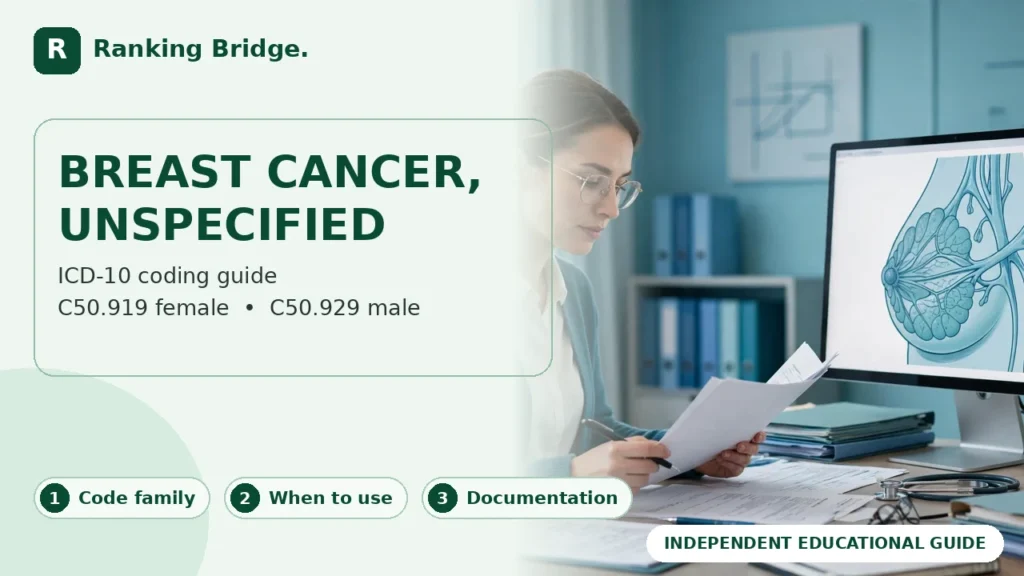
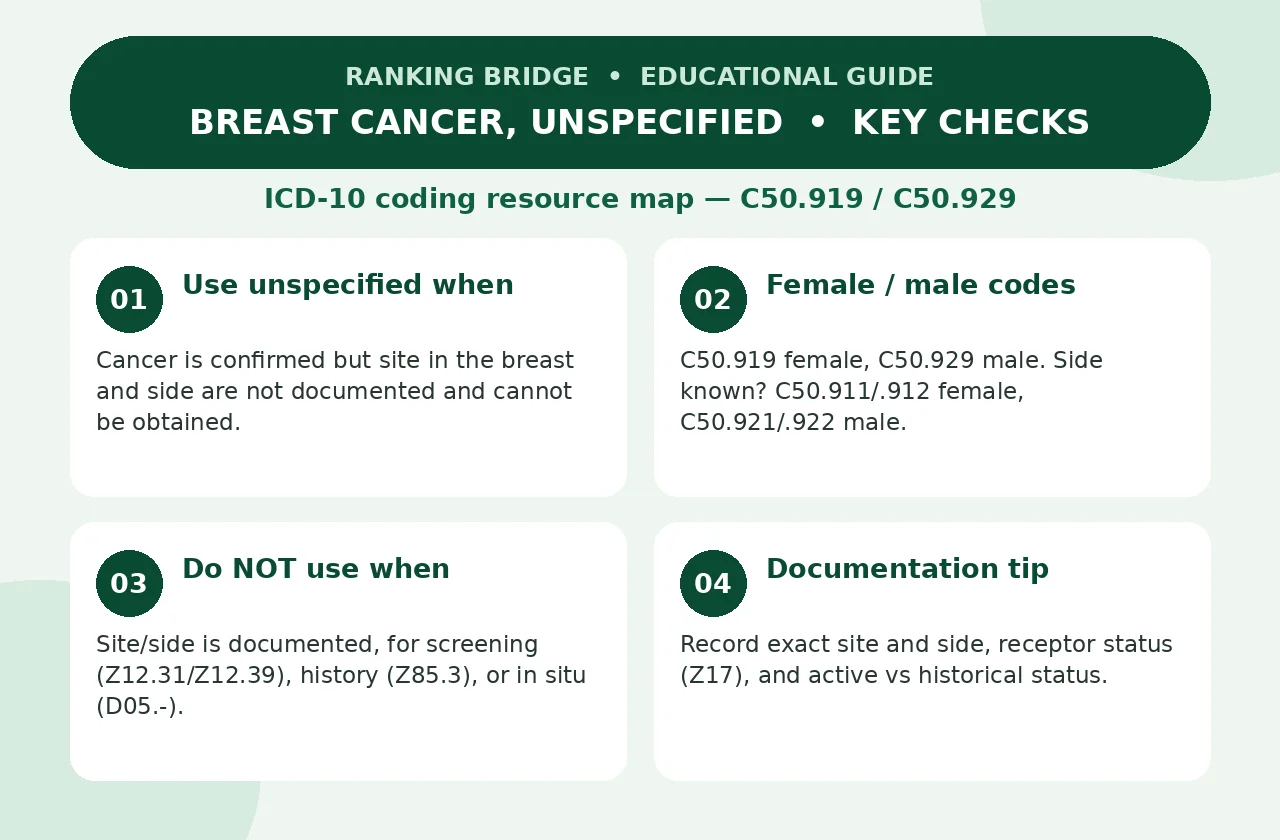
The ICD-10-CM code for breast cancer when neither the site within the breast nor the side is documented is C50.919 — malignant neoplasm of unspecified site of unspecified female breast. For a male patient, the equivalent code is C50.929. These are billable codes, but they should only be used when documentation genuinely does not state the tumor site or laterality. When the record names a quadrant, the nipple, or a side, a more specific C50 code applies.
What the Codes Mean
Category C50, Malignant neoplasm of breast, sits in Chapter 2 (Neoplasms) of ICD-10-CM. Codes in this category are built in layers: the first characters identify the site within the breast (such as nipple and areola, central portion, or a named quadrant), and the final characters identify sex and laterality — right, left, or unspecified.
C50 by itself is a category header, not a billable code. Claims require the full code, including site, sex, and laterality characters. The “unspecified site, unspecified breast” codes exist for records where the provider has confirmed a malignant breast neoplasm but has not documented where it is or which breast it affects.
The complete C50.91- family (unspecified site of breast) is:
| Code | Description |
|---|---|
| C50.911 | Malignant neoplasm of unspecified site of right female breast |
| C50.912 | Malignant neoplasm of unspecified site of left female breast |
| C50.919 | Malignant neoplasm of unspecified site of unspecified female breast |
| C50.921 | Malignant neoplasm of unspecified site of right male breast |
| C50.922 | Malignant neoplasm of unspecified site of left male breast |
| C50.929 | Malignant neoplasm of unspecified site of unspecified male breast |
Note the pattern: the fifth character “1” is female and “2” is male, and the final character follows the usual laterality pattern — 1 for right, 2 for left, 9 for unspecified. Estrogen receptor status, when documented, is reported with an additional code from category Z17.
When Unspecified Is Right
C50.919 or C50.929 is appropriate when:
- The provider documents breast cancer but the record does not state a site, quadrant, or side, and the information cannot be obtained before the claim is submitted
- Documentation from the treating provider confirms malignancy, but available reports genuinely lack laterality
- A referral record references established breast cancer without anatomical detail, and no more specific documentation exists
Even in these cases, best practice is to query the provider first. Unspecified codes are a fallback, not a default.
When It Is NOT Right
- The site or side is documented. If the note, imaging, or pathology states a quadrant, the central portion, the nipple and areola, or simply “right” or “left,” code to that specificity. Using C50.919 when laterality is in the chart is under-coding and a common audit finding.
- The encounter is for screening. A screening mammogram in an asymptomatic patient is not C50 at all — use Z12.31 (encounter for screening mammogram for malignant neoplasm of breast) or Z12.39 for other breast screening.
- The cancer is historical. If the breast cancer has been treated, there is no evidence of disease, and no current treatment is directed at it, report Z85.3 (personal history of malignant neoplasm of breast) rather than an active C50 code.
- The lesion is in situ. Carcinoma in situ of the breast is coded from category D05.-, not C50, which is reserved for invasive malignant neoplasms.
Documentation Tips
- Record the exact site — quadrant, central portion, nipple/areola, axillary tail, or overlapping sites — and the side for every breast malignancy.
- Make sure the pathology, imaging, and provider notes agree; coders must code from provider documentation, and conflicting laterality should be clarified before billing.
- Document estrogen receptor status so the Z17 code can be added, and note any associated conditions or metastatic sites, which are coded separately.
- State clearly whether the cancer is active and under treatment or historical — this single detail decides between C50 and Z85.3.
- If the site cannot be determined, say so in the note. A documented “site not specified” supports the unspecified code if it is ever questioned.
Why This Matters for RCM
Unspecified neoplasm codes attract payer scrutiny. Medical-necessity edits and authorization requirements are often tied to specific diagnoses, and vague coding makes it harder to show why a service was needed. In a climate of rising claim denials, coding a claim to C50.919 when the operative report clearly states the quadrant is an avoidable denial risk. Clean documentation and specific coding protect compliance and collections.
Frequently Asked Questions
What is the ICD-10 code for breast cancer, unspecified?
For a female patient, C50.919 (malignant neoplasm of unspecified site of unspecified female breast). For a male patient, C50.929.
Is C50.919 a billable code?
Yes. C50.919 is a billable, specific ICD-10-CM code. The category header C50 alone is not billable and cannot be submitted on a claim.
What if only the side is known, but not the quadrant?
Use C50.911 for the right female breast or C50.912 for the left female breast (C50.921 / C50.922 for male patients). These capture laterality even when the site within the breast is unspecified.
What code should be used for a screening mammogram?
Z12.31 for a screening mammogram, or Z12.39 for other screening for malignant neoplasm of breast. Do not use a C50 code unless the patient actually has breast cancer.
When should Z85.3 be used instead of C50?
When the breast cancer is historical — previously treated, with no current evidence of disease and no active treatment directed at the malignancy.
Sources
ICD-10-CM Tabular List, category C50 (Malignant neoplasm of breast), Centers for Medicare & Medicaid Services (CMS) and National Center for Health Statistics; ICD List, C50 code descriptions (icdlist.com/icd-10/C50).
Disclaimer: This article is general coding information for educational purposes only and is not coding, billing, or medical advice for any specific case. Always verify code selection against the current ICD-10-CM code set and the Official Guidelines for Coding and Reporting, and against the documentation in the individual record.
