ICD-10 Code Z79.4: Long-Term Use of Insulin Documentation
ICD-10 code Z79.4 means “Long term (current) use of insulin.” It is a status code showing that insulin is an ongoing part of a patient’s diabetes treatment. Z79.4 is always a secondary code — never the first-listed or principal diagnosis — because it does not name the condition being treated. The diabetes code comes first; Z79.4 adds context about how that condition is managed.
Despite that simple definition, Z79.4 is often added where it does not belong, most commonly with type 1 diabetes, and left off where it does belong. This guide covers both errors.
What Z79.4 Means
Z79.4 sits in Chapter 21 of ICD-10-CM, “Factors influencing health status and contact with health services” (Z00–Z99). Codes in this chapter are called Z codes. They do not identify a disease; they capture circumstances that affect care, such as statuses, histories, and long-term treatments.
Category Z79, “Long term (current) drug therapy,” records medications taken on an ongoing basis, and Z79.4 is its insulin entry. Two properties matter. First, Z79.4 is supplementary: alone on a claim, it explains nothing and supports no medical necessity. Second, it describes current, long-term therapy — not a single dose.
When to Use ICD-10 Code Z79.4
With type 2 diabetes mellitus
The most common use is with type 2 diabetes (category E11). When a patient with type 2 diabetes uses insulin long term, report the appropriate E11 code first and add Z79.4. This applies whether insulin is the only glucose-lowering therapy or is combined with oral medication. If oral antidiabetic drugs are also used long term, Z79.84 may be reported as well.
With other forms of diabetes
The diabetes guidelines also direct coders to assign Z79.4 for patients on long-term insulin with other forms of diabetes: diabetes due to an underlying condition (E08), drug- or chemical-induced diabetes (E09), and other specified diabetes (E13). The test is the same in each case — insulin is continuing treatment, documented as such, not a short-term measure.
Insulin pump use is separate
Do not confuse the drug with the device. A pump patient is still receiving insulin, so Z79.4 still applies when criteria are met. The pump itself is captured with Z96.41, “Presence of insulin pump (external) (internal)” — reported in addition to, not instead of, Z79.4.
When NOT to Use Z79.4
Never with type 1 diabetes
Per the ICD-10-CM Official Guidelines, Section I.C.4, do not assign Z79.4 with type 1 diabetes mellitus (category E10). The reason is definitional: a type 1 patient’s body does not produce insulin, so insulin use is inherent to the condition and the E10 code already conveys it. Adding Z79.4 is redundant and incorrect.
Not for temporary insulin
Z79.4 requires long-term therapy. Do not assign it when insulin is given temporarily, for example:
- A dose given during an encounter solely to correct hyperglycemia.
- Short-term insulin in a patient who does not have diabetes.
- Insulin given once in connection with a procedure, with no continuing regimen.
Not for oral medication
Long-term oral antidiabetic therapy has its own code, Z79.84. A patient managed on oral agents alone should not receive Z79.4.
| Code | Description | Use it for |
|---|---|---|
| Z79.4 | Long term (current) use of insulin | Ongoing insulin therapy, mainly with E11 and other non-type 1 diabetes |
| Z79.84 | Long term (current) use of oral hypoglycemic drugs | Ongoing oral antidiabetic medication |
| Z96.41 | Presence of insulin pump | Documented pump use, in addition to Z79.4 |
Documentation Tips for Z79.4
Z79.4 stands or falls on the provider’s documentation. The record should show:
- Diabetes type. Type 1 versus type 2 changes the coding completely; query the provider if the type is unclear.
- Insulin regimen. Insulin type, dosing pattern (basal, basal-bolus, or pump), and frequency.
- Long-term intent. Language making clear insulin is continuing treatment, not a temporary correction.
- Device and oral therapy. Pump use, to support Z96.41, and oral antidiabetics, to support Z79.84 where applicable.
A medication list alone is thin evidence. A short assessment statement — “type 2 diabetes, continues on long-term basal insulin” — settles the question.
Why Z79.4 Matters for RCM
Status codes rarely drive payment directly, but they shape how a claim reads. Pairing the diabetes code with Z79.4 supports the medical necessity of diabetes education, glucose monitoring, insulin supplies, and specialist follow-up, and presents a consistent clinical story to reviewers. Incorrect use does the opposite: Z79.4 on a type 1 claim signals careless coding, while missing status codes invite questions about why services were billed. With practices already facing rising claim denials, a simple encoder edit — flagging Z79.4 whenever E10 is selected — prevents the commonest error before the claim leaves.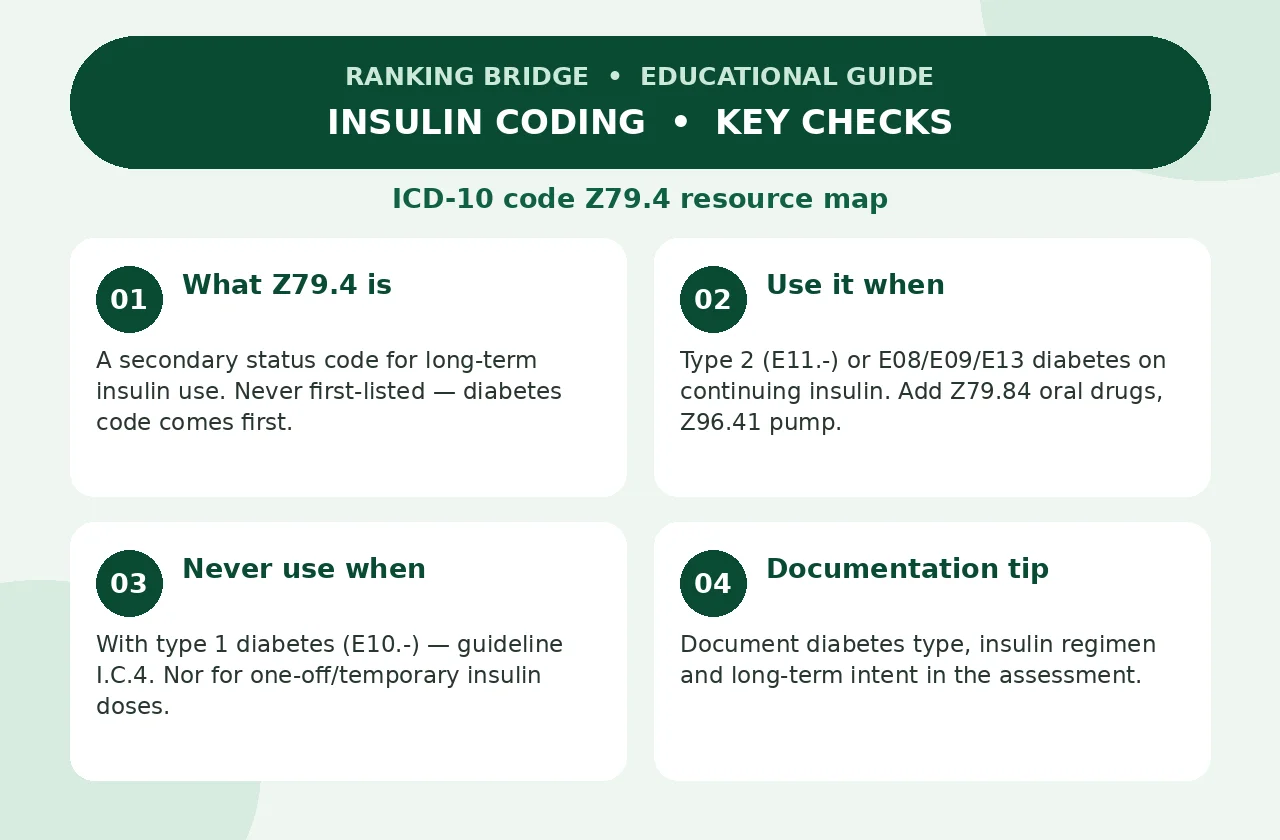
Frequently Asked Questions
Can Z79.4 be the only diagnosis on a claim?
No. It is a secondary status code and must accompany the code for the condition treated, usually a diabetes code.
Do I use Z79.4 for type 1 diabetes?
No. Insulin use is inherent in type 1 diabetes, so per guideline I.C.4, Z79.4 is not assigned with E10 codes.
My type 2 patient uses insulin and metformin. Which codes apply?
Both: Z79.4 for insulin and Z79.84 for the oral drug, following the E11 code.
Does an insulin pump change the coding?
Only by addition. Report Z96.41 for the pump alongside Z79.4 for the insulin therapy.
A non-diabetic patient got one insulin dose for high blood sugar. Z79.4?
No. Temporary insulin to correct hyperglycemia is not long-term therapy.
Sources
- ICD-10-CM Official Guidelines for Coding and Reporting, Section I.C.4, Centers for Medicare & Medicaid Services (CMS) and National Center for Health Statistics.
- ICD-10-CM Tabular List, Chapter 21, category Z79.
Disclaimer: This article is educational information for coding and billing professionals, not coding, billing, or legal advice. Always code from the current ICD-10-CM code set, official guidelines, and the provider’s documentation for the specific encounter.
