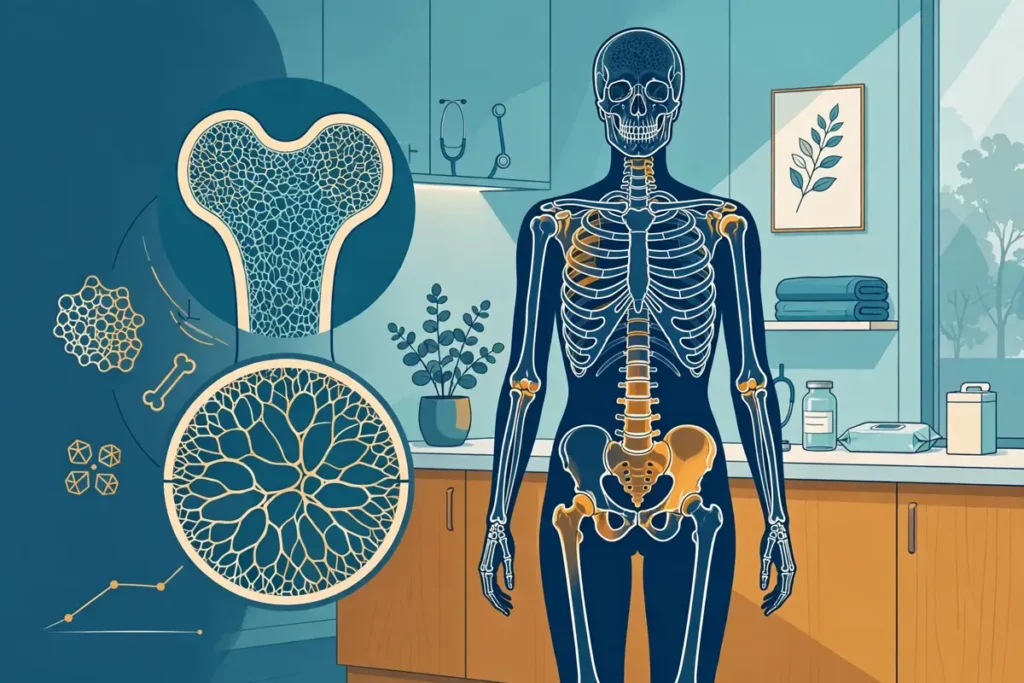
ICD-10 Code M81.0: Age-Related Osteoporosis Without Current Pathological Fracture
Introduction
M81.0 is one of the most quietly misused osteoporosis codes. Its full description — age-related osteoporosis without current pathological fracture — contains two conditions that must both be true: the osteoporosis is age-related, and there is no current pathological fracture. Miss either half and the code is wrong.
This guide explains what M81.0 covers, how it differs from the M80 fracture codes, and what documentation coders should look for.
What M81.0 means
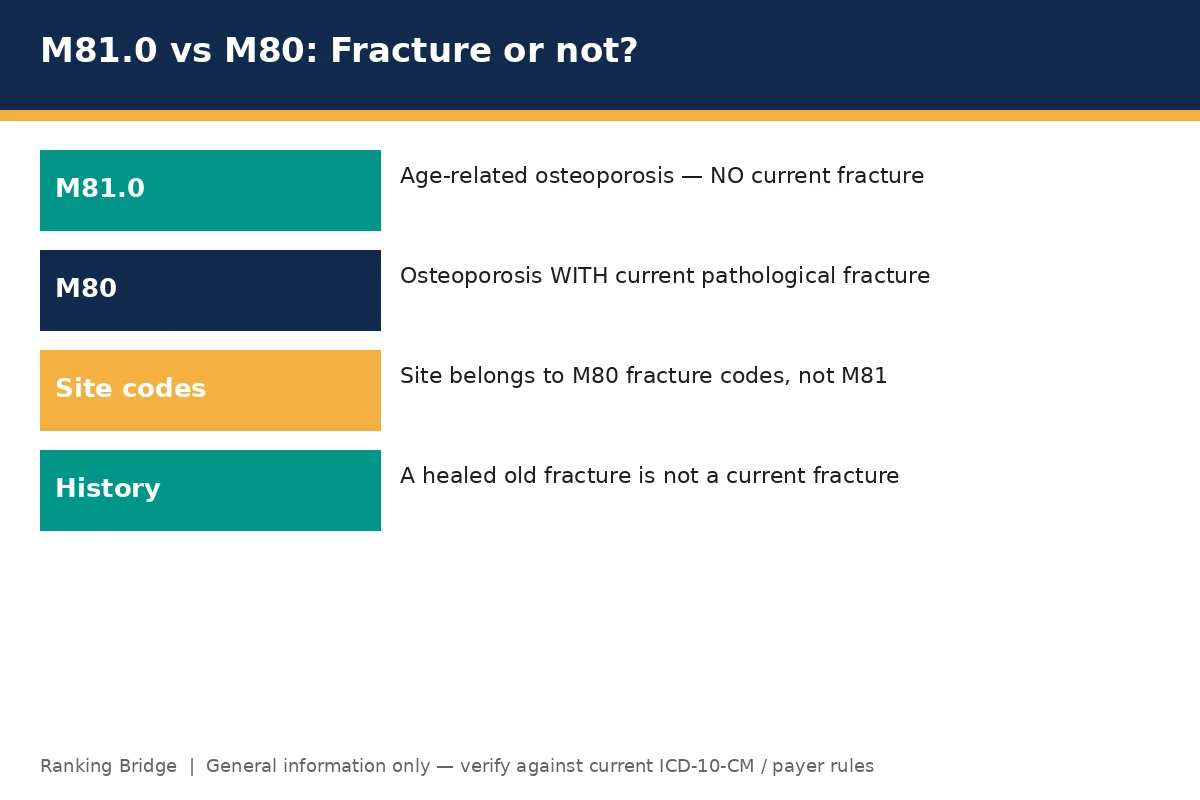
M81.0 sits in category M81, Osteoporosis without current pathological fracture. Osteoporosis is a systemic condition affecting the whole skeleton, which is why M81 codes do not carry site designations — unlike M80 codes, where the site identifies the fracture, not the osteoporosis itself.
“Age-related” here means the osteoporosis is associated with ageing, rather than caused by another specified condition such as a drug, a disease or disuse. “Without current pathological fracture” means the patient is not currently experiencing a fracture caused by weakened bone. A history of fracture is not the same as a current pathological fracture — that distinction drives many coding errors.
M81.0 vs M80: the key distinction
| Situation | Code family |
|---|---|
| Osteoporosis without a current pathological fracture | M81, including M81.0 for age-related |
| Osteoporosis with a current pathological fracture | M80, with site and encounter characters for the fracture |
If a patient with age-related osteoporosis presents with a new pathological fracture, M81.0 is no longer the right code for that encounter — the M80 code for the fracture site takes over. Conversely, coding M80 for a patient whose bones are fragile but not currently fractured overstates the encounter and misrepresents the clinical picture.
When to use M81.0
Use M81.0 when all of these are true:
- The provider documents osteoporosis, and it is age-related (or no other cause is specified)
- No current pathological fracture is documented
- The encounter relates to the osteoporosis itself — for example, monitoring, treatment planning or follow-up
Typical settings include primary care follow-up, endocrinology, rheumatology and preventive care where bone health is being managed without an acute fracture.
Common errors
- Using M81.0 for a patient with a current fracture: This is the most consequential error. A current pathological fracture changes the code family entirely to M80. Always check the assessment and imaging for fracture status before defaulting to M81.0.
- Using M81.0 for drug-induced or secondary osteoporosis: If the osteoporosis is documented as caused by a drug, a disease or another specified condition, a more specific M81 code or a different category may apply. “Age-related” is not a catch-all for every osteoporosis case.
- Adding site codes to M81.0: M81 codes do not take site designations. Site specificity belongs to M80 fracture codes. Adding a site to an M81 code is a structural error that can reject a claim.
- Coding osteoporosis from a problem list alone: A problem list entry without current documentation of the condition in the encounter note is weak support. Coders should code from the provider’s assessment for that encounter, and query when the note is ambiguous.
Documentation tips
- Look for explicit language: “age-related osteoporosis,” “senile osteoporosis” in older terminology, or osteoporosis without fracture mention.
- Confirm fracture status in every note: “no fracture,” “no acute fracture,” or a fracture assessment.
- If a DEXA result or bone density finding is the only evidence, check whether the provider actually diagnosed osteoporosis — a low bone density reading alone is not automatically an M81.0 diagnosis.
- Code related conditions separately where documented, such as vitamin D deficiency or a history of falls, only when the guidelines support it.
RCM angle: why M81.0 accuracy matters
Osteoporosis care is long-term, high-volume work: monitoring, medication management and fracture prevention. Clean M81.0 coding keeps chronic-care claims consistent, supports medical necessity for bone density testing and treatment, and avoids the denial pattern that follows when fracture and non-fracture codes are mixed up. It is the same documentation discipline that protects revenue across the board — see our guide to rising claim denials (rising claim denials) for why small coding patterns become large denial problems.
FAQ
What is the difference between M81.0 and M80.0? M81.0 is age-related osteoporosis without a current pathological fracture. M80 codes are osteoporosis with a current pathological fracture, with site and encounter detail for the fracture.
Can M81.0 be used if the patient had a fracture years ago? Yes, if there is no current pathological fracture. A healed, historical fracture is not a current fracture — but document the history separately where appropriate, and do not confuse history with a current event.
Does M81.0 require a DEXA scan result in the chart? No. M81.0 requires a provider diagnosis of age-related osteoporosis without current fracture. Imaging supports the diagnosis but does not replace it.
Is M81.0 a billable code? Yes, M81.0 is a billable ICD-10-CM code. Its parent category M81 is for osteoporosis without current pathological fracture, and M81.0 specifies the age-related type.
What if the cause of osteoporosis is not documented? Query the provider rather than assuming age-related. If the record genuinely does not specify a cause, follow your organisation’s query policy and the ICD-10-CM guidelines for unspecified causes — do not default silently.
Sources and further reading
- ICD-10-CM tabular guidance for category M81, via CMS ICD-10-CM resources
- Ranking Bridge, What Is a Superbill: What Is a Superbill
- Ranking Bridge, Claim Denials Are Still Rising in 2026: Claim Denials Are Still Rising in 2026
Disclaimer: This article provides general coding information only. It is not medical advice or billing advice for any specific patient or claim. Coders should verify every code against the current ICD-10-CM guidelines, the full medical record, and applicable payer rules.