
ICD-10 Code Z00.01: Preventive Visit With Abnormal Findings
Introduction
A patient comes in for a routine checkup feeling fine — and the visit finds something. That single fact changes the diagnosis code. Z00.01, Encounter for general adult medical examination with abnormal findings, is the code for a general adult preventive examination where an abnormal finding is identified during the visit. Its sibling, Z00.00, is the same examination without abnormal findings. The difference looks small; the billing consequences are not.
What Z00.01 means
Z00.01 sits in category Z00, Encounter for general examination without complaint, suspected or reported diagnosis, within the Z-code range for factors influencing health status and contact with health services. Z codes describe reasons for encounters, not diseases — and Z00.01 describes a preventive encounter whose outcome included an abnormal finding.
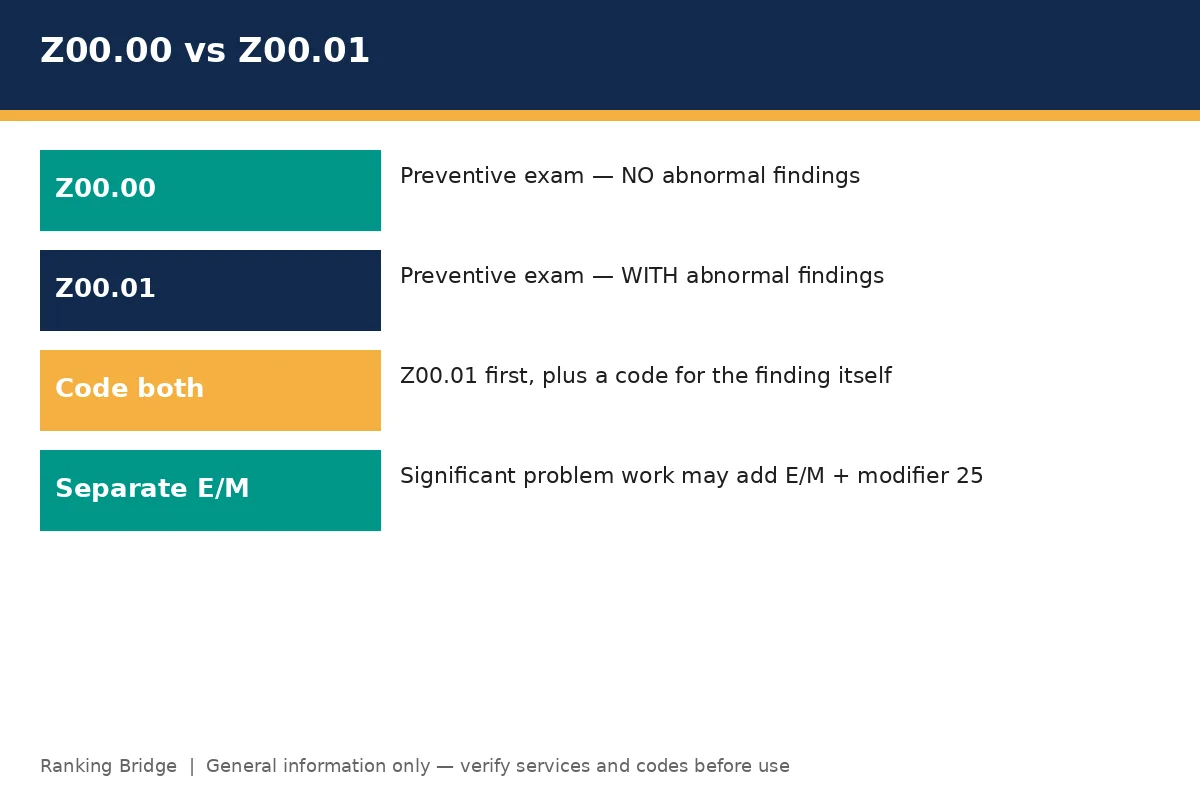
The key idea: the primary purpose of the visit remains preventive. The abnormal finding does not automatically turn the visit into a problem-oriented visit. It does, however, need to be coded — both with Z00.01 as the first-listed diagnosis for the preventive service, and with a code for the finding itself.
Z00.01 vs Z00.00
| Code | Meaning | Use when |
|---|---|---|
| Z00.00 | General adult exam without abnormal findings | The preventive exam finds nothing abnormal |
| Z00.01 | General adult exam with abnormal findings | The preventive exam identifies an abnormal finding |
If no abnormal finding is documented, Z00.00 is correct — coding Z00.01 without a documented finding is a red flag for payers. If labs are still pending when the visit is coded, current guidance allows Z00.00, with correction if findings later emerge.
What counts as an abnormal finding
An abnormal finding is a newly identified condition, a change in severity of a chronic condition, or an abnormal result identified during the exam — for example:
- Elevated blood pressure found during the exam that requires a new care plan
- A newly discovered lump, murmur or other examination finding
- An abnormal screening or laboratory result identified as part of the visit
- A new problem the patient mentions that the provider evaluates during the preventive visit
What does not count: a chronic condition that is stable, already known and unchanged, with no new finding at this visit. Nor does a finding count if it is never documented — the coder codes from the record, not from suspicion.
When a separate problem visit also applies
If the abnormal finding requires significant additional work — a full evaluation and management service beyond the preventive exam — the encounter may support both the preventive service and a separate problem-oriented E/M service. In that case, coding guidance commonly describes billing the preventive service with Z00.01 and the problem-oriented service with the specific diagnosis, using modifier 25 on the E/M code where payer rules require it. The diagnoses must be pointed correctly: Z00.01 to the preventive line, the problem diagnosis to the E/M line. Do not point every diagnosis at every line.
For a Medicare Annual Wellness Visit, the same logic applies with G0438/G0439 rather than a preventive medicine CPT code — the AWV is a personalised prevention plan visit, not a head-to-toe physical, and Z00.01 still marks the AWV portion when findings are documented.
Common errors
- Coding Z00.01 with no documented finding: The most common audit trigger. If the note says “exam normal” throughout, Z00.00 is the code.
- Coding only the finding and dropping Z00.01: If the visit was preventive, the preventive code belongs first for that service. Dropping it can turn a covered preventive visit into a diagnostic one in the payer’s eyes — with patient cost consequences.
- Coding only Z00.01 and omitting the finding: Z00.01 says a finding exists; it does not say what it is. Always add the code for the finding itself.
- Confusing a follow-up problem visit with the preventive visit: If a problem found at a preventive visit is evaluated at a later, separate visit, that later visit is coded on its own merits. The preventive visit’s Z00.01 does not carry forward as the reason for the follow-up.
Documentation tips
- Providers should state findings explicitly: “abnormal finding: elevated BP 150/95, plan started” rather than leaving it in vital signs alone.
- Coders should check the assessment, orders and results — not just the exam template — for findings.
- When a finding is borderline or pending, follow the organisation’s policy on holding the claim versus coding Z00.00 and amending later.
- Keep the preventive and problem-oriented documentation distinct when both services are billed, so modifier 25 is supportable.
RCM angle
Preventive visits are high-volume and heavily audited precisely because coverage depends on the preventive label. A pattern of Z00.01 without findings, or of preventive visits billed as diagnostic, creates denials and patient billing complaints. Clean Z00.00/Z00.01 discipline protects both revenue and patient trust — and it pairs with the documentation discipline in our superbill guide (superbill guide).
FAQ
Is Z00.01 only for adult exams? Yes — Z00.01 is the general adult medical examination with abnormal findings. Child and adolescent examinations use different Z00 codes.
Does an abnormal finding mean the visit is no longer preventive? No. The visit remains preventive in purpose; Z00.01 records that the preventive exam produced an abnormal finding. Only a separately performed, significant problem-oriented service changes the billing structure.
What if the abnormal finding is minor and needs no follow-up? It still counts if it was identified and documented during the exam. Minor does not mean absent — but it must be documented, not assumed.
Can Z00.01 be used for a Medicare Annual Wellness Visit? Yes, for the AWV portion when findings are documented during the AWV. The AWV itself is billed with G0438 or G0439, and a separate E/M service follows its own rules.
What is the difference between Z00.01 and a screening code? Z00.01 is the examination encounter code. Screening codes (Z13.-) describe specific screenings ordered or performed, and they sit alongside — not instead of — the encounter code where appropriate.
Sources and further reading
- AAFP, Coding and Documentation on preventive visits: AAFP Coding and Documentation on preventive visits
- WMWTL, Z00.00 and Z00.01 guide: WMWTL Z00.00 and Z00.01 guide
- Ranking Bridge, What Is a Superbill: What Is a Superbill
Disclaimer: This article provides general coding information only. It is not medical advice or billing advice for any specific patient or claim. Coders should verify every code against the current ICD-10-CM guidelines, the full medical record, and applicable payer rules.