J44.9 vs J44.0 vs J44.1: Key ICD-10 Coding Differences
Introduction
COPD coding looks simple until a coder has to choose between three very similar codes. Category J44, Other chronic obstructive pulmonary disease, contains J44.0, J44.1 and J44.9 — and the right choice depends entirely on what the provider actually documented: an acute infection, an acute exacerbation, both, or neither. Getting this wrong does not just change a code; it can misstate the reason for the visit, weaken medical necessity, and invite denials.
This guide explains the distinctions in plain language, with sequencing rules and documentation tips that RCM teams can use on real charts.
The three codes at a glance
| Code | Full description | Use when |
|---|---|---|
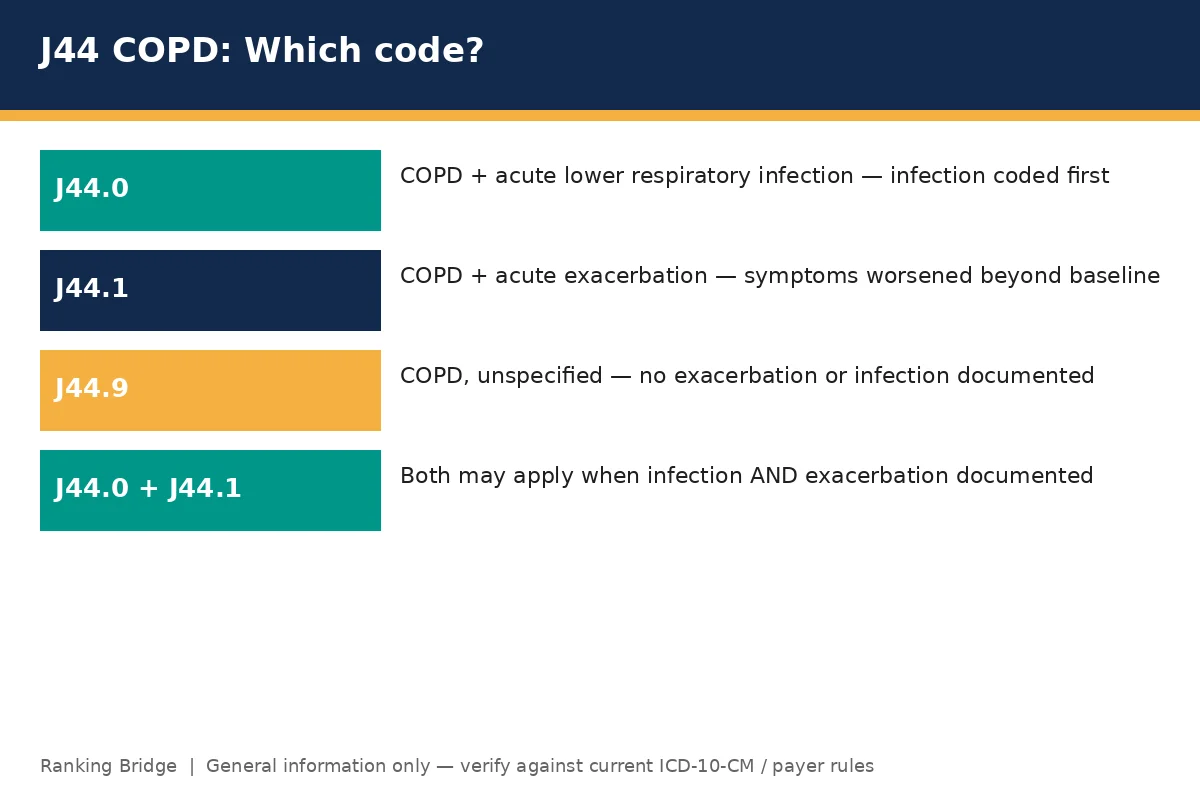
| J44.0 | COPD with acute lower respiratory infection | COPD plus a documented acute lower respiratory infection, such as acute bronchitis or pneumonia |
| J44.1 | COPD with acute exacerbation | COPD symptoms have acutely worsened beyond day-to-day variation, without an infection being the coded cause |
| J44.9 | COPD, unspecified | COPD is documented but no exacerbation or acute infection is documented |
J44.0: COPD with acute lower respiratory infection
J44.0 is a combination concept: the patient has COPD and an acute infection of the lower respiratory tract. The infection must be documented and linked to the COPD encounter — for example, “COPD with superimposed acute bronchitis” or “acute pneumonic exacerbation of COPD.”
Sequencing rule coders most often miss: J44.0 carries an instruction to code the infection first, then J44.0. For pneumonia, the pneumonia code is sequenced before J44.0, not after. Leading with J44.0 and appending the infection afterwards reverses the required order and can affect how a payer reads the principal diagnosis.
What not to do: Do not add a separate code for the acute bronchitis or pneumonia as if it were unrelated when J44.0 already captures the combination — follow the “code also” instruction for the infection type instead, and code the specific organism where documented.
J44.1: COPD with acute exacerbation
An exacerbation is an acute worsening or decompensation of a chronic condition — symptoms suddenly worse than baseline, requiring a change in therapy. J44.1 applies when the provider documents that worsening, for example with the words “exacerbation” or “acute on chronic.”
Crucially, an exacerbation is not the same thing as an infection. An infection may trigger an exacerbation, but the two are not equivalent. If the provider documents both an acute infection and an acute exacerbation, J44.0 and J44.1 can both be reported, because J44.1 carries an Excludes2 note for J44.0 — meaning both conditions may be present at the same time. One well-documented example in coding guidance: COPD with acute exacerbation caused by acute bronchitis can support J44.0, J44.1 and J20.9 together, when each is documented.
J44.9: COPD, unspecified
J44.9 is the fallback, not the default. Use it when COPD is documented in a stable state, for routine care, or when the note does not document an exacerbation or acute infection. It should never be used as a shortcut when the body of the note clearly describes an acute worsening — if the worsening is documented, code it.
Common errors that cost claims
- Coding J44.9 for an exacerbation visit: If the note describes increased dyspnoea, wheezing or a therapy change beyond baseline, “COPD” alone in the assessment does not justify J44.9. Query the provider or code what is documented — do not guess.
- Treating every flare as an infection: Flares caused by pollution, missed inhalers or unknown triggers are not infections. Without a documented infection, J44.1 — not J44.0 — is the code.
- Reversing J44.0 sequencing: Remember: infection first, then J44.0. This is the single most common sequencing error in this family.
- Forgetting related codes: Code tobacco use or dependence (F17.-) where applicable, and code chronic bronchitis (J42) or other documented conditions separately when the guidelines require it. COPD and asthma can also be coded together when each is separately documented, since J44 carries an Excludes2 note against J45, not an Excludes1.
Documentation tips for RCM teams
- Ask providers to write “exacerbation” explicitly rather than only “flare-up” or “worse today.”
- Ask for the infection to be named and linked: “acute bronchitis superimposed on COPD” beats “COPD, cough.”
- When both infection and exacerbation are present, document the causal link if there is one — it determines whether both codes apply.
- Build a pre-bill check: any COPD chart with a therapy change, oxygen change or admission should trigger a J44.0/J44.1 review before submission.
Why this matters for revenue cycle
COPD is a high-volume, high-cost condition, and these three codes sit on many inpatient, emergency and outpatient claims. A pattern of J44.9 on exacerbation visits understates acuity; a pattern of J44.0 without a documented infection overstates it. Either pattern can draw payer scrutiny. Clean J44 coding supports accurate risk adjustment, cleaner claims and fewer denials — the same discipline behind our earlier work on rising claim denials (rising claim denials) and on what a superbill must capture (what a superbill must capture).
FAQ
Can J44.0 and J44.1 be coded together? Yes, when documentation shows both an acute lower respiratory infection and an acute exacerbation. J44.1’s Excludes2 note for J44.0 means both may be reported together when appropriate.
Is J44.9 ever correct for a hospital visit? Yes, when the patient has COPD but the encounter does not document an exacerbation or acute infection — for example, stable COPD during care for an unrelated problem. It is the fallback, not a convenience code.
What if the note says “COPD exacerbation” but no infection is mentioned? Use J44.1. Do not assume an infection, and do not add J44.0 without documented infection.
Does “acute bronchitis” always mean J44.0 in a COPD patient? Only when the bronchitis is documented as an acute lower respiratory infection in the COPD patient and linked to the encounter. Unlinked or unrelated bronchitis documentation needs careful review, not automatic combination.
Where can I check the official guidance? See the AAPC COPD coding guidance and the ICD-10-CM Official Guidelines, Section I.C.10, plus the resources linked below.
Sources and further reading
- AAPC, COPD coding guidance: AAPC COPD coding guidance
- Verified RCM, ICD-10 coding for COPD: Verified RCM ICD-10 coding for COPD
- Ranking Bridge, What Is a Superbill: What Is a Superbill
Disclaimer: This article provides general coding information only. It is not medical advice or billing advice for any specific patient or claim. Coders should verify every code against the current ICD-10-CM guidelines, the full medical record, and applicable payer rules.