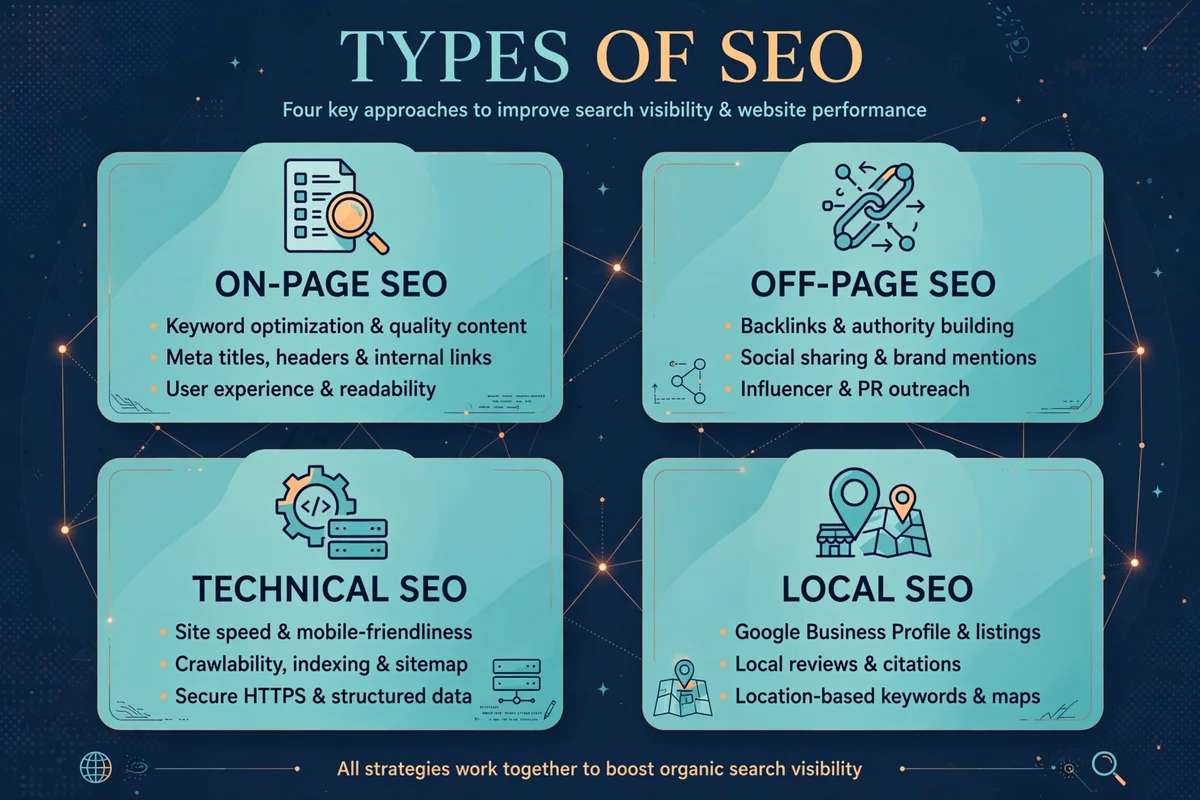
SEO is often talked about as if it were one thing. In practice, it has four main parts, and they work best together. If you only fix one part, the others can hold you back.
Here is a clear, beginner-friendly breakdown of the types of SEO, with examples you can actually use.
1. On-Page SEO: what is on the page itself
On-page SEO is everything you control directly on a page: its title, headings, content, images, and internal links.
It includes:
- A clear, descriptive title and meta description
- One main heading that matches the topic, with subheadings that organise the rest
- Content that answers the searcher’s question directly, in natural language
- Helpful images with descriptive alt text
- Internal links to related pages on your own site
Example: a page about keyword research should explain what keyword research is in the first paragraph, use headings for each step, and link to a related guide on keywords, not just repeat the phrase “keyword research” over and over.
Google’s own starter guide stresses the same basics: descriptive titles and meta descriptions, and content that is accessible as text. Read it here: Google Search Central, SEO Starter Guide
For a deeper checklist, see our guide: What Is On-Page SEO? Checklist for Beginners
2. Off-Page SEO: what happens away from your site
Off-page SEO is about reputation and references from other sites. The best-known part is backlinks, but it also includes brand mentions, reviews, and shares.
A strong off-page signal is an editorial link from a relevant, trusted site that links because your content is genuinely useful. A weak signal is a large number of low-quality links placed mainly to manipulate rankings.
Google’s spam policies list creating links primarily to manipulate rankings as link spam, including paid links that pass ranking credit without proper qualification. See: Google Search Central, Spam policies for Google web search
Learn the basics here: What Is Off-Page SEO? A Complete Beginner Guide
And: How Do Backlinks Help SEO?
3. Technical SEO: can search engines find, crawl, and understand your site?
Technical SEO is the foundation underneath the content. If search engines cannot crawl or index your pages, or if pages are slow or broken on mobile, even good content will struggle.
It covers:
- Crawlability and indexing: sitemaps, robots.txt, and no broken internal links
- Speed: fast loading, especially on mobile
- Mobile-friendliness: the site works well on phones, not just desktops
- Security: HTTPS
- Structured data: schema markup that helps search engines understand a page
Start with the basics: What Is Technical SEO? A Simple Explanation for Beginners
And: How Do Search Engines Work? (Crawling, Indexing, Ranking)
4. Local SEO: for businesses that serve a place
Local SEO helps a business show up when people search for something near them, such as “dentist near me” or “plumber in Austin.”
It includes:
- A complete, accurate Google Business Profile
- Consistent name, address, and phone number across listings
- Local reviews and local pages that mention the areas served
- Content that answers local questions, not just generic ones
Local SEO matters most for businesses with a physical location or a local service area. For a purely online business, on-page, off-page, and technical SEO usually come first.
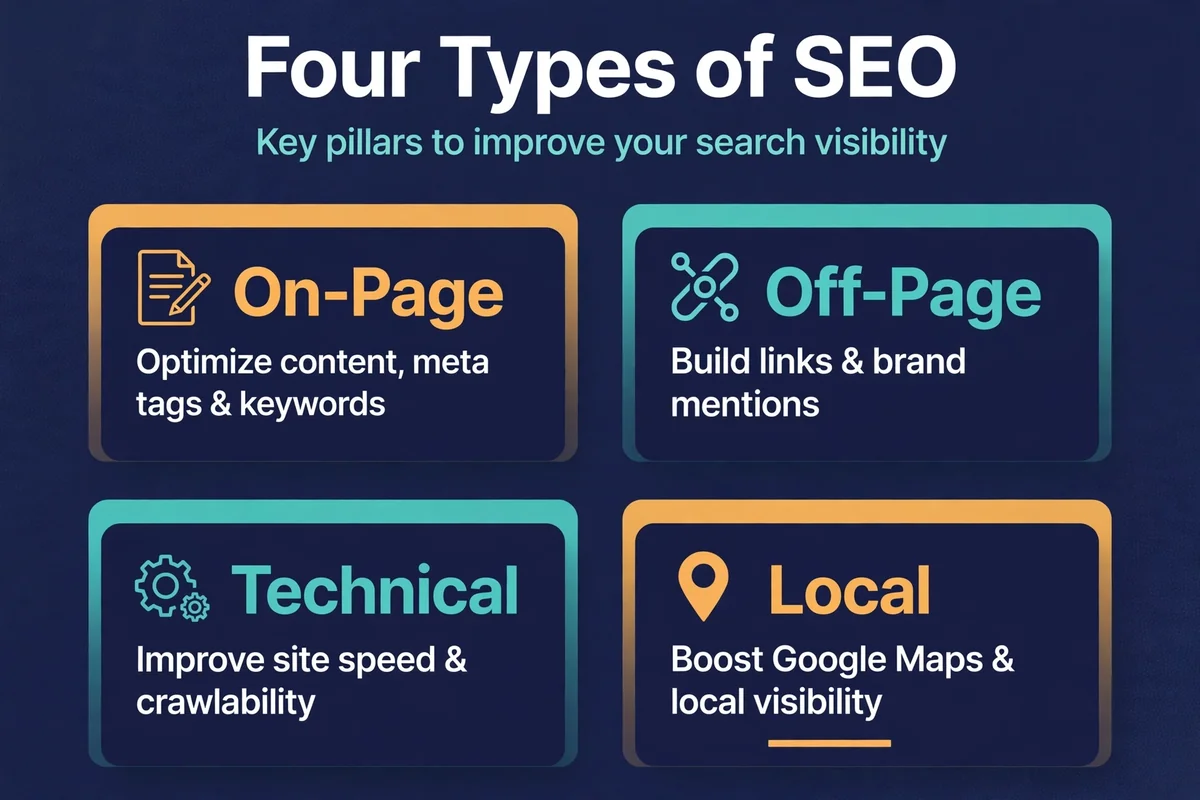
How the four types work together
Think of it like a shop:
- On-page SEO is what is on the shelves and how clearly it is labelled.
- Technical SEO is whether the shop door opens, the lights work, and customers can move around easily.
- Off-page SEO is whether other people recommend the shop.
- Local SEO is whether people nearby can find it on a map.
You need all of them working, but you do not need to fix everything at once.
Where to start first
For most beginners, this order works well:
- Fix technical basics: make sure pages load, are indexed, and work on mobile.
- Improve on-page SEO: one clear topic per page, good titles, headings, and internal links.
- Build off-page SEO slowly: publish useful content, then earn mentions and links naturally.
- Add local SEO if you serve a local area: claim and complete your business profile.
Start with one page, improve it properly, then repeat the process. That steady approach beats trying to optimise everything in a single day.