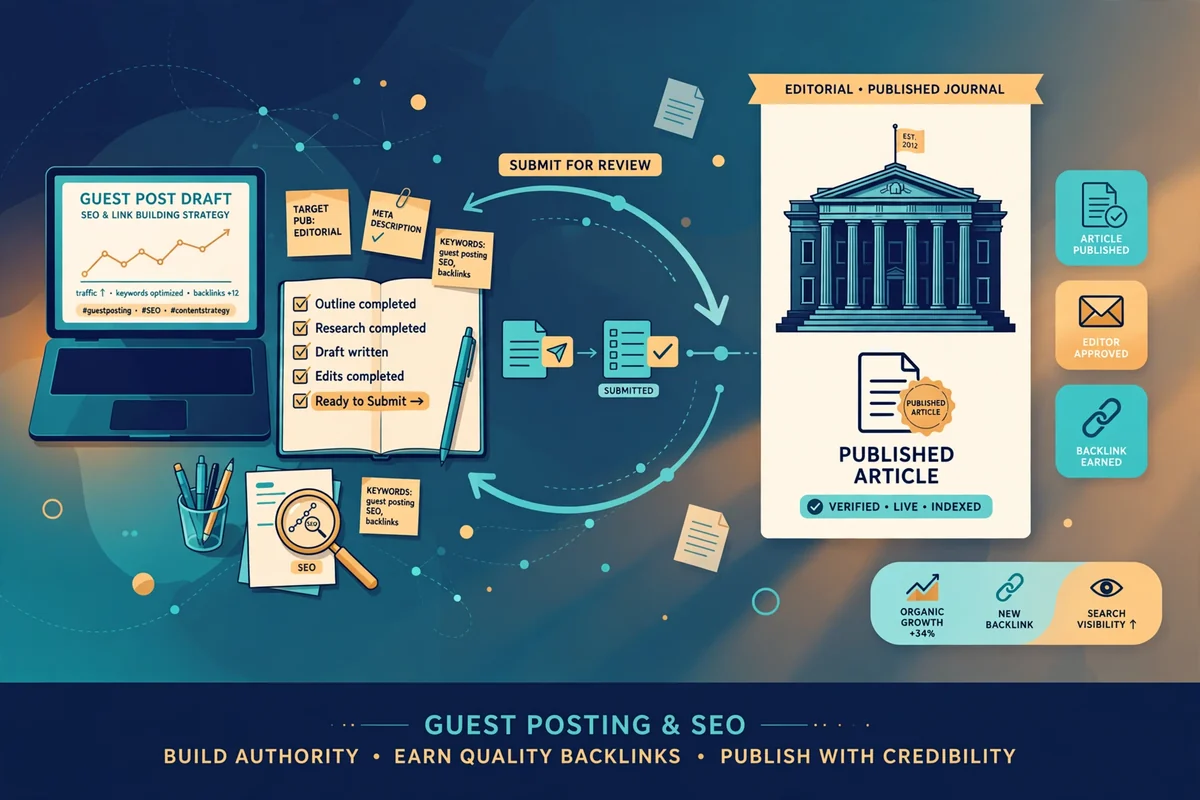
Guest posting is simple to describe, and easy to get wrong. At its best, it is writing a genuinely useful article for another website in your niche, under your own name, so that site’s readers discover you. At its worst, it is a shortcut for collecting links — and that version no longer works the way it used to.
This guide explains the difference, step by step, so you can use guest posting for the right reasons: reach, reputation, and referral traffic, with SEO as a secondary benefit, not a trick.
What guest posting actually means
A guest post is an article you contribute to a website you do not own. The host site publishes it, usually with a short author bio. You get exposure to a new audience. The host gets fresh, expert content without having to write it themselves.
It is not the same as:
- Syndication, where the same article is republished in several places.
- Sponsored content, where a brand pays for placement and the post should be disclosed as such.
- A link exchange, where two sites agree to link to each other mainly to influence rankings.
Good guest posting starts with the reader of the host site. If that reader would not find the article useful on its own, it is not a good guest post, however many links it contains.
How guest posting helps SEO — honestly
Guest posting can help SEO in three realistic ways:
- Referral traffic. Readers who like your piece click through to your site. That traffic is interested by definition, because they chose to follow you from a topic they already care about.
- Visibility and authority. Being published on a respected site in your field builds name recognition. People search for you later, mention you, and invite you back.
- Editorial links, when earned. If a host site links to a relevant page of yours because it genuinely helps its readers, that is a normal editorial link.
What guest posting does not reliably do anymore is move rankings simply because you placed a keyword-rich link. Google’s spam policies for web search list link spam as creating links primarily to manipulate rankings, including exchanging money for posts that contain links, and links with optimised anchor text in guest posts distributed on other sites. Paid or sponsored links that pass ranking credit should be qualified with rel=”sponsored” or rel=”nofollow”.
You can read the policy directly here: Google Search Central, Spam policies for Google web search
The practical takeaway is not “never guest post.” It is: pitch useful work, do not buy followed links at scale, and do not stuff exact-match anchors into every post.
How to choose a site worth pitching
Before you write a pitch, check five things:
- Real audience. Does the site publish regularly, get comments or shares, and rank for topics in its niche?
- Topical fit. Would your article sit naturally next to what it already publishes? A finance article on a healthcare blog is a mismatch, even if the site accepts it.
- Editorial standards. Does it have guidelines, an editor, and examples of well-written guest posts? Automatic acceptance is a warning sign.
- Link policy. Is it clear about author bios, disclosure, and whether links are followed, nofollow, or sponsored? Transparency is a good sign.
- Your own relevance. Can you write this topic from experience, not just research? Editors can tell.
If a site fails most of those checks, a link from it is unlikely to help you, and it could hurt the host’s reputation as well.
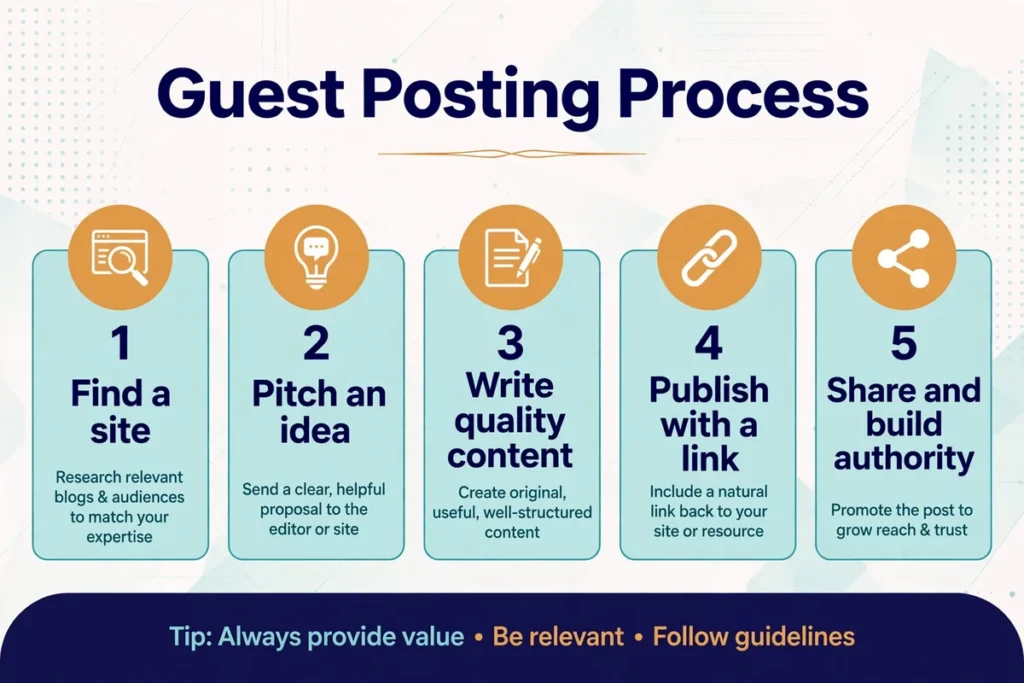
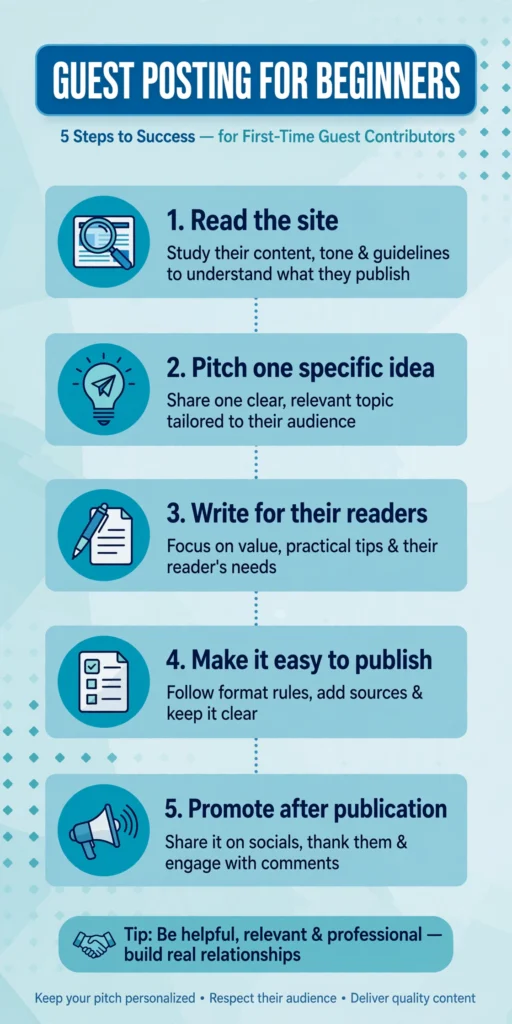
A simple pitching process that works
1. Read first, pitch second
Read at least three recent articles on the target site. Note what topics are missing, what angle is overdone, and how long and detailed the pieces are.
2. Pitch one specific idea, not a topic list
A weak pitch says: “I can write about SEO.” A strong pitch says: “I would like to write ‘How small clinics can check if a guest post site is trustworthy,’ with a checklist for editors, based on cases I have seen in healthcare marketing.”
Include a two-sentence outline, why you are qualified to write it, and one link to your best previous work.
3. Write for their readers, not for your link
Use their tone, their heading style, and examples their audience will recognise. Put your link, if allowed, where it genuinely helps the reader — for example, to a deeper guide or an original study — not in the first paragraph with an exact-match keyword.
4. Make it easy to say yes
Follow their guidelines on word count, images, formatting, and bio length. Offer an original image or a simple chart. Editors remember contributors who need little editing.
5. Promote it after publication
Share the post, reply to comments, and thank the editor. A guest post that gets no promotion helps neither side. Promotion also shows the host that working with you again is worthwhile
Common beginner mistakes to avoid
- Pitching everywhere at once. Ten thoughtful pitches beat a hundred copied templates.
- Reusing the same article. Duplicate content helps no one, and editors will notice.
- Hiding who you are. Use a real name, a real bio, and disclose any commercial interest.
- Chasing domain authority alone. A smaller, genuinely relevant site with an engaged audience is often more valuable than a large, generic one.
- Treating the link as the goal. If you would not want the post published without a link, reconsider the post itself.
A beginner’s checklist
Before you hit send, ask:
- Would this article be useful even if no one clicked my link?
- Is the host site one I would be proud to be associated with?
- Is my anchor text natural, not keyword-stuffed?
- Have I followed the site’s guidelines exactly?
- Can I promote this post honestly after it goes live?
If you can answer yes to all five, you are doing guest posting the right way.
Where Ranking Bridge fits
Ranking Bridge publishes guest posts across Digital Marketing, Finance, Healthcare, Revenue Cycle Management, Real Estate, and News. If you want to contribute, start with the Write for Us page — and read the guidelines there before pitching.
For digital marketing contributors, the category page is https://rankingbridge.com/category/digital-marketing-write-for-us/
For finance contributors, see https://rankingbridge.com/category/finance-write-for-us/
For healthcare contributors, see https://rankingbridge.com/category/healthcare-write-for-us/
Guest posting works best as a long-term habit: one strong, relevant article at a time, for sites whose readers you actually want to reach. Start there, and the SEO benefits — traffic, mentions, and earned links — have a much better chance of following naturally.
Sources and further reading:
- Google Search Central — Spam policies for Google web search
- Google Search Central — Qualify your outbound links (nofollow / sponsored guidance, via Search Central documentation)