CMS Finalizes 2027 Physician Fee Schedule: Conversion Factor Falls to $32.63
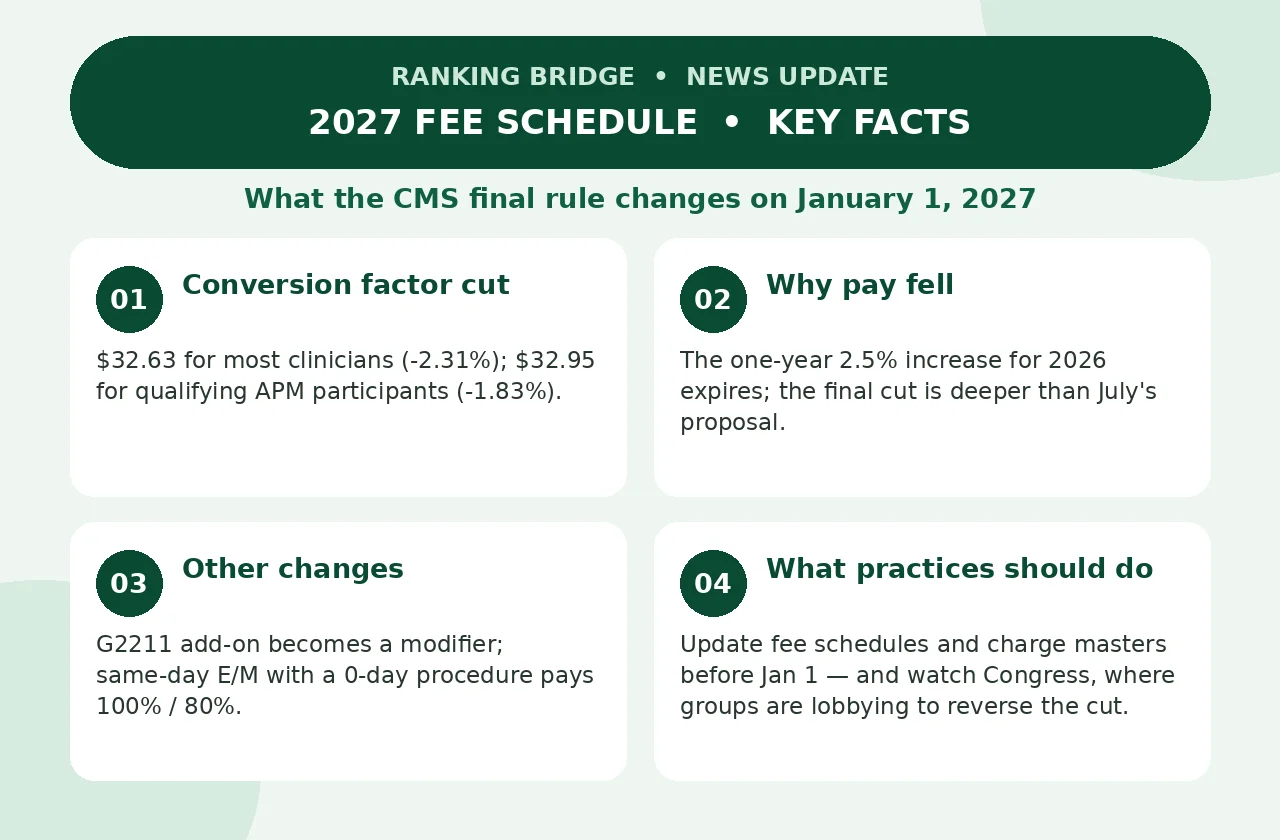
The Centers for Medicare & Medicaid Services (CMS) released the calendar year 2027 Physician Fee Schedule final rule on November 4, 2026, confirming a pay cut for most clinicians from January 1, 2027. The conversion factor — the dollar figure Medicare multiplies by a service’s relative value units to set payment — falls to $32.63 for most physicians and clinicians, down 2.31% from $33.40 in 2026. For qualifying participants in advanced alternative payment models (APMs), the factor falls 1.83% to $32.95, from $33.57.
The final cuts are deeper than CMS proposed in July, when reductions of 1.68% and 1.19% were projected. Most of the decline comes from the expiration of a one-year 2.5% increase that applied only to 2026.
What CMS Finalized
- Conversion factors: $32.63 for clinicians who are not qualifying APM participants (−2.31%); $32.95 for qualifying APM participants (−1.83%), effective January 1, 2027.
- G2211 converted: The visit complexity add-on code G2211, widely used in primary and longitudinal care, is converted into a modifier under the final rule.
- Same-day E/M and procedures: When a separately identifiable office or outpatient E/M visit is furnished on the same day as a 0-day global procedure by the same physician or practice, the more expensive service is paid at 100% and the other at 80%.
- Remote monitoring reprieve: The proposed requirement that RPM and RTM services be furnished only by directly employed clinical staff is delayed — it will not take effect until January 1, 2029.
- Companion rules: CMS issued the 2027 outpatient prospective payment rule the same day, and the CY 2027 Home Health PPS final rule was also released this week.
Why Physician Groups Are Pushing Back
Medical groups broadly welcomed new payments in the rule for prevention, coaching and behavioural health integration, but warned that the headline cut will take an act of Congress to stop. Advocacy groups from primary care to orthopaedics are pressing lawmakers to intervene before the January 1 start date, arguing that practice costs keep rising while Medicare payment per service falls again.
What This Means for Practices and Billing Teams
For revenue cycle teams, the work starts now. Fee schedules and charge masters need updating before January 1 so that expected reimbursement, patient estimates and contract models reflect the new factors. Practices should also review how the same-day E/M policy affects their highest-volume procedure combinations, confirm how their EHR and clearinghouse will handle the G2211 change, and model the cut’s effect on 2027 budgets — particularly for Medicare-heavy specialties. Teams already working through rising claim denials should treat the transition as a January denial risk: mismatched fee schedules and outdated code logic are exactly the kind of errors that surface in the first payment cycles of a new rule year.
Key Dates
- November 4, 2026: Final rule released by CMS.
- January 1, 2027: New conversion factors and most provisions take effect.
- January 1, 2029: Delayed RPM/RTM staffing requirement now scheduled to begin.
Sources
- CMS — Calendar Year (CY) 2027 Medicare Physician Fee Schedule final rule fact sheet, November 4, 2026 (cms.gov).
- Medical Economics — “Physician advocates urge Congress to counter cuts in final 2027 Medicare Physician Fee Schedule,” November 5, 2026.
- Chief Healthcare Executive — “CMS’ final 2027 physician fee schedule cuts pay and reworks ACO incentives,” November 4, 2026.
- Alston & Bird — Health Care Week in Review, November 6, 2026.
This is a news summary for general information. Payment policy details should be verified against the final rule text and CMS guidance before operational or billing decisions are made.
