ICD-10 Code K21.9: GERD Without Esophagitis Coding
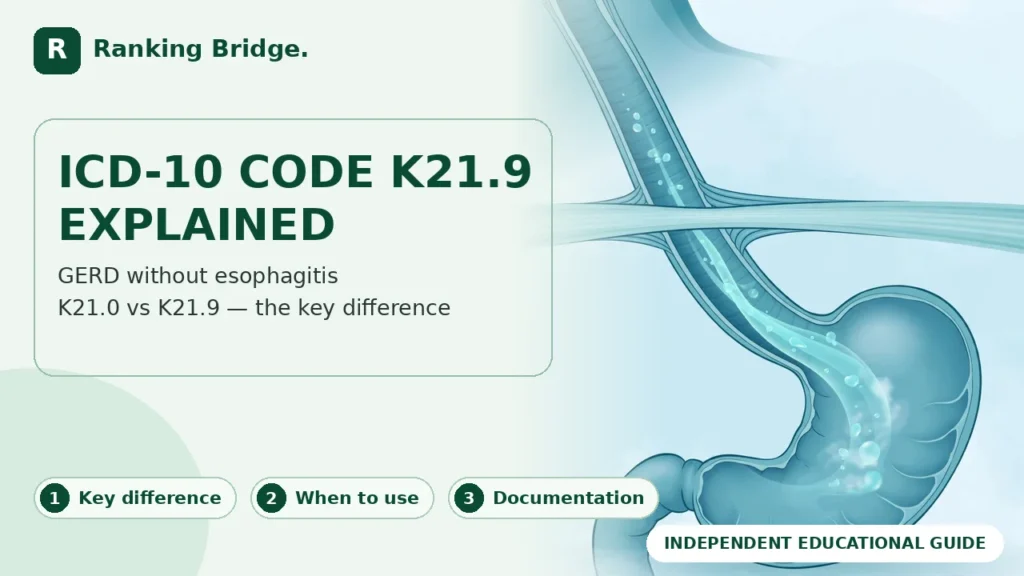
ICD-10 code K21.9 is Gastro-esophageal reflux disease without esophagitis. It is a billable, specific ICD-10-CM code used when a provider diagnoses gastroesophageal reflux disease (GERD) and there is no documented esophagitis — inflammation or erosion of the esophagus. K21.9 is one of the most commonly reported digestive codes in primary care and gastroenterology, and the coding decision behind it is simple: is esophagitis documented or not?
That one detail splits category K21 in two: when esophagitis is present the code changes, and complications such as Barrett’s esophagus use a different category. This guide explains when to use K21.9, when not to, and how to document and bill it correctly.
What K21.9 Means
K21.9 sits in category K21, Gastro-esophageal reflux disease, within Chapter 11 of ICD-10-CM, Diseases of the digestive system (K00–K95). Category K21 contains only two codes, which makes it one of the smallest — and most frequently confused — categories in the chapter.
| Item | Detail |
|---|---|
| Code | K21.9 |
| Official description | Gastro-esophageal reflux disease without esophagitis |
| Category | K21 — Gastro-esophageal reflux disease |
| Chapter | Chapter 11: Diseases of the digestive system |
| Billable? | Yes — billable, specific code; no additional characters required |
K21.0 vs K21.9: The Key Comparison
| Feature | K21.0 — With esophagitis | K21.9 — Without esophagitis |
|---|---|---|
| Esophagitis documented? | Yes | No, or not documented |
| Also known as | Reflux esophagitis; erosive GERD | Non-erosive reflux disease |
| Typical evidence | Provider documents reflux esophagitis, or endoscopy shows inflammation or erosions | Provider documents GERD or reflux; endoscopy normal or not performed |
| Billable? | Yes | Yes |
Most GERD patients have non-erosive disease, so K21.9 is reported far more often than K21.0. Never assume esophagitis from symptom severity — severe heartburn can occur with a normal esophagus. Code what the provider documents.
When K21.9 Is the Right Code
K21.9 is appropriate when:
- The provider documents GERD, gastroesophageal reflux, or acid reflux disease as a diagnosis.
- Endoscopy was performed and showed no esophagitis, or esophagitis is not mentioned in the documentation.
- The patient is managed with lifestyle measures, antacids, H2 blockers, or proton pump inhibitors, with no esophageal inflammation documented.
- Extraesophageal problems, such as reflux-related chronic cough or laryngitis, are attributed to GERD by the provider — code the manifestation additionally, as documented.
Example of correct use
A patient reports frequent heartburn and acid regurgitation. The provider documents “GERD,” counsels on diet, and prescribes a proton pump inhibitor. No endoscopy is performed and esophagitis is never mentioned. K21.9 correctly reports this encounter.
When K21.9 Is NOT the Right Code
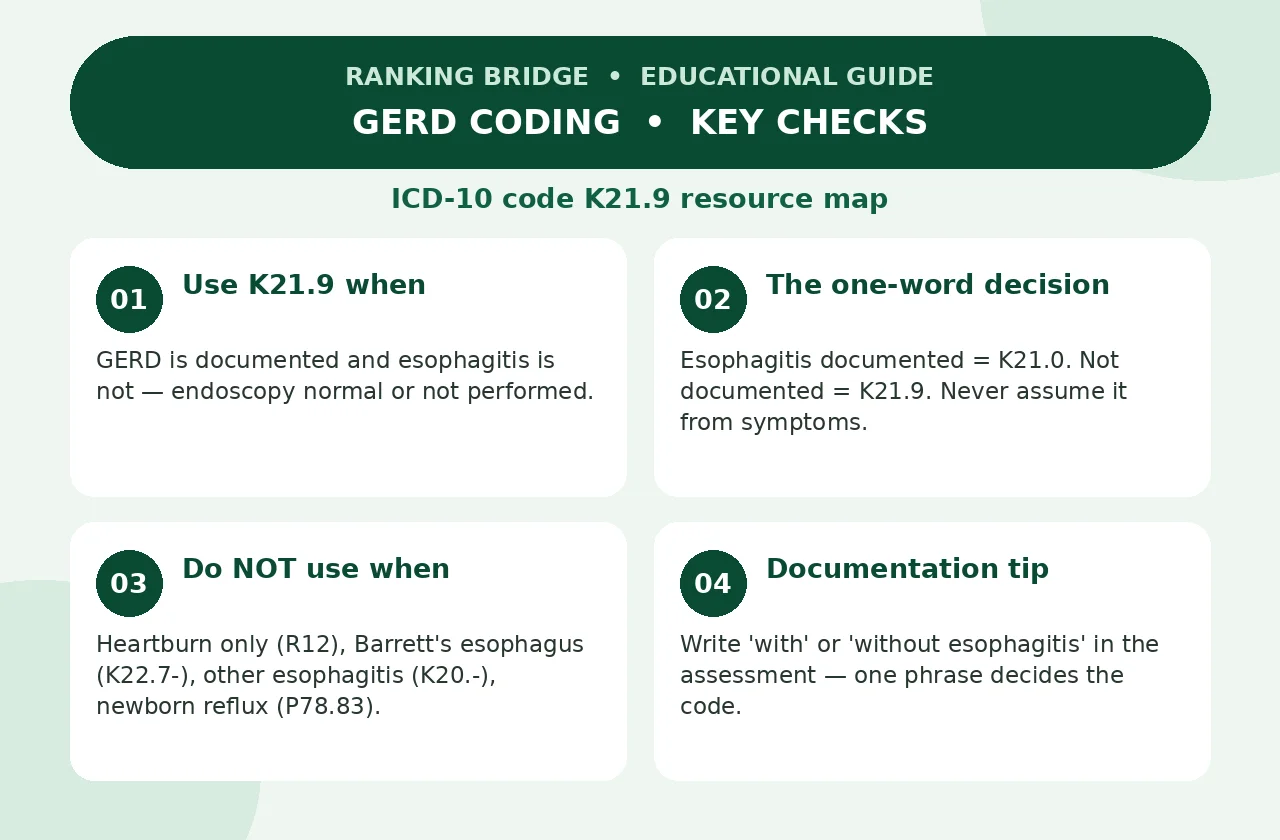
- Esophagitis is documented — GERD with esophagitis, including reflux esophagitis, is coded K21.0. “Reflux esophagitis” indexes directly to K21.0.
- Barrett’s esophagus — this precancerous change in the esophageal lining, associated with chronic reflux, is coded to K22.7 (K22.70 without dysplasia; K22.71- with dysplasia, as documented). GERD may be coded additionally when separately documented and relevant.
- Heartburn alone — heartburn is a symptom, coded R12. If the provider documents only heartburn and has not diagnosed GERD, assign R12; coders cannot upgrade a symptom to a disease.
- Other causes of esophagitis — esophagitis from another cause, such as eosinophilic esophagitis (K20.0), belongs in category K20 or the relevant infection codes, not K21.0, unless reflux is documented as the cause.
- GERD in a newborn — neonatal gastro-esophageal reflux is coded P78.83 from the perinatal chapter, not K21.9.
Documentation Tips
- State the diagnosis. “GERD” in the assessment supports K21.9; symptoms alone support only symptom codes such as R12.
- Say whether esophagitis is present. One phrase — “with esophagitis” or “without esophagitis” — decides between K21.0 and K21.9.
- Carry endoscopy findings into the assessment. Erosions, inflammation, or a normal esophagus should appear in the provider’s diagnosis, not only in the procedure report.
- Document complications explicitly. Barrett’s esophagus, esophageal stricture (K22.2), and ulcer of esophagus (K22.1-) each have their own codes.
- Link extraesophageal symptoms. If cough or hoarseness is attributed to reflux, document the link so both GERD and the manifestation can be coded.
- Note treatment and response. Therapy, treatment failure, or referral reason supports medical necessity for testing and procedures.
The RCM Angle: Why K21.9 Claims Get Denied
K21.9 denials usually trace back to a documentation mismatch: coding K21.9 when the same record’s endoscopy documents esophagitis, billing GERD procedures where the note supports only a symptom code such as R12, or omitting codes like Barrett’s esophagus that justify surveillance endoscopy. Because category K21 turns on one documented word, it is an easy audit target. With rising claim denials across the industry, making “with or without esophagitis” standard in GERD documentation removes a whole class of preventable denials before claims go out.
Frequently Asked Questions
Is K21.9 a billable code?
Yes. K21.9 is a billable, specific ICD-10-CM code requiring no additional characters, used for GERD when esophagitis is not documented.
What is the difference between K21.0 and K21.9?
K21.0 is GERD with esophagitis, including reflux esophagitis. K21.9 is GERD without esophagitis. Whether esophagitis is documented decides which code applies.
Can heartburn be coded as K21.9?
No. Heartburn without a GERD diagnosis is coded R12. K21.9 requires the provider to document gastroesophageal reflux disease.
How is Barrett’s esophagus coded with GERD?
Barrett’s esophagus is coded from K22.7- (for example, K22.70 without dysplasia). GERD (K21.9 or K21.0, per documentation) may be reported additionally when documented and relevant to the encounter.
What is the ICD-10 code for GERD in a newborn?
Neonatal gastro-esophageal reflux is coded P78.83, not K21.9. Perinatal chapter codes apply to conditions originating in the newborn period.
Sources
- CMS ICD-10-CM Tabular List, Chapter 11 — category K21, codes K21.0 and K21.9.
- ICD List — K21.9, Gastro-esophageal reflux disease without esophagitis (ICD-10-CM tabular data).
- ICD-10-CM Official Guidelines for Coding and Reporting — guidance on coding documented diagnoses versus signs and symptoms.
Disclaimer: This article is general coding information only and is not coding, billing, or medical advice for any specific patient or claim. Always code from the provider’s documentation for the individual encounter, follow the current ICD-10-CM Official Guidelines for Coding and Reporting and payer policy, and query the provider when documentation is unclear.
