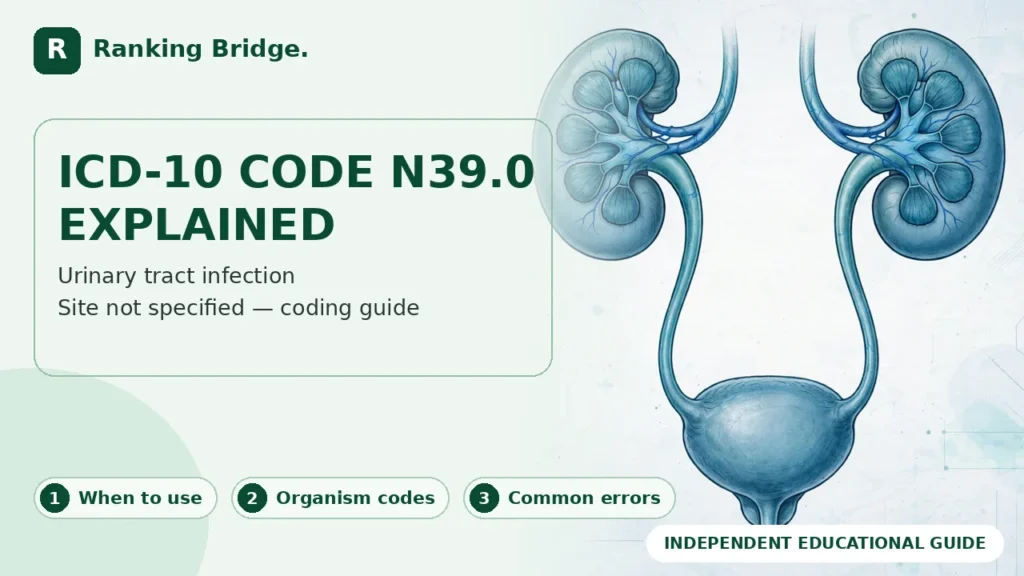
ICD-10 Code N39.0: Urinary Tract Infection Coding
ICD-10 code N39.0 is Urinary tract infection, site not specified. It is a billable, specific ICD-10-CM code used when a provider diagnoses a urinary tract infection (UTI) but the documentation does not identify a site, such as the bladder or kidneys. No additional characters are required — but it should be used only when the record truly supports an unspecified site.
UTIs are among the most common reasons for outpatient and urgent care visits, making N39.0 a frequently reported code in primary care and urology. Auditors watch it closely, because it is often assigned from a positive urine test alone, without a provider diagnosis.
What N39.0 Means
N39.0 sits in category N39, Other disorders of urinary system, in Chapter 14 of ICD-10-CM, Diseases of the genitourinary system (N00–N99). Its tabular note also instructs coders to add a code identifying the organism when one is documented — covered below, because missing organism codes are a common reason N39.0 claims are questioned.
| Item | Detail |
|---|---|
| Code | N39.0 |
| Official description | Urinary tract infection, site not specified |
| Category | N39 — Other disorders of urinary system |
| Chapter | Chapter 14: Diseases of the genitourinary system |
| Billable? | Yes — billable, specific code |
When N39.0 Is the Right Code
N39.0 is appropriate when all of the following are true:
- The provider has diagnosed a UTI in their own assessment — not a coder interpreting a lab result.
- The documentation does not specify the infection site.
- Supporting signs, symptoms, or tests are documented where available, such as dysuria, frequency, urgency, fever, or a positive urinalysis or culture.
When N39.0 Is NOT the Right Code
N39.0 is an unspecified-site code, so whenever the documentation gives more information, a more specific code takes priority.
When a specific site is documented
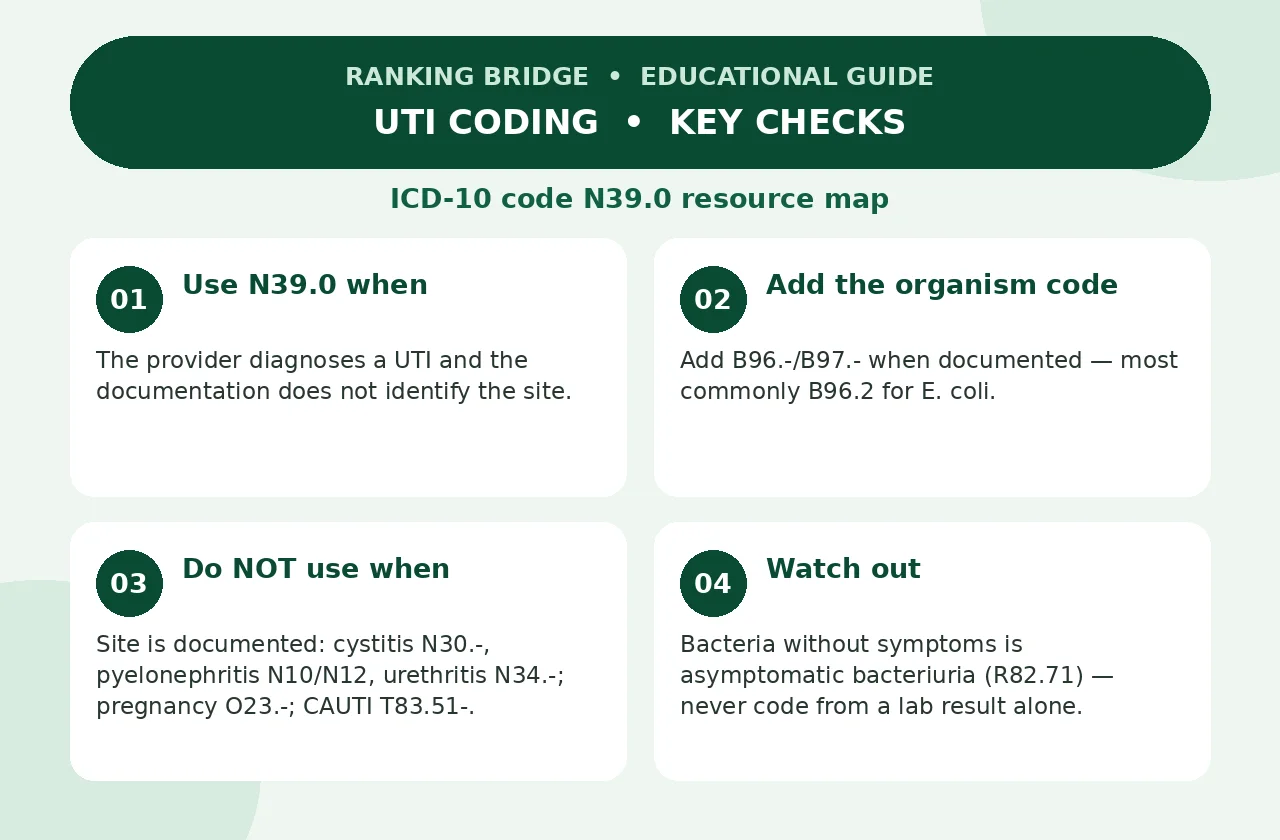
- Cystitis (bladder infection) — category N30.-, for example N30.00 (acute cystitis without hematuria) or N30.90 (cystitis, unspecified).
- Pyelonephritis (kidney infection) — N10 (acute pyelonephritis), or N12 when not specified as acute or chronic.
- Urethritis — category N34.-, such as N34.2.
- Prostate infection — category N41.- instead.
Add an organism code when the organism is documented
The tabular note instructs coders to add a code from B96.- (bacterial agents) or B97.- (viral agents) identifying the organism when the provider documents it. The most common is B96.2, Escherichia coli [E. coli], which causes most UTIs. The organism code is secondary — N39.0 remains the code for the infection. Do not assign one from a culture result alone if the provider has not linked it to the infection.
Asymptomatic bacteriuria is not a UTI
Bacteria in the urine without symptoms is asymptomatic bacteriuria, reported with R82.71, Bacteriuria — not N39.0. A positive culture, or bacteria or nitrites on urinalysis, does not by itself establish a UTI, so never assign N39.0 from lab findings alone; if no UTI is diagnosed, query the provider. The distinction also matters clinically: asymptomatic bacteriuria generally should not be treated with antibiotics, except in pregnancy or before certain urologic procedures.
Special situations
- UTI in pregnancy — code first from category O23.- (genitourinary infections in pregnancy), with additional codes for the infection and organism.
- Catheter-associated UTI (CAUTI) — assign T83.51- (infection due to indwelling urinary catheter) as principal, plus codes for the infection and organism (for example, B96.2) when documented.
- Postprocedural UTI — a complication code from category N99.- may also be required.
Documentation Tips
- Diagnose, don’t imply. State “UTI” or a site-specific diagnosis in the assessment; coders cannot diagnose from lab results.
- Name the site when known. Documenting cystitis or pyelonephritis supports a more specific code.
- Link the organism. Document the causative organism when cultures return so the B96.-/B97.- code can be added.
- Record symptoms and results. Symptoms and lab findings support medical necessity for testing and antibiotics.
- Clarify bacteriuria. If bacteria are present without symptoms, document asymptomatic bacteriuria so R82.71 is assigned instead.
- Document catheter status. Note whether the infection is catheter-associated, because that changes code sequencing.
The RCM Angle: Why N39.0 Claims Get Denied
Because N39.0 is high-volume and unspecified, payers scrutinize it. Common denial triggers include assigning it from a positive lab result without a provider diagnosis, omitting the organism code a culture identifies, using it when the note documents cystitis or pyelonephritis, and billing tests the diagnosis does not support. With rising claim denials across the industry, these habits have an outsized effect on first-pass payment. Clean claims pair a clear diagnosis with whatever site and organism detail the record contains, so medical necessity is obvious on first read.
Frequently Asked Questions
Is N39.0 a billable code?
Yes. It is a billable, specific code requiring no additional characters, used when a UTI’s site is not specified.
Can I assign N39.0 from a positive urine culture alone?
No. The provider must document the UTI diagnosis. Bacteria in the urine without symptoms is asymptomatic bacteriuria (R82.71), not N39.0.
What additional code is used with N39.0 for E. coli?
Add B96.2 as a secondary code when the provider documents E. coli as the causative organism.
What is the difference between N39.0 and N30.90?
N39.0 reports a UTI with no documented site. N30.90 reports cystitis — a bladder infection. A documented site always wins over an unspecified site.
How is a catheter-associated UTI coded?
Assign T83.51- as principal, followed by a code for the infection and an organism code such as B96.2 when documented.
Sources
- CMS ICD-10-CM Tabular List, Chapter 14 — category N39 and code N39.0, including its “use additional code” instruction for the infectious agent.
- ICD List — N39 and N39.0, Urinary tract infection, site not specified.
- ICD-10-CM Official Guidelines for Coding and Reporting — unspecified codes and coding from provider documentation.
Disclaimer: This article is general coding information only, not coding, billing, or medical advice for any specific patient or claim. Always code from the provider’s documentation for the encounter, follow the current ICD-10-CM Official Guidelines and payer policy, and query the provider when documentation is unclear.
