
CY 2027 Medicare Physician Fee Schedule: What RCM Teams Should Check Before 1 January 2027
Proposed, Not Final — Read This First
This post is based on the proposed CY 2027 Medicare Physician Fee Schedule rule (CMS-1848-P, released 14 July 2026, published in the Federal Register 16 July 2026, comments closed 14 September 2026). As of the morning of 3 November 2026, CMS’s Physician Fee Schedule notices page still listed the proposed rule as the latest CY 2027 entry, with no CY 2027 final rule published.
That matters for how you use every figure below: treat them as proposed, not final. If the final rule changes a conversion factor, a work value, or a modifier rule, the final rule governs — and any fee schedule built from this proposal should be re-run once the final work RVUs are published. Nothing in this post should be used to set a 2027 fee schedule on its own.
The Proposed Conversion Factors
The headline change is the conversion factor — the dollar amount Medicare multiplies by a service’s relative value units to set payment.
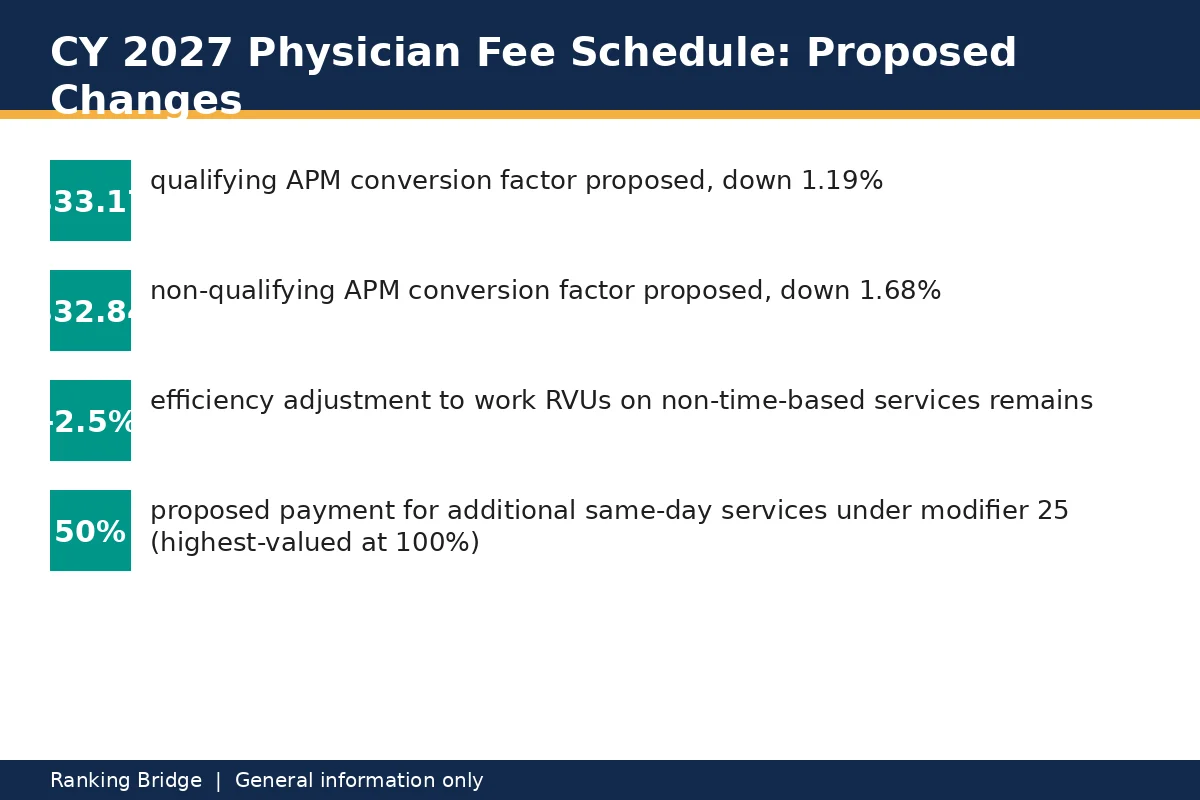
- Qualifying APM participants: proposed $33.1693, down $0.40 (-1.19%) from $33.5675.
- Non-qualifying APM participants: proposed $32.8409, down $0.56 (-1.68%) from $33.4009.
The main driver cited in summaries of the proposal is the expiration of the temporary 2.50% increase attached to CY 2026 payments. Statutory updates of +0.75% for qualifying APM participants and +0.25% for others only partly offset that expiration — which is why both factors fall despite the statutory increase.
For RCM teams, the practical point is the split: the same service pays differently depending on the clinician’s APM status. Modelling the change on a blended average will understate the hit for non-qualifying clinicians and overstate it for qualifying ones. Model by APM status, on your top CPT codes, and you will see where the revenue change actually lands.
The -2.5% Efficiency Adjustment Stays
The proposal keeps the -2.5% efficiency adjustment to work RVUs on non-time-based services, introduced in the CY 2026 final rule. In plain terms, the work value of many procedural and diagnostic services is reduced by 2.5% before payment is calculated.
That interacts with the conversion-factor cut: a service can lose value twice — once in its work RVUs, once in the conversion factor. When you model 2027 revenue, do not model the conversion factor alone. Apply both, and pay attention to your procedural and diagnostic code mix, where the efficiency adjustment bites hardest.
Proposed Modifier 25 Same-Day Rule
The proposal would change how same-day evaluation and management (E/M) services combined with procedures are paid, under modifier 25:
- The highest-valued service on the day would be paid at 100%.
- Additional same-day services would be paid at 50%, for services with 0-, 10-, or 90-day global periods.
If finalised as proposed, this is a documentation and workflow change as much as a payment change. Same-day E/M plus procedure combinations need to be flagged before submission: is the E/M service separately identifiable, is it documented to support modifier 25, and does the payer policy match the proposed rule? A combination that was routine in 2026 could be paid at half for the second service in 2027 — or denied outright if the documentation does not support it. For the claim-level mechanics, see our guide to what a superbill is and how it works.
Proposed G2211 Redesign
The proposal would redesign G2211, the add-on code for visit complexity, from a fixed add-on amount to a percentage-based modifier. The exact final form is to be confirmed from the final rule, so do not rebuild G2211 workflows around a single assumed percentage yet.
What RCM teams should do now is check the workflow, not the rate: which visits currently qualify for G2211, is eligibility captured consistently at the point of care, and would a qualifying visit ever go out without it? A percentage-based design makes the dollar value move with the underlying visit — which makes consistent capture more valuable, not less.
The RCM Checklist Before 1 January 2027
- Model the conversion-factor change by APM status on your top CPT codes — qualifying and non-qualifying separately, not blended.
- Apply the -2.5% efficiency adjustment alongside the conversion factor, and review your procedural/diagnostic mix.
- Flag same-day E/M + procedure combinations for modifier-25 documentation and payer-policy checks before submission.
- Check G2211 eligibility and capture so qualifying visits do not go out without it, and hold any rate rebuild until the final rule is published.
- Re-run fee schedules only once the final work RVUs are published — not from the proposal alone — and version-control the draft so the proposed and final models are never confused.
- Re-verify eligibility and coverage start dates for January patients, especially as ACA open enrollment changes plan details at the start of the year.
That last point connects to the wider revenue cycle: payment rules only matter if the claim goes to the right plan, in effect on the date of service. For the fundamentals, see what RCM in healthcare covers, the Medicare Shared Savings Program, and New York’s I-STOP prescription monitoring system.
Frequently Asked Questions About the CY 2027 Fee Schedule
Is the CY 2027 fee schedule final?
Not as of 3 November 2026, when CMS’s notices page still showed the proposed rule (CMS-1848-P) as the latest CY 2027 entry. All figures in this post are proposed and must be re-checked against the final rule before use.
Why are both conversion factors falling if there is a statutory increase?
Because the temporary 2.50% increase for CY 2026 expires. The statutory updates (+0.75% qualifying APM, +0.25% others) partly offset that expiration but do not fully replace it, so both factors fall on a net basis under the proposal.
Should we update our billing software now?
Prepare the model now, but do not lock in 2027 fee schedules from the proposal alone. Build the proposed model, keep it clearly labelled as proposed, and re-run it once the final rule’s work RVUs are published.
The Bottom Line
Under the proposal, Medicare physician payment falls in 2027 for both qualifying and non-qualifying APM participants, procedural work values carry the -2.5% efficiency adjustment, same-day services face a 100%/50% modifier-25 rule, and G2211 moves toward a percentage-based design. None of that is final yet — but all of it is modellable now. The teams that will be ready on 1 January are the ones who model the proposal by APM status and code mix today, and re-run the model the day the final rule lands.
Further reading on Ranking Bridge:
- What Is the Medicare Shared Savings Program (MSSP)?
- What Is I-STOP?
- What Is a Superbill?
- What Is RCM in Healthcare?
Sources checked 2–3 November 2026:
- CMS Physician Fee Schedule Federal Regulation Notices page — CMS-1848-P listed as latest CY 2027 entry, no CY 2027 final rule, checked 3 November 2026.
- AAFP summary of the CY 2027 proposed rule (July 2026); Strategic Healthcare executive summary (26 October 2026); OmniMD analysis of CMS-1848-P (8 October 2026).
This article is general information about Medicare payment proposals. It is not financial, billing, or legal advice for any specific practice. Confirm all figures against the final rule and your payer contracts before use.
