
What Is the Medicare Shared Savings Program?
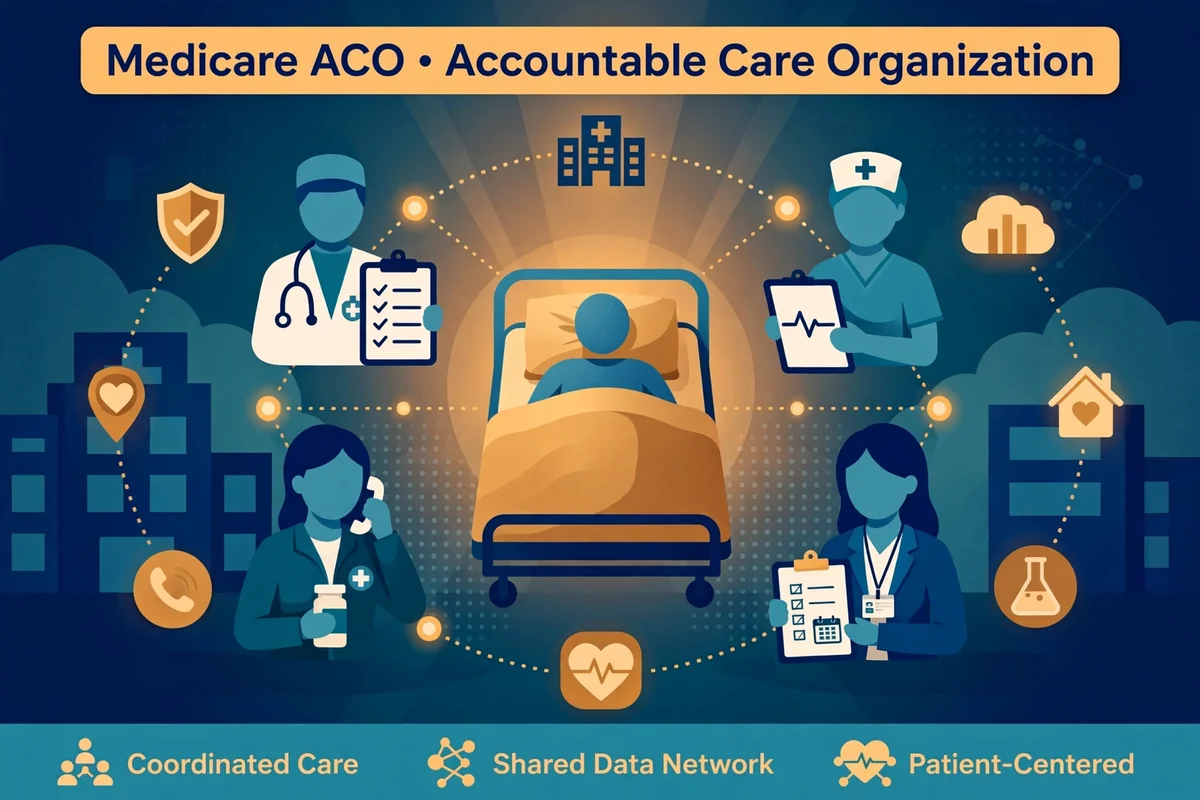
The Medicare Shared Savings Program, usually shortened to MSSP, is a Medicare programme that encourages groups of doctors, hospitals, and other healthcare providers to work together as an Accountable Care Organization, or ACO.
The idea behind MSSP is simple, even if the rules are detailed: if providers coordinate care well, avoid unnecessary tests and hospital stays, and meet quality standards, Medicare spends less than it otherwise would — and the ACO can share in those savings.
If care is not coordinated, or quality falls short, the savings may be smaller, or, for ACOs that take on two-sided risk, the organisation may owe money back. In other words, MSSP ties payment more closely to both cost and quality, rather than paying for each service in isolation.
How Does an ACO Work?
An ACO is a group of providers and suppliers that agree to be accountable for the overall cost and quality of care for an assigned group of Medicare fee-for-service beneficiaries.
In practice, that means:
- Coordination across settings. Primary care, specialists, hospitals, and post-acute providers are expected to work from a shared picture of the patient, not in silos.
- Assigned beneficiaries. ACOs must have at least 5,000 Medicare fee-for-service beneficiaries assigned in each benchmark year to be eligible, which is why MSSP is generally a programme for organised groups rather than solo practices acting alone.
- Quality measurement. Savings alone are not enough. ACOs must meet quality and performance standards to qualify for shared savings.
- A benchmark to beat. Medicare compares actual spending for the assigned population against a benchmark. Spending below the benchmark, with quality met, can produce shared savings.
Patients, it is worth noting, keep their normal Medicare freedom. A beneficiary assigned to an ACO can still see any Medicare provider. Assignment is about accountability for measurement, not about restricting patient choice.
Who Can Participate in MSSP?
Eligible participants include a wide range of Medicare-enrolled providers and suppliers, including:
- ACO professionals in group practice arrangements
- Networks of individual practices
- Partnerships or joint ventures between hospitals and ACO professionals
- Hospitals employing ACO professionals
- Critical Access Hospitals billing under Method II
- Federally Qualified Health Centers
To participate, providers must form or join an ACO, and the ACO must apply and be accepted into the Shared Savings Program. A Medicare-enrolled taxpayer identification number that bills for primary care services and is used for assignment must generally be exclusive to a single Shared Savings Program ACO during a performance year.
BASIC and ENHANCED Tracks: One-Sided vs Two-Sided Risk
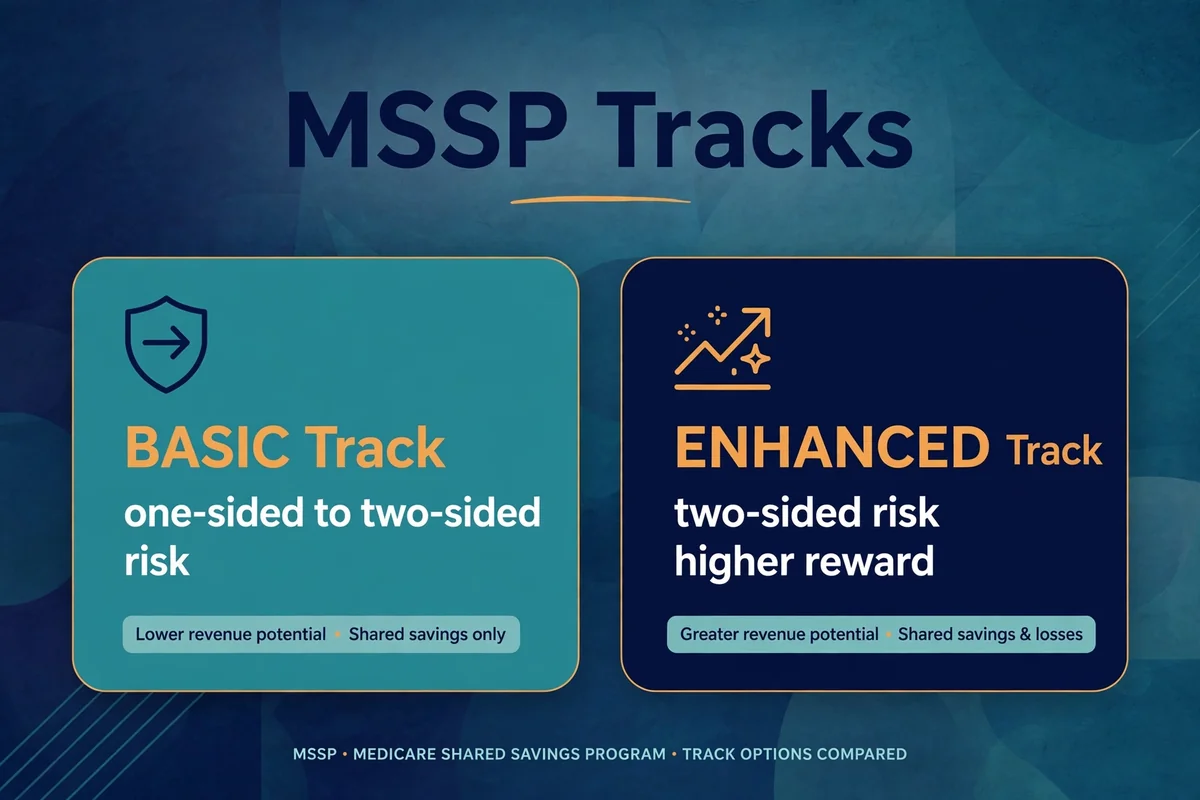
MSSP ACOs participate under different tracks, and the track determines how much risk and reward is involved.
The BASIC Track
The BASIC track is a glide path. At its lower levels, an ACO can share in savings without being at risk for losses — one-sided risk. As it moves to higher levels, it takes on progressively more downside risk, but can also earn a higher share of savings. The highest BASIC level is designed to qualify as an Advanced Alternative Payment Model under the Quality Payment Program.
The ENHANCED Track
The ENHANCED track involves two-sided risk from the start: the ACO can earn a larger share of savings, but it is also accountable for a share of losses if spending exceeds the benchmark. This track suits organisations with strong data, care management, and financial reserves.
Choosing a track is therefore a strategic decision, not just a form. It should reflect an organisation’s data maturity, care coordination capability, patient population, and appetite for financial risk.
How Are Shared Savings Calculated?
At a high level, the calculation follows four steps:
- Set a benchmark. Medicare establishes a spending benchmark for the ACO’s assigned population, based on historical spending and other adjustments.
- Measure actual spending. At the end of the performance year, actual spending for that population is compared with the benchmark.
- Check quality. The ACO must meet quality performance standards. Poor quality can reduce or eliminate shared savings.
- Apply the sharing rate and limits. If savings qualify, the ACO receives a share of the savings, subject to caps and its track’s rules. In two-sided risk arrangements, losses are shared in a similar, but reversed, way.
This is a simplified overview. Benchmark methodology, risk adjustment, quality scoring, and payment rules change over time, and CMS publishes detailed programme guidance for each performance year. Organisations considering MSSP should work from the current year’s CMS rules, not from a general article alone.
Why MSSP Matters for Revenue Cycle Management
MSSP is often discussed as a payment model, but its day-to-day impact is felt in revenue cycle operations:
- Documentation and coding accuracy matter more, not less. Risk adjustment, quality reporting, and benchmark calculations all depend on accurate, complete documentation.
- Care coordination reduces avoidable cost. Preventing duplicate tests, avoidable emergency visits, and poorly managed transitions is both good care and good revenue cycle management.
- Data becomes a revenue function. ACOs need timely claims data, quality data, and population health data to manage their assigned population. Without that data, they are managing blind.
- Denials and follow-up still count. Value-based payment does not remove fee-for-service claims work. Clean claims, timely follow-up, and strong denial management remain essential.
For the wider revenue cycle picture, see What Is RCM in Healthcare? and What Is Revenue Cycle Management in Healthcare?. For what happens when claims go wrong, see our guide to denial management in medical billing.
Common MSSP Challenges
Benchmark Volatility
Benchmarks are rebased over time, which can change the savings picture even when an organisation’s care has not worsened. This is one of the most debated features of MSSP, and a reason why long-term planning matters.
Quality Reporting Burden
Meeting quality standards requires consistent data collection across all participants. Organisations with fragmented electronic health record systems often find this harder than the financial modelling.
Care Management Investment
Care coordinators, population health tools, and data analytics cost money before savings arrive. Smaller organisations may find it harder to fund that investment, which is why many join larger ACOs rather than forming their own.
Patient Attribution Surprises
Because assignment is retrospective in many cases, an ACO may not know its exact assigned population until after the performance year. That makes in-year management more challenging and puts a premium on managing the whole population well, not just known patients.
Is MSSP Right for a Practice or Health System?
MSSP is not right for every organisation. It tends to fit best where:
- There is already strong primary care and care coordination.
- Data and reporting systems are reasonably mature.
- Leadership is willing to invest before savings arrive.
- The organisation can tolerate financial risk, or can start on a lower-risk track and build up.
It tends to fit less well where data is fragmented, care coordination is minimal, and the organisation needs immediate, predictable fee-for-service revenue with no downside exposure.
Frequently Asked Questions About MSSP
Does joining an ACO change a patient’s Medicare benefits?
No. Patients keep their Medicare benefits and can still see any Medicare provider. Assignment is for measurement and accountability, not for restricting choice.
Can a provider be in more than one Shared Savings Program ACO?
Generally, a taxpayer identification number used for assignment and billing primary care services must be exclusive to a single Shared Savings Program ACO in a performance year.
Do ACOs always save money?
No. Savings depend on care coordination, quality performance, benchmark, patient population, and track. Some ACOs earn shared savings; others do not, and two-sided risk ACOs can owe shared losses.
Is MSSP the same as Medicare Advantage?
No. MSSP is a programme within Traditional Medicare fee-for-service. Medicare Advantage is a separate programme where private plans provide Medicare benefits.
The Bottom Line
The Medicare Shared Savings Program is Medicare’s main vehicle for accountable care in Traditional Medicare. It rewards providers who coordinate care, meet quality standards, and manage total cost — and it holds them accountable when they do not.
For healthcare leaders, the practical question is not whether value-based care is coming, but whether their organisation has the data, coordination, and documentation discipline to succeed in it. MSSP, done well, is less about a payment formula and more about building a system of care that is coordinated, measured, and accountable.
Further reading on Ranking Bridge:
- What Is RCM in Healthcare?
- What Is Denial Management in Medical Billing?
- What Is an EMR? The Definitive Guide to Electronic Medical Record Systems
- What Is Insurance Verification in Healthcare?
Authoritative sources:
- U.S. Department of Health and Human Services, Shared Savings Program guidance for providers: https://www.hhs.gov/guidance/document/providers
This article is general information about a Medicare programme. It is not financial, legal, or compliance advice. Organisations should check current CMS Shared Savings Program rules and guidance for the relevant performance year before applying or making participation decisions.